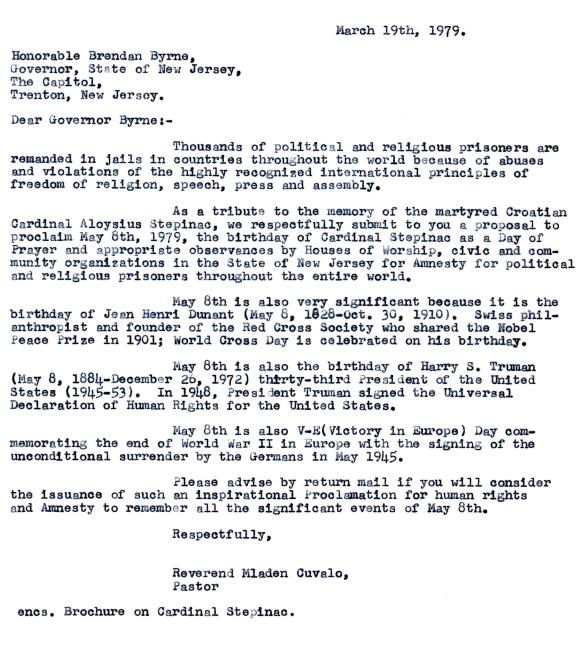
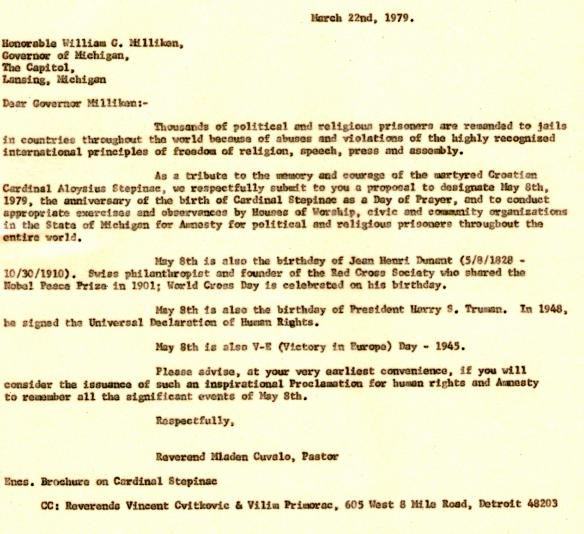


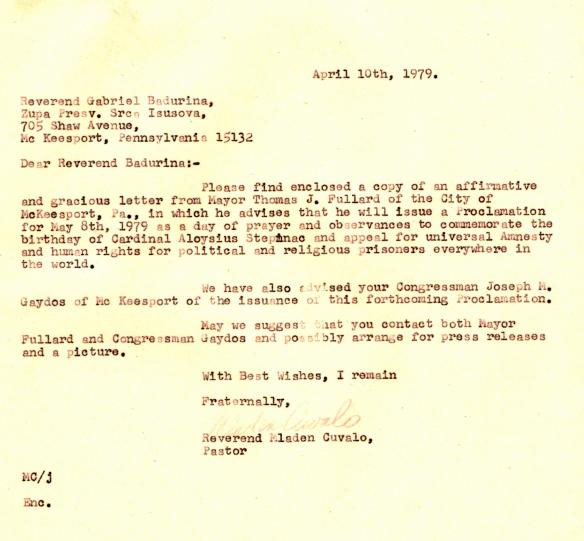
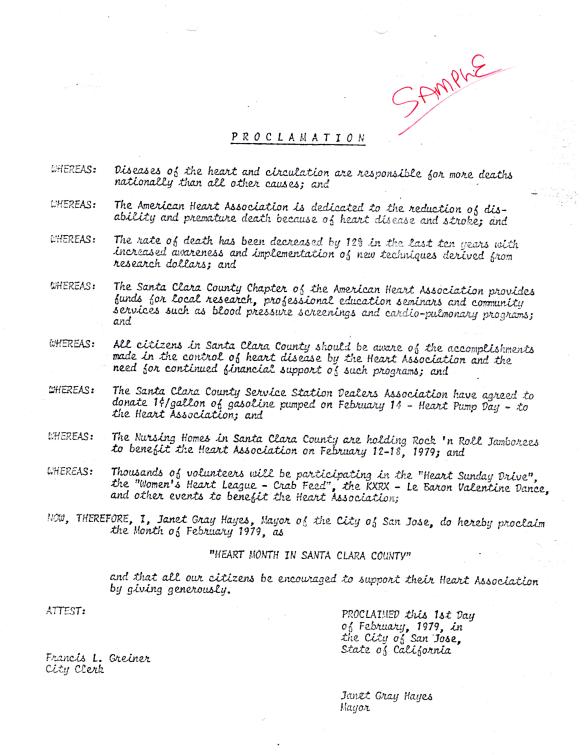


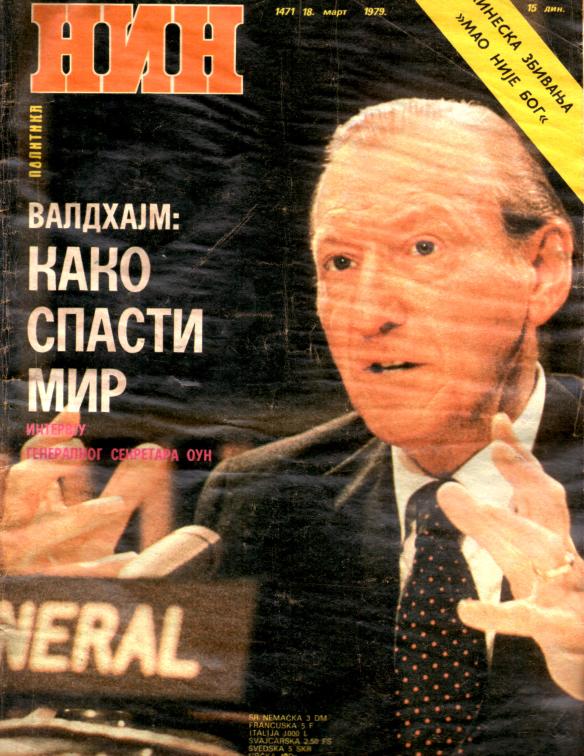


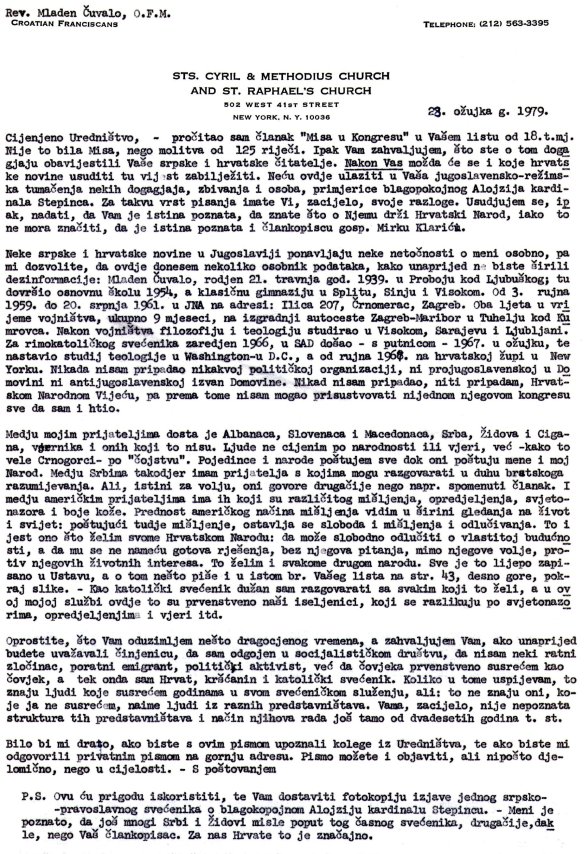
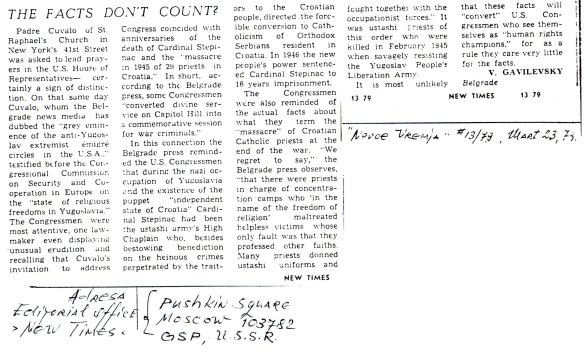
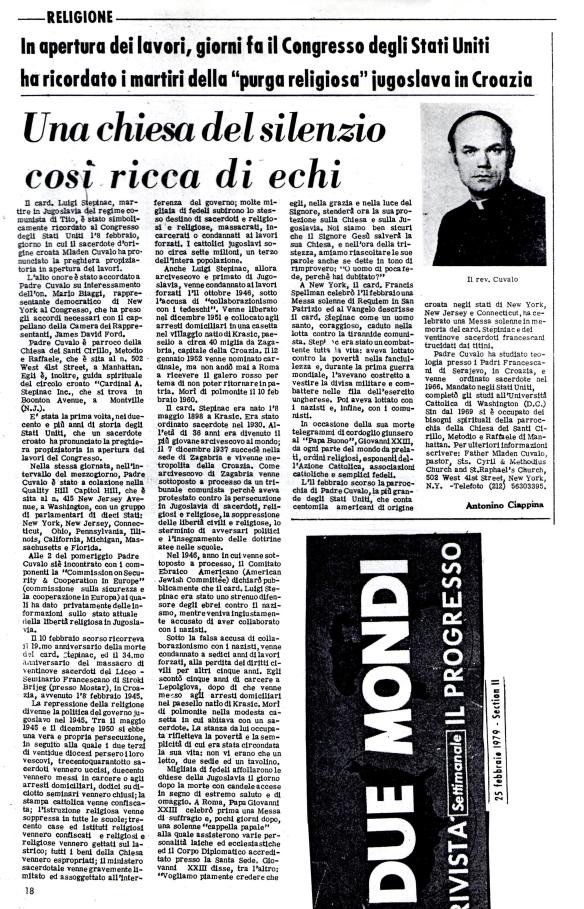
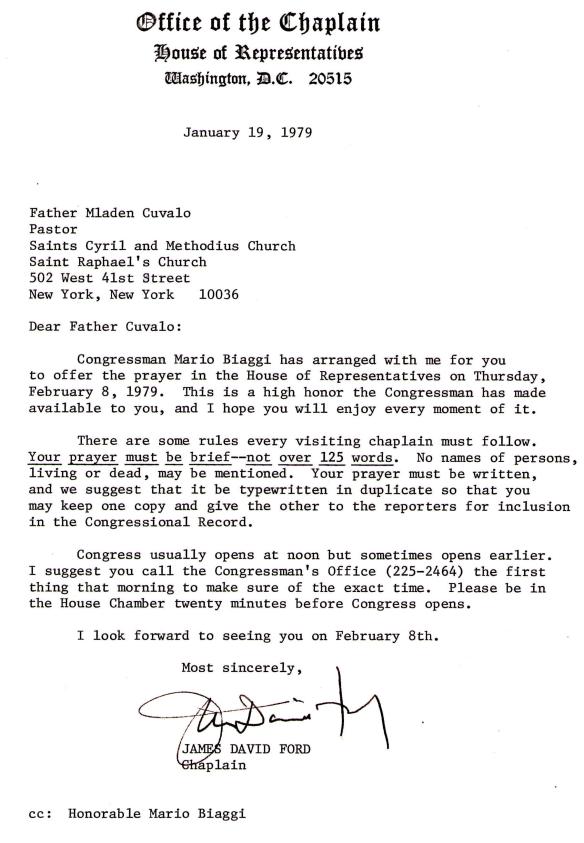
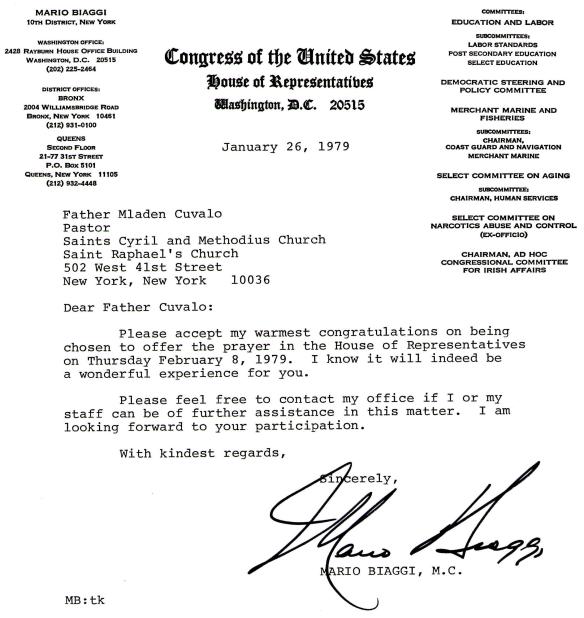
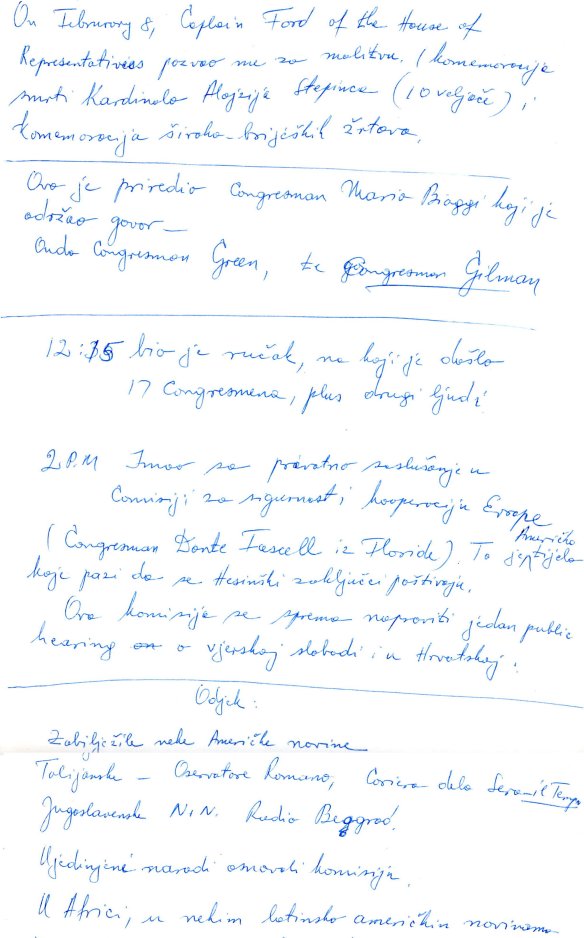
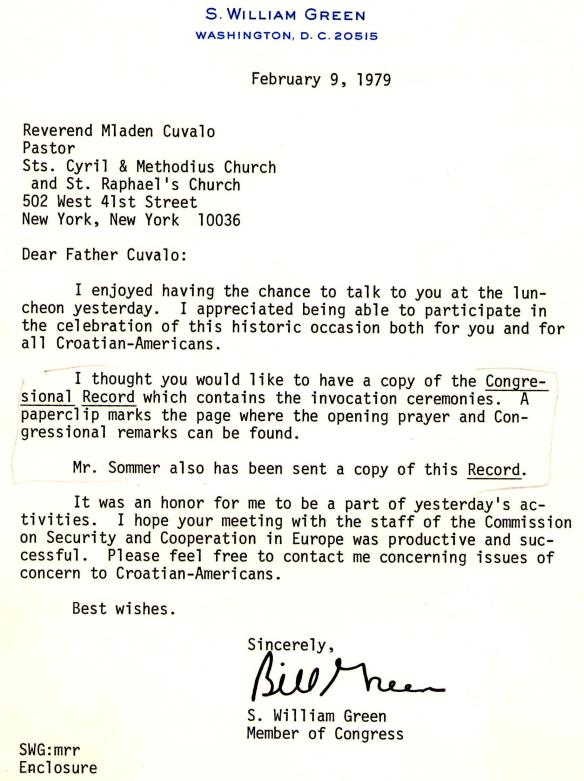
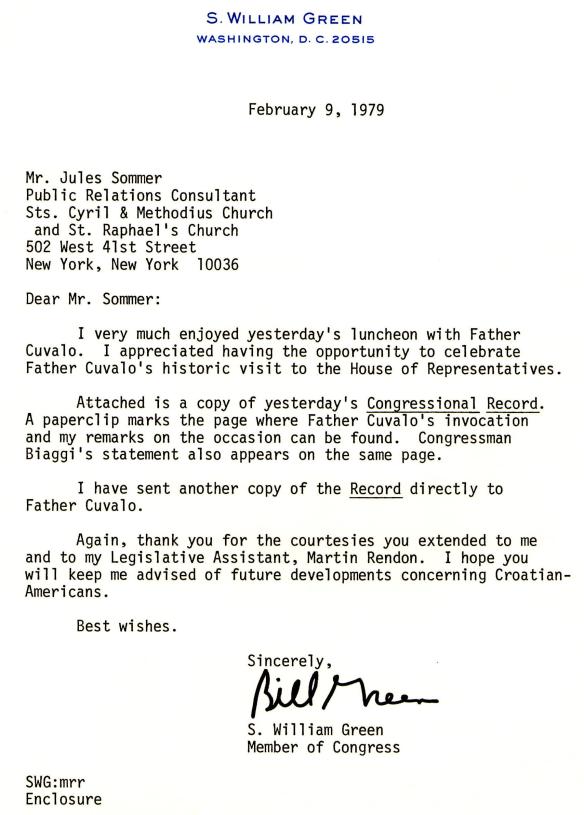
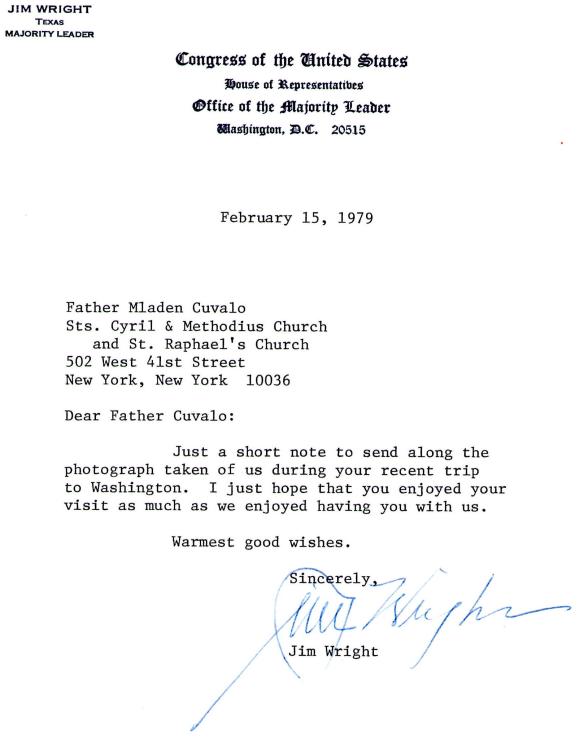
Budući da vrlo mali broj Hrvata još čita ćirilicu (mlađi vrlo rijetko), ovdje donosimo na uvid bez komentara prijepis teksta u latinici iz beogradsko NIN-a (Nedeljne informativne novine, br. 1471, 18. ožujka 1979., st. 14-15). Odmah iza teksta iz NIN-a donosimo preslik fra Mladenova pisma upućeno uredništvu tog tjednika. Usput, čuvari ondašnje države i režima su više puta mješali fra Mladena i mene. Ovdje govore kako je Mladen bio u Saboru Hrvatskog narodnog vijeća, a bio sam ja. U jednom udbaškom dokumentu iz savezne Udbe (od kojeg imam kopiju) govore kako sam ja predovido molitvu u Kongresu, a bio je Mladen.
A. Čuvalo
***
Apsurdi
Misa u kongresu
(za spas duša ratnih zločinaca)
U toku dve stotine i nešto više godina burne istorije Sjedinjne Američke Države su svašta doživele i preživele, ali još, ipak, ima stvari koje se i tamo događaju “prvi put”. Jedan takav događaj odigrao se 8. februara ove godine, sudeći bar prema zvaničnom dnevniku Predstavničkog doma američkog Kongresa, čija je jedna stranica, sa tim datumom, dospela ovih dana do naše redakcije posredstvom crkve Svetog Ćirila i Metodija i crkve Svetog Rafaela, iz njujorške 41. ulice, Zapadna strana.
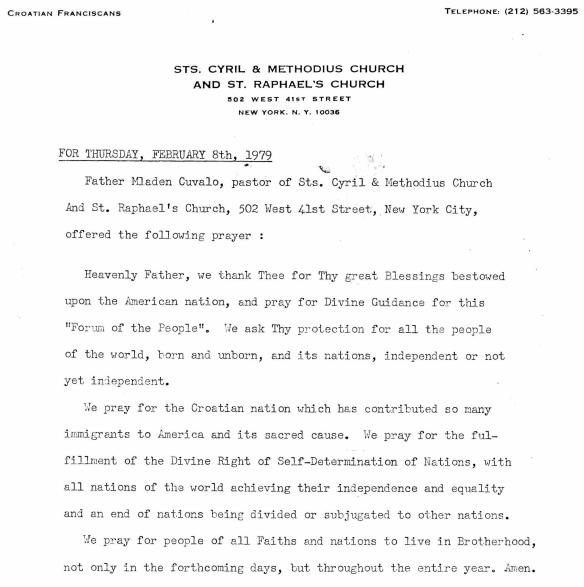
Tog, rekolo bi se istorijskog dana, sednica Predstavničkog doma Kongresa otvorena je – “prvi put u više od 200 godina”, kako piše u dnevniku – bogoslužjem jednog “hrvatsko-američkog sveštenika”, prečasnog Mladena Čuvala, pastora već pomenute crkve sa Zapadne strane.
Pošto se zahvalio svevišnjem na blagoslovima koje je podario američkoj naciji, prečasni Čuvalo ga je – u svoje ime i u ime prisutnih predstavnika naroda – zamolio za zaštitu “svih ljudi sveta, rođenih i nerođenih, i njihovih nacija, nezavisnih i onih koje to još nisu”. Tim povodom, nakon što je pomenuo i hrvatsku naciju i njen doprinos za “Američku i njenu svetu stvar”, prečasni je pozvao prisutne kongresmene da se mole za “ostvarenje božanskog prava na samoopredeljenje nacija, da sve nacije na svetu ostvare svoju nezavisnost i jednakost, za okončanje njihovih podela i (njihovog) potčinjavanja drugim nacijama”.
prečasni nije naivan
To bi, uglavnom, bilo sve što je prečasni Čuvalo izgovorio sa kongresne predikaonice, uz aminovanje prisutnih narodnih poslanika. Da je na tome ostalo, ovaj “istorijski događaja” ne bi, s ove strane Okeana, bio vredan pomena, sem što bi se, možda, moglo postaviti pitanje ukusa. Naime, koliko je ukusno da se pred najvišim predstavničkim telom SAD, u ulozi božjeg pastira, pojavljuje čovek koji se kao pripadnik ekstremne fašističke emigracije javno deklarisao neprijateljem jedinstva i nezavisnosti jedne Americi prijateljske zemlje. Ali o ukusima se ne raspravlja…
Nije ostalo samo na molitvi: neki uvaženi narodni predstavnici rekli su i više od “amen”. Ono što je prečasni Čuvalo vešto izrbegao ili samo maglovito nagovestio – ostajući dosledan ulozi “sive eminencije” koju već godinama igra u emigrantskom ustaškom podzemlju – umesto njega izgovorili su njujorški kongresmeni Biađi i Grin. Jedan od osnivača takozvanog “Hrvatskog nacionalnog veća” i član njegovog “prvog saziva”, prečasni Čuvalo je sve samo ne naivan, što se izgleda ne bi moglo reći za njegove njujorške prijatelje, čijom se zaslugom pojavio pred Kongresom. Jer, kako inače objasniti to što im se “omaklo” 8. februara – da misu u Kapitolu pretvore u komemoraciju ratnih zločincima, i to iz onog rata u kojem je i Amerika dala velike žrtve i ogroman doprinos savezničkoj pobedi nad fašizmom?
“specijalni značaj”
A upravo se to dogodilo tog “istorijskog” 8. februara, koji po kongresmenu Biađiju ima “specijalni značaj”, jer obiležava “godišnjicu smrti kardinala Alojzijusa Stepinca” i, dalje, “godišnjicu masakra nad 29 sveštenika u Hrvatskoj, Jugoslaviji, 8. februara 1945”.
Za kongresmena Biađija kardinal Stepinac je značajan po tome što je sa 36 godina “postao najmlađi nadbiskup na svetu” i “poznati i predani krstaš za stvar ljudskih prašva (sic!), progonjenih i potlačenih u istočnoj Evropi”. Godišnjica njegove smrti poslužila je ovom američkom kongresmenu kao povod da izrazi solidarnost sa svima koji su “progonjeni zbog verskih ubeđenja” i da, ujedno, izrazi nadu da će papa Jovan Pavle Drugi – “koji potiče iz Poljske, još jedne porobljene nacije kao što je Jugoslavija” – doprineti unapređenju verskih sloboda širom sveta.
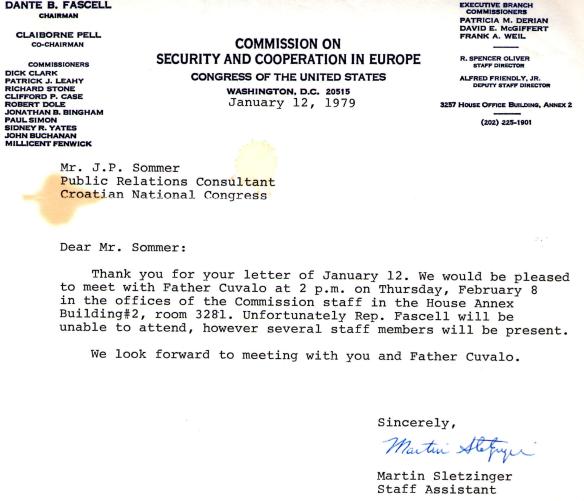
Slično Biađiju govorio je i kongresmen Grin, dodajući da će po podne tog “istorijskog dana”, prečasni Čuvalo biti primljen u kongresnoj Komisiji za bezbednost i saradnju u Evropi – da bi “izneo informacije o stanju verskih sloboda u Jugoslaviji”. A to će, po njegovom mišljenju, “značajno doprineti radu Komisije”. Amen!
Teško da je svemu ovome potreban kakav komentar. Našem čitaocu je, svakako, jasno šta je posredi, a nemamo ni najmanju želju da kongresmene Biađija i Grina – niti one njihove kolege koji su im eventualno poverovali na reč – razuveravamo i oslobađamo od “zabluda” o stanju verskih sloboda u Jugoslaviji, odnosno – kako bi to oni rekli – “još jednoj porobljenoj naciji”. Dalje, još je manje potrebno ukazivati na to koliko su ovakva istupanja njujorških kongresmena u suprotnosti sa politikom sadašnje američke administracije i njenog predsednika Đimija Kartera, koji je u bezborj prilika u toku dve godine svog mandata podvukao američku zainteresiranost za očuvanje nezavisnosti i jedinstva Jugoslavije i razvoj prijateljskih odnosa dve zemlje. Jasno je, također, da u SAD ima snaga kojima se takav razvoj odnosa sa Jugoslavijom ne sviđa, pa koriste svaku priliku (uključujući i godišnjice smrti ratnih zločinaca) da bi se suprostavile policiti (sic!) sadašnje administracije. Interesi koji nas povezuju, međutim, isuviše su značajni da bi se mogli ugroziti sitnim provokacijama i besmislenim incidentima poput ovog poslednjeg.
“primerni duhovni lider”
Mada beznačajan za američko-jugoslovenske odnose, ovaj incident, ipak, zaslužuje da bude do kraja razjašnjen, jer ukazuje na pravu prirodu aktivnosti prečasnog Čuvala, onih u čije ime istupa i onih koji ga – poput kongresmena Biađija i Grina – podržavaju, podstiču i reklamiraju kao “primernog duhovnog lidera koji zaslužuje mnoge pohvale za humanizam”.
Prvo, nekoliko reči o “humanizmu” onih čija je godišnjica smrti obeležavana bogoslužjem u Predstavničkom domu američkog kongresa. Nadbiskup Stepinac, ratni zločinac, osuđen 1946. godine na 16 godina zatvora, uslovno oslobođen 1952. umro 10. februara 1960. Glavna, mada ne i jedina tačka optužnice protiv zagrebačkog nadbiskupa i vrhovnog sveštenika ustaške vojske: masovno, nasilno pokrštavanje “grko-istočnjaka” (pravoslavaca, Srba) u katoličanstvo, naravno, sve to u ime “verske slobode”. Nadbiskup Stepinac bio je član “Odbora trojice” koji je, opet, pod sobom imao “Izvršni odbor za pitanje konverzije grko-istočnjaka na katoličku veru” – sve sa ciljem da akcija pokrštavanja bude što organizovanija i efikasnija. U pismu papi iz aprila 1943. godine, nadbiskup Stepinac piše o “240.000 prelaznika sa srpskog pravoslavlja”. Ali rat i njegova akcija pokrštavanja trajali su još dve godine, tako da je ovaj broj, u najmanju ruku, udvostručen. Zapadne diplomate i novinari, koji su prisustvovali procesu pred Vrhovnim sudom Hrvatske, mogli su da čuju i prenesu mnogobrojna svedočanstva o tome kako je nadbiskupova akcija sprovođena na terenu: pokrštavalo se s kamom pod grlom, a mnogi sveštenici su, da bi bili “uverljiviji” u “nagovaranju Srba u prednosti katoličanstva”, prvo oblačili ustašku uniformu, a zatim, preko nje – da bi se “stvar izvela po crkvenim propisima – svešteničku odoru. Sve to, sa znanjem i blagoslovom već pomenutog “predanog krstaša za stvar ljudskih prava” i “verskih sloboda”, kako je to lepo rekao kongresmen Biađi. Uzgred, da podsetimo uvaženog kongresmena da su saveznici – a među njima je, ako to nije znao, bila i Amerika – nasilno pokrštavanje proglasili za ratni zločin. A ono koje je izvedeno pod Stepincem, bilo je najmasovnije i najnasilnije od vremena verskih ratova.
pitanje pristojnosti
Zbog toga je, najblaže rečeno, nepristojno dovoditi u bilo kakvu vezu nadbiskupa Stepinca i poljskog papu Vojtilu, što je u svom pledoajeu pred Predstavničkim domom učinio kongresmen Biađi. Nije naš posao da jednom uvaženom kongresmenu držimo lekcije iz istorije i lepom ponašanju, ali ćemo mu, ipak, skreniti pažnju na činjenicu da je katolička crkva u Poljskoj – iz koje je potekao i papa Jovan Pavle Drugi – bila jedna od retkih koje nisu pristale na kolaboraciju sa fašističkim okupatorima. Dajući patriotski i etički primer, ona je platila visoku cenu: više od trećine poljskih sveštenika izgubilo je život u pokretu otpora i u nacističkim koncentracionim logorima. Kod nas je, na žalost, sem časnih iznimaka, bilo suprotno: bilo je sveštenika koji su upravljali logorima i u ime “verske slobode” prednjačili u zločinima nad bespomoćnim žrtvama, čija je jednia krivica bila druga vera. Mnogi su oblačili ustaške uniforme i borili se na strani okupatora – onih istih fašističkih sila protiv kojih je, da podsetimo, i Amerika bila u ratu. Ali to kongresmenima Biađiju i Grinu ne smeta da u Predstavničkom domu prirede komemoraciju sveštenicima u ustaškim uniformama (ili ustašama u svešteničkoj odori, svejedno), koji su 8. februara 1945. poginuli na Širokom Brijegu pored Mostara, ogorčeno braneći od Narodnooslobodilačke vojske jedno od najtvrđih ustaških uporišta.
Na kraju, umesto bilo kakvog zaključka, uzimamo slobodu da spikeru Predstavničkog doma gospodinu Tomasu O’Nilu preporučimo da za kongresmene Biađija i Grina priredi specijalnu projekciju američke televizijske serije “Holokaust”. Veoma je poučna.
Mirko Klarić





STJEPAN RADIĆ – AUTOBIOGRAPHY
A note to the reader
Current History, the oldest US periodical dedicated to world affairs, Vol. XXIX, October 1928 – March 1929, pp. 82-106, published the article Autobiography of Stephen Raditch (Stjepan Radić). After a few introductory remarks written by the editor of the periodical, an opening short article “The Last Years of Stephen Raditch” was written by Charles A. Beard, one of the most influential American historians of the last century.
In his numerous books and articles, Beard (1874-1948) advocated a new approach to American history that would include the relationship of economic interests to politics. He was a well-known political scientist as well. He supported America’s participation in the First World War and, as a political liberal, he was also a leading supporter of the New Deal, but Beard opposed America’s entering World War II. He was then labeled an isolationist and that helped to derail his professional carrier. However, he became a very successful independent scholar.
Both Radić’s autobiography and Beard’s preface are significant historical writings, and we bring them to public attention one more time, so that they may contribute to the understanding of events that took place in Croatia, and also in the region since they were published.
Ante Čuvalo
Also see
Stjepan Radic – His Life – His Party – His Politics.
Listen to an audio version of this speech.
Autobiography of Stephen Raditch
With an Introduction by
CHARLES A. BEARD
 The unique document published herewith was handed to Professor Charles A. Beard, in Zagreb, Croatia, in March, 1928, by Stephen Raditch’s daughter, under the circumstances described by Professor Beard at the end of his introduction. Written indifferent, and at times even bad French, its interest and importance are incontestable. It is a record of one of the stormiest political careers of modern times. From a humble peasant home Raditch rose to a position of power in his own country as the founder of a peasant party which eventually was destined to participate in the Government and subsequently to form an Opposition party representing a political force that could not be ignored.
In these pages Raditch tells of his early struggle to obtain an education, of the growth of his desire to help his ignorant and oppressed Croatian people, of his eternal battle with the police for championing the peasant cause, leading to many arrests and imprisonments, often to flight and exile, of his eventual rise from persecution and grinding poverty to a position of national and international importance. Raditch’s Recent assassination, as Professor Beard points out, leads a tragic interest to this autobiography. –EDITOR CURRENT HISTORY.
I –The Last Years of Stephen Raditch
By CHARLES A. BEARD
FORMERLY PROFESSOR OF POLITICS, COLUMBIA UNIVERSITY
The death of Stephen Raditch in August, 1928, as the result of complications arising from a wound inflicted by an assassin in the Yugoslav Parliament, removed from the theatre of Balkan politics one of the most interesting figures in that peninsula of storms. What irony that he should perish at the hand of a South Slav brother, not a Hungarian police officer!
A son of Croatia and educated in the traditions of Croatian autonomy, Mr. Raditch early in his youth came into conflict with the Hungarian Government, then in control of his native province. More than once he collided with the authorities in Zagreb; many weary days did he spend in exile. And yet he was not a revolutionary advocate of Yugoslav unity at all costs-he called himself “the greatest of political acrobats”; on the contrary, he was rather, most of the time at least, an advocate of a triune system which would give Croatia a position of autonomy akin to that enjoyed by Austria and Hungary under the Habsburg monarchy
Unlike the other Croatian intellectuals, who took a similar view of affairs, Mr. Raditch appealed mainly to the peasants. Groaning under the burdens of landlordism, largely illiterate, and for the most part too poor to vote for members of the Croatian Diet under the existing suffrage law, these laborious tillers of the soil rallied enthusiastically around the one leader who understood them and championed them in the forum. They were not seriously disturbed by the agitations of the poets and dreamers in favor of a great South Slav State dominating the Balkans and making adventures in the grand style. Far from it. They were more interested in getting land for the landless, in easing the load of alien landlordism, and in reducing Hungarian taxes, than in the projects of the young Slavs who frequented the cafes on Belgrade, Zagreb, and Sarajevo, and planned for “the great day of union.”
When at last, in the Autumn of 1918, the Austro-Hungarian Empire crashed to earth, all schemes for a triune kingdom came to naught; events now pointed out some kind of a union as the destiny of the South Slavs. In the late Autumn of that year a revolutionary Assembly, known as the National Majority, composed of party leaders from the sections formerly subject to the Habsburgs, met in Zagreb to make momentous decisions. Stephen Raditch was among them. But he had little power over their deliberations, because the real strength of his Peasant Party was unknown. In the rush he was overborne in his fight for complete Croatian autonomy. Against his wishes a committee of the convention went to Belgrade in November and surrendered to the Serbian Nationalists, without first making sure of federalism. Its leaders, conservative men, felt that they could not wait; Italian troops were busy on the Dalmatian coast; peasants were sacking the castles of landlords; and the protection of the Serbian Army was needed.
After two years of Provisional Government, elections were held for the convention to graft a Constitution for the United Kingdom. Although the Croatian Peasant Party, under Mr. Raditch’s leadership, returned fifty members, it refused to take part in the manufacture of the new document. For five years more Mr. Raditch remained in the Opposition, spending a part of the time in prison. But convinced at last that this course was futile, he finally made a truce with the Belgrade authorities in 1925. Before many months passed he entered the Government as Minister of Education and remained there through various vicissitudes until the Spring of 1926, when in a Cabinet crisis he was retired temporarily to private life.
Despite this turn in his affairs Mr. Raditch remained at the head of the Croatian Peasant Party, and members of his organization continued to serve in the Cabinet until Feb., 1927, when Slovene Clericals were substituted for Croats, sending the latter to the Opposition benches. Triumphantly returned to Parliament in the elections of Sept. 11, 1927, Mr. Raditch, assisted by his nephew, Paul, and his former enemy, Mr. Pribichevich, an Independent Democrat, took personal charge of the Croat Opposition in Belgrade and held practically all legislative business in a deadlock until he was laid low by the assassin’s bullet in June, 1928.
RADITCH’S POLITICAL FAITH
In the course of an interview granted to the author of this note and Mr. George Radin of the New York Bar, last February, in Belgrade, Stephen Raditch expounded three fundamental articles of his political faith. “first of all,” he said, “the unity of the Yugoslavs is permanently established”; then he pointed out that, owing to their relations to Italy, Hungary and Austria, the Croats were simply compelled to cling to the United Kingdom of the Serbs, Croats, and Slovenes. But, in the second place, Raditch laid great stress upon the historical and cultural differences of the several sections now composing the kingdom, and insisted that more autonomy must be granted in the interest of national harmony. Finally, he emphasized the necessity of settling the long-delayed questions of land reform and providing full compensation for property already expropriated, especially lands taken away from rich peasants whose accumulations represented years of toil and saving.
In response to a request for material bearing on his career, Mr. Raditch stated that he would arrange for us to secure it in Zagreb. Immediately on our arrival in that city, late in March, we hurried to his little bookshop on one of the crowded streets of the ancient Croatian capital and were fortunate enough to receive from his daughter, among other papers, the manuscript of his autobiography (written in French), which is here presented in English translation. Besides its value as a human documents and a contribution to the story of Yugoslav political development, it possesses a tragic interest now that its author has gone to his last sleep in Croatia, the land of his birth and his enduring love. No one can tell, either from it or from other records, whether Mr. Raditch, called a vacillating madman by his foes and worshipped as a hero by his followers, will become a great figure in death. Perhaps his historical stature will depend more upon the course of affairs in the Balkans than upon the work that he did there and the dramatic close of his troubled career.
II – The Story of My Political Life
By the late STEPHEN RADITCH
(Translated by Current History)
I was born on June 11, 1871. I was the ninth of a poor peasant’s family, which lived at Trebarjevo, a village quite near, and lying on the “right bank of the Sava. My parents had eleven children, eight of whom were still living not a long ago, and five of whom survive today. Those of my brothers and sisters who are still alive are peasants.
My late father, Imbro Raditch, found himself at the beginning of his career with a family dependent on him and with only a hectare (2.47 acres) of land which he cultivated assiduously. Besides this he was a skillful wheelwright, and though he had so many children, he became in twenty years’ time one of the most comfortably well-off peasants of his village. He sent all his children to a school in the near-by village of Martinskaves, although this village was three kilometers distant from Trebarjevo, and although this often imposed on him the burden of providing shoes, clothing and food, especially for the school, for three school children at a time.
The village has him to thank for the foundation of a peasant society, organized on the most modern basis, and not considering the importance of each member’s farm but rather the size of his family. Thanks to this organization, it was found possible to purchase from Count Erdödy some 6,000 hectares of a forest that lay on the outskirts of the village. The peasants, divided into three classes, according to the number of their children, pledged themselves to contribute a fixed sum, payable over twenty years. My father paid his contribution regularly on St. George’s and St. Michael’s Day; the amount, in his case 24 florins, was quite a considerable sum in those days. Although he could neither read nor write, he was considered the man of the most outstanding intelligence of the village, and the man who was most capable in conducting the public affairs of this little community. He drank neither wine nor brandy, nor did he smoke. Not until his last years he smoke, and this was because he had a mill on the Sava, and as a miller he had to smoke.
My mother, whose maiden name was Posilovich, was one of a large family to the same branch of which the Archbishop of Zagreb, of the same name, belonged. She also was illiterate, but she was a woman of great intelligence and also of great courage. One day, while she was still a young woman, the Mayor of the village tried to strike her with a stick because she was late in arriving to do her share in a piece of compulsory community labor. She tore the stick from his hands and broke it. For this she was condemned to nine days in jail, in accordance with a ministerial decree then in force. When she was released she went directly to the Governor and succeeded in having the Mayor dismissed. Later she went to Vienna to see Emperor Francis Joseph and persuaded him to pardon her eldest son, Andres, father of Paul Raditch, the present Minister, #so that he might be able to support his family, which was a large one.
When the famous Prefect of Zagreb, Stefan Kovachevich, nicknamed Pishta Bachi, tried to start an uprising in our parish of Martinskaves, my mother publicly asked him about a dozen questions, which were so searching that he could fin no answer, and stole away in this carriage ignominiously. She asked him also how he could have said in the Croatian Parliament that he had two countries, inasmuch as a man’s country was his mother, and no man can have more than one mother.
EARLY LIFE
My School Life—My late brother Anthony was three years older than me. He was born on June 11, 1868. It was said in our family that he resembled his father, not his mother. Our parents allowed him to attend school at Zagreb. Our mother obtained for him the patronage of the late Canon Rumpler. But they did not wish me to go to the lycèe because of my extreme shortsightedness, with which I had been afflicted since my birth. But I persuaded my brother to help me find lodgings, and the Humanitarian Society provided dinners for me in the People’s Kitchen. Besides this I helped myself by giving lessons to my little classmates, and so I found it possible to attend school regularly. I always received the highest grade in all my examinations, and my conduct was always rated as irreproachable.
Without asking for it I received the privilege of entering the college of the Zagreb Archbishopric, where I was admitted to the second class. There I clashed with the monitor, who compelled the boys to shine his shoes, and when I told him that he ought to ask us politely to do him this service he slapped my face, and I returned his slap. He investigation that followed this incident proved that it was I who had been in the right, and the monitor was dismissed by Rector Krapac, who became Bishop of Djakovo a few year later. But at the close of the school year they sent me away from the lycee (temporarily) under the pretext that I was so nearsighted that I was destined to lose my sight in two or three years.
From my third class on I was financially independent, thanks to the lessons I gave my classmates. In my fourth class I had another conflict with one of the teachers, whose brutal treatment of the pupils was notorious. As the head of my class I considered it my duty to defend my comrades. The director pronounced me to be in the right, but at the same time advised me to leave the College of Zagreb. Thus I entered the fourth class at Rakovac, near Karlovac, where I suffered greatly at first, having no friends nor any possibilities of giving lessons.
My First Travels to Learn to Know the People—During the Summer vacation of 1886, after finishing my third class, I undertook alone my first student tour from Zagreb to Koprivnica, and then through the Drava and Danube Valleys to Zemun and Belgrade, and through the plain of the Sava returning to Sisak, the governmental district to which my native village belongs. I left Zagreb with about 2 francs in my pocket, and I returned with around 64 francs, although I had asked no help from any one. The rector of the high school of Belgrade, now the university, forced me to accept 10 dinars, and the Orthodox priests in Eastern Croatia were as hospitable to me as the Catholic priests. I wrote my travel-diary regularly, describing particularly what the people thought of officials, of government, the economic position of the peasants in one Department or another, the organization and values of the schools, state of the roads, and so on.
A MOMENTOUS DECISION
It was then that I decided never to be an official, but to devote myself entirely to defending the rights of the people and to their education. My father did not oppose my plans and my mother was delighted with them. She predicted that I would often be arrested, but this she did not mind, preferring it to my being either a lawyer or a priest, for, she said, lawyers must plead that falsehood is truth and truth falsehood, and the pocket of priests has no bottom. During the Summer vacation after my fourth class I could not travel, the Director having held back my diploma because my roommate had not paid his share of the rent. I was so annoyed by this that I asked the Director of the Zagreb Lycèe to admit me to the fifth class of his institution, for the Zagreb Lycèe, in comparison with that of Rakovac, was a real university.
Subsequent Travels—After the fifth class I traveled through Styria, Corinthia, Carniol and the old Austrian littoral. Finally I returned home from Triest by way of Istria and the Croatian littoral. At Ljubljana (Laibach) I visited the then Bishop, Mgr. Misia; at Goritza, Archbishop Zorn, and at Triest M. Mandich, Governor of Istrian Croatia. While traveling through the Vipara Valley I visited at Gradishka the famous Slovene poet, Simon Gregorchich, who was delighted when I declaimed from memory some of his poems, and particularly his wonderful poem called “The House of Peasants.”
In the sixth class we counted, all told, more than seventy pupils. The teachers were in despair when they saw how many we were. They did not even have time to get to know us, much less to examine us. I then proposed to the teachers to organize the instruction in such a way as to allow the strongest students to teach the weakest. The former then brought to the teachers at every lesson as many weak pupils as the teachers themselves deemed practicable to examine. In this way the teachers would not be compelled to examine at random those pupils whom they considered weakest, and who usually stammered and halted in their replies. The teachers thus would have all their time for real instruction and examination. Those pupils who had fallen far behind in their studies would voluntarily attend the Thursday and Sunday classes. My proposal was accepted, and the success of this reorganization was so great that thirty-six of us were graduated with distinction; seventeen received excellent grades in all subjects and not one a low mark. Even the weakest had good marks. And furthermore the deportment of our class was exemplary.
THE FIRST ARREST
My First Demonstration and Arrest—Toward the middle of April the Ban,# at this time Count Khuen-Hedervary, issued a decree suppressing the Croatian opera, I was very indignant over this, and I decided to make a public protest against this decision. I could easily have convinced my whole class of the need of making a vigorous demonstration, but I hesitated to urge my comrades to commit an action which I knew might have unpleasant consequences for them.
On April 13 the opera Nikola Zrinjski was being played for the last time. The libretto was by the poet Hugo Badalich. I knew that in a passage of the third act the Pasha Sokolovich offered Zrinjski, in the name of the Sultan, the crown of Croatia, if he would surrender the fortress to the Turks. Zrinjski replied: “The Croats need no King, for the Ban is King to the Croats.” I took advantage of this scene to shout three times: “Glory to Zrinjski; down with the tyrant Hedervary!” I was arrested. When I was questioned at the police station I was told that I would be released if I expressed regret at my action, or if I declared that I had uttered the cries in a moment of excitement. I replied that I had made this demonstration with full deliberateness and in the deep conviction that Hedervary was really a tyrant, and that he was unworthy of occupying the historic seat of the Ban of Zrinjski and Jelachich. On the third day of my imprisonment the police tried by violent threats of long imprisonment to make me repudiate in writing the words I had shouted in the theatre. They told me that I would be severely punished; that I would be forbidden to attend the lycèe, and that I would be expelled from Zagreb. I absolutely refused to do what they demanded; and yet I was not delivered over to the courts, and I heard Count Khuen himself intervening in my favor over the telephone.
My First Journey to Russia—I was not expelled from the lycèe because one of my teachers, Mr. Georges Arnold, advised me to leave of my own accord, adding that I would receive a diploma attesting that I was an excellent pupil, so that the teaching board would not have to expel me. I followed this advice and decided to go to Bishop Strosmayer at Djakovo, on foot of course, and ask him to give me a letter of recommendation to someone in Russia. I traveled through the Moslavina and the Pogega valley and through the Krndija. Strosmayer received me in a very friendly way, but said that any recommendation from him would do me more harm than good. He did give me, however, a very warm letter of recommendation to the Serbian Metropolitan Michael at Belgrade, who had just returned from Kiev, where he had been exiled by King Milan and where he had been living for many years. Metropolitan Michael received me very cordially and gave me a short but cordial letter of recommendation to Professor Rakhmaninov of the University of Kiev, who was at that time President of a Slav charity society. He gave me 10 dinars, explaining that he was poor; and he severely condemned all Serbs who were then Magyarphils, in general, and above all the Orthodox priests. We talked about the political situation for more than two hours. Before my departure ha gave me his blessing and kissed me affectionately, wishing me the greatest success in Russia. What pleased him most was my resolution not to continue my studies at a Russian lycèe. I decided also not to take up advanced studies at a Russian university, for I was happy and proud that we had a university—we Croatians—and it was for that reason that I wanted above all to finish my studies—with God’s help—at Zagreb. I contemplated traveling widely afterward when I reached manhood. I dreamed above all of visiting Russia.
I learned to speak Russian perfectly in Kiev and then returned to Zagreb, where I entered the seventh class at the college. During that time I was watched by the police, who believed that they had found in me a Russian military spy.
EXILED TO NATIVE VILLAGE
While in the sixth class I established in cooperation with several of my fellow students a reading room, for which we subscribed to all the literary reviews of the Croatians, Serbs, and Slovenes. The most important Serbian reviews were Brankovo Kolo, Bosanska Vila and Stragilovo. We took also the Russian literary review Njiva (The Fields), and I taught Russian to nearly all my fellow-students. Aside from the class, we met often on Thursdays and Sundays in our reading room to tutor the weakest among our group in mathematics, physics, and languages. The Faculty began to suspect that we were discussing politics at these meetings, and, without warning, the director, M. Divkovich, said to me in class: “Since this class is organized without political aspects, I demand that you leave the college at once. Whoever cares to follow you may leave with you.” After hearing these words I turned to my classmates and said to them: “You will have an opportunity to follow me later on; or, still better, to act according to your convictions. For the present it is better for me to go alone.”
Some days later the police arrested me during the night and took me to the hospital of the Brothers of the Misericordia, where they placed me in the ward for melancholia observation. News of this got about in Zagreb and a professor of the university, Francois Markovitch, intervened for me with the former Mayor, M. Amrousch. He insisted that I be given my freedom and said that if the doctors, Dr. Sladovich, Dr. Markovich, and Dr. Chvrluga, wished to find me insane they must do so on their own responsibility. I was released from the hospital on the eighth day and from there I was hurried away accompanied by the police, back to my native village.
I remained at home nearly a year. I took part in the work in the fields. I tended the horses in the forest. My comrades were only peasants. They began to tease me and to try to find a sweetheart for me, as is the custom in our village when a young man approached his twentieth year. But as for me, I worked untiringly in the hope of finishing my college course and, thanks to the intervention of my friends, the police of Zagreb in the Fall of 1890 promised not to disturb my plans until I had secured my diploma. My friend and classmate, Stanko Hondl, now professor in the university, taught me on a big blackboard in a tiny garret during many a long hour the principles of physics and mathematics, and another of my comrades, who also is now professor in the university, Jean Maourovich, read Horace and Sophocles to me. Before passing my examinations for the bachelor’s degree as a day scholar, I had to undergo a severe test in which I had to know and translate perfectly the works of these two poets. I secured my degree at the modern college in 1891 at Rakovac, although I had made the classics my particular study.
Immediately after my examination I left for Dalmatia with my diploma. I walked through the whole of Dalmatia from Obrovac in the North to Metkovich. From Metkovich I went to Mostar. Here some Serbs before whom I had spoken enthusiastically of an economic and ethnographic exposition held at Zagreb, denounced me to the authorities, accusing me of conducting Croatian propaganda in Bosnia. The police arrested me and expelled me from Bosnia and Herzegovina.
Escorted by the police, I went by steamer to Fiume. I then walked through the whole Croatian littoral, also through all the mountainous sections between the sea and the valley of the Sava. I returned to the university with my mind teeming with vivid impressions of the life of the people.
My First Political School—These impressions influenced me so greatly that I definitely decided to prepare and devote myself to public life and I requested certain of the cleverest politicians of the time—the late M. Rachki, M. Smichiklas, M. Brestiyensky, M. Boroch and M. Amrouch—to permit me to lunch with them once a week so that I might keep in touch with the most important events of recent political history, which at that time was still not discussed in print.
In my conversations with M. Rachki, above all, I learned many important things about the creation of the Croat-Hungarian compact, and about all our relations with Vienna and Budapest. I repeated all I heard almost daily at our [viz, student] meetings. In this way a large number of students at the university received most important political instruction, and they were delighted with this addition to their studies. With regard to our meetings we adopted the following resolutions:
1—Those students who are the most ardent and most race-conscious Croats, shall attend regularly all the university courses, and shall pass their examinations with high grades as quickly as possible.
2—They shall not demonstrate in favor of any party, less still shall they make any disturbance In the streets and coffee houses; but they shall prepare themselves for political life by serious study in the university library, by mutual discussions and by establishing contact with the people in order to learn to know them better.
At this time seventeen Dalmatians and four Bosnians, joined by a few apprentices, organized a demonstration against the university Professor, M. Smichiklas (a Serbophile). Under his windows on Mesnichka Street they sang the song: “Cursed Be the Betrayer of His Country!” The former leader of the Right Party (a Serbophobe) wrote an article saying that hundreds of students headed this demonstration, attended by several thousands of Zagreb citizens. For this reason our club published in the paper Obzor, a statement signed by seventy-two students, severely condemning the demonstration against Smichiklas, and declaring that the students should demonstrate in the public streets only when they were forced to demonstrate against the alien Government, which was becoming more and more tyrannical.
Because of these last words, steps were taken at the university against all the signatories of the resolution, and scholarship students were threatened with the withdrawal of the scholarships which they were receiving from the State. In reply to these threats, fourteen more students signed the manifesto, and the eighty-six signers, all told, must be considered as the nucleus of the group which shortly afterward burned the Hungarian flag on Oct. 16, 1895. [After this act, the militants moved the headquarters of their organization to Prague, and from this group issued the men of our generation who are today at the head of the intellectual and political life of the Croat people.]
During the long vacation before my entrance into the second class of the university, I visited Southern Germany, particularly Bavaria and Württemberg. I lived for several weeks in Munich, where I devoted myself to quite a thorough study of the most notable artistic productions and of the extraordinary political relations between Bavaria and Prussia.
THE FIRST IMPRISONMENT
My first appearance in court for political causes, and my first sentence—On July 232, 1893, my comrade, Jean Kovachevich, and I were sent to Sisak as delegates of the university to the third centenary of the victory of Ban Tomo Bakach over the Turks, which occurred on July 23, 1593. It was decided that no toast would be proposed to the authorities. Buy Mayor Fabac, who was a violent Maryarphil, violated this decision by proposing a toast to the Ban then in power, Count Khuen-Hedervary. I protested vigorously against this action, stressing the facts: “We are celebrating the third centenary of the victory of the Croat Ban, not the tenth anniversary of the barbarous tyranny of a Magyar Hussar who gave himself this title in Parliament and who was proud of it.
Because of this declaration, I was sentenced to Petrinja, in the Autumn of 1893, for four months of imprisonment with hard labor. I refused to appeal and went immediately to prison. In prison I learned the Czech language, and when I was freed, I went to Prague, where my most eminent professors, the eminent jurists, M. Randa, M. Braf and M. Cuker, were living. M. Braf took a liking to me, and from him I learned many things, for he had been the son-in-law of M. Rieger, the famous statesman, who, it was said, held the whole political history of the Czechs in his hand.
From Prague to the burning of the Hungarian flag—I taught Russian and Croatian at Prague in the “Slavia” Academy with considerable success, and established friendly relations with almost all the present leaders of the Czech nation, some of whom have since died. My friendship with M. Rachin, especially, who later became Finance Minister of the Czechoslovak Republic, and who, as the result of his strong character, was the victim of a homicidal attack, was extremely cordial. During the Christmas and Easter vacations I did not return home, but went to visit Czech families outside of Prague. At the end of the academic year 1894, during an excursion, I made the acquaintance of my future wife who, at this time, was finishing her studies at the Normal School to become a teacher [We were married at Prague in the Autumn of 1898.]
I passed the vacations of 1894 as a tutor in the house of Count Thomas Erdödy at Chtakorovatz near Dugoselo, preparing him for the first examination of the Croatian University. I succeeded in establishing the custom of speaking Croatian at table while I was there, and persuaded the Count to obtain several hundred books in Croatian on legal, economic, and literary subjects. The naïf astonishment of the Count and the Countess when the Count received these Croatian books elegantly bound, and when I told them that these represented but a tenth part of our Croatian literature, constituting a veritable historical monument, was almost indescribable.
I had but little to do in the Count’s household, and I had much leisure time, which I devoted exclusively to study of the Czech language, in which I was the more interested because I wrote daily to the lady whom I now considered my fiancée, long letters and summaries of my lectures. After a few months I began to write to her in Croatian, with explanations in Czech, and finally I used only Croatian written in Slavic characters, so that she might learn the Russian language more easily.
In the Autumn of 1895, on Oct. 16, the students of the University [the Zagreb University, where Raditch had resumed his studies] almost under the eyes of Emperor Francis Joseph burned the Hungarian flag. While my comrades were busy burning the flag, some holding it, others wetting it with alcohol and some others finally burning it, I undertook the self-imposed task of interviewing the Chief of Police of Zagreb, to show him that by virtue of the Croatian-Hungarian entente, the Hungarian flag ought not to be on Croatian territory, and that we were burning it as a protest against he illegal Magyar supremacy and not to offend the Magyar nation. I explained to the Chief of Police tht it was for this reason that the flag had been dipped in alcohol so that it might burn quickly without leaving any disagreeable odor. Several students proposed that the flag be dipped in oil, but eh proposal was rejected in order to avoid the accusation that the manifestation had an offensive character.
My version of the incident made the Chief of Police so angry that I almost had to hold him back by main force. Thanks to my action, my colleagues were able to return freely to the university, while the police could arrest me as the leading spirit of the demonstration.
Meanwhile, the late Lacko Vidrich, who, because he was the handsomest boy among us, had been deputed to bear the famous Croatian flag of the university of 1848, under which the Magyar flag was burned, on his return from this manifestation organized a meeting, at which it was decided, amidst scenes of indescribable enthusiasm, that the entire assembly should go and declare to the police that the demonstrators were all my accomplices.
EFFECT OF THE DEMONSTRATION
But the police drove the majority of the students roughly out of the police court. Those who remained were asked: “Did you take part in the burning of the flag by impulse or by conviction?” Those who replied “by impulse” were thrown out, for the police were determined to diminish the importance of this manifestation. Those who replied “by conviction” were imprisoned. Of these there were about fifty. But despite this fact, the Hungarian Government stated in the press that twenty-three students only had taken part in this manifestation, allegedly condemned by the vast majority of the young student body. Francis Joseph himself, in his thanks to the City of Zagreb, described our action as reprehensible, and we were threatened with many years of imprisonment. Nevertheless we were sentenced only to a punishment of from two to six months. But the political historians of the world recorded the fact that Croatia was so dissatisfied with her relations with Hungary that the youth of the university had expressed their discontent by the burning of the Hungarian flag in the presence of the Emperor himself.
The news of our conviction and sentence was published on Nov. 19, 1895. We were sent at once to prison and before Christmas we were removed to the Departmental House of Detention of Bjelovar in order, as the Director, M. Herrenheiser explained to us, to prepare for us an “honorable status of imprisonment” (custodia honesta). The whole first floor of the prison was reconstructed and made into bedchambers, and the large hall into a study room during the day. I profited by this opportunity to teach Czech to my comrades, as we had all agreed to go to the Prague University after our release. Because of this, the authorities separated me from my comrades and placed me among the prisoners sentenced for common law crimes. They forbade me to receive food from outside. All this was very illegal. Fortunately some of my comrades were sentences to only four months’ imprisonment, so that on March 17 I found myself again alone and back again on the first floor, with almost the whole library of the Minister of Justice at Zagreb, which M. Herrenheiser had had transported for my comrades, at my disposal. Among the law books then very much in use there was a remarkable work on Russia in three volumes translated into German under the title Das Reich der Zaren und die Russen (The Empire of the Czars and the Russians). The author was M. Anatole Leroy-Beaulieu, who is [was] perhaps the most profound Russian scholar of the time and who subsequently became my teacher in Paris. During the two last months of my imprisonment they allowed me to have a drum.
My Second Visit to Russia and How Love Saved My Life—On May 19, 1896, I was taken from Bjelovar to my native commune under a strong police escort. The gendarmes delivered me over to the Department Prefect, who set me free only on my arrival within the limits of the commune. Next day, to my great surprise, two ladies elegantly dressed in black and wearing gloves drove up to see me in carriages. They introduced themselves as the mother-in-law and the wife of the Chief Justice of Zagreb, Rakodozay, who had inflicted on us so harsh a penalty for the flag demonstration. The two ladies declared that they had heard I wished to go to Russia and said they knew I was innocent and persecuted, and they gave me a loan of 300 florins to pay my traveling expenses. I also received 100 florins from a society organized to assist students financially.
I reached Moscow at the beginning of June, 1896. On the insistence of some ladies of Zagreb I had decided to be in Moscow at the time of the coronation of Czar Nicholas II, which was to take place on May 30, 1896. He was to be crowned at the Hodin Fields and a souvenir was promised to all who witnessed the ceremony. The souvenirs were to be a pitcher, a saucer and an artistically embroidered handkerchief. I had promised these ladies to bring each of them one of these imperial gifts and wished to keep my promise. But on my way to the coronation I broke my trip in order to visit my fiancée, who was then a teacher in Eastern Moravia in a village situated amid the mountains. Thanks to this, I reached the coronation ceremonies late, to learn that about 10,000 people had been killed there in a terrible accident, most of them buried alive, while an even larger number had been grievously wounded. So I can say that my love for my fiancée saved my life.
THE VISIT TO MOSCOW
At Moscow I lived in the house of a Polish patriot named Chrzanowsky, who came from Vilna [then a part of Russia]. I taught Russian to my host’s younger son, who had failed in his Russian examination for the sixth class as the result of his ardent patriotism, which had brought him to the unwise decision not to learn the Russian language. I succeeded in persuading him that the Russian language and literature had nothing in common with the oppression of Poland by the Czaristic Government and that his duty as a Polish patriot was, on the contrary, to acquire a thorough knowledge of both. My host’s eldest son was of about my own age and we soon became fast friends.
I remained in Moscow for five months. Hearing that the Minister of Public Instruction had arrived there, I went to see him personally and asked him to allow me to enroll at the university as a special student. He first replied severely that by rights I should not be at the university but in Siberia, but after he heard all I had to say he wrote an order allowing me to enroll at the university. But I could not take advantage of this favor, for the reason that the curriculum was so arranged that I would have had to stay in Moscow for several years to finish my law studies and this, because of lack of money and time, was impossible.
At the School of Political Science of Paris—I had already been excluded from the University of Zagreb on account of the episode at Sisak, when I had protested against the toast in honor of Ban Hedervary. I had also been excluded from the University of Prague in the Autumn of 1894 because of a conflict with the Police Commissary, who had dispersed a student meeting on the ground that the students had applauded the orator too enthusiastically. At the same time I was expelled from all the countries represented in the Vienna Parliament (17 provinces of old Austria). I had enrolled in the University of Budapest in January, 1896. I had learned Hungarian so well that I was able to follow the courses; but at that time# the Hungarian flag had been burned under my inspiration and on this account I was also excluded from the Budapest University.
Fortunately enough, I had already learned in Moscow that there existed in Paris a Free School of Political Sciences which had been founded in 1871. I received its curriculum and saw at once that it contained everything I needed to finish my university studies. SO I left for Prague, where I had to stay in hiding for six weeks and where, with a small group of Croatian comrades, I made all necessary preparations for the publication of a monthly review called Croatian Thought (Hrvatska Misao). I wrote almost all the articles for it and here for the first time. I expressed all my political and social ideas. I also devoted many pages to the works of the famous Russian professor and historian, Karieiev, who was working actively to provide the young generation of Russia with a study plan with which they could themselves fill in all the lacunae of the secondary and university courses which they needed. Hence I translated and published in Croatian Though six letters of this professor explaining how the young people of Russia could learn by self-study all the modern ideas about the world and life.
Although I went to Paris at the end of January I could not enroll in the Political School until the Autumn of this year, because the enrolment fee was 180 francs and I had only 57 francs in my pocket when I reached Paris. But my Prague and Zagreb comrades aided me. I passed the 1927 [sic!] 1897 vacations at Lausanne, where many courses on the French language and literature are given even during the vacation period, and I was also able at the same time to study the political situation in Switzerland and to perfect my knowledge of spoken French.
I finished the first semester at the Ecole Politique in June, 1898, with great distinction. I chose the general section, the main subjects of which were diplomatic history, comparative civil law and finance. I also chose nine other subjects, including the Russian and German languages.
MARRIED IN PRAGUE
I learned at this time that my fiancée had become a teacher in Prague, her native city. I was afraid that she would be too weak to resist the influence of her whole family and all her friends who reproached me for what they called my Bohemian life, and I therefore decided to marry her immediately. I advised her to resign her teaching post which she had now held for four years. When I received her definite consent, I hastened to Prague, and we were married there on Sept. 23, 1898. After this, I left Prague, and traveling by way of Krakow, Lwow and Russia, beneath the Carpathians of today, I reached Trebarjevo, my native village. But I noted a complete change in the attitude of my comrades, and even of my family, due to my having married without having either any position or any money. They were all afraid that I would fall back on them for support, and some of them even broke off all relations with me. I lived in poverty in my village for fully four months, and I finally became convinced that all my political career would be held up unless I finished my university studies. “They will all forget,” I thought, “that I have been excluded from all the universities of the Monarchy, and that I had no money to go abroad, and they will think my failure was due merely to neglect.”
With much difficulty I succeeded in getting together the sum of 300 francs, with a “white-seal,” [signature in blank] of course. I thus arrived for the second time at Paris, this time with my wife. To this fact alone I owed the possibility of being able to write my thesis and to prepare for my examination in five months, during which time we often had to pass whole days without eating. The title of my thesis was, “Croatia of Today and the Southern Slavs.” I was busy with my courses the whole day, so that I was obliged to dictate my thesis till the late hours of the night.
The eminent French Professor, Anatole Leroy-Beaulieu, was assigned the duty of estimating the value of my work, and he found it so good that in May, 1899, he reported that it was not only wholly original, but also a learned political study. Thanks to this judgment it was recopied by a number of eminent French statesmen, among others by the President of the Chamber of Deputies, Paul Deschanel, who later became President of the French Republic. Some of these gentlemen, who knew how poor I was, gave me a financial recompense for the work, and the Ecole Politique, on the basis of the thesis, and of my oral and written examinations conferred on me a diploma, declaring me “Laureat des Sciences Politiques,” that is, a scholar of political science crowned with laurels. Moreover, I received a whole political library composed of the works of the best French writers.
EXPELLED FROM PRAGUE
A year of work at Prague, and a year and a half at Zemun—I returned from Paris to Prague in July, 1899. I did not believe that the Prague police would interfere with me. I remained in the neighborhood of Professor Masaryk, the present President of the Czechoslovak Republic, with whom I was on friendly terms, although our political views were different. He had a marked preference for the Jews, and I told him that he should turn the universal prestige which he enjoyed to the service of his unhappy Slovak people. He was also the advocate of a policy favorable to Germany, while I, on the contrary, advocated a policy favorable to Russia.
I contributed to almost all the literary and national economic periodicals, and I was a member of the editorial staff of a weekly paper called Samostalnost (independence), for which I wrote the regular review of foreign politics. When I began to write for the daily newspapers and for the Radikálni Listy (Radical Leaves), in particular, I received one day a notice from the police ordering me to leave Prague immediately and to stay out of a full half of the Austrian State. After reflection, I decided to go to Zemun, where I would be on Croatian territory, and from where I might watch the ominous events developing at Belgrade, and I succeeded in obtaining the post of reporter for several Czech, French and Russian newspapers.
Throughout the whole year I wrote several books in Czech, for which the Czech Literary society, Svatobor, conferred on me the tile of Czech man of letters. One of these works was a pamphlet called The Ecole Libre of Political Sciences at Paris; another Croatia of Today, in which I incorporated the first part of my thesis at the Ecole Politique at Paris. At Prague I also wrote a work called The Southern Slavs, which took in the second half of my thesis, and which appeared in a monthly review, Rozhledy (Panorama), of which Joseph Pelel was the editor. Somewhat later I wrote a work called Reflections on International Politics, in which I embodied translations of some of the most important lectures on diplomacy by one of my teachers, the French historian of diplomacy, Albert Sorel.
The press, and particularly that of the Social National Party, the leader of which is still today M. Klofach, made sympathetic comments on my expulsion, and M. Klofach referred to it most sympathetically in his paper and protested energetically to the Government against it. He also asked me to write a kind of farewell pamphlet to be called Slavic Youth and Its Social Action. I did this, and thousands of copies of the work were printed; it also appeared in the leading paper of the Social National party, a weekly journal called Czech Democracy.
At Zemun the police wanted to expel me immediately, but Alexander Badai, the present Chief Justice of the Court of Cassation, who was the most influential member of the Municipal Council, intervened in my favor against this action.
My Relations with Serb Politicians: I study the Serbian Political Situation—I lived at Zemun for nearly a year and a half. At first I rarely went to Belgrade, because it was difficult to get permission to cross into Serbia. I established contact with some of the leading Serb politicians and three of them became my close friends, namely Professor Ljuba Jovanovich; the then Chief of the Macedonian section of the Foreign Ministry, Sveta Simich, who wrote under the pseudonym of Paul Orlovich, and who later became the Serbian Ambassador to Sofia, and finally the secretary of the Ecole Supérieure, later the University of Belgrade, Zhivojin Dachich. All complained, cautiously, of course, of being worse off in Serbia than in Afghanistan, and declared that they did not know how the tyranny of the Obrenovich dynasty and the apathy of the Serbian people respecting this tyranny would end.
At this time there again appeared a bi-monthly review called Srbski Knjizhevni Glasnik (Serbian Literary Review), in which two of my studies were printed without change, the first under the title The Croats and the Magyars From 1848 to the Present (1901), and the second entitled The German Influence in the Balkans. The other collaborators received no honorarium, but through the intercession of M. Jovanovich I received a recompense of 26 dinars for each of these two studies. This sum, plus the 10 dinars which I had received from the Director of the Grande Ecole, as well as the other 10 dinars which the Metropolitan Michael had give me, are all the money I ever received from Serbia.
M. Michael Vouich and Sveta Simich tried to persuade me to enter the Serbian Diplomatic Service, or at least to collaborate in the correspondence work of the Serbian Bureau, of which I might soon become the Chief, but I politely but decisively refused both opportunities, mainly because the collaborator the Chief of a Correspondence Bureau would obviously be the servant of all Governments.
FINANCIAL DISTRESS
I remained at Zemun from the Summer of 1900 till the beginning of 1901. I then went to the Czech village, Konchanitsa, in Croatia, near Daruvar, on the invitation of a professor who lived there, M. Joseph Krzepelka, who had helped me during my stay in Paris. There I passed several months in great financial distress.
At this time Ban Khuen-Hedervary declared open the period of the legislative elections of the Croatian Parliament in the Autumn of 1901, a whole year before the date when they were scheduled, obviously to precipitate the Opposition, in which object he was successful. As for me, I was arrested because in my propaganda work in the large villages of Podravina (on the right bank of the river Drava), I advised the peasants to vote in favor of the Opposition. Seventy-seven Magyarphile Deputies named solely by the Magyar people were elected, and the Opposition received only eleven mandates. M. Joseph Frank and M. Michael Starchevich broke away from the other Opposition parties, and fought more energetically against the Opposition Party than against the Government. The rest of the Opposition, represented by nine Deputies, organized the “Union of Croatian Opposition,” which, on the recommendation of M. Derenchin, the lawyer and Deputy, appointed me Secretary, with a salary of 60 florins a month. Toward the middle of the year 1902, I moved from Konchanitsa To Zagreb, and settled down there. The union of Croatian Opposition had then no political nor financial organization and they charged me with the task of creating one. I wrote thousands of letters to America and I traveled from village to village in Croatian, and on account of this I was arrested not long afterward.
My Program of Peasant Policy in My First Pamphlets—At Zemun I had written a pamphlet called How to Find a Remedy for Our Troubles. Twelve points listed in the conclusion may be considered as the embryo of the social program of the Peasant Party. This pamphlet was printed in Sisak in 3,000 copies at my own expense. It was already exhausted when it was seized by police. In the Autumn of 1902 I published another pamphlet, called The Strongest Party in Croatia. In this study I advocated the idea that the toilers of the field, viz, the peasants, constituted the strongest party because their life and their conception of the rights of the State, as well as their national consciousness naturally inspired them with the best of programs, and that it was necessary only to organize them in order to realize this program by means of the real vital forces of the nation. This second pamphlet was also seized, but fortunately I had then already sold or sent out almost all copies. Two thousand copies were printed at my expense by the Cooperative Printing House.
In the Autumn of 1902 I published a monthly review of democratic Slavic thought called Hrvatska Misao or Croatian Thought, which had already appeared in Prague for one year in 1897, and which was already imbued with this same Slavic and peasant sentiment.
FOSTERS PEASANT CAUSE
“The Croatian Thought”—This was a review whose object was to win over intelligent and cultivated people to the peasant cause. I published this review for three years, and toward the month of July I published also in a special pamphlet the plan of the complete program of the Croatian Peasant Party. This plan served as a basis, which I developed into a final program at the end of the same year. During the first year of its existence, from 1903 to 1904, the review was active and gained great influence among its readers; but the second year, 1904-1905, there was a small financial deficit. The third year all the younger readers ceased reading the review because in my articles I had condemned the policy of the Croat-Serbian coalition, that is, the policy of the Magyar Kossuth. The older readers also turned against it, because at that time I was organizing the Croatian Peasant Party. It took me several years to pay the debts the magazine had made me incur.
My Sufferings on Account of My Defense of the Serbs of Zagreb in My Struggle Against the Magyarization of Croatia—On Sept. 2 and 3 there occurred at Zagreb serious demonstrations against the Serbs, the result of an article called “War or Destruction,” published in The Serb Literary Review of Belgrade and republished in the Zagreb paper Srbobran. I was living then at 15 Prilaz Street, and next door stood the shop of a Serb named Popovich. From the first floor I witnessed the scene of violence which took place during which the mob wrecked the shop and destroyed all the merchandise. On the second day of this reign of terror (Sept. 2), I went down at the insistence of my wife amongst the demonstrators, and spoke to them briefly, telling them that thought he obstinacy of the Serbs and their pro-Magyar action hampered all progress in our country, nevertheless they were our blood brothers, and hence that I was both inhuman and unwise to take such violent action against them. The Magyars, on the contrary, I added with whom we are bound by a compact which has the character of an international treaty—a compact under whose terms the Croatian language must be the only official language of the [Government] bureaus and the Croatian re-white-blue tricolor can wave over the public buildings—wish to tear up this treaty and make us slaves. If the people wish to protest against illegality and violence, I said, they have every opportunity to do so at the railroad station, where all public notices are printed in Hungarian. “Your numbers are so great that you can as easily as playing a game for your own amusement tear down all these illegal notices, put them in a box and send them back to Budapest!”
At first the mob wanted to attack me, but some young men began to shout: “Leave him alone; it’s Raditch, who six years ago burned the Magyar flag! He’s right; let’s leave the Vallagues [viz., the Serbs] alone, and march to the station to tear down the Magyar notices!” At once the mob rushed to the University Square, following the road to the station. But the police and gendarmes were already there an, of course, they arrested me.
SIX MONTHS MORE IN PRISON
My words to the crowd brought me six months more in prison, after an investigation in which the police tried vainly to drag false statements from other witnesses who had been questioned. The police wanted the witnesses to say that I had urged the demonstrators to destroy the station.
My Family and My Freedom—Already at that time the police persecuted my wife and children to force them to leave Zagreb on the ground that they were not of this section. We were fortunate enough to possess 1,000 crowns, 600 of which came from the literary society “Matica Hrvatska” for my work entitled Djevojachki Svijet, or the World of Girls; and 400 came from the Czech society “Svatobor” of Prague, mentioned by me above, with which sum my wife was able to begin negotiations for the purchase of a house which had no second story, make advance payments, and with the money which she borrowed from certain banks to buy the house and have it registered in her name as the possessor.
RADITCH CREATES THE PEASANT PARTY
Organization of the Croat Peasant Party Under My Presidency—During this time I worked diligently on a long study called Modern Colonization and the Slavs, which soon appeared, published by the society “Matica Hrvatska.” This article increased my influence among my political colleagues and because of it I was chosen as President of a temporary committee for the organization of the Peasant Party. This choice was renewed each year and always unanimously by the members of our party.
On Dec. 22, 1904, the meeting of the chief temporary committee for the founding of the Peasant Party was held and at this meeting there was drafted the party program and its interpretation. The program by itself appeared on Dec. 31, 1904, in the weekly review, The Croat Nation, and about the middle of January, 1906, the platform and its interpretation were published in a special pamphlet, 10,000 copies of which were printed.
During this time I was occupied on one hand with the organization of the party, on the other hand with writing scientific articles which the above-named association, “Matica Hrvatska,” published. These were: The Real Europe, in 1908, The Science of Finance, The Czech Nation at the Beginning of the Century, and then a book of great length, Real Parliamentarianism—Or the Basis for the Establishing of the State in the Countries of the West. This work first appeared in 1910 and was published at my own expense.
In 1901 and 1901 I had written a published part of y Recollections of Prison in two volumes. The first volume was seized, but by that time it had been entirely sold our or distributed and so the censors suppressed about twenty passages in the second volume. At the following session of the court I appeared for the sole purpose of obtaining a decision under which my book might appear in such a form that it would show no evidence of the suppression of these twenty passages. Two thousand copies of these volumes were printed and sold, for the most part among students.
Because of the amount of work which the organization of the Peasant Party and the editing of the party’s magazine put upon me, I was obliged to give up my collaboration on several Czech, Russian, and French newspapers to which I had regularly contributed. I kept up my relations with Czech politicians, however, and for several years I spent a good deal of time in Prague.
The second Slav Congress at Prague and My Third Trip to Russia: My Sufferings and My Success at St. Petersburg—In 1908 the second congress of the Neoslavs (new Slavs) took place in Prague. To this congress came also a delegation of Russian deputies, at the head of which was Maklakov, as well as the delegation of Polish members of the Russian Parliament headed by Dmovski. (The first Slav Congress had taken place in Prague in 1848.) The delegates only, that is to say, those representatives of all the Slav nations eligible to active membership, took part in the congress. I myself took part as a member of the Croat Parliament and succeeded in making myself known as a force for insistence. The congress held meetings throughout an entire week and after these discussions the members of the congress, Russian and Polish particularly, made a trip to the south of Bohemia, where I translated for the Czech public the speeches of each of the members of the congress. I made the acquaintance of and better still I made friends with several Russians, who seeing that I spoke the Czech language perfectly and knew the Czech situation in all its details, invited me to come again during the same Autumn to St. Petersburg to give a series of lectures on the Czechs and on the Slavs of the South. Prince Lvov, later the Minister-President [Premier] of the first truly democratic government of Russia, as well as General Volodimirov and M. Ozerov, Professor of the University of Petrograd, among others, invited me for these conferences. But several months went by after the close of the congress and even the entire Autumn of 1908 and nearly the whole Winter of 1909 before I was able to go to Russia. For this sojourn I had to borrow from the First Croat Savings Bank on our little home, still without a second story and now burdened with a mortgage of 1,400 crown to pay for this trip.
THE WAR THREAT OVER BOSNIA
At this time the Austrian Government proclaimed the annexation of Bosnia and Herzegovina to Austria-Hungary. Bulgaria at once proclaimed herself independent of Turkey, and there came about in Europe an extraordinary political tension between Russia on one side and Germany and Austria on the other. Nevertheless, I went to St. Petersburg with my wife, and my children remained in Prague with my family. In St. Petersburg I found a whole group of Serbs, who were agitating, with a great deal of success, to the effect that Russia should not recognize the annexation and who proposed that Bosnia be annexed to Turkey. They lectured and wrote especially that it would be preferable to provoke a war than that Bosnia and Herzegovina should be annexed to Austria.
There was then in St. Petersburg an organization called “The Society of Public Combatants” at the head of which were Milyukov and Maklakov. I succeeded in obtaining the privilege of lecturing before this society on the rights of Croatia and Croatians in Bosnia and Herzegovina from a geographical point of view, taking into account both intellectual and moral aspirations and religious considerations, since the Mohammedans of Bosnia, who are Slavs and who form the oldest part of the population of Bosnia, were in increasing numbers declaring themselves Croats in both the political and nationalistic sense of the word. Thus Bosnia and Herzegovina, with regard to nationality are as much Croatian as Serbian.
My lecture lasted nearly two hours, in spite of interruptions from the Serbs, who at the outset heckled me at each phrase and punctuated my sentences with ironic reflections. I succeeded, nevertheless, in securing the serious interest of political circles in the questions that I had discussed. I said in particular that it was stupid to assert that there would come to Bosnia every year a half million Germans from Germany and that Bosnia would be Germanized within several years, since no political desire can direct the flow of emigration, which is subject to very severe and unavoidable economic laws. I pointed out in particular that about 1890, 200,000 people had emigrated from Germany, but that at the end of ten years this total had fallen to 20,000; that all the German population was bound for America and that all the Bismarcks in the world and all the Hohenzollerns could not make them go to Bosnia.
Prince E. E. Ukhtomski, the most intimate friend of the Czar, was interested in this and invited me to his home some time later. There I found a very distinguished group of Russian and foreign economists, specialists in economic and financial questions, and also some politicians. I had the opportunity there of expressing my views on the annexation of Bosnia and of showing clearly and briefly the situation of all the Slav nations in Austria-Hungary. At this meeting were present, as I have already said, several political and financial notables, to whom I repeated briefly what I had said in my public discourse on the subject of the annexation of Bosnia. I expressed also my opinion that only the Poles, the Czechs and the Southern Slavs could be the links between Russia and the democracies of the West, under the condition naturally that the Russians should be free as well. I explained finally the organization of the Peasant Party, referring to a number of the Croat Idea of 1904, in which an article entitled Against Tyranny and Against Revolution had helped me to develop the idea that a real democracy is as far from violence from above as from revolution from below.
Prince Ukhtomski observed that he had never heard any one express these ideas and be begged me to tell him in detail the history of the founding of the Peasant Party and what had been the result of my work and my organization up to this time (1909). I told him among other things that in the course of my frequent sojourns in Croatia I had questioned the children so as to learn whether there was in their village a single man who would not drink at the local tavern, who had the courage to reproach the village priest, who was economical and who loved not only his own children but those of others as well. When the children had shown me such a man I went to stay at his home and when I learned that he could read and write, that he loved the school and that his wife ate with him at their table, I put him down as one of my future collaborators. There were then a few more than a hundred of these peasants and all together we had succeeded in bringing together about 10,000 peasants, having for our chief principle the doctrine that we must not believe in any authority, but that we must fight no government with arms. When the entire nation, or at least a great majority, would be organized on this basis no government would be capable of resisting our will.
After these words, a banker arose and interrupted me, saying: “You will never succeed in this, even in fifty years.”
CZAR ACCEPTS HIS ADVICE ON BOSNIA
But Prince Ukhtomaki asked me whether I could make a resume in writing of all that I had just said and in addition of my ideas of a peasant democracy, of the annexation of Bosnia and finally of the present situation and of the duty of Slavs who were not Russians. He said that he wished to send it to the Czar and to the Minister of Foreign Affairs, and to publish some passages from it in his newspaper, Peterburgskiya Viedomosti Petersburg News). Furthermore, he told me that Professor Sirotinin had written a comment of seven columns on my study The Modern Colonization and the Slavs in the above paper and that Professor Sirotinin was going to translate some chapters of my book The Real Europe, because, as he said, a book of this kind did not exist in Russian political literature. The next day I received an invitation from the famous Russian publicist, M. Stakhovich. This publicist, who had also been at the Congress of Prague, where he had invited me to go to St. Petersburg, lived outside St. Petersburg on his estate. He held Ukhtomski not only as a conservative but as a violent reactionary Nevertheless, he rejoiced that Ukhtomski had promised that he would take my resume to the Czar, and he encouraged me to write my best.
I worked at this report for nearly two weeks and if I had written it alone it would have taken me a month. As it was, I delivered it in a beautifully written manuscript in my wife’s handwriting on Feb. 12, 1909, I believe in the presence of Baron Frederiks, Minister at the Czar’s Court, who was intensely interested in the reasons why the annexation of Bosnia was [as I stated] a triumph for the Slav cause. This would be the case, of course, only if Russia would give the Slavs, instead of the orthodox or territorial policy, a national policy, which in fact would mean a policy of peasant democracy. I explained this briefly and earnestly and I talked with so great persuasiveness of the foolishness and the terrible danger that it would be for Russia (because of the internal revolution) to undertake a war on behalf of Bosnia, that, after I had spoken, Baron Frederiks rose and said to me: “All that you have said I would like to repeat today to the Czar. Russia will confirm the annexation and because of the annexation will not invoke a war.”
HONORS IN MOSCOW AND PRAGUE
I judged from this that I had succeeded in the principal purpose of my trip to Russia. On the insistence of my Russian friends I remained in St. Petersburg until the end of the on the of March and then delivered a lecture in Moscow, which was organized by some professors of the university. By good fortune General Volodimirov, Professor in the Military Academy of st. Petersburg, spoke before me, and in a discourse which lasted for an hour he presented the Croat Peasant Party as the purest form of democracy imaginable. In the midst of the conference about twenty Serbians rushed into the hall crying, “Down with Austria! Down with Annexation! Down with Raditch!” and they started toward the platform. God alone knows what would have happened if they had reached me. But I was seated in the audience and General Volodimirov simply ordered that the Serbs be excluded and that they be kept from re-entering the hall. Thanks to that order I was able to deliver my lecture without interruption. The subject of the discourse was The Situation and the Duty of Forty Million Slavs Who Are Not Russians. I began it by speaking of Prague and the Czechs, I continued speaking of Constantinople, of the Bulgarians and the Serbs, and finally of the Poles of Posed (which then belonged to Germany) and of Galicia, and I finished by speaking of the Danube, of the Adriatic Sea and of the Croats. I had an extraordinary success and they applauded me at the end for ten minutes.
After this lecture I delivered a very animated address in a well-known hotel in Moscow at which several hundred men of the intellectual elite were present. Through this speech I prevented any further attention from being paid to the perfidious calumnies according to which I had bee sent to Russia by the Austro-Hungarian Minister of Foreign Affairs, Count Aerenthal, and that I had gone to Russia with the expectation of being rewarded with an Austrian portfolio.
From Russia I se out for Krakow, where I remained for only a short time and where I lectured before the “Slav Society,” at the head of which was the University Professor Zdiechowski, and in the Union, the largest academic society in Krakow. I took for the subject of my discussion The Two Slav Factions, the Faction for Revolution and the Faction for Democracy. I spoke naturally in favor of the democratic party and I proved with irresistible and convincing force that the real Slav democracy should and must be only the Peasant Democracy.
Soon after, in Prague, I wrote a long article, My Third Trip to Russia, which appeared in a monthly Czech conservative review, most highly esteemed, entitled Osveta). This article was published by the Croat Journal of Sarajevo, but it did not appear until April or May, 1914. The entire Czech press commented at length on this article and M. Francois Udrznal, the President of the Slav Union and then a member of the Austrian Parliament, who was a short time ago Minister of War, wrote me a long letter, which he concluded as follows: “You alone are ignorant of the extent to which the Slav Union is indebted to your work in St. Petersburg and Moscow, for all your discourses have been taken down word for word and communicated to the Minister of Foreign Affairs, and this proves that our Slav policy is open, pure and loyal in this monarchy. I can tell you that I have learned that you have contributed enormously to the avoidance of an outbreak of war on the occasion of the annexation. And this war would have had for us Slavs consequences even more terrible than those which the war of 1866 held for the Germans.”
PEASANT PARTY PROGRESS
The Peasant Party and Ban Tomasich—At this time the Croat-Serb Coalition became reconciled with Budapest and Professor Tomasich of the university became the Ban, or Governor, of Croatia. He interested himself in the peasant program, not in the way in which it was drawn up, but in its realization. For this reason, I had long discussions with him which ended in such a way that the Governor made known to Pesth and to Vienna that the Peasant Party, although against militarism and in favor of the referendum of Switzerland [Under this referendum the Swiss people have the right to vote on Constitutional Amendments—EDITOR] was not a party of revolution, but, on the contrary, was conservative with respect to religion and national customs; that from a political point of view it was liberal, particularly in what concerned constitutional liberty and electoral rights; that it was radical in concrete social questions already ripe for solution and that it pointed out specific ways of solving these problems.
The result of these discussions was a small brochure, The Rights of the Peasant, containing 100 questions and 100 answers, of which 10,000 were printed.
Governor Tomasich pointed out to me in particular that at Budapest, and still more in Vienna, he had found a flurry of denunciations proceeding from the aristocracy and from the bishops, as well as from several “secret advisers” of all possible parties. And all these denunciations ended in the mendacious affirmation that the Peasant Party was entirely of the Pan Slavic and Republican faith; that I myself was the most dangerous enemy of the dynasty and the monarchy, and that I was in the service of Serbia, of Russia, and of France.
A short time later they extended the electoral rights, a reform the greatest credit for which must be given to Governor Tomasich, who, on May 28, 1910, presented the above mentioned bill for signature to the Emperor and King, Francis Joseph, at Budapest, without asking to be announced to the Minister-President [Premier] Khuen-Hedervary until this project should receive the royal sanction.
This law increased the total of voters from 48,000 to more than 200,000 at the following Parliamentary elections in the Autumn of 1910. Thanks to this law the Peasant Party obtained 16,000 votes and nine Deputies, five of whom were real peasants working their own lands themselves. The party made use of this force to bring about the insertion by the Governor in the message to the King of some of the measures advocated in the peasant program, and in this it succeeded. The Ban seemed to believe that the Peasant Party could aid him under the terms of the Croat-Serb Coalition. But not only were the denunciations of the reactionary circles—feudal and clerical—not stopped, they even brought into their net the Governor, Tomasich, about whom they said that he was like Raditch and perhaps even worse. In order to free himself of this accusation Tomasich decided to arrest me, although the Croat Parliament was not yet dissolved. I declared that as a Deputy I would submit only to armed force. To avoid all scandal the chief of police suspended my arrest, but I was to be arrested after the dissolution of the Chamber. I succeeded in finding a refuge throughout the entire electoral session, that is, for six weeks, and when at last the official report of my election in my district of Ludbreg was announced I was able to come out of hiding and to return to my home.
Founding of the Slav Bookshop—At this time, I founded with my wife the Slav Bookshop, which still exists today as the property of my wife. I borrowed the necessary amount for the bookshop from a Czech friend, who could not bear that in spite of my constant literary and political work I should live in the greatest poverty with my wife and children. He advised me not only to write but to sell books, assuring me that I would earn more thereby.
NEW IMPRISONMENTS
But scarcely had I established this bookshop, in November, 1911, than the successor of Governor Tomasich, the Royal Commissioner Cuvaj, at the end of January dissolved the Chamber without having convoked it, by a simple decision published in the official record. The Commissioner of Police arrived at my bookshop with a number of the official record which was not yet dry and took me off to prison with all speed, whence I was later transferred to the prison of the tribunal of the city of Osiek. They left me there until the month of August and then I was again transferred to Zagreb. There I had to serve another sentence of three weeks, discovered on the books. After that I regained my liberty while waiting for the Supreme Court to pronounce a decision on my condemnation.
My Struggle and My Pamphlet Against Political Assassinations and Against All Revolutions—At this time an attempt was made to assassinate the Commissioner, Cuvaj. I was imprisoned for some time with the instigator, Yukich, his accomplices and his supposed accomplices. I had the opportunity to talk with all these young men and I learned from them that they had brought ideas from Belgrade, from the society of young Serbian students which was called Slovenski Yug (Southern Slavs). This society edited a weekly journal by this name. Of course, I had spoken to no one except my most intimate political friends, for I knew that young Croatia aspired to national enfranchisement and that under the growing pressure of Magyar tyranny and Austrian reaction a revolt of this kind was inevitable on the part of a people such as ours. In spite of that I was very uneasy, because I was even at that time profoundly convinced that a terrorist action could hinder the growth of even great nations and could bring about the ruin of a small nation, without considering the fact that terrorism and revolt are outlawed from a moral point of view.
In the meantime I received a visit from a Young American who told me that he had been sent by a secret society of seventy Croats in America for the purpose of assassinating the royal commissioner. I listened attentively to this young man and when he had finished I said to him: “Either you are a rascal and an agent provocateur [policy spy] and then naturally would assassinate no one, which is well, or you are a brave lad and believe truly that you can enfranchise Croatia by an attempt at assassination. But in the latter case you are on the wrong track, for the royal commissioner is not the cause of our slavery to Hungary and Austria; on the contrary, his presence is the consequence of this slavery. It is the terrible political ignorance of the Croat peasants which is the cause of it. An you must find another cause in the deplorable fact that for twenty years, every year, ten, twenty and even thirty thousand men among the most capable and enterprising of our country emigrate to America. More than a half million Croats are in America, and you tell me that seventy of them wish to assassinate, one after the other, all the tyrants imposed on us by Vienna or Budapest. First, this shall not and cannot come about; second, if assassinations were committed, Austria would consider us—all Croats—as outcasts and would put us outside the law. Do you know what Prince Kropotkin did in Russia? Yes? Good! Have you heard of the whole list of Russian, Polish and Magyar princes and counts who brought about a revolution? Yes? Good! You see, then, that only an aristocracy, and an aristocracy only of a great nation where the aristocrats are in large numbers, can have recourse to assassination or instigate a revolution with more or less success. A nation of peasants like ours has before it but one road, that of culture and organization, and finally a fearless and tenacious struggle by all the means which Western democracy has at its disposal.”
I concluded by asking him: “Have you understood all I said?” He replied: “Yes; I thank you for the excellent advice which you have given me.”
I added something more at the end of our conversation: “Listen! If you are really an honest lad, it would be regrettable for you to expose your life for a renegade like Cuvaj. There are dozens of men like Cuvaj, while you are the only one of your kind.” I warned him that he must not by his language allow any one to suspect that he had been sent by Croats in America.
TRIUMPHS OVER CENSORSHIP
Some time after this conversation Baron Skrlec became the Governor, and my mysterious visitor made an attempt upon his life. I began then to believe that it was true that our American compatriots had organized a secret society having for its purpose the sending into our country of as many patriotic assassins as the commissioners whom Hungary and Austria put in Authority. I reflected upon this and decided to work over the article which I had published in 1904 in my magazine under the title, Against Tyranny and Against Revolution. I had it published in a little pamphlet entitled A Public Message to Our Croat Brothers in America. I wrote as an inscription on the cover of the pamphlet the words of Jesus Christ, “They who take the sword shall perish by the sword,” and I put with it the Croat proverb: “Mud is not purified with mud.” I wrote this pamphlet at one sitting, and poured my whole soul into it.
The pamphlet appeared in 25,000 copies, and I secured a number of the publication of the National Croat Union in America entitled The Unionist (Zajednichar), in which were the addressed not only of its branches, but also the addresses of all the committed of each branch. I had thus several thousand correct addresses which were recorded day and night in my bookshop, and I hoped to be able to sell several thousand in Croatia. But suddenly I received a decision of the Attorney General that my pamphlet, entirely censored, had been seized. I went immediately to the headquarters of the Government to ask of the Governor what this action meant, but the Governor was in Budapest. I then went to the home of the Vice Governor, Fodrocij, and I commenced my conversation with him in these words: “Even God cannot help imbeciles.”
“What do you mean by that?” he replied. I explained to him that I feared that this outrage would be followed by another, and that I proposed to prevent it. We would not, I
said, succeed in this through the medium of the police, but by an appeal to reason, to honor, to humanity and to the political conscience of our people yonder. Naturally, I could do this only by relying on the Croatian peasant policy which was at once constitutional and progressive, Slav, and humane, and in consequence in entire agreement with the opinions of our American compatriots. At the same time, I read him several passages from my pamphlet, in which I proved irrefutably that attempts at assassination and revolution could ruin a small people. Recourse to this method was not necessary, I added, now, especially since we had received wider electoral rights, which placed in our hands an invincible weapon for continuing the struggle legally, following the example of the western democracies. The Lieutenant Governor at once summoned. Teodor Bosnjak, a Serb, and M. Gustave Frank, a Jew, and requested them to read the pamphlet rapidly and report to him whether or not the censorship could be released. Four hours later I arrived to learn the answer, and M. Fodrocij informed me that he had just telephoned the Governor at Budapest, M. Skrlec, to tell him his own personal opinion and that of the two gentlemen, and that the Governor had ordered that the censorship be lifted entirely.
I rejoiced at this measure; I took a dozen copies of my pamphlet and, going from one publisher to another, I asked them whether they would be willing to announce it and recommend it. I also expressed my views of what should be written on the subject of the attack, and, naturally, against it. Finally, I went to the publishing house Srbobran (The Serbian Defender), where M. Pribichevich, the publisher, received me coldly and unpleasantly, telling me that he was unwilling to publish, much less recommend, such a pamphlet, since we needed among us men of this kind. I interrupted him with the words, “If you were not a vulgar coward you would have been forced to make such an attack long ago.”
The Beginning of the World War: The Croatian Peasants Opposed to the War—At the close of the Autumn of 1913 the Parliamentary elections were held under the control of a royal Commissariat. All the bourgeois parties united to defeat the Peasant Party. For this reason it obtained only three representatives, although it had received 17,000 votes. Ten candidates, among them my brother, M. Antoine Raditch, were defeated by ten votes. Even this did not satisfy the Serb-Croat coalition majority in Parliament, which, therefore, voided my election twice on the pretext that I had no civil rights, not yet having served a sentence incurred in an affair with a Prefect. This accusation was made despite the fact that, though sentenced for only three months, I had spent nearly a year in prison. I was elected at each of these elections, the first time in April, 1914, and the second time on June 28, of the same year; that is to say, on the exact day of the murder of Sarajevo.
AS A DEPUTY
At the same moment that my election was announced the telegram telling of the murder of Sarajevo arrived at Ludbreg. I condemned this murder publicly, in accordance with my convictions, and the people condemned it even more severely. At the same time the people immediately began to say that it would not be just to kill many thousands of people because of the death of only two people, Francis Ferdinand and his wife. This proved to me that the judgment of enlightened workers on great events is more profound and broader than that of the greatest thinkers and philosophers.
At the beginning of the war I immediately received news from all parts of Serbia of the fire and destruction caused by the Magyars in the Serbian country, being, as they were, a people who had no idea of the difficulties of building a home and raising wheat.
Shortly afterward I received an immediately published peace songs written by women and young girls, for which reason the army authorities informed me that they had suppressed the Dom [the weekly periodical of the Peasant Party]. I went to army headquarters and explained that the war was a passing fever, and that in respect to those duties which apply in ordinary times war is an exception, while peace is the normal state. That will not injure war, I added because soldiers know how to do their duty, that duty which finds the Croats also at their posts. Nevertheless, I was later summoned twice more and ordered not to publish any songs of peace under that title, or, at least, not to print them on the front page, but only on the last page. I found myself the latter time in the presence of an intelligent officer, to whom I succeeded in showing the fundamental fallacy, primarily from the military point of view, of suppressing the Dom solely because of the publication of the pacifist songs. From then on I was not again summoned on this charge.
But suddenly I was put through a military examination and declared fit for service, in spite of my extreme nearsightedness. I succeeded with great effort in obtaining counter-examinations, naturally by a Magyar and a German doctor. Fortunately, both were so honest that they declared me so nearsighted that I could not even walk in the street, and that, for this important reason, it would be absolutely impossible for me to serve in the army.
How did I Learn That the Entente Would Be Victorious? My departure for Prague at the Beginning of 1918—At this time I began to receive some interesting cards and letters from military men who were partisans of the Peasant Party. These communications, written with a profound knowledge of the sentiment of the Slav people, and the Russian people in particular, and all overflowing with the purest humanity, gave me a picture of all that was happening at the front and enabled me to foresee what would be the denouement of the war. Although I had absolutely no relations either with military circles here or with our political exiles abroad, already in 1915 in my speeches in Parliament, I was calling the Entente the conscience of Europe, and America the conscience of the Entente. I also protested against the inhuman and barbarous treatment to which the Germans subjected the Serbs, and on another occasion I predicted that the German Emperor, Wilhelm, would end his days on an island off Siberia or Africa, as Napoleon had on St. Helena. When Charles, the new Emperor, mounted the throne I told Parliament clearly that Croatian fidelity did not and could not mean fidelity to the dual hegemony of the Magyars and the Germans, nor fidelity to the Croat-Hungarian convention, nor, in general, fidelity to the relation of tyrants to slaves. I added that if we Croats were forced to remain always faithful to such a form of state I would be the first to cry, “Down with the Habsburgs!” and that I was sure that all the Croatian soldiers would follow me, especially those of the Italian front.
Because of these declarations, the former Vice President of the Parliament, M. Lukinich, excluded me from fifteen to thirty sessions, sometimes on his own initiative, sometimes on the initiative of the Croat-Serb coalition, then in the majority. Simultaneously the same coalition, as I afterward found out, by a secret and sure way sent my declarations, exaggerated and falsified, to the foreign press, particularly to Switzerland, with lying statements regarding the wild enthusiasm with which the majority in Parliament had applauded and actively approved my declarations and what I had said in favor of immediate union with Serbia.
MOMENTOUS CONFERENCES IN PRAGUE
In March, 1918, M. Rudolf Giunio of Dubrovnik (Ragusa), in Southern Dalmatia, former editor-in-chief of the Svobodna Tribuna (The Free Tribune), brought me an invitation for M. Shvehla President of the Czech Peasant Party and former President of the Government of Prague, to come to that city, despite all obstacles, in view of the fact that the fate of all the Slav people under monarchies was at stake. I accepted this invitation, and on the way visited the Bulgarian Embassy at Vienna, where I declared without reservation that at home in Croatia there were practically no partisans of the Habsburg dynasty, and that we Croats begged and implored Bulgaria to forsake the Central Powers, to stop fighting and to hasten the liberation and union of the Slavs in Southern Austria-Hungary. At the above-mentioned Slav Congress of Prague in 1908 I had struck up very cordial relations with a professor of the University of Bulgaria, Bobchev, who a little later became Minister of Religion. In this role he had sent me all the information I needed and requested, to keep me in touch with the Bulgarian situation, from the political, intellectual, and economic points of view. Basing my study on this data and on personal observations which I had made in Bulgaria in 1911, I wrote a work at great length, entitled The Bulgarian Renaissance (Obnovljena Bugarska), the first part of which I published in 1914 under the title of The History o Bulgaria to 1878 (Bugarska od najstarijih vremena do 1878). The second part, entitled Bulgaria from 1878 to 1913 (Bugarska od 1878 to 1913), is still in manuscript because of my lack of resources. This work gained for me the deep and sincere sympathy of several Bulgarian political leaders, particularly the former Ambassador to Vienna, and it was for this reason that I went to his home with as much confidence as though I had known him for many years.
In Prague I was present, on March 13, at a confidential meeting which included seventy foremost Czechs of all parties, and besides myself three other Croats, a Serbo-Croat and one Slovene (Korochez). I explained to them frankly, in the course of an hour and half’s speech, that for the Croats the policy of Vienna and Budapest was completely finished, that in Croatia the old confidence in Austria, similar to that of the soldiers of the frontier, had disappeared, and that the new hopes that Hungary might be better than Austria had vanished. I told them also that we were entirely ready to accept with open arms union with Serbia and Montenegro, but naturally on the guarantee of complete and concrete equality, either from the standpoint of the old Croat State, which had existed for a thousand years, with national independence, or, what would be still better, in the spirit of our Slav peasant policy. I insisted that this evolution existed also among the Slovenes and that M. Shushtershich, and his small group of adherents, made up of “black and yellow” [designations of political factions] incorrigibles, were the only ones who stood in the way.
Among the most important Czechs who were present at this meeting were M. Shvehla, M. Stanek, M. Udzhal, M. Kramar, the late M. Rashin, and M. Hay, M. Shamal, who congratulated me and begged me to make a resume in Croatian so that the Croats and M. Budisavljevich, a Serb, also present, might express themselves o the subject of my speech, the only part of which they disapproved being my attack on M. Shushterschich. The Croats and the Serb enthusiastically approved what I said.
At that moment, a message arrived form Ljubljana, containing the information that Shushtershich had, in the Assembly, condemned my departure for Prague, and had declared that the whole conference of Prague was treasonous. After that the Czechs placed even more faith in my assurances that Croatia was entirely willing to leave Austria-Hungary.
In the same year, 1918, I spent a week at Prague toward the middle of May, and while passing through Vienna I stopped off at the Bulgarian Embassy. There I received positive information that Bulgaria had decided to quit the Solun frontier, abandoning the Central Powers, and that the Bulgarian people were ready to take this action in case King Ferdinand refused to do so.
On July 27, 1918, so certain was I of this, that I convened, for the first time since 1914, a meeting of the Chief Committee of the Peasant Party. In these circumstances the Peasant Party declared itself republican. The regular annual General Assembly, which was held on Nov. 25, 1918, and the extraordinary General Assembly, held on Fe. 3, 1919, approved this decision. At the first Assembly 2,832 representatives participated, and at the second 6,838 representatives of all the Croatian countries. All this was the work of the Croatian peasant spirit, reawakened and developed by the World War.
HIS LIFE THREATENED
The Tyranny of Svetozar Pribichevich—In the interval, according to a plan of M. Pribichevich to be carried out by one of his most zealous agents, I was to be brought before a tribunal of the people in the public square of St. marc and executed there. I told Pribichevich that he could do that, but that he would have to cope with the fury of the peasants, who within twenty-four hours would make short work of him and all the members of the National Council.
On Nov. 24, 1918, it was decided that some Dalmatian and Serbian officers would attack me in the great hall of the Parliament. But they were so impressed by my speech, which lasted late into the night, and in which I stressed the possibility of a real union of spirit between the Croats and Serbs, that two of them, accompanied by Dr. Dushan Popovich, one of the leaders of the Pribichevich faction, escorted me home as a bodyguard.
At the close of 1918 I sent to President Masaryk at Prague two delegates of the Peasant Party with written and irrefutable proofs of the inhuman beatings which had occurred in Croatia, beginning Dec. 1, 1918, especially in the Department of Bjelovar, and particularly in the commune of Racha. Among the documents there was also the condemnation of a certain Lieutenant Yovanovich, a former Judge, who also had beaten women for reading Dom (the weekly periodical of the Peasant Party) and for proclaiming themselves republicans. President Masaryk promised that he would intervene with a friendly warning to the Government of Belgrade against the beatings. This intervention, if carried out, had absolutely no effect. But the Belgrade Government officially denied in the foreign press that any beatings were occurring or ever had occurred in Croatia. In the meanwhile, beatings continued to occur all over Croatia.
The chief instigator of these barbarisms was a man named Teslich, a former Austrian Colonel, a Serb and a fanatic adherent of Pribichevich, who, as Commandant of the town of Fiume, then under Yugoslav control, evacuated that town and seaport without orders from Belgrade and subsequently started a large alcohol and liqueurs factory at Sisak, near Zagreb. On March 22, 1921 [Z. Kulundžić in his book Stjepan Radić (1971) in a footnote on page 91 states that the year was 1922] he attempted to kill me during an assembly of the Peasant Party by firing at me four times as I stood on the platform, about to begin my speech. He was no further than twenty meters away from me and counted on surely killing me with the first volley. The Attorney General, nevertheless, refused to prosecute him for this crime.
My Third Trip to Prague in 1918 to Fix a Common Boundary for the Croats and Czechs—Between the Croatian town Varazhdin, on the Drava, and the Slovakian town Bratislava, on the Danube, there is a region called Burgenland, part of which at present belongs to Austria, but most of which has remained under Magyar rule. Historically this area has been entirely Slav for a thousand years, and from the racial point of view is today largely Croatian. Even in 1851 the noted Austrian statistician, Dr. Czoernig, found 140,000 Croats here. According to Austrian and Magyar statistics, there are actually 80,000. From the point of view of the new European policy, which was supposed to assure a lasting peace, feudal, anti-social and militaristic Hungary had to be absolutely cut off from Austria, which fortunately considers itself only an appendage of Germany, and it was of first importance to connect Czechoslovakia and Yugoslavia by this region. I explained the plan of this union to the Premier of Czechoslovakia chiefly from the economic standpoint, suggesting a railway from Bratislava to Varazhdin through a neutral zone similar to that between Germany and France. Minister Shvehla was enthusiastic about it, but the Minister of Foreign Affairs vetoed the project.
TWO YEARS OF IMPRISONMENT
The Croatian Note to the Versailles Peace Conference and My Two Years’ Imprisonment—On Feb. 3, 1919, 6,668 Croatian peasant delegates at Zagreb adopted a resolution to address to the Peace Conference a note, signed by the head of the party, demanding the right of self-determination for the Croat nation. During one month more than 200,000 signatures were collected. On March 25, 1919, in spite of the fact that I was a member of the Croatian Parliament and one of the temporary representatives at Belgrade, I was arrested by order of Pribichevich, then Minister of the Interior, who kept me in prison without instructions and without giving a single reason for the arrest until February, 1920, or about one year. Soon after, on March 22, 1920, under the regime of the famous Stojan Protich, I was arrested for a speech at Sisak, where the above-mentioned Teslich was to have killed me. Since I escaped death, they again deprived me of my liberty, and it was not until Nov. 28, 1920, the day of the election of the Yugoslav constituents, that I was set free by a royal pardon.
My Exile—On March 28, 1923, the Peasant Party obtained 420,000 votes and 69 Deputies in the Parliamentary elections. The Premier, then Pashich, made me a secret offer to enter the Government, without any condition, or he would dispose of me in the same way as he had disposed of several Serbian officers, members of the Black Hand. Thus, I was forced to leave the country, and I betook myself to London to learn English and to study at close rate the institutions of British political life.
I arrived in London on Aug. 17, 1923, and remained there until Dec. 22 of the same year. I made no effort to see any of the high officials, but on the contrary lived in complete retirement and studied ten hours a day, with the result that I was able to read three lectures in English, one to the Balkan Committee, another to the Central Committee of the Labor Party and a third to the Near East Society. These lectures explained the Croatian problem and the general economic and social situation in Yugoslavia.
On Dec. 24, 1914, I arrived in Vienna. There I did everything in my power to come to an agreement with the faction opposing M. Pashich and succeeded in reaching an agreement with the leader of this faction, M. Davidovich. The Croatian peasant Deputies came to Belgrade and forced him into the minority, so that he was obliged to resign. But suddenly the Parliament, which had been completed by the arrival of Croat Deputies, was dissolved on May 26, 1924, until Oct. 20 of the same year.
At this moment I received the fourth invitation from M. Chicherin to come to Moscow to study the Soviet regime on the spot. Before leaving, I explained to the Austrian Chief of Police, former Chancellor Schober, in a long conference, my reasons for my trip to Moscow. I explained to him in particular that I in no way approved the dictatorial method and the materialistic ideal of the Bolshevist leaders, but that I was eager to know the other half of Europe in its new form, which in my opinion would never return to Czarism. I left Vienna on May 29, 1924, arrived at Moscow on June 2 and returned directly to Zagreb on Aug. 1, 1924.
On July 26, 1924, M. Davidovich formed the new Government, with the consent of the Croatian Deputies, and although this Government did not dare invite me to return to my native land, it also did not dare to arrest me when I did come back.
The Davidovich Government lasted only four months, and it was then that the famous PP regime (Pashich-Pribichevich) was formed, which on Dec. 24, 1924, by an executive act outlawed the Croatian Peasant Party as Bolshevist and imprisoned not only me but five other leaders of the party and approximately 2,000 leaders of local organizations. The general election took place under this exceptional regime on Feb. 8, 1925. The Peasant Party cast 532,000 votes and elected 67 Deputies.
RADITCH AND HIS PARTY TRIUMPH
The Peasant Party in Power—At the Parliament of Belgrade on March 27, 1925, a declaration was read in which the Peasant party reaffirmed its faith in its program of social justice, from the peasant point of view, including the recognition as well as the radical reform of private property; respect for religion, but also the elimination of all clerical influence, and lastly, respect for the citizen, not only as a juridical entity but also as a human personality, as the basis of all civilized society. This declaration expressly recognized the monarchy, the Karagjorgjevich [Karageorgevich] dynasty, and the existing Constitution of the Yugoslav state.
After this, it was impossible to invalidate all the Croatian representatives as being communistic. They annulled only the eligibility of six of the leaders and appointed for twenty-nine representatives a board of inquiry, which declared after three months of work that there was not the slightest trace of communism in the ranks of the Croatian Peasant Party. All the Croatian delegated were then proclaimed eligible, with the exception of the President and the five collaborators.
It was then that the Radical Serb Party and the Croatian Peasant Party each chose three Deputies, who during six weeks held oral conferences and written communications, culminating in an agreement on July 14, 1925, which provided that in the entire State of the Serbs, Croats and Slovenes, all citizens would be equal in the eyes of the Constitution; that all communes would receive complete autonomy and that all taxes would be levied by the same method throughout the kingdom.
On July 18, following, the new RR (Radical-Raditch) Government was appointed and I, together with the five leaders of the Peasant Party, was freed by an act of royal pardon.
On Nov. 18, 1925, I entered the coalition Government as Minister of Public Instruction. At the beginning of April, 1926, I told M. Pashich quite frankly that I could cooperate with him only on condition that a serious and efficacious struggle would be carried on against corruption and that a continuous and effective effort would be made to give the people legislation on taxes and on the autonomy of the communes. Since Mr. Pashich refused my conditions, I declined to cooperate with him and it was another leader of the Radical Party who, after having accepted these conditions, again formed a coalition Croat-Serb Government. This Government had already been partially revised four times and I retired from it to facilitate the position of the new President of the Council, Mr. Uzunovich, in the radical club. At the time of the fourth partial revision of the Government, I succeeded in introducing a Slovene into the actual coalition Government to represent the entire Slovene people, so that there are now [viz, in 1926] thirteen Serbian Ministers, four Croats and one Slovene. The time is approaching when there will be nine Serbs and nine Croats and Slovenes, which will be a visible sign and an irrefutable proof of the real and practical equality between the Croats and Slovenes and our brother Serbs.
Current History
A Monthly Magazine
Vol. XXIX
October, 1928-March, 1929
Published by
The New York Times Company
REMOVING THE MASK: LETTERS AND STATEMENTS CONCERNING CROATIA AND BOSNIA-HERZEGOVINA 1989-2000.
By Ante Čuvalo. Chicago: Croatian Franciscan Press,
2000. 352 pp. Index. ISBN 0-9674466-2-7.
1INTRODUCTION
 The letters and statements published in this volume reflect the colossal historical events that took place in the formerly Communist-controlled parts of Europe during the last ten years. More specifically, these writings reflect the views of the author on the events that accompanied the collapse of socialist Yugoslavia, namely, the Serb rebellion-cum-aggression against their neighbors and the response of the world power holders to those tragic events.
On the 9th of November 1989, the Berlin Wall collapsed and the bitter reality behind it began to crumble. The floodgates of freedom were finally opened for peoples and individuals; for Western political leaders, however, an era of uncertainty and fear of “runaway freedom” ensued. Historically, the guardians of world order were always reluctant to accept changes, especially more radical ones, and the world stewards of the 1990s followed the example of their predecessors. But, while those in the East could not keep the “gates” closed any longer, the political establishment in the West was still preoccupied with keeping the status quo. Its main concern was not human rights and freedoms or how to guide the new and much more complex Europe (and the world) forward, but to slow down, and even stop, the new political and social winds blowing in the East, and thereby to prevent the Soviet Union and Yugoslavia from breaking up.
Contingency plans in the free world did not exist for the dramatic and millennial changes that were taking place in the Communist block at the end of the 1980s. Such events simply were not supposed to take place. Not only Western politicians but also “leading experts” on the Soviet Union and Eastern Europe were not able to see reality much beyond their own vested interests in the bipolar world of the time. Unfortunately, most Soviet and Yugoslav experts in academia were also coopted: they clung to political correctness to the end. Job security and professional prominence prevented most of them from seeing the reality that was emerging from under the rubble of Communism.
One did not have to believe in historical determinism, however, in order to anticipate the collapse of the countries held together only by fear and a Communist monopoly on truth and power. Anyone with common sense and willingness to look at historical reality with an open mind could have concluded that with the collapse of the Communist controlled power structures, countries like the USSR and Yugoslavia were but history. The ultimate causes for their collapse, however, were much deeper than a few decades of life under Communism. From their very inception, these multinational countries were carrying the seeds of their own destruction.
Contrary to popular opinion in the West, the primary cause for the Yugoslav demise, both the royalist and socialist, was not Croatian, Slovene, or Bosnian Muslim separatism, or Germany’s “rush” to recognize Slovenian and Croatian independence (December 19, 1991), but Serb hegemony, which was clearly formulated by the 1840s and kept alive ever since. A Yugoslavia made up of free individuals and several equal peoples and religious groups was never an option to the Serbs. It had to be dominated by them or replaced by a greater Serbia. The process of Yugoslav destruction, therefore, began in 1918 when the ruling Serbian elite, instead of promoting equality, rule of law, political and human rights, turned to terror against all those who did not submit to the will and interests of Serbia and its regime.
All leading Serb institutions together with their political, cultural, and religious elite, used historical myths and promoted nationalist messianism to mislead the Serbian people into believing that the Serbs were a “special nation” which had played a great role in history as was its destiny to do; that the Serbs had “liberated” their neighbors who remained ungrateful for Serbian sacrifices; that all Serbs must live in Serbia; and that Serbia encompasses Vojvodina, Montenegro, most of Croatia, all of Bosnia-Herzegovina, Macedonia, and above all, Kosovo, the symbol of the Serbian universe that connects Serbia and the Serbs wherever they live to the heavenly spheres.
Slobodan Milosevic, who emerged as a leading Serb politician in 1987, was not the main ideologue but simply the latest executor of the Serbian national program, one who knew how to use the existing national ideology in his own unlimited thirst for power. Very few Serbs in the country or those living in the West opposed Milosevic’s goals or his methods of achieving them. Even numerous well-educated American-born Serbs (as well as those who adopted Serbianism through marriage) who work in various higher institutions of learning in the West became active supporters of the Serbian grand design and became a part of Milosevic’s propaganda machine. If such American Serbs and some of those who adopted Serbian history and tradition were totally blind to the events in Vukovar, Dubrovnik, Sarajevo, Srebrenica, and Kosovo, what can one expect of an ordinary Serb in Serbia? Only when Milosevic failed to achieve their grand objectives did he become a political problem for “democratic forces” in Serbia and abroad.
The latest attempt to create a greater Serbia began in Kosovo in 1989, and by 1999 it had made a full circle. Kosovo became the final battle of the great tragedy unleashed ten years earlier. In the end, Serbs lost the battle and the Kosovo province. Now, after spreading horror and death in the region, Serbs are looking for scapegoats and not for the real causes of the tragedy they brought upon themselves and others. Moreover, there are still strong individual, group, and institutional voices among the Serbs who claim that their recent defeats are only temporary setbacks in the on-going struggle for the unification of “all Serbian lands.”
At the present time, international power wielders, with good justification, do not wish to look into the “black hole of the Balkans”; rather, they are eager to see Serbia leap over the abyss it has dug around itself. The Western politicians also foster strengthening young democracies, market economy, human rights, and civil society in other countries of the region. Their general approach in implementing these honorable goals, however, has some fundamental flaws and it is doubtful that the desired results will be achieved. First, there is no willingness on the part of American and European political leaders or their expert advisors to take a serious look at the recent past of Southeastern Europe, to find what have been the fundamental and lasting problems in the region so that the real grievances can be addressed instead of simply papered over. Second, the relativistic premise that every side caught up in the tragic events accompanying the collapse of socialist Yugoslavia is equally guilty is not only false but absurd and creates more harm than good. There is an immense difference between peace, reconciliation, and forgiveness on the one hand and equalizing the victim and the victimizer on the other. Making certain that there are no winners or losers and acting as if the entire tragedy was simply a minor glitch in the history of the region where “they kill each other any way” is a hindrance and not a help in bringing normalcy to that part of Europe. Third, there are strong indicators that in the minds of many politicians and “experts” a romantic image of Tito’s Yugoslavia is still at least a virtual reality and, according to them, the Yugoslav breakup was simply an accident or the work of a few madmen. Some of them still hope that Humpty Dumpty will be put together again in some shape and form. These forces advocate a regional approach for the future development of countries that emerged from the ruins of socialist Yugoslavia (minus Slovenia), using the same sticks and carrots in dealing with all of them and in making sure that they earn their entrance into Europe together. But the regional uravnilovka (leveling) already has and will have in the future an opposite effect, most of all among the Croatians. Finally, one may suspect that international bureaucrats are not in a rush to resolve any crisis around the world, including the Balkans. If they did bring such crises to successful resolutions in a reasonable time they would actually eliminate their own jobs and often their powerful careers on the world stage. They, therefore tend to see everything as a process and as long as that process is “moving forward” they can justify their jobs and high salaries. One should not forget that in such processes real people are not only forgotten, but ultimately they become victims of international bureaucrats and local villains.
The world powers have helped, although reluctantly, to stop the killings in the Balkans, but unfortunately the international post-war cures in Croatia and Bosnia-Herzegovina will not be of much help to the new generations to reach a better tomorrow unless they can solve their own problems.
I hope that future researchers, in their attempts to see history from various angles, will find this collection of letters and statements useful. These documents will give them insight into how an American Croat responded to events related to Croatia and Bosnia-Herzegovina from 1989 to 2000.
BOOK REVIEW
Journal of Croatian Studies
Volume XLII, Year 2001, pp. 149-151.
REMOVING THE MASK: LETTERS AND STATEMENTS CONCERNING CROATIA AND BOSNIA-HERZEGOVINA 1989-2000.
By Ante Čuvalo. Chicago: Croatian Franciscan Press,
2000. 352 pp. Index. ISBN 0-9674466-2-7. No Price indicated
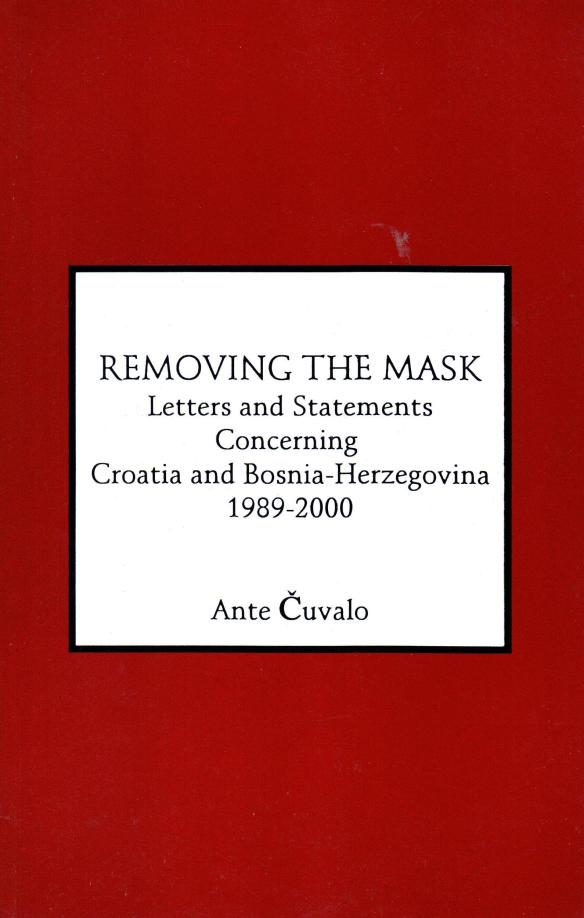 This book consists of a collection of letters and political memoranda which Ante Čuvalo wrote over more than a decade in connection with events in Croatia and Bosnia-Herzegovina. Čuvalo is easily one of the most active Croatian-American academics, and this anthology highlights his remarkable energy and ability to apply his scholarly skills to the practical arena of policy. Beginning with a salvo in reply to an article by Serb intellectual Momčilo Selić in 1989, Čuvalo wrote letters to newspapers and magazines in response to news reports or opinion pieces which he felt presented misleading or downright biased positions. In doing so, Čuvalo crossed words with such personages a David Binder, Srdja Trifković, Bogdan Denitch, Robert Hayden, and Helen Delich Bentley. Many of his letters were published in such newspapers as The New York Times, The Chicago Tribune, The International Herald Tribune, and the Cleveland Plain Dealer. Even those of his letters to the press which were not published often elicited responses from the editors (which are also published here), and his efforts probably had at least some effect in changing how the news was covered.
In addition, Čuvalo sent other letters, also published here, to prominent public figures with the intent of providing criticisms or suggestions, including to Presidents George Bush and Bill Clinton, their Secretaries of State, Lady Margaret Thatcher, Ambassador Richard Holbrook, the Secretary-General of the United Nations, and to numerous U.S. Senators and Congressmen. Often, Čuvalo would send along an analysis of political events when writing to policymakers, as well as copies of his Historical Dictionary of Bosnia-Herzegovina, and often received replies thanking him for his think-pieces.
There are also letters with Čuvalo sent to publishers of new educational textbooks and maps, seeking to correct traditional and new errors which recent reference works, if left unchallenged, would only reinforce. Particularly interesting is an exchange between Čuvalo and the organizers of a roundtable discussion at DePaul University in 1992, with Čuvalo focusing on the background and views of one of the sponsors, Bogdan Denitch, and the questionable framework for the proposed roundtable. This elicited a heated response from the sponsors which, as much as anything, probably characterized the extreme and rather naïve outlook of this apparently ephemeral group called “DiYUlog for Peace” (pp. 77-80).
There was probably no one as active in letter-writing on behalf of the Croatian cause during this period, something which must have required a significant amount of time and effort.
The themes in the letters reflect the topical issues over the span of a decade, beginning with the need to clarify to foreign observers the reasons for an implications of the impending and then actual disintegration of Yugoslavia, followed by the need to elicit action by the International Community (an specifically the United States) in dealing with the onslaught of Serb military actions in Croatia and Bosnia-Herzegovina, and ending with the need to craft and support a viable post-war solution. Future historians one day may well use such letters to gain an understanding of how the various diasporas in the United States reacted to events in the former Yugoslavia, and Čuvalo’ anthology provides what may turn out to be one of the richest samplers of such primary material. In the meantime, this book provides a very readable and personal overview of one Diaspora intellectual’s perspectives and activities during an entire decade of momentous change in the region, as well as valuable insights into the views of other opinion-makers and policymakers, who engaged Čuvalo either in agreement or disagreement. In many ways, Čuvalo has set the standard for making available his correspondence to the public, and hopefully others will follow suit.
NORMAN CIGAR
US Marine Corps Command & Staff College
POVIJEST KOJA (JOŠ) TRAJE
Malo se tko spasio iz tamnica u Ljubuškom
Traženje istine nije osveta nego pravo žrtava na dostojanstvo
Piše: dr. Ante Čuvalo

Ljubuške tamnice i grobišta (priredio Anđelko Zlopaša)
Prošla su desetljeća od kraja Drugog svjetskog rata, pali su komunistički totalitarni režimi, raspale se umjetne državne tvorevine, prohujao i odnio živote još jedan rat, donesena je Rezolucija o europskoj savjesti i totalitarizmu (2. travnja 2009.) kojom su osuđeni zločini protiv čovječanstva, ali kod Hrvata (ali i nekih drugih) još uvijek je nedovršena kobna dionica nedavne povijesti. Premda zamagljena, ona je prisutna, ona ne zacjeljuje rane i ne podučava mlađe, nego kao ružna mora muči (još poneke živuće) progonjene i progonitelje, pa i njihove potomke. Kosti ubijenih leže u masovnim grobištima, a za mnoge ne znamo jesu li uopće i pokopani. Grobišta za koja znamo još su (uglavnom) neistražena. Državne vlasti u BiH, kao i u Hrvatskoj, žele te naše drage pokojne i dalje ostaviti iza komunističke dimne zavjese koja nas još obavija i svakodnevno udišemo zrak koji su ta ideologija i njezini talibani zagadili. Misle valjda da će pobijeni i mučeni pasti u zaborav, kao i mučitelji i posljedice njihove ideologije. Ali ljudska memorija je čudna; sve ostaje, ništa se ne briše. I kroz donedavno olovna vremena ljudi su očuvali sjećanja na stratišta i grobišta, mjesta gdje su naši očevi, djedovi, braća, stričevi i rođaci bez suda i presude pobijeni i leže čekajući da istina o njihovoj nepravednoj smrti ugleda svjetlo dana.
Vodstvo Općine Ljubuški, da bi poduzelo istraživanje ratnih i poratnih žrtava na svom području, 29. prosinca 2009. ustrojilo je Povjerenstvo za obilježavanje i uređivanje grobišta iz Drugog svjetskog rata i poraća na području općine Ljubuški. Članovi Povjerenstva su Vice Nižić (predsjednik Općinskog vijeća) – predsjednik, te članovi Nevenko Barbarić (načelnik Općine), mr. fra Miljenko Stojić, fra Ante Marić, dr. Ante Čuvalo, Gojko Grbavac (šef imovinsko-pravne službe), prof. Drago Grgić, Ivan Herceg (pomoćnik načelnika) i prof. Ante Paponja.
Uz Nevenka Barbarića i Vicu Nižića, dvojicu vodećih osoba Općine, posebice je važna uloga fra Miljenka Stojića, vicepostulatora postupka mučeništva »Fra Leo Petrović i 65 subraće«. Premda je njegova službena dužnost pronalaziti, iskopavati i istraživati okolnosti poginule mu subraće tijekom i poslije Drugog svjetskog rata, svojim znanjem, iskustvom i poletom on predvodi i ovaj tužni, ali neprocjenjiv posao.
Grobište Tomića njiva
Na području općine Ljubuški ima veći broj stratišta i grobišta. U samom gradu zna se za nekoliko lokaliteta. Prvo iskapanje obavljeno je na lokalitetu Tomića njiva, koji se nalazi nedaleko od OŠ Marka Marulića, danas u okružju lijepih obiteljskih kuća. Radovi su trajali od 19. do 28. srpnja 2010. Stručni dio posla predvodili su prof. mr. sc. Tihomir Glavaš te forenzičarka prof. dr. sc. Marija Definis-Gojanović. Iskopavanje su izvodili ljudi iz Javnog komunalnog poduzeća Ljubuški uz stalnu fra Miljenkovu nazočnost, kao i čestu nazočnost vodećih ljudi iz vodstva općine.

Bili su to vrući ljetni dani, ali radilo se zdušno i prije i poslije radnog vremena. Svatko je želio da se posao odradi dobro i u što kraćem vremenu. Kroz sve te dane dolazili su članovi obitelji onih za koje se zna ili se misli da su tu ubijeni. Dolazili su mnogi fratri iz samostana na Humcu, okolnih župa i iz daljeg, jer se zna da u tom grobištu leže posmrtni ostatci i (najmanje) dvojice fratara. Jedan od njih je vjerojatno fra Slobodan Lončar, a drugi bi mogao biti ili fra Paško Martinac ili fra Martin Sopta, ili sva trojica. Saznat će se tko je pokopan u ovom grobištu, kao i drugima, kad stručnjaci naprave DNK analizu posmrtnih ostataka pobijenih.
Dolazili su ljudi iz političkog života i sredstava javnog priopćavanja koja su svakodnevno izvješćivala o rezultatima rada. Više posjetitelja donosilo je vodu i sokove da ublaže žeđ i vrućinu onima koji rade, a neki bi došli i s velikim pijetetom gledali hrpu kostiju i probali shvatiti osjećaje tih ljudi u trenutku kad su ovdje gledali smrti u oči, a vjerujem da su poneki pokušali barem donekle dokučiti dubinu mržnje onih koji su naredili i izvršili to i takva zlodjela. Radilo se to u ime komunizma i pod znakom crvene petokrake za koju nedavno reče nitko manje nego predsjednik Hrvatske da je ona »simbol ljubavi i mira«! Kakve li perverzije! Ovo grobište, kao i druga te vrste, prava su slika te ideologije i simbola ne ljubavi nego mržnje prema svima i svemu što nije bilo ideološki podobno.
Grobište na Tomića njivi nalazi se unutar jednog škripa, a po svemu izgleda da su ga prije pogibije kopali sami pogubljenici. Veličina mu je 5,10 x 4,18 x 2,54 m. U tom je prostoru pronađeno 26 cijelih tijela i 2 djelomična kostura. Ta dva tijela zacijelo su bila slabo zakopana te su im gornji dio raznijele životinje. Netko je to morao zamijetiti te je, srećom, nabacio zemlju na ono što je preostalo pa su ipak očuvani donji dijelovi njihovih tjelesa. Slaže se to s pričom svjedoka koji je kao dječak vidio ruku u fratarskom habitu koja, kao ruka pravde, viri iz zemlje. Također je vidio i ptice kako kljucaju lubanju jednog od ubijenih. Oko šaka i mišica tih naših nevino pobijenih pronađeni su ostatci telefonske žice kojom su očito bili vezani. Jedan je bio vezan oko vrata, a drugome su vezane i noge. Možemo samo nagađati zašto su ih baš tako vezali. Ubijani su na rubu jame i u nju gurnuti. Nekima, dok su bili okrenuti licem prema jami, pucali su u zatiljak pa su naglavačke pali na hrpu već mrtvih ili umirućih žrtava. Njihove suhe kosti i danas punim glasom govore o tim strašnim trenutcima.
Među hrpom kostiju nađeni su razni predmeti: dijelovi krunica, češalj, naočale, okviri za naočale, nožić, puce, ostatci rukavica na rukama dva tijela, kopče na remenu, ostatci obuće i odjeće, krojačke škare, pribor za pušenje, gumeni potplati za opanke. Među svim tim predmetima, uz ostatke telefonske žice, ponajviše je čahura i naboja. Ubojice nisu žalili streljiva! Sve te osobne stvari svjedoče o stvarnim ljudima, s imenom i prezimenom, o njihovu životu i zvanju. Također, žica, naboji i čahure dovoljno, i previše, govore o onima koji su ih ubijali.
Grobište Bare
 Ovo se grobište nalazi iznad starog komunalnog, istočno od nekadašnje duhanske stanice i nedaleko od današnjeg autobusnog kolodvora. Radovi na pronalaženju i otkopavanju ovog masovnog grobišta otpočeli su 27. rujna 2010. Trebalo je očistiti teren veličine 43 x 28 metra te skinuti asfaltni sloj. Tek se tada moglo početi s otkopavanjem. Jesenske kiše počesto su ometale rad te iskopavanje nije teklo ni blizu onako brzo kao na »Tomića njivi«. No, nije se posustajalo. Iskopano je mnoštvo probnih rupa dok se konačno nije došlo do grobišta koje se nalazi samo 5-6 metara istočno od bunara koji je pravljen za vrijeme austro-ugarske vlasti u ovoj zemlji. Meni, nestručnjaku za bunare i vodu, izgleda da se u ovaj bunar sabire podzemna voda koja ispod brda kroz propusni teren uvijek pomalo teče, a otud se kroz cijev, ili kanalić, prirodnim padom prelijevala u česmu Gujista. Kako nam natpis na česmi svjedoči, ona je napravljena 1900. i nalazi se uz cestu nedaleko od bunara. Ako je to tako, onda počinitelji zločina nisu marili ni za zdravlje živih jer su pokopali ljude u neposrednoj blizini bunara iz kojeg se pila voda.
Tek nakon dva tjedna rada i iščekivanja, 12. listopada 2010., pronađeni su ostatci devet ubijenih osoba. Za neke se žrtve znaju imena, kao i za imena nekih ubijenih na Tomića njivi, ali se sa sigurnošću ne može ništa tvrditi dok stručnjaci ne završe svoj dio posla. I na ovom stratištu ljudi su pobijeni na sličan način kao i na Tomića njivi. Poslije strijeljanja bačeni su na hrpu u postojeći cik-cak rov koji je iskopan za Drugog svjetskog rata. Kosturi su isprepleteni žicom kojom su mučenici bili vezani, a čahura i naboja i ovdje ima napretek. U ovom grobištu nije nađeno puno predmeta. Tu su kutija za duhan, ogledalo, puce. Forenzičarki prof. dr. sc. Mariji Definis-Gojanović prilikom vađenja tijela pridružio se asistent Pero Bubalo. Oni su došli kao stručna pomoć arheologu prof. mr. sc. Tihomiru Glavašu koji je vodio radove.
Dok ovo pišem, iskopavanje na lokalitetu Bare još nije dovršeno. Ako budu povoljne vremenske prilike, možda sve bude gotovo do izlaska ovog broja Stopama pobijenih. Misli se da je ovdje ubijeno i zakopano još ljudi. Nitko nije siguran u broj pobijenih i točno mjesto zakopavanja. Uglavnom se govori o 4-5 mjesta na kojima su ubijani i zatrpavani. Istraživat će se dok ne bude procijenjeno da je učinjeno sve što se, ljudski govoreći, moglo učiniti da bi se pronašli ostatci komunističkih žrtava pobijenih na ovom lokalitetu. Dakle, radovi na ovom i drugim ljubuškim grobištima nastavljaju se.
Svjedoci i usmena predaja
Općinsko povjerenstvo već je od početka njegova ustrojstva molilo, i dalje moli, sve one koji su bili svjedoci, ili su od svojih najbližih čuli o stratištima i grobištima iz Drugog svjetskog rata i poraća na području ove općine, da se jave bilo kojem članu Povjerenstva i daju svoj iskaz, a anonimnost im je, ako tako žele, zajamčena. To je građanska i moralna dužnost svakog od nas. Nadamo se da će Povjerenstvo, odnosno općina, ustrojiti i posebnu sekciju Povjerenstva za prikupljanje i obradu svih prikupljenih svjedočenja da bi se mogla dobiti što potpunija slika o svemu što se dogodilo tijekom tog kobnog vremena iz naše ne tako davne povijesti.
Žiro-račun
Nakon iskopavanja, posmrtni ostatci pobijenih pojedinačno su odloženi u kutije te će se u limenim sanducima poslati Sveučilišnoj kliničkoj bolnici Mostar gdje će se DNK analizom obaviti identifikacija. Kako rekosmo, taj proces predvodi prof. dr. sc. Marija Definis-Gojanović. Za sve ove radove, posebice za identifikaciju, trebat će velika novčana sredstva. U tu svrhu Povjerenstvo, uz potporu vicepostulature i vicepostulatora fra Miljenka Stojića koji je njegov član, obraća se za pomoć svima koji su u mogućnosti pomoći ovaj human i povijesno važan pothvat. Radi toga je, u sklopu općinskog žiro-računa kod UniCredit banke – poslovnica Ljubuški, otvoren račun za troškove iskopavanja i identificiranja pronađenih posmrtnih ostataka i onih koji će zacijelo još biti pronađeni. Broj računa je 3381602276734328. Svaki i najmanji prilog dobro je došao na čemu unaprijed zahvaljujemo.
Zločin i pravda
Dužnost Povjerenstva je pronaći, istražiti, obilježiti i urediti stratišta i grobišta iz Drugog svjetskog rata i poraća na području općine Ljubuški. Zakonska istraga vezana za počinitelje ovih i sličnih zločina te pokretanje pravnog procesa kojim bi se došlo do saznanja o naredbodavcima i izvršiteljima ovih zlodjela, te eventualno kažnjavanje onih koji su još živi, nije u nadležnosti općinskog povjerenstva nego pravne države. Za vrijeme iskopavanja na Tomića njivi dva tehničara iz županijskog MUP-a Zapadnohercegovačke županije obavila su svoj dio stručnog posla. Je li to znak da će pravosuđe ove županije i države ipak pokrenuti pravni proces protiv poznatih i nepoznatih počinitelja zlodjela? Nadajmo se!
Moralo bi svima biti jasno da ovdje nije riječ o traženju osvete i o nečijem zatvaranju i progonu nego o želji da se sazna povijesna istina, da naši mrtvi ne ostanu prešućeni, da ih se pokopa na dostojanstven način i da im se oda dužno poštovanje. Ako se to napravi, bit će lakše djeci i rodbini pobijenih. Bit će mirniji i oni koji su doprinijeli i sudjelovali u ovim zločinima. Traži se samo da istina već jednom ugleda svjetlo dana, a istina oslobađa. Oslobađa sve! Na taj ćemo način i mi kao društvo i kao narod, kao hrvatski narod, konačno moći zatvoriti to žalosno poglavlje svoje povijesti.
Objavljeno u Stopama pobijenih – Glasilo Vicepostulature postupka mučeništva „Fra Leo Petrović i 65 subraće. Godina IV., broj 1 (6), siječanj-lipanj 2011. st. 13-15.
Jerome Alexis Brentar (1922 – 2006)
 Jerome Alexis Brentar died unexpectedly on December 1, 2006 in Cleveland. He was a well respected humanitarian known for his good deeds in Croatian communities throughout the world. He was born on July 17, 1922 in Cleveland to Croatian parents who came to the United States in 1899 from Klana, Istria. During WW II he served with the 93rd Armored Cavalry under the command of General William Patton. After the war ended the young man of 24 years criss-crossed Europe and what he saw made a deep and lasting impression on him. Destroyed cities, columns of refugees and homeless people, refugee camps full of hunger and hopelessness caused him to decide to study sociology and to spend his life as social worker.
It is a well known fact that Jerry emptied Austrian refugee camps of Croatian widows with their young children, whom no country was willing to accept. Not only did he bring them to the U.S. but he also found organizations and individuals who were ready to help them. Later on when I received political asylum and moved to Munich to work for the NCWC. There I had ample opportunities to observe Jerry’s work on the entire territory of West Germany and Austria, including all the refugee camps. He helped thousands of Croatians, Muslims, Slovenians and others. His name became legendary. Not only did he help those who wanted to emigrate, but he also helped those who stayed in Europe. Jerry’s home was always open to immigrants who came to the U.S. He helped them find jobs, apartments, or even temporary overnight stay. After returning from Europe Brentar founded The Europa Travel Service, which it made possible for him to continue his humanitarian work in Croatian communities in Ohio and the rest of the country. He was a member of countless Croatian organizations, among them the American Croatian Academic Society, for which he also served as president. Brentar is survived by his spouse Dora, his three daughters Carolyn, Mary Ann and Dora, his son John, four grandchildren and three brothers. Jerome Brentar, a deeply religious man, leaves a legacy of compassion for his fellow man. And will always be remembered for his strong commitment to a free Croatia. His friends and Croatian communities throughout the U.S. will dearly miss him.
J. Bombelles
Theodore Božidar Ivanuš (1916-2007)
Professor Emeritus of the University of Notre Dame, a member of the ACS, and well-known Croatian American, Theodore B. Ivanuš, died on December 18, 2007 in South Bend, Indiana.
 Theodore was born on March 15, 1916 in Velika Gorica, near Zagreb, into a well-known Croatian family. In 1934, he graduated form the First Classical Gymnasium in Zagreb. In 1941, he earned a doctorate in Law and also in Political Science. He was one of the leading student activists at the end of the 1930s and the President of the Students’ Club of the School of Law. Theodore also earned an M.A. degree at the State Academy of Music in Zagreb and was an accomplished piano player.
During and after World War II, Theodore lived in Austria and Germany, and he came to the United State in 1952. He, along with a number of other Croatian post-war immigrants, settled in Cleveland. While working in various factories as a physical worker, he enrolled at the Case Western University in Cleveland and in 1956 he earned an M.A. in political science and, in 1963, an M.L.S. in the library science. At the same time, he was an active member of the local Croatian community. He took an active part in establishing the Croatian Academic Club, Croatian radio program, and other cultural endeavors.
In 1963, Theodore joined the Department of Government and International Studies at the University of Notre Dame. He was also with the Institute for International Studies and the Memorial Library. He taught courses on Government and Politics of East Central Europe, the former Soviet Union and International Communism. Theodore was instrumental in developing the International Resources Center and contributed greatly to the growth of International Studies at the ND University. He was also involved in the local Croatian community and, among other activities, Theodore was a director and conductor of the Croatian Glee Club “Preradović” in Gary, Indiana.
Before his death, Theodore donated his rich library and archives to the Institute of Croatian History in Zagreb, Memorial Library at the University of ND, and the Croatian Ethnic Institute in Chicago.
Dr. Ivanuš married in 1970. However his wife Anne, an American Croatian, preceded him in death. He was a member of the Croatian Academy of America, the Croatian American Association, AAASS, the Association for Croatian Studies, and other cultural and professional clubs. We thank Theodore for being a friend and active member of the ACS.
Ante Čuvalo
ASSOCIATION FOR CROATIAN STUDIES (ACS)
30TH ANNIVERSARY
Founding
On October 15, 1977, a small number of Croatian scholars in America, gathered at the Annual Convention of the American Association for the Advancement of Slavic Studies (AAASS) at Capital Hilton Hotel, Washington D.C., and laid the foundation to the Association for Croatian Studies. The idea for such organization was circulated among Croatian scholars participating at the AAASS Convention in Atlanta a year earlier, but someone had to take the initiative and do the work.
For those who are not familiar with the American Association for the Advancement of Slavic Studies, suffice to say that the AAASS was established in 1948 and it is a leading private organization dedicated to the advancement of knowledge about Russia, Central Eurasia, and East and Central Europe. It publishes the quarterly Slavic Review, the leading journal in Slavic studies.
The provisional name of the new Croatian scholarly organization was “Society for Croatian Studies.” Its first officers were: Dr. Joseph T. Bombelles, President; Dr. George J. Prpić, Secretary-Treasurer, Dr. Ante Kadić and Dr. Francis H. Eterović, Vice Presidents. Drs. Bombelles and Prpić were entrusted to affiliate the Society with the AAASS and to register the organization in the State of Ohio as a scholarly not-for-profit society.
On November 27, 1977, during the Twelfth Annual Seminar of the American Croatian Academic Society at Case-Western Reserve University in Cleveland, the name of the newly formed “Society for Croatian Studies” was changed to “Association for Croatian Studies” (ACS).
At the beginning of 1978, a proposed Constitution and By-Laws of the ACS were submitted to the membership for approval and a request was sent, with the necessary documentation, to the AAASS for acceptance as an affiliate scholarly society. At the same time, Dr. Prpić issued the first ACS official bulletin, called the “Announcement.”
The affiliation process was not so easy as one might assume. Actually, the AAASS officials at the time implemented delaying tactics, in order to dampen the desires of Croatian scholars to affiliate their organization with the AAASS. We can probably guess what might have been the reasons for not welcoming the ACS to this large association of Slavic scholars, but we have to move on, just as the ACS officers at the time did. They persisted, and the Association was officially affiliated with the AAASS in October of 1978, and the ACS was allotted an official panel session for that year’s National Convention in Columbus, Ohio.
The ACS’ first panel was entitled “Croatia and the Croatians in the 1970s”. The participants were : Dr. Joseph Bombelles, Chair; Prof. Mirko Vidović (France), Dr. Ante Kadic, Dr. George J. Prpic, Presenters, and Dr. Thomas F. Magner was a discussant. Dr. Prpić later reported: “The meeting was attended by more than sixty people of whom about a dozen were American Croatians.” A day later (October 13), the Provisional Executive Committee of the ACS was elected to serve a year term and the Constitution and By-Laws were unanimously accepted, under the condition that they may be revised, if necessary, in order to make them acceptable to the AAASS and the State of Ohio.
The Association was incorporated in the State of Ohio on June 8, 1983, and on November 14, 1984, the ACS became “exempt from Federal income tax under Section 501 9c) (3) of the Internal Revenue Code.” In December of the same year the name of the ACS’ official publication was changed from Announcement to the Bulletin of the ACS.
Purpose and Activities
The main purpose of the Association for Croatian Studies, as defined in its Constitution, is “to foster closer communication among scholars interested in Croatian Studies” and to “promote the dissemination of scholarly information on Croatia and Croatians through the organization of meetings, conferences, and panels at conventions devoted to Slavic and East European Studies.” Its particular and most important mission, however, is to organize scholarly panels at the AAASS National Conventions dealing with Croatian issues. Furthermore, the ACS encourages its members to organize and/or participate in scholarly panels that foster comparative studies with other affiliates of the AAASS and scholars from other countries and backgrounds. It also promotes scholarly activities and cooperation among its members, especially the younger scholars. Moreover, the Association often serves as a resource hub where various scholars and institution turn for assistance and information dealing with Croatian subjects and issues.
The ACS Bulletin, besides informing the members of AAASS convention activities, brings news about the association and its members, and it often publishes relevant articles and/or book reviews. It frequently includes selective bibliography of new titles and Ph dissertations dealing with Croatia and the Croatians. For this reason, a number of academic libraries receive the Bulletin, and it has been included in some bibliographies as a resource publication.
The ACS founders have established a wonderful tradition, according to which during every AAASSS convention ACS members, their friends, and individuals from the local Croatian community, get together for a “Croatian Dinner.” We all look forward to this annual event in order to meet new scholars and friends, and to renew old friendships and acquaintances. It is in such gatherings that quite often new ideas for work and cooperation are born. We are pleased to announce, that this year’s “Croatian Dinner” will be at the famous Drago’s Seafood Restaurant, in the Hilton Hotel, New Orleans. It will be Croatian style and hospitality with New Orleans flavor! In 1986, the ACS enjoyed its “Croatian Dinner” at Drago’s restaurant, but at that time it was at the original location in the city’s suburbia. This year, it will be at the downtown Hilton hotel.
Panels
Since its inception, the ACS and its members have organized numerous panels dealing with a wide range of topics. Just to mention a few: Renaissance in Croatia, Marko Marulić, Faust Vrančić, Ivan Gundulić, Bartol Kašić, Rudjer Bošković, Juraj Križanić, Illyrian Movement, Kačić Miošić, Ivan Mažuranić, Krleža, Budak, Ujević, Film, History of Music, Theater, Croatian Dissent in the 1960s and 1970s, History of Dubrovnik, Croatian Language, Economic issues, Croatians in America, Croatian History, Vojna Krajina, Radić Brothers and HSS, Croatian Nationalism, Jews in Croatia, Religion, US Foreign Policy and Croatia, Croatians in Bosnia and Herzegovina, Independence and War of Liberation, Regionalism in Croatia, International War Crimes Tribunal, Dayton Accords, BiH Constitution, Geography, Politics, Ideologies, Croatia and European Integration, and many other topics. The list of participants at ACS panels is very long. It includes almost all Croatian scholars in the West, and also many non-Croatians who study Croatia or the region. Many of such scholars are also members of the ACS, and some of them have served or are serving as officers of the association.
Looking back at the three decades of ACS activities, one might divide the life and work of the association into three main periods. First, from its beginnings to 1989. This was the era of the Cold war. The AAASS was seen by the East as an instrument of Western interests and, as they would put it, scholarly propaganda. The ACS was seen in a similar, but worse light not only by the Yugoslav regime but also by Yugoslav sympathizers among American scholars. Furthermore, it was not permissible for scholars from Croatia to participate on ACS panels or Croatian scholarly institutions to be in touch with the Association. For example, the late Ivan Supek came to the 1987 Convention to participate on a panel about Ruger Bosković, but he was told by the regime’s officials he better stay away. He was actually in the convention hotel while his paper was read by an American Croatian colleague. This might sound bizarre today, but it happened not so long ago!
The second period began in 1989. For the first time scholars from Croatia began to participate at the ACS activities and panels. The guests from Croatia at the Chicago convention of that year were: Ivan Supek, Franjo Tudjman, Dalibor Brozović, Ivo Smoljan, and Vladimir Konšćak. The Iron Curtain was cracking and the dawn of freedom was on the rise. However, the early 1990s brought not only freedom but, unfortunately, also war to Croatia and Bosnia and Herzegovina. During the war years, the ACS and its members in their panels and presentations made an effort to clarify the causes and issues dealing with the wars of aggression, that most often, intentionally or not, were portrayed even in scholarly circles and by “experts” in a twisted light.
During the post-1995 era, scholarly activities of the ACS and its members have been oriented toward a variety of subjects and scholarly interests. In the last few years there is an increase of interest in Croatian studies among young scholars who are not of Croatian ethnic background. The ACS encourages such scholars to join the association, as well as those of Croatian heritage, so that in cooperation with each other we may contribute to the understanding of the Croatian past and present.
Although there are no more political, ideological or other barriers that might prevent cooperation of the ACS with cultural and scholarly institutions in Croatia, the bridges between the ACS and the homeland are not as strong as they could and should be. It seems to us that the homeland institutions, and (too) many scholars, don’t realize the importance of participating in scholarly activities on this side of the ocean. There has been an improvement, but both sides must cooperate in order to advance knowledge and understanding of our Croatian heritage and culture.
Anniversary
Thirty years have passed, and, one might say, passed too fast. But a lot has been accomplished, thanks to the ACS founders and members, living and those who have passed away. At the present, the ACS is healthy, doing well, and it is fulfilling its mission as defined by its Constitution. A good indicator that it “promotes and disseminates scholarly information on Croatia and Croatians,” are a number of panels and lectures that are on the program of this year’s AAASS National Convention in New Orleans. As long as there is Croatia and the Croatians there will be an interest and need to study the country and the people. The ACS’ mission, therefore, continues. We hope and believe that the younger scholars of Croatian and non-Croatian heritage will have interest, will, and stamina to carry on and build on the foundations that were laid thirty years ago, and keep the ACS young forever.
Ante Čuvalo
Executive officers
The following have served as executive officers of the ACS:
Presidents:
Joseph T. Bombelles
Joseph Čondić
Ivo Banac
Ante Čuvalo
Secretaries:
George J. Prpić
Elinor M. Despalatović
Paula Lytle
Ante Čuvalo
Ivan Runac
Treasurers:
George Prpić
Tia Paušić
Sarah Kent
Ellen Elias Bursać
Aida Vidan
At the present (2007), the ACS officers are:
Ante Čuvalo – President (cuv@gmail.com)
Jasna Meyer – Vice-President (jmeyer@mcdaniel.edu)
Ivan Runac – Secretary (ivan.runac@gmail.com
Aida Vidan – Treasurer (avidan@fas.harvard.edu)
 Ante Čuvalo