Josip Jelačić – Ban of Croatia

JOSIP JELAČIĆ – BAN OF CROATIA

Ante Čuvalo – Chicago

(Published in: Review of Croatian History, IV. no. 1, 2008, pp. 13-27)

This year (2008) marks the 160th anniversary of the 1848 revolution in which Ban Jelačić played a significant role. The short survey of Jelačić’s life that follows is written mainly for young Croatians around the world so that they may have a better understanding of Jelačić, the times in which he lived, and Croatian history in general.

Introduction

In 1848, a revolutionary wave swept across Europe, except in England and Russia. In England, the revolutionary pressures were deflated by reforms; in Russia, no action could be undertaken because of the cruelty of the tsarist regime.

A mix of severe economic crisis, romanticism, socialism, nationalism, liberalism, raw capitalism, growing power of the middle class, the misery of the workers and peasants (that still included the serfdom), the slipping power of the nobility and, in some countries, royal authoritarianism bordering with absolutism, created a volatile blend that brought about the Year of Revolution! The prelude to the 1848 events began among the Poles in Galicia in 1846, a civil war in Switzerland in 1847, and an uprising in Naples in January of 1848. However, in February 1848 the French ignited a fire that spread rapidly across the continent.

In the Austrian Empire liberals demanded a written constitution, which meant a quest for greater civil liberties by curbing the power of the Habsburg regime. When such attempts failed, popular revolts ensued, especially among the students and urban workers. At the beginning there was an alliance of students, middle-class liberals, workers, and even peasants. Under such pressure, the monarchy gave in to the demands and ultimately collapsed. But because of disunity among the revolutionaries, the traditional forces and the military establishment regained courage and strength, and in the end crushed the revolution.

The Hungarians were at the forefront of the revolution in the Habsburg Empire and in March 1848 promulgated a liberal constitution in their part of the monarchy. However, what Hungarians demanded for themselves they were not willing to give to non-Hungarians. Namely, they stood firmly for a unitary Hungary in which Croatians and other non-Hungarians would not have political and cultural rights. It should be remembered that Croatia was a separate kingdom united with Hungary under the crown of St. Stephen, and not a Hungarian province. But Hungarian imperialists, including Lajos Kossuth, the key man of the revolution, were liberals only for themselves. Because of their narrow-mindedness the Hungarians pushed the revolution over the edge and turned it into a disaster for themselves and others.

***

Revolutions bring out an array of forces and passions and produce both heroes and villains. Depending on the perceptions, interests, and judgments of the observer. One example of such a revolutionary is Josip Jelačić, Ban of Croatia. To the Croatians, and to other Slavs in the empire, he was a hero, as he was to the supporters of the Habsburg monarchy. To the Hungarians and other anti-Habsburg forces, Jelačić was a villain. He fought the Hungarians to get more independence for his native Croatia. He also championed national and individual rights of Slavs to be equal with those of Hungarians and Germans within the empire. Thus, his goals were progressive and noble. But by fighting the Hungarians and revolutionaries in Vienna he supported the Habsburgs, whom he saw as the lesser of two evils. Because the Hungarian revolutionaries were portrayed as liberals and had the sympathy of the West, Jelačić was depicted as a reactionary. But the same pro-Hungarian forces outside the empire did not want to see the sinister side of Lajos Kossuth and his bogus liberalism.

Josip Jelačić Before 1848

Ban Jelačić came from a family deeply rooted in the Habsburg military tradition. For two hundred years it had given officers to the empire, especially to the Military Frontier region in Croatia. He was the oldest son of Baron Franjo Jelačić Bužimski, a Field-Marshal,1 who distinguished himself in the war against Napoleon.2 His mother was Anna Portner von Höflein.

Josip was born on October 16, 1801 in the fortress of Petrovaradin, which was one of the well-known forts in the long struggle against the Turks. Military spirit and smell of gunpowder were a part of Josip’s life from the time of his birth; it was no wonder then that he kept the family tradition and became an officer.

As an eight-year-old boy Josip had the honor of being presented to Emperor Francis I, who recommended he be accepted at the Theresianum in Vienna. Shortly after his father’s death in 1810, Josip entered the famous Theresianum, where new military and administrative personnel of the empire were trained.

Jelačić was an excellent student with a variety of talents. Because of his eloquence his teachers advised him to become a lawyer, but he preferred being a soldier.3 Besides Croatian, he spoke German, Italian, French, and Magyar.4 In 1819, he graduated from the academy with honors, and as a Sub-Lieutenant he was sent to Galicia. Jelačić was loved by his peers, respected by his soldiers, and recognized as an excellent officer by his superiors. He loved army life and it seems that he fascinated everyone around him. His vigor, exuberance, good temper, wit, bravery, and even his talent for poetry brought him fame, good fellowship and popularity in the military circles.5

Jelačić’s joyous and carefree military spirit was interrupted, however, by a sudden and serious illness in 1824. For a year he recuperated at his mother’s house in Turopolje, near Zagreb. During that year he wrote a book of poems, which was published in 1825 and reissued in 1851. Suffering added to the depth of his character without affecting his vigor and love of life.

In 1825, Jelačić returned to his friends and comrades in arms, who were at this time in Vienna. He was again “the beginning, middle, and end of all proceedings” among his peers.6 After a short stay in Vienna, he was sent again to Galicia. In 1830, he became a Lieutenant Captain in the Ogulin regiment at the Croatian Military Frontier, where he was stationed. One year later he and his regiment were in Italy, where he served under the renowned General John Joseph W. Radetzky. About Jelačić the General once stated: “I expect the best of him; never yet have I had a more excellent officer.”7 After his return from Italy in 1835, Jelačić stayed permanently in Croatia. In 1837, he became a Major and was assigned as adjutant to the military Governor of Dalmatia, where he gained much valuable administrative experience and also had a chance to learn more about his native land and its people. Four years later he became a Colonel and returned to the Frontier troops.

At the Frontier territory, Jelačić had military and administrative responsibilities. In both areas he became not only very efficient but also popular. With his soldiers he was fair, and he cared for their well being. He even abolished corporal punishment. As an administrator, he would hear complaints of the local people and proved to be a fair arbitrator. He was well-known in the villages, attending various community gatherings and celebrations, including dancing the kolo (circle dance) at weddings.8 Such demeanor contributed to his fame among the soldiers and civilians.

A German officer in the Habsburg armed forces, who served under Jelačić in 1848, gives the following personal and vivid account of Jelačić:

The impression which this distinguished officer made upon me at the very first moment was most prepossessing; and it has since become stronger and stronger, the more I have had occasion to observe him in all the situations of life—in battle, and in cheerful society. He is an extraordinary man; and Austria may deem herself fortunate in possessing him and Radetzky precisely at the same moment.

Jellachich is of the middling height and size. His bearing is upright and truly military; his gait quick, as indeed are all his motions. His face, of a somewhat brownish tinge, has in it something free, winning, and yet determined. The high forehead, under the smooth black hair, is very striking. The eyes are large, hazel, and full of expression. In general, there is something extremely calm and gentle in their glance; but, when the Ban is excited, they flash, and have so stern—nay, so wild—a look as to curb even the most daring fellows. At the same time he is the mildest and kindest of officers. When but captain, he had almost entirely abolished blows in his company; and, while commanding the second Banat regiment as Colonel, there were not so many punishments in it in a year as there were formerly in a month.

Here is just one instance of the care which the Ban takes of his men. Last winter, when he was still Colonel, Lieutenant Field-marshal D——, Who commanded on the frontier, fixed a certain hour for inspecting the regiment. There was a piercing frost, and the soldiers shook with cold; but the Lieutenant Filed-marshal sat enjoying himself over his bottle at the tavern, leaving the regiment exposed to the cutting wind on the parade, to be frozen or petrified, for what he cared.

Jellachich waited nearly an hour beyond the appointment time; and the General not yet making his appearance, he ordered the regiment to disperse quietly. No sooner had it obeyed, than the General appeared upon the ground; but it was then too late, and the inspection could not take place.

This affair is said to have produced a great sensation, and, when reported to Vienna, to have been entered in the black book. But March has expunged this, like many other matters; and the Ban was in a few weeks promoted from Colonel to Lieutenant Field-marshal. The whole army, some antiquated nobs perhaps excepted, rejoiced at it. But this was nothing to the rejoicing with which, on the appointment of Jellachich to the office of Ban, he was received in Croatian and Slavonia, and which is said to have defied description.

Never was general more beloved by his troops. Wherever he shows himself in a military village, all—old and young, little boys and aged men, ay, and pretty girls, too—all rush out to see him, to shake hands with him, and to greet him with one Zivio! [Long live!] after another. In battle, after the most fatiguing march; in bivouac, exposed to pouring rain; wherever and whenever the border-soldier espies his Ban, he joyously shouts his Zivio! and for the moment, bullets, hunger, weariness, and bad weather, are nothing at all to him.

The scene that I witnessed when the Ottochans, who had been with me in Peschiera, and who arrived a few days after me in Croatia, were reviewed by the Ban, I shall never forget. Old border-soldiers—who had often braved death, and not flinched when the bombs at Peschiera fell in their ranks—wept for joy, when Jellachich praised them for their good behaviour. And yet he told them at once that the repose at their own homes which they had so richly earned and hoped to enjoy could not yet be granted to them; that, after a few days’ rest, they must start for Hungary, to engage in fresh conflicts.

… His voice is soft and pleasing, but perfectly distinct when giving the word of command. He is unmarried; has not much property; lives simply and frugally, applying almost all that he can spare to the support of his soldiers.9

The above biographical account, even if from a friendly officer, is impressive for any individual and it supports other first-hand accounts about Jelačić.

The Political Situation in Croatia in the 1840s

The political and cultural life in Croatia was very vibrant during the 1840s. Young intellectuals were full of enthusiasm for national revival. National newspapers began to appear, book publishing flourished, and even the first Croatian national opera premiered in Zagreb in 1846. Political life was dynamic and exciting, especially after use of the “Illyrian” name was forbidden in 1843. The language question became one of the major issues. The Magyars decreed their language to be the only official language in the kingdom; the Croatians, however, rejected this resolution of the Hungarian Diet (Parliament). The question of language was in the forefront of the policies of Magyarization by which Lajos Kossuth and other nationalists demanded an integrated Hungary stretching from the Carpathian Mountains to the Adriatic Sea. Hungarian pseudo liberalism denied others what Hungarians were demanding for themselves. On the other hand, nationalism in Croatia, and other non-Magyar regions was not less intense then that of the Magyars. It was inevitable that these forces and passions would clash sooner or later.

The Military Frontier and the army did not play a significant role in the national movement. But it had not been isolated from the spirit of the time either. There were demands from the Frontier for better living conditions, for reduction of military obligations, and even for the abolition of the region as a separate political unit from the rest of Croatia.10

Jelačić himself was under the influence of the leaders of the “Illyrian” movement, like Ljudevit Gaj and others. However, this did not prevent him from being a loyal officer of the empire.

Jelačić and the Events of 1848
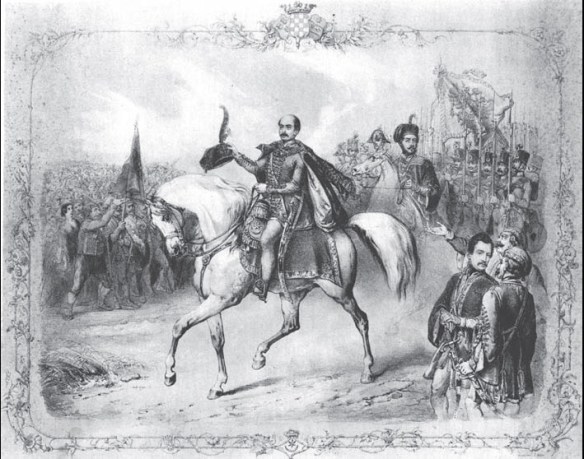
Scene from Jelačić’s ceremonial installation on the position of Croatian ban in Zagreb, June 4, 1848 (Contemporary engraving published in Zagreb’s weekly Svijet on May 19, 1928)

Scene from Jelačić’s ceremonial installation on the position of Croatian ban in Zagreb, June 4, 1848 (Contemporary engraving published in Zagreb’s weekly Svijet on May 19, 1928)


With Ferdinand’s approval of Magyar self-rule in March 1848, a new situation developed in the relationship between Hungary and Croatia. From that moment, Hungarians were responsible to their Diet (Parliament) and not to the emperor/king. (The official title of the Austrian emperor in Hungary and Croatia was king, not emperor.) The king would no longer be able to veto resolutions and laws passed by the Diet in Hungary even if such laws were directed against other nations and nationalities in the kingdom. Therefore, non-Magyars were thrown at the mercy of the ruling nation. The results of this development were soon felt. The Hungarian Diet passed legislation by which Croatian political and cultural distinctions were to be obliterated. In one of his speeches Kossuth declared that there had never been a Croatian name or a Croatian nation.11

A provisional national assembly was called in Zagreb on March 25, 1848 in order to respond to the dramatic changes in Hungary and their effects on Croatia. This was done on the initiative of some leading Croatian liberals. However, only a few days earlier one of the conservative nationalists, Franjo Kulmer, who had good relations with the Court, went to the capital to advocate the Croatian cause among influential circles in Vienna. Interestingly enough, Croatian nationalists of both liberal and conservative political persuasions, wanted Jelačić to lead the nation through this growing crisis. They believed that a man with his popularity and character, who had also the army behind him, could make a stand against the Magyars and their imperialistic appetite. He was a nationalist but a Habsburg loyalist who believed that the only way to stop the Hungarians was to be on the side of Vienna. On March 23, 1848, Kulmer succeeded in Vienna to get Jelačić nominated as the new Croatian Ban (Viceroy); two days later the provisional assembly in Zagreb unanimously acclaimed him for that position without knowing about the Vienna nomination.

However, no one asked Jelačić if he would accept the nomination. On the contrary, he was not eager to get involved in the political arena. On March 26, 1848 he wrote to his brother: “Indeed we live in extraordinary days. That I am Ban, Privy Councilor, and General you will know already…. I can forbid no one to nominate me; but if they ask me whether I wish to be Ban, then decidedly I say No!”12 He was at the same time promoted to the rank of Lieutenant Field-Marshal and Commanding General in Croatia, including the Military Frontier.

Jelačić, therefore, became Ban without the approval of the government in Hungary, so in the Magyar eyes it was an illegal appointment. This defiance made the new Ban completely independent from Pest. Hungarians began giving orders to the Frontier regiments and to local governments in Croatia, but Jelačić issued a proclamation forbidding anyone to take orders from anyone except himself. He officially broke all relations with Hungary, leaving it to the new Croatian Sabor (Parliament) to renegotiate Hungarian-Croatian relations.

The Hungarian government tried to stop the meeting of the Sabor. Due to Magyar pressure, the Habsburg emperor ordered Jelačić to call off the meeting. But Jelačić declared that “he could not obey the order of his sovereign who does not have his free will.”13 The Sabor was solemnly opened on June 5, 1848. It confirmed all the decisions made by Jelačić since he took office, among them abolition of serfdom and the law of equal taxation. This finally ended feudalism in Croatia. The Sabor then proposed a structural change of the Habsburg empire. It advocated federalism, in accordance with the wishes of other Slavs in the realm. This Sabor deliberated in full freedom and independence from Vienna and Pest. It proved itself to be a capable political body of free representatives.14

Jelačić’s political views, one could say, were shaped by the spirit of the time and by his military and family background. He desired to make a big step forward for his Croatian and other peoples in the empire by advancing federalism, but he was against any radical revolutionary undertakings in this process. His national feelings can be seen already in his first proclamation as Ban of Croatia, which states:

The good of the people and country; that is my wish and my sole aim. I desire that our country may be strong and free…. In all my thoughts and deeds I will be the true expression of the nation’s will and thoughts. Therefore I intend to walk and continue in the path, which shall lead our country to happiness and glory.

The revolution has shattered and overthrown the old foundations of social life and the national and governmental relations, especially those with our old ally, Hungary—therefore, remembering our ancient league with the crown of Hungary, it is necessary to renew the connection in spirit of freedom, self respect, and equality, and to form a basis worth of a free and heroic nation, though on our side all relations with the present Hungarian Ministry must be broken off….15

In his speech on the day of the opening of the new Sabor Jelačić reiterated his position:

Brothers, all the relationships between governments and the people, between state and state, between nation and nation have to be based on freedom, equality and fraternity. That demands the powerful spirit of the time in which mankind is progressing toward its perfection. On this basis we too will base our relationship with the Magyars…. In an unfortunate case, if the Magyars show themselves to be not like our brothers toward us our kinsmen in Hungary and assume the role of oppressor, let them know that we said it, the time has passed when one nation ruled over another. We are ready to prove this to them even with a sword in our hand, keeping in mind the words of our honorable Ban Ivan Erdedi: ‘Regnum Regno non praescribit leges.’ [Kingdom does not prescribe the laws to another kingdom.]16

Jelačić stressed national rights very strongly, but on the other hand he believed that the Habsburgs would respect the liberal “spirit of the time” and help to achieve the equality of various nations in the empire. He had perhaps too much faith in the Habsburgs’ good will and willingness to change. In May of 1848, Jelačić wrote to the Archduke Karl; “Is it possible that all will get their freedom and only we Croatians and Slavonians will be left to the despotism of the Magyar Ministry?… We ask you to respect us now or never!”17 He was looking for help from Vienna. It seems, however, that he already suspected help would not be forthcoming.

On June 12, 1848, Jelačić and his Council arrived in Innsbruck to present the emperor the Sabor’s recommendations; but two days earlier Hungarians had persuaded Ferdinand to dismiss the Ban. However, Jelačić did not know this when he met with the emperor. Magyar representatives were present at that audience. Furthermore, Archduke John was appointed to mediate between the Magyars and the Croatians.

Jelačić’s visit to Innsbruck was a turning point in his policies toward Vienna. Kulmer and his friends at the Court gave the impression that Vienna was fully behind the Croatian cause. One of Jelačić’s companions in Innsbruck, F. Žigović, wrote to Zagreb: “…from the highest to the lowest [person] here is disposed with the friendliest spirit toward us.”18 Jelačić agreed to call upon the Croatian soldiers in Italy to continue the fight for the empire there. He began to think as a Habsburg general again. But the contradictory situation of Croatia and her Ban became more and more evident.

To look for the reason of Jelačić’s support of the dynasty in Archduchess Sophie’s weeping on his shoulders, as some do,19 is naïve, or that the only freedom he knew was “that which he proclaimed with his sword”20 is perhaps a willful misjudgment of his character. He definitely had a high vision for Croatia and the freedom of its people, as can be seen from his speeches. He must have had honorable political goals — perhaps even assurances — in mind when he decided to support the dynasty. Even Camillo Cavour of Piedmont recognized that Jelačić’s demands were in accordance with the demands of other Slavs and not based on Habsburg reactions.21

Jelačić learned about his dismissal as Ban while returning from Innsbruck, but he ignored it and continued to function as though nothing had changed. The Court in Vienna did press the case. Hungary, however, took the emperor’s order seriously by trying to get some anti-Jelačić support in Slavonia. But this did not bring the desired results. In Slavonia Jelačić was received as a national hero. The imperial commissioner, who was to replace Jelačić’s authority as military commander, at Magyar urging, attacked the town of Srijemski Karlovci and a general fight broke out with the local Serbian population. The Sabor in Zagreb passed a resolution to send immediate help to the Serbs, but Jelačić did not rush to engage the fight.

There was another attempt to solve the Hungarian-Croatian crisis by peaceful means. Archduke John called a meeting of Jelačić and Hungarian Prime Minster Battyanyi in Vienna in July of 1848. It is said that Jelačić asked for the impossible because he did not want peace with the Hungarians.22 However, his demands were misinterpreted “in respect of their spirit and intention.”23 The meeting with Battyanyi did not bring any results because the Magyars demanded a total submission on the part of Croatians. It actually ended with a threat of war. Battyanyi declared to Jelačić: “Then we meet on the Drava [river].” “Say rather on the Danube,” responded Jelačić.24 On this occasion in Vienna, Jelačić told the “immense multitude” that came to greet him “I wish a great, a strong, a powerful, a free, an undivided Austria.”25 In response to the Magyar threat he sought to save the Monarchy and Croatia with it.

Soon after, the Habsburg war machine started to move, and Jelačić with it. On September 4, 1848, the emperor restored Jelačić to his rightful position as Ban. Three days later he was on his way from Zagreb toward the Drava, or rather toward the Danube. In his manifesto to the people before he moved into Hungary he declared: “We want a strong and free Austria…we want equality, and the same rights for all nations and nationalities living under the Hungarian crown. This was promised by the words of our sovereign to all nations in the Monarchy in March [1848].”26 Obviously he had taken Ferdinand’s promises seriously.

On September 11, Jelačić crossed the river Drava. His army, however, was not a unified fighting force. The volunteers were undisciplined and not of much help. He sent 12,000 volunteers home after the battle of Pákozd on September 29.27 The battle had been fought to a draw, and neither Jelačić nor the Hungarians were eager to renew the fight. Jelačić waited for 7,000 more Graničars (men from the Military Frontier), but they never arrived. Meanwhile revolution broke out in Vienna and Jelačić turned his forces toward the capital.

There are indications that Vienna had not wished Jelačić to enter Pest after he crossed the Drava. For example, the material support given him by the Court had not been significant. Also, the seven thousand Graničars under General Roth did not follow Jelačić’s plan. Meanwhile, Count Lamberg was in Pest seeing if things could be worked out between Hungarians and the Court. It seems that Jelačić was being used to put pressure on the Magyars, while Croatian interests were simply ignored.28 One interpretation of these events is that Hungarian conservative forces had planned this “little war” in order to stop their Hungarian liberal colleagues in their radical pursuits.29
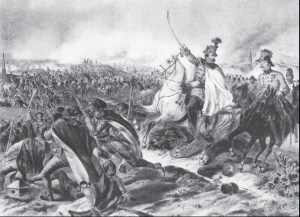
Ban Jelačić leading his troops during the battle of Schwechat near Vienna, October 30, 1848 (Contemporary engraving published in Zagreb’s weekly Svijet on May 19, 1928)

Ban Jelačić leading his troops during the battle of Schwechat near Vienna, October 30, 1848 (Contemporary engraving published in Zagreb’s weekly Svijet on May 19, 1928)


Jelačić’s march to Vienna signified a major change of purpose in his struggle. He began fighting the Hungarian oppression and now he found himself fighting Austrian revolutionaries and also a war of the Habsburgs against the Magyars. He was appointed the Royal Commissioner of the Hungarian kingdom, but this did not mean much in reality. As soon as General Windisch-Gratz and his troops joined him near Vienna, his role became secondary. From then on, Windisch-Gratz commanded the army and events. Jelačić did win a few victories for the Habsburgs in Hungary, but these were the exploits of a Habsburg General, not of a Croatian Ban. In August 1849, Jelačić fought for Petrovaradin, his native town. It surrendered to him on September 6, 1849, ending his last military campaign and his military career as well.

Tragic Ending

Soon after the revolutionaries were pacified, Jelačić learned about the “rewards” for his loyal service. Oppression, centralization, and Germanization were equally applied to the loyalists and to the revolutionaries. This was a bitter disappointment to Jelačić. His popularity at home declined. The former pro-Magyar forces in Croatia came to power again. He was Ban in name only. From 1849 to 1851, he attended all the meetings of the government in Vienna. He resisted oppressive measures but seeing that he could do nothing about them, he stopped going to Vienna. At his last meeting he told the emperor: “Highness, there is not a single man satisfied in the country.”30 But things did not improve. Jelačić himself was under police surveillance. Even his wife’s chamber maid was in the police service.31

A contemporary English diplomat, Sir Robert Morier, who visited Croatia soon after the revolution and even took private crash-courses in Croatian, states the following about the Habsburg treatment of Jelačić, whom he describes as “a most remarkable man:”

If ever, since the foundation of the Order of Maria Theresa, an Austrian subject deserved the Grand Cross of the Order by the fulfillment on the largest scale of the conditions originally stipulated by the rules of the Order, it was the Ban. Those rules, as is well known, recognize by preference the claims of those who have successfully achieved some great exploit either without or in contradiction to orders received from their superiors. Now, this latter was achieved by the Ban upon a scale rarely seen in history. As an outlaw he places himself at the head of an entire nation, declares war on his own responsibility, marches successfully into the very heart of the enemy’s country, and then by a brilliant maneuver, after a doubtful battle, comes to the rescue of the capital of the Empire. Nevertheless, the Chapter of the Order (on the very same day, if I am not mistaken) awarded to Prince Windishgrätz, for his successful putting down of the émeute at Prague, the Grand Cross of the Order; and to the Ban, for the services by him rendered, the Commander’s Cross only. Again, Prince Windishgrätz was named Field-Marshal, the Ban General; but two years later it was retrospectively stipulated that he should not advance towards the grade of Field-Marshal, otherwise than if he had become General by seniority.32

The main reason for such treatment of the Ban and the Croats, according to Morier, was “the contempt which the Austrian German” has for the Austrian Slav “combined with the very real fear with which the numerical superiority of the latter inspires him.” Furthermore, the Englishman describes the Habsburg ungratefulness as follows: “…I must confess that, with every wish to make allowance for the difficulties of the situation, it yet seems to me that a more wholesale act of injustice, ingratitude, and bad faith, a display on a large scale of mean and paltry spirit, grosser fraud, more clumsily veiled, it would be difficult to meet with in all the pages of history.”33

Jelačić was politically active until 1853. His policy was to save what could be saved. By his efforts the Zagreb diocese became an archdiocese, independent from the Hungarian church hierarchy. He organized the National Theatre in Zagreb, in which only Croatian was used. He succeeded in getting Juraj Strossmayer nominated as bishop of Djakovo. And a number of other cultural advances are also attributed to him.

In 1850, Jelačić married Countess Sophie von Stockau. He was forty nine and she was sixteen years old. On the occasion of the marriage in 1854, he received the title of Count from Francis Joseph, the emperor. But already at that time his health was waning. A year later his only child died. His public life was ended and he was tormented by all that had happened since the euphoric days at the beginning of 1848. He told one of his closer friends: “The Austrian government is killing me. I do not have any organic sickness. I am healthy. I have full strength of the body, but I am dying. Austria, in which I have believed, is destroying me.”34

Jelačić died on May 20, 1859, a man whose ideals were destroyed by a regime which he helped to save. He was buried in his Novi Dvori, near Zagreb, by the side of his only child.

Conclusions

Ban Jelačić’s equestrian monument in Zagreb on original position at Ban Jelačić’s Square (on the postcard from late 1920s). The monument was erected in 1866. Removed by communist authorities in 1947, it was returned to the square after the collapse of communist regime in 1990.

Ban Jelačić’s equestrian monument in Zagreb on original position at Ban Jelačić’s Square (on the postcard from late 1920s). The monument was erected in 1866. Removed by communist authorities in 1947, it was returned to the square after the collapse of communist regime in 1990.


Jelačić was a product of both national and pro-Habsburg feelings and loyalties which he did not perceive to be contradictory. When he entered Zagreb on his inaugural day, the whole city came out to greet him. It was an historic occasion. Croatians and many other Slavs looked at him as the only hope for a better future in the Monarchy. He declared that his only goal was the good of the people and his native land.

On the other hand, when he came to Vienna to meet Battyanyi, he was greeted again as a hero, but now by the Vienna crowd. He declared to them “I wish a great, strong, powerful, free, and undivided Austria.” He tried to synthesize these two conflicting goals. He believed that the first could be achieved through the second one. But the Habsburgs had other aims and plans for him, Croatia, and the empire.

Jelačić has been attacked from many sides, as a Panslavist, as a pro Russian, as an Austrophile, and a reactionary, among other and often contradictory labels. Even after his death, he was a hero to some and a villain to others. To Croatians he became a symbol of the struggle against the Magyars and a martyr of the devious Austrian regime. A monument was erected in the main square in Zagreb to his honor and patriotic songs about him carried his name to the younger generations. After the Second Word War, however, he was condemned once more as an antirevolutionary and reactionary figure. His monument was removed from public eye and the songs were banned. But his name could not be obliterated from the memory of the Croatian people. As soon as the communist regime in Croatia collapsed his monument was returned to its rightful place and Zagreb’s main city square bears Jelačić’s name again. He continues to be a symbol of Croatian enthusiasm for freedom and independence.

Der kroatis che Banus Josip Jelačić

Zusammenfassung

Der Autor verfasste diesen Überblick über Jelačić“ Leben anlässlich des 160-jährigen Jubiläums der 1848-er Revolution und seines Antritts in den Amt des kroatischen Banus in demselben Jahre. Dieser Überblick ist vor allem den jungen Kroaten zugedacht, die außerhalb Kroatiens leben und die grundsätzliche Informationen über das Leben und politische Tätigkeit des Banus Jelačić erfahren wollen. Der Aufsatz ist hauptsächlich aufgrund zugänglicher Literatur geschrieben und bezieht sich größtenteils auf die wichtigste Periode in der politischen Tätigkeit des Banus Jelačić – auf die Revolutionsjahre 1848-1849. Zu dieser Zeit war Jelačić nicht nur die hervorragendste Person der kroatischen Politik, sondern auch ein wichtiger Teilnehmer an den Geschehnissen in der Habsburgermonarchie im Ganzen.

1 Jellachich, Ban of Croatia,” Eclectic Magazine 16 (March 1849), p. 359.

2 E. F. Malcom Smith, Patriots of the Nineteenth Century. New York: Longmans and Green, 1928, p. 55.

3 Ibid., p. 56.

4 “Jellachich,” Eclectic Magazine, p. 359.

5 Ibid., p. 359.

6 Ibid., p. 360

7 Smith, Patriots, p. 58.

8 Ibid., p. 59.

9 W. baron. Scenes of the Civil War in Hungary in 1848 and 1849; with the Personal Adventures of an Austrian Officer. Philadelphia: E.H. Butler & Co., 1850, pp. 19-23.

10 Gunther E. Rothernberg, “Jelačić, the Croatian Military Border, and the Intervention against Hungary in 1848.” Austrian History Yearbook, Vol. 1, 1965, p. 50.

11 Lovre Katić, Pregled povijesti Hrvata. Zagreb: Matica Hrvatska, 1938, p. 218.

12 Smith, Patriots, p. 61.

13 Josip Horvat, Politička povijest Hrvatske. Zagreb; binoza, 1936, p. 182.

14 Vaso Bogdanov, Historija političkih stranaka u Hrvatskoj. Zagreb: NIP, 1958, p. 300.

15 Smith, Patriots, pp. 62-63.

16 Horvat, Politička povijest, p. 184.

17 Enciklopedia Jugoslavije, Vol. IV, S. v. “Jelačić, Josip.”

18 Ibid.

19 Perscilla Robertson, Revolutions of 1848: A Social History. Princeton: Princeton University Press, 1967, p. 281. Sophie was mother of Emperor Franz Joseph I.

20 Ibid., p. 282.

21 Josip Nagy, “Smjernice pokreta g. 1848.” Hrvatsko kolo 14, 1933, p. 27.

22 Robertson, Revolutions of 1848, p. 282.

23 C. Edmund Maurice. The Revolutionary Movements of 1848-9. New York: G. P. Putnam’s Sons, 1887, p. 383.

24 Smith, Patriots, p. 65.

25 “Jellachich,” Eclectic Magazine, p. 365.

26 Horvat, Politička povijest, p. 193.

27 Ibid., 195.

28 Ibid., 196.

29 Bogdanov, Historija, p. 309.

30 Horvat, Politička povijest, p. 212.

31 Ibid., p. 207.

32 Rosslyn Wemyss. Memoirs and Letters of the Right Hon. Sir Robert Morier, G.C.B. From 1826 to 1876. London: Edward Arnold, 1911, pp. 150-151.

33 Ibid. p. 150.

34 Antonija Kassowitz Cvijic, “Grofica Sofija Jelačic,” Hrvatsko kolo 13, 1932, p. 105.ć

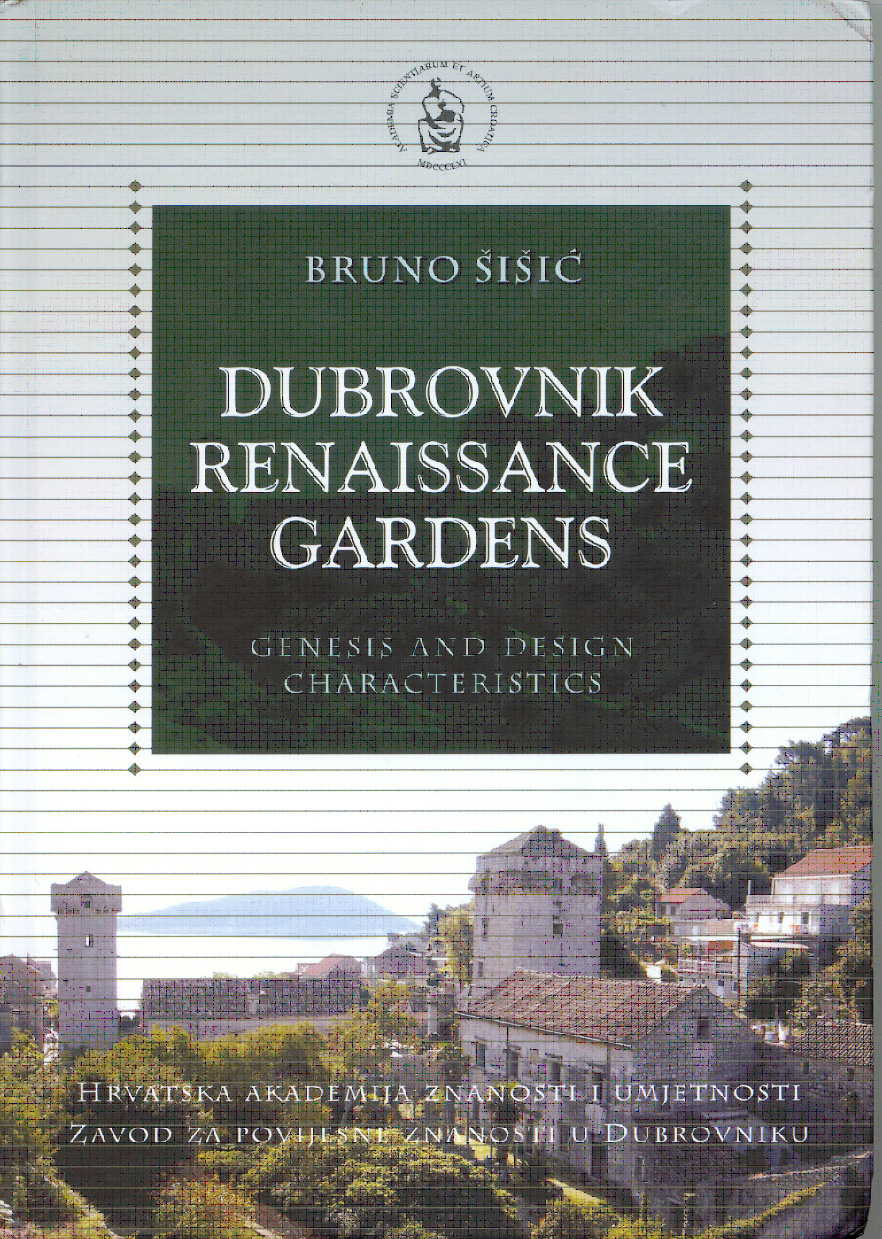
Bruno Šišić – Dubrovnik Renaissance Gardens: Genesis and Design Characteristics

Zagreb-Dubrovnik: HAZU, Zavod za povijesne znanosti u Dubrovniku: 2008, 248p.

ISBN 978-953-154-760-4

(Conclusion, pp. 199-201)

Your browser may not support display of this image.Dubrovnik Renaissance gardens and villas were, as a rule, designed and built by local craftsmen with the full participation of their owners, so they reflect the potentials, wishes, philosophy and creative capabilities of local residents.
Through comparison of Dubrovnik Renaissance gardens with the authentic models of their Italian counterparts, it can be concluded that Dubrovnik gardens are characterised by certain features related to the size, landscaping and articulation of their garden space. This results from natural and social differences and is consequently reflected in the quantity of particular natural and compositional elements, as well as differences in garden patterns. Dubrovnik Renaissance gardens were created in a dry, karst region, which results in the dominance of two compositional elements: stone and verdure. In Italian gardens, established on mild, fertile slopes on a hilly terrain, spring water has an equally significant role as stone and verdure.
Both Italian and Dubrovnik Renaissance gardens are geometrically shaped, but there are differences in this respect too. While the geometrical shaping in Italian gardens was carried out with consistent precision, in Dubrovnik gardens it is done more flexibly, with less insistence on the preciseness of geometrical shapes and symmetry.
The difference in design of the systems of principal garden paths or walkways is great. While in Italian gardens the principal paths were most often bordered by hedges and clipped verdure, in Dubrovnik gardens they were bordered by low stone walls carrying stone columns which supported pergolas.
This is the reason why in Dubrovnik Renaissance gardens verdure did not need to be artificially trimmed. Nor was its tectonic (constructional) function in the creation and articulation of the garden area significant to the same extent and in the same manner.
In each Dubrovnik Renaissance garden the pergola is a delightfully significant element. It is supported by colonnades made of slender carved stone monolith columns. In gardens characterised by a more complex landscaping design, pergolas comprise entire systems of green porches which articulate the garden spaces into open quadrangular shapes of garden verdure and intersecting walkways canopied by grapevines.
Generally speaking, Dubrovnik gardens were designed more modestly compared to Italian ones, which abounded in sculptures and sculpted water features. Dubrovnik gardens are littoral gardens, both with regard to their natural properties and the fact that, as a rule, they overlook the sea. Moreover, many of them were in immediate contact with it. This contact resulted in specific landscaping solutions, which resulted in the appearance of garden terraces, belvederes or organs (boathouses) attached to the house, garden and sea.
All of the previously stated had an impact on the distinctive and distinguished iconographic expression of Dubrovnik Renaissance gardens.
An investigation into the formal properties of Dubrovnik Renaissance gardens and the study of the factors which brought about their historical genesis leads us to the realisation that developments in agriculture, planning, utilitarian gardens and, in particular, gardens of leisure considerably contributed to their distinctiveness. All of this took place before Renaissance times in Dubrovnik and paved the way towards the authentic expression of Dubrovnik Renaissance gardens.
It can be inferred from everything stated above that Dubrovnik Renaissance gardens are characterised by numerous common features regarding their design and function. At the same time, these make them quite special and recognisably distinctive, both in comparison to the original model of the Renaissance garden – the Italian garden, and when viewing them within the framework of overall achievements in Renaissance garden art.
The fact that Dubrovnik gardens possess a number of common features with the distinctive mark of the region categorises them as a separate group with a typological uniqueness within the framework of Renaissance garden art, which can be named with the common term Dubrovnik Renaissance gardens.

Joseph M. Condic (1924-2009)

In Memoriam

Joseph M. Condic died on February 21, 2009 in Kalamazoo, Michigan.  He was born on November 21, 1924. in Chicago to an immigrant Croatian family.  His father, Marko Čondić, came from Svib, near Imotsk, and his mother, Tona Utrobičić, from Slime, a village near the river Cetina.  They were married in Chicago in 1921 and had eight children.  The family was shaken by Marko’s death in 1935, but Tona, regardless of her misfortunes and the Great Depression, raised their children in a way that any parent would be proud of.

Joseph, or as many of us called him Jozo, pursued a higher education and earned a Ph.D. which was followed by career as a professor at the Department of Humanities, Western Michigan University. Kalamazoo, Michigan, for 34 years.

He is survived by his beloved wife, Dolores, of 53 years, seven children (Dorena , Marin David, Melanie, Maureen, Eric, Adam, and Samuel), eighteen grandchildren, five siblings (John, Mark, Peter, Simon, and Rosanda), and over seventy descendents of Marko and Tona Condic. He was buried from St. Augustine Cathedral and laid to rest at Mountain Home Cemetery, Kalamazoo.

Joseph Condic was a member, among other organizations, of the Association for Croatian Studies and served as its president in the late 1980s.  It should also be mentioned that Jozo translated and prepared for publication a manuscript of his friend, the late Ivan Supek, entitled  Crown Witness against Hebrang. Chicago, Markanton Press, 1983.  The writings of this renowned Croatian physicist and humanist were banned by the communist regime at the time.

Jozo was a faithful husband, an excellent father, a great teacher, and a truly humble man. For that reason, this in memoriam to such a wonderful person and a friend, is also humble.

Ante Čuvalo


Jottings about Croatians in America

Josip F. Mikulec

Tireless World Hiker

Some one-hundred years ago, the American press (and, I’m sure, elsewhere as well), reported on the then young, and I must say, very brave Croatian adventurer, Joža Mikulec.  He set out to circumnavigate the globe on foot in the span of five years.  With the start of this journey, Joža, one might say, became a perpetual wanderer.  Mostly hiking, he traveled the world some 28 years and achieved a degree of fame for having collected more than 30,000 autographs of world-famous people.  From time-to-time, some of the more notable American newspapers kept track of his wanderings across this globe of ours.

I haven’t noticed that this interesting, if not especially notable Croatian was mentioned among his fellow Croatians—at least not through the past decades or so.  I haven’t investigated as to how much was written about him in the Croatian press of the time.  I’ll leave that to those in Croatia who might be interested in his story.  Let this brief glance at Mikulec serve as my contribution to a fuller biography of this American Croatian who, by all accounts, was a restless soul who was always ready to break-in a new pair of shoes.

Joža Mikulec first caught my eye as I was searching trough some microfilm images of the Chicago Hrvatska Zastava  (The Croatian Banner), dated the 24th of January, 1908. The Banner carried a translation of an article that appeared in the Star Journal from Pueblo, Colorado, dated the 23rd of November, 1908.  Joseph Mikulec came through Pueblo at the time, and the Journal carried the story of his journey from Zagreb to Pueblo.

Among other facts, the article stated that Mikulec, a “young Croatian,” had arrived in Pueblo.  He had entered into an agreement with Matica Hrvatska (Croatian Cultural and Publishing Society) in Zagreb to hike 25,000 miles in the course of five years, and, upon completion of his trek that he would set to paper his journey for them. Matica, in return, would award him 50,000 crowns (c.$10,000 at the time) and also publish his account. The Star Journal stated that Josip was to have sent his report to Matica each and every week updating his journey.

Mikulec departed Zagreb on the 5th of February, 1906 and by the time he arrived in Pueblo, he had walked 15,800 miles. He had already exceeded his plan by 800 miles. Mikulec set out on his journey without any sort of material support. He simply sold picture postcards along the way so that he could have enough cash to feed himself. One could add, he found many kind and generous people along the way who were willing to come to his aid.

The Mikulec’s path took him across Italy, France, Spain and Portugal. He set out from Portugal by way of boat to Cape Town in Africa. From Cape Town he set sail for Argentina. He intended to cross from Mendoza into Chile, but, because of intense cold and snow in the Andes, he set out for Buenos Aires instead. Mikulec encountered particular difficulties when crossing the Argentinean Pampas. Besides the unfavorable terrain for hiking, and the lack of food and water, he was beset by robbers as well. That was toward the end of 1907. While in Buenos Aires, Mikulec came into contact with the richest Croatian in Argentina, namely, the ship-owner, Nikola Mihanović. Mihanović was most welcoming to him.

From Buenos Aires, Mikulec set out for Montevideo and then on to the North through Brazil (Santos, Rio de Janeiro, Vitoria, and Bahia). Once again, he was robbed while in Brazil, however, it was the mosquitoes that gave him the biggest pain. He set out from Brazil as a deckhand on a steamer bound for the U.S. He arrived in Philadelphia and from there, he set out for Baltimore and Washington. Leaving Washington, he set out through Virginia, West Virginia, Kentucky, part of Ohio, onto Indiana, Illinois, Missouri, Kansas, and into Colorado. Wherever he traveled, he sought out the autograph of important people and state and civic officials. He would ask that they affix the official seal of their jurisdiction to the signed autograph. He had a special book made just for that purpose, and he guarded it against loss faithfully.

Colorado’s Star Journal article printed his comments of praise for America and the Americans. They mentioned that he arrived in Springs, Colorado on the 22nd of November, 1908, and that he would temporarily reside with Nikola Badovinac. After leaving the company of Badovinac, Mikulec continued his journey toward the western shores and on into Portland. From Portland he planned to set out for Australia and from there to Japan, across Asia, and on through Siberia by way of train to St. Petersburg, Russia.

I have not succeeded in finding a description of Mikulec’s journey to Portland and beyond. However, I did find an article in the Chicago Daily Tribune, dated the 29th of July, 1910, wherein they report that the world traveler, Mikulec, arrived in Chicago on the 27th of July, and that the local Croatians were preparing a welcoming party for him on the 30th of July, in the National Hall on 18th Street. Mikulec would then set out for Springfield, capital city of Illinois, so as to obtain the autograph of the Governor just as he had done in all the states that he had traversed. The article also mentioned that he had an authentic autograph of President Taft. The article went on to say that Mikulec had worn out 42 pairs of shoes and that his journey was on schedule as he had planned and agreed to with Matica Hrvatska. In fact, he had said, he was 19 days ahead of his planned schedule.

From this “encounter” with Mikulec in Chicago, I was unable to thus far learn anything more about his journey until his reappearance in Chicago. The Tribune once again on the 21st of February, 1917—a full seven years later—writes that Mikulec once again arrived on foot in Chicago, and that his agreement with Matica Hrvatska was abrogated because he failed to fulfill his promise to journalize his travels as promised. They said that instead, he wrote what might be seen as a romanticized novel. This time they asserted that he had worn out 36 pairs of shoes. This would mean that Mikulec, despite his disagreement with Matica, continued his journey nonetheless and that he started anew to record how many shoes he had worn out. Meanwhile, the more important announcement in the article was the fact that Mikulec, adorned the length of his body with various medals of honor that he had received, had made a visit to the City Clerk’s Office of Marriage Registrations so that he could marry his fiancée, Mary Medrić. Mary was 36 years old at the time, and Mikulec was three years her senior. The author of the article notes that Mikulec, at the time of his registration, “is now plain Chicago ‘Joe’ instead of Croatian ‘Joža’,” and that the young couple would now reside at 1332 W. 18th Street, in Chicago. At the time, that part of Chicago had a very large Croatian community. One would think that Joe Mikulec, now married, would have settled down to a “normal” life among his fellow Croatians in Chicago. However, the newsman deceived himself: Mikulec remained the “Croatian Joža” and continued his adventurous journey across the world.

The New York Times, dated the 2nd of September, 1923, carried an article about Joseph Mikulec, the “collector of autographs.” The article goes on to relate that Mikulec had already traversed the globe twice, and had gathered autographs of important personages wherever he traveled. He found himself in New York city at the time of the article along with his leather-bound Autograph Book. The book, at the time, weighed a full 57 pounds. John F. Hylan, the mayor of New York, had signed Mikulec’s book as well as those who were well-known persons among the industrialists, artists, politicians, and others. The signatures of American Presidents, T. Roosevelt, W. H. Taft, W. Wilson, W. G. Hardy, C. Coolidge, along with other notables such as Lloyd George, Lord Curzon, the Prince of Wales, the President of China, Admiral Togo, J. Pierpont Morgan, and various senators, governors, ambassadors, etc. The article goes on to give a brief account of Mikulec’s first journey across the world, and adds that Joža’s full time residence was now (September, 1923) in Philadelphia. It goes on to say that he became a naturalized citizen in December of 1910, and that from 1910 through 1923 he journeyed through Australia, New Zealand, China, Japan, India, Egypt, the Holy Land, and South Africa. Mikulec told the press that he was quite exhausted and that he wished to settle down into a “normal” life on some farm in the plains of America that has fertile soil. Along with this wish, he hoped to see his book of autographs in some appropriate museum. Meanwhile, wanderlust, and, perhaps, a new pair of shoes, won out again, and Mikulec set out from New York for the West.

Within two months time, (20th of November, 1923) the New York Times once again carried a somewhat longer article about Mikulec. The article goes on to say that Mikulec arrived once again in New York along with his 58 pound, 2,896 page book of autographs. Upon entering the city, Joža immediately set out for the Rosenbach rare book store so as to attempt to sell his book of autographs. His main reason for doing so was that he was exhausted of lugging that heavy book around. It is interesting to note that the New York Times newsman accompanied Mikulec to Rosenbach’s firm. The newsman reports that Mikulec bemoaned the fact that he had not succeeded in gathering so much as a single autograph of any monarch. He sought $10,000 for his collection. Dr. Rosenbach felt the collection was worth at least that amount, but that he did not traffic in such books. He, however, did suggest that Mikulec seek out Henry E. Huntington in California who, perhaps, might be interested in buying his collection. Hand on forehead, Mikulec bemoaned the fact that he had collected Huntington’s autograph but that it had not occurred to him to offer Huntington his collection.

We meet Mikulec once again on the pages of the New York Times, on the 30th of October, 1927. This time, the paper simply published a picture of Mikulec showing his book of autographs to admirers on the streets of Berlin. Clearly, Joža did not find a buyer for his collection of autographs as he had hoped to do in New York some four years earlier. Instead, Mikulec continued his wandering across the world.

The last article I was able to find about Mikulec was also in the New York Times, dated the 29th of April, 1928. The headline read: “Man 28 Years on Tour Collects Autographs.” The sub-head read: “Wheels 55-Pound Volume Containing 30,000 Signatures in a Special Carriage.” The article says that Mikulec was 50 years old at the time, that he was from Croatia, that he set out across the world some 28 years ago and gathered autographs of renowned people along the entire way including the autographs of several European rulers, and nine American Presidents as well as those of well-known artists, writers, actors, scientists, politicians, religious leaders, etc. He lugged his collection in a specially designed cart, but had to haul the book on his back as he visited various offices of those whose autograph he sought. Mikulec said that he had traversed hundreds of thousands of miles on foot gathering these autographs and that he would continue his journey.

Thanks to the internet (boards.ancestry.co.uk) we found the following facts: Josip Franjo Mikulec was born on the 15th of January, 1878, in the village of Krušljevo selo, Croatia, near Zagreb. His father was Josip Mikulec, and his mother was Kata Novosel from the same village. The internet also informs us that Mikulec arrived in America in 1905, that he married Anna Stiopu on the 20th of June, 1908 in Westfield Chautauqua County, NY, and that on his application for citizenship (September, 1910) he indicated that he was not married.

The New York Times article dated the 2nd of September, 1923 states that he was born in Stubice, Croatia. Krušljevo selo is near Stubičke toplice.  What is more, the article of 1928 states that Mikulec had been on his journey for the past 28 years. If that is accurate, then we must assume that he could have arrived in America even before 1905 and then returned to Croatia to enter into his agreement with Matica Hrvatska. He set out on that agreed-to journey on the 5th of February, 1906. It is reasonable to assume that Mikulec was somewhat acquainted with the world prior to his setting out on his hike across the world. As far as his marriage is concerned, if he did in fact enter into a union with the Rumanian poetess, Anna Stiopu, who also set out on foot across the world in May of 1905, it would seem that the marriage of these two world-travelers did not last long; meanwhile, we are told that Josip married in Chicago in 1917.

As I said at the start, this is no more than a small excerpt of the life of a Croatian who wandered the world endlessly. Many questions arise such as those that ask: where and how did he die; did he have any children; what all lands did he hike through; do any reports that he was to have sent to Matica Hrvatska exist, that is, if they ever existed at all; and especially pertinent, whatever happened to his book of collected autographs? Should all the details of Joža’s travels ever become know, and the whereabouts of his book of collected autographs, the name of Josip Mikulec would and should find its way into the Guinness Book of World Records.

It is my hope that this article will arouse the interest and attention of its readers about this tireless Croatian adventurer and hiker, and that this article will inspire someone to seek out, record, and publish a fuller biography of Josip Franjo Mikulec, as well as to discover where and when he ended his life and what became of his treasured book of autographs gathered over so many years.

Ante Čuvalo—Chicago

Translated by Duško Čondić from Croatian into English

****

* Picture 1 – in possession of Ante Čuvalo
* Picture 2 – taken from the web: boards.ancestry.co.uk
* I am grateful to the staff of the Robert Hoag Rawlings Public Library in Pueblo for providing me with a copy of the Mikulec article from Star Journal, November 23, 1908.

Crtice iz povijesti Hrvata u Americi

JOSIP F. MIKULEC

NEUMORNI PJEŠAK KUGLOM ZEMALJSKOM

Unazad oko stotinu godina američke (vjerujem i drugdje) novine pisale su o tad mladom, moramo reći i veoma hrabrom, hrvatskom pustolovu Joži Mikulcu, koji se uputio pješice za pet godina obići kuglu zemaljsku. Tim putovanjem, moglo bi se reći, Joža postaje vječiti putnik. Putovao je širom kugle zemaljske, najviše pješice, barem 28 godina i proslavio se prikupljanjem preko 30.000 autografa raznih svjetskih uglednika. Neka važnija američka glasila pratila su, s vremena na vrijeme, njegov hod kroz ovaj naš bijeli svijet.

Nisam zapazio da se ovog, ako ne baš znamenitog, ali svakako zanimljivog Hrvata spominjalo među nama u Americi, svakako ne zadnjih desetljeća. Koliko se o njemu pisalo u Hrvatskoj u njegovo vrijeme i kasnije, nisam imao prigodu istraživati. To ostavljam znatiželjnima u domovini. Ovo moje upoznavanje s Mikulcem nek bude doprinos budućoj potpunijoj biografiji toga američkog Hrvata nemirna duha i uvijek spremna derati đonove novih cipela.

Joža Mikulec mi je prvi put „zapeo za oko“ kad sam pretraživao mikrofilmove čikaške Hrvatske Zastave i u broju od 24. prosinca 1908. pročitao prijevod članka iz dnevnika Star Journal od 23. studenog 1908 iz Pueblo, Colorado. Naime, koncem studenog 1908. Josip Mikulec je boravio u tom gradu i novine su donijele podulje izvješće o njegovu putovanju pješice od Zagreba do Puebla.

Među ostalim se veli, da je tih dana u grad Pueblo stigao Mikulec „mlad Hrvat“, koji je napravio ugovor s Maticom hrvatskom u Zagrebu (njezinim nakladnim zavodom) da će za pet godina proći 25.000 milja pješice i nakon putovanja napisati putopis, a Matica će mu isplatiti 50.000 kruna i izdati knjigu. Zato je Josip, veli novina, tokom putovanja svaki tjedan slao izvješće Matici o prevaljenom putu.

Mikulec je pošao iz Zagreba 5. veljače 1906. i do dolaska u Pueblo prevalio 15.800 milja, te da je nadmašio svoj plan i raspored putovanja za 800 milja. Putovao je bez ikakvih materijalnih sredstava, jedino je prodavao razglednice i od toga kupovao hranu. A moglo bi se zasigurno dodati, da je bilo uvijk dobrih i darežljivih ljudi koji su mu priskakali u pomoć.

Put iz Hrvatske našeg je Jožu vodio preko Italije, Francuske i Španjolske do Portugala. Otud je brodom otplovio u Cape Town, a odatle je otputovao u Argentinu. Htio je preći iz Mendoze u Čile, ali zbog hladnoće i snijega u Andama, pošao je prema Buenos Airesu. Posebice je imao problema preko provincije Pampa; osim neprikladna terena za hodanje, trpio je nestašicu hrane i vode, a usput su ga orobili i razbojnici. Bilo je to 1907. godine. U Buenos Airesu Mikulec se susreo s najbogatijim Hrvatom u Argentini, brodovlasnikom Nikolom Mihanovićem, koji ga je vrlo gostoljubivo primio.

Iz Buenos Airesa je otišao u Montevideo, zatim prema sjeveru kroz Brazil (Santos, Rio de Janeiro, Vitoria, Bahia). I u Brazilu je bio orobljen, ali su mu tamo najviše jada zadavali komarci. U Brazilu se, kao radnik, ukrcao na parobrod i stigao u Philadelphiu, a odatle je pošao u Baltimor i Washington – kroz Virginiju, Zapadnu Virginiju, Kentucky i dio Ohia, Indianu, Illinois, Missouri, Kansas do Colorada. Kamo god je prolazio, tražio je razne uglednije osobe da mu dadu autograf i, u slučaju državnih i drugih službenika, da udare pečat grada, općine ili države u njegovu knjigu napravljenu za tu svrhu, a koju je pažljivo čuvao.

Članak iz Puebla donosi i Josipove pohvale Americi i Amerikancima, te veli da je Mikulec 22. studenog stigao u mjesto Springs, Colorado, i da će odsjesti kod Nikole Badovinca, te zatim nastaviti put prema zapadnoj obali, a iz Portlanda je trebao poći u Australiju, pa preko Japana (Azije), te sibriskim vlakom preko Rusije do St. Petersburga.

Opis Josipova putovanja do Portlanda i dalje još nisam uspio pronaći, ali sam pronašao članak u Chicago Daily Tribune (29. srpnja 1910.) u kojem piše da je svjetski putnik Mikulec stigao u Chicago 27. srpnja, da Hrvati za njega priređuju doček za nedjelju 30. srpnja u Nacionalnom domu na 18. ulici, te da zatim odlazi u Springfield, glavni grad države Illinois, da bi od guvernera mogao dobiti autograf, kao što je dobio od drugih guvernera kroz čije države je prolazio. Također se navodi da je imao autentičan autograf predsjednika Amerike Tafta. Članak završava da je Mikulec dotad poderao 42 para cipela i da mu putovanje ide po planu kako je ugovorio s Maticom, i čak da je je 19 dana ispred planiranog vremena.

Iza ovog mog „susreta“ s Mikulcem u Chicagu, nisam mogao ništa pobliže saznati o nastavku njegova putovanja do njegove ponovne pojave u Chicagu. Gore spomenuta čikaška novina od 21. veljače 1917. (znači blizu sedam godina kasnije) piše da je Mikulec ponovo dopješačio u Chicago, da mu je propao ugovor s Maticom hrvatskom jer nije ispunio obećanja, da je počeo pisati putopis, ali se to izrodilo u romantični roman. Ovaj put se navodi da je poderao 36 pari cipela, što bi značilo da je Mikulec, premda nije ispunio Matičine uvjete, nastavio pješačiti i dalje, te valjda iznova počeo brojati koliko je poderao cipela. Ali najvažnija vijest u članku je ta da je Mikulec dan prije, „nakićen duzinom“ raznih odličja na grudima, sa svojom zaručnicom Mary Medrić posjetio gradski ured za vađenje vjenčanih dozvola. Ona je tada imala 36, a on 39 godina. Pisac članka veli da je Mikulec tad postao „obični čikaški ‘Joe’, umjesto hrvatskog ‘Jože’“ i da će mladi par živjeti na adresi 1332 W. 18. ulica, Chicago. Usput, u tom dijelu grada bila je jedna od tadašnjih velikih hrvatskih naseobina. Dakle, bilo bi za očekivati da se sad Joe Mikulec oženio, smirio i nastavio „normalan“ život među Hrvatima u ovom gradu. Ali, novinar se prevario, on je i dalje ostao „hrvatski Joža“ i nastavio putovati svijetom.

Naime, New York Times od 2. rujna 1923. donosi članak o Josephu Mikulcu, „sakupljaču autografa“. Članak ističe da je Mikulec dva puta obišao svijet pješice, sakupljajući autografe uglednijih osoba kamogod je prolazio. Tih dana je bio u New Yorku i njegovu ogromnu, kožom uvezanu knjigu s autografima (koja je tad težila 57 funti) potpisao je gradonačelnik John F. Hylan, kao i važnije osobe iz poslovnih krugova, kazališta, politike i drugi. U knjizi su bili potpisi američkih predsjednika T. Roosevelta, W.H. Tafta, W. Wilsona, W.G. Hardya i C. Coolidgea, kao i mnogih drugih uglednika: Lloyd George, Lord Curzona, Princa od Walesa, predsjednika Kine, admirla Togoa, J. Pierpont Morgana, raznih senatora, guvernera, ambasadora itd. Članak donosi sažetak priče o njegovu prvom putovanju i dodaje da je Jožin stalan boravak u to vrijeme (rujan 1923.) bio u Philadelphiji i da je u prosincu 1910 postao američki državljan, te da je otada, to jest od 1910. do 1923. obišao slijedeće zemlje: Australiju, Novi Zeland, Kinu, Japan, Indiju, Egipat, Svetu Zemlju i Južnu Afriku. Mikulec je za novine izjavio da je već umoran, da se želi smiriti i otpočeti „normalan“ život na kakvoj manjoj farmi u američkim plodnim ravnicama, a da bi knjigu sa autografima želio vidjeti u kakvu muzeju. Ali, ipak je želja za putovanjem pobijedila pa je Joža tada iz New Yorka krenuo prema zapadu.

Samo dva i pol mjeseca kasnije (20. studenog 1923.) New York Times opet donosi članak o Joži, ovaj put malo podulje štivo. Veli se da je Joža ponovo stigao u New York noseći svoju kjigu od 2.896 stranica i tešku 58 funti. Joža je došao u grad i odmah posjetio tvrtku Rosenbach, trgovinu rijetkih knjiga, da bih unovčio dragocjene autografe. Glavni mu je razlog za prodaju bio umor od nosanja te velike knjižurine. Zanimljivo je da ga je u trgovinu pratio novinar New York Timesa, koji opisuje Jožu i njegovo podrijetlo. Novinar dalje piše da je Joža vječiti putnik, nabraja iskupljene autografe znameniti ljudi, kako se Joža žali da nije uspio dobit autograf ni jednog kralja, itd. Mikulec je tražio 10.000 dolara za knjigu a vlasnik Dr. Rosenbach je prosudio da je to realna cijena, ali da se on ne bavi takvim knjigama, nego mu je preporučio posjetiti Henry E. Huntingtona u Kaliforniji, koji bi možda otkupio knjigu ove vrste. Mikulec se uhvatio za glavu i kazao da ima Huntingtonov autograf, ali da mu nije palo na pamet ponuditi mu knjigu kad je bio kod njega.

Jožu Mikulca ponovo susrećemo u New York Timesu 30. listopada 1927., ali ovaj put novina donosi samo njegovu fotografiju na kojoj znatiželjnim prolaznicima na ulicama Berlina pokazuje svoju ogromnu knjigu autografa. To znači da Joža nije prodao knjigu i da se nije smirio, kako je priželjkivao dok je bio u New Yorku četiri godine ranije, nego je nasatavio putovati svijetom.

Zadnji članak o njemu kojeg sam mogao pronaći u New York Timesu je od 29. travnja 1928., a naslovljen je „Čovjek 28 godina na turneji skupljanja autografa“. Podnaslov glasi: „Vozi u posebnim kolicima 55 funti težak svezak koji sadrži 30.000 potpisa.“ Članak navodi da je Joža tada imao 50 godina, da je iz Hrvatske, da je prije 28 godina pošao po svijetu skupljajući autografe poznatih osoba i da knjiga sadrži potpise nekoliko europskih vladara, devet američkih predsjednika i mnogobrojnih glasovitih umjetnika, pisaca, glumaca, znanastvenika, poltičara, vjerksih uglednika itd. Knjigu je vozio na posebno sagrađenim kolicima, ali ju je ipak morao na leđima nositi u urede osobama od kojih je tražio potpis. Josip izjavljuje da je prošao stotine tisuća milja i da nastavlja svoje putovanje svijetom prikupljajući autografe.

Zahvaljujući internetu (boards.ancestry.co.uk) nalazimo slijedeće podatke: Josip Franjo Mikulec rođen je 15. siječnja 1878. u selu Krušljevu od oca Josipa Mikulca i majke Kate r. Novosel iz istog sela. Također se, u istom izvoru, navodi da je Mikulec došao u Ameriku 1905. i da je oženio Annu Stiopu 20. lipnja 1908. u Westfield, Chautauqua County, NY, a da na molbi za američko državljanstvo (rujan 1910.) piše da nije oženjen.

U članku u New York Timesu od 2. rujna 1923. se kaže da je rođen u Stubici, a Krušljevu selo je nedaleko od Stubičkih toplica. Nadalje, članak iz 1928. navodi da Josip putuje već 28 godina, ako je to točno onda je on mogao biti u Americi i prije 1905., a zatim se vratiti u Hrvatsku i dogovarati s Maticom putovanje oko svijeta, koje je otpočeo 5. veljače 1906. Vjerovati je da je Joža ipak bio barem malo upoznao svijet prije nego se poduzeo poći pješice oko kugle zemaljske. Što se tiče ženidbe, ako je sklopio brak sa Annom Stiopu, rumunjskom pjesnikinjom koja je iz Rumunjske krenula pješice u svijet u svibnju 1905., izgleda da brak dvoje svjetskih lutalica nije trajao dugo i Josip se ponovo ženi 1917. u Chicagu.

Kako rekoh na početku, ovo je samo mali doprinos biografiji jednog Hrvata, vječitog pješaka lutalice po svijetu. Nameću se mnoga pitanja na koja bi trebalo odgovoriti, kao na primjer: gdje i kada je umro, da li je imao potomstvo, koje je sve zemlje propješačio, da li postoje izvješća koja je slao (ako je slao) Matici, a posebice gdje i kako je završila ta ogromna Jožina knjiga s autografima? Ako se pronađu detalji o Jožinim putovanjima i autografima, vjerujem da bi njegovo ime moglo i trebalo biti u knjizi Guinnes World Records.

Nadam se da sam člančićem barem malo probudio pozornost čitatelja na ovoga hrvatskog neumornog svjetskog putnika pješaka, te da će ovaj dopis nekoga ponukati istražiti, napisati i objaviti potpuniji životopis Josipa Franje Mikulca te pronaći gdje je i kako su završili on i njegovo blago kojeg je sakupljao toliko godina.

Ante Čuvalo – Chicago

***

* Slika 1.- u vlasništvu A. Čuvalo
* Slika 2. – uzeta sa web-a: boards.ancestry.co.uk
* Zahvaljujem osoblju u Robert Hoag Rawlings Public Library in Pueblo za kopiju clanka o Josipu Mikulec iz Star Journal, 23. studenog, 1908.

Our Declaration – A 1916 declaration by Croatian and Slovene Priests in America

Our Declaration

(A 1916 declaration by Croatian and Slovene Priests in America)

As Croatians and sons of the nation of Croatia, and of our fraternal Slovene lands, from the very start, we hereby announce and confirm our political stance as regards our homeland during these bellicose times—times which hold seen and unforeseen consequences.

We stand on the national, state, historical, and written rights of the Nation of Croatia and her people, which are contained, among others, in the Coronation Oaths taken by Croatian rulers as far back as 1490 and beyond, in fact, up to this very day; these rights are also contained in the Electoral Charter from the year 1527, as well as in the Pragmatic Sanction dated 1712. In short, we stand by the program as represented by the Party of Right from the year 1894 and as developed and promulgated long since by the apostle of Croatianism, Dr. Ante Starčević, and as adopted by our Slovene brothers at the gathering in Trsat.

We believe in the strength, national awareness, and patriotism of the Croatian and Slovene Peoples whom much more powerful enemies were unable to crush, as witnessed by 14 centuries of our history. In that already realized past, we look to our freedom and independence.

We believe that the Croatians and Slovenes, who are bound by faith, history, culture, and a contemporary national consciousness, factors that are powerful features in the nation of all peoples, comprise one whole group of peoples in southern Europe, and, as such, have all the necessary prerequisites for independence.

We know that from its inception in 924, the Croatian Nation, stretching from Mt. Triglav to the Drina and from the Danube to the Adriatic has never ceased to be, not even in its darkest days in the past, nor in more recent times from 1790 to the present. She has remained as a Nation and as a People, and will continue to remain so. Her loyal sons will not traffic with her rights.

We know that official Austria and Hungary, Turkey and Italy, aided by Great Britain, have, through the centuries, encroached and truncated the sacred rights and freedom of the Croatian People. The past history of the Croatians and Slovenes has condemned publicly and continues to condemn those very same peoples for all the wrongs and violations of their rights. Through the centuries we have fought and stood firm for our rights, rights which we will continue to value and honor, and which we ourselves must and will ultimately accomplish. Those who doubt the abilities of people to free themselves, thereby deny existence to them. Peoples who gain their freedom at the hands of others soon become their subordinates.

In the name of humanity and the right of a People to exist, we strongly condemn Hungary’s politics of force, and Austria’s approval of such politics. We seek the right to freely develop and will continue to seek the right for Croatians to retain their own lands and sea, as well as all their other rights. In the name of all the Croatian and Slovene blood spilt on the battlefields of Europe, we will seek that all wrongs against us be corrected, for that spilt blood cries out for revenge from God who is the avenger of all wrongs.

Herein we assert that the so-called Serbian element which was born and lives in the nation of Croatia during the past fifty years, or, better said, since they emerged on the political scene in Croatia, has always and faithfully stood on the side and at the service of the enemies of Croatia—especially the Hungarians, Austrians, and Italians. As to the question of the Slavs in general, and the South-Slavs in particular, our thoughts are guided by those expressed in the writings of our Croatian statesmen—patriots in life and work—Eugen Kvaternik and Ante Starčević, as well as by the mournful experience related to this question which befell our great Bishop Strossmajer from the very founding of the Jugoslav Academy and up to the very year 1885. When Bishop Strossmajer wanted to visit Serbia, the response of the Serbian government was that it could not guarantee his life or safety if he were to visit his flock which lived in Serbia. The fanatcism of the Serbs, a particular characteristic of theirs, was previously seen as being strong, as based on their oft repeated syntagm: “Serbians all and everywhere.” That fanaticism is now even stronger. According to their notion and teaching, all the Balkan Peoples should be subsumed by Serbia. We do not wish to become Serbs, or Yugoslavs, nor Serbo-Croatians, but we will remain Croatians, brothers to all remaining Slavs; however, each in his own house, in his own land, and within the scope of his own rights. From the time our forefathers settled in our present homeland, we have evolved and we have created our own history in this manner.

With Italy’s entrance into the present war, she commended the insane Austrian politics against the Croatians and Slovenes as related to their Littoral and Dalmatia. By being favorable to the Italian minority, Austria prepared the way for the Italian aggression. The French, English, and Russian Trilateral Memo of Understanding promised Italy ownership of the Adriatic and possession of our shore and the lands between Trieste and beyond. We most strongly condemn this traitorous act carried out by the great powers. England did not offer the Island of Malta to Italy as a reward for entering the war—an island she rules but which is inhabited only by Italians; nor did she offer them greater rights in the Mediterranean wherein she and the French rule, and even less, dominion in Egypt. France did not grant Italy the territories of Savoy or part of Tunisia where more than one and one-half million Italians live. Russia, which has interests in the Kingdoms of Serbia and Montenegro, acceded to the promises made to Italy such that no one asked Serbia or Montenegro at the time the promise was made to Italy; rather, they simply informed it (Serbia) of what they sold to Italy. These who thunder and rule in Europe did not offer that which, by virtue of the principles governing nationhood, they should have offered; rather, they gifted the very eyes and door of Croatian state and people to treacherous and enemy Italy, so that she might close the door and eyes of the Croatian Nation forever. They offered the bones and flesh of the Croatian and Slovene Peoples at the marketplace so as to buy Italy’s entrance into the war, a war where Croatian and Slovene heroes are dying while defending their home and hearth from the treachery committed against their Peoples by France, England, and Russia. In the announcements to their peoples, these powers stated that they are going to war for sake of freeing small nations. Their history belies such an announcement since they never freed so much as one People. To the contrary, they, in fact, always opposed such freedom; nor should they castigate Germany or Austria in that regard. They promised foreigners a full two-thirds of Croatian lands such that one-third of its 110,000 square kilometers will cease to remain part of Croatia once the fundamentals of the Trilateral Agreement and Italy take place…“They divided my garments and cast lots for them.”

A free and united Croatia will order its international and political relationships, and will enter into agreements and laws according to the principle which states: “regnum regno non praescribit leges”—“One nation does not prescribe laws to another.”

Previous [pro-Yugoslav] declarations, starting with that from the gathering in Chicago on the 10th of March, 1915, fail to mention any sort of guarantees sought by an independent People as a condition of their independence; quite to the contrary, they obliterate the basis for individual and national existence for the Croatians. They divest Croatia of its past, its rights, its national name, and its national significance.

Thus far, there is no authoritative declaration on anyone’s part that Croatia will remain independent in “Yugoslavia”; to the contrary, representatives of the parties that have the authority to issue such a declaration made pronouncements at their gatherings and in their speeches in favor of a monarchical Serbia. We do not want the nation of the Croatian People to be swallowed by a unitary “Yugoslavia,” or better said, a Greater Serbia, a Croatia that is at least three centuries older than the nation of Serbia. We remain loyal to God, to our People and Homeland, and to him to whom our people conveyed their sovereign right to rule, and which persists to this day, and is sustained through the Crown of Croatian rulers.

In conclusion, and in the uncertain position in play on these shores wherein our immigrants live, let the tried and tested words of the defenders of our People’s rights, namely, Dr. Matko Laginje from Istria, representative Stjepan Zagorac from the province of Croatia, Rev. Ivo Prodan from Dalmatia, Bishop Šarić from Bosnia, and Dr. I Kreka, from Kranjska in Slovenia, serve as our guiding beacon.

Let the war end as it will, we do not abrogate our stand; rather, we will seek an Independent Croatian Nation along with all those rights possessed by a sovereign people.

Rev. Dr. E. Kajić

Rev. Pet. Čančarević (after signing the document, he withdrew his name)

Rev. Bosiljko Bekavac

Rev. Ivan Raab

Rev. Ambroz Širca

Rev. D. Krmpotić

Rev. A. Živić

Rev. Leon Josip Medić

Rev. Anton Sojar

Rev. Francis Podgoršek

Rev. Irenej Petričak

Rev. Mihael Tušek

Rev. Fr. Racinger

Rev. M. Hranilović

Rev. Valentin Mihelić

Nasa izjava 1916 – Izjava skupine hrvatskih i slovenskih svećenika u Americi

NAŠA IZJAVA“

I

K NAŠOJ IZJAVI“

STANOVIŠTE HRVATSKOG I SLOVENAČKOG SVEĆENSTVA

U AMERICI GLEDOM NA JUGOSLAVENSKU,

BOLJE VELIKO-SRPSKU PROPAGANDU U AMERICI.

CINE 25 CENTI

TISAK „NARODNOG LISTA“, NEW YORK, N.Y.

NAKLADA: CROATIAN PRINTING & PUBLISHING CO. N.Y.

1916

PREDGOVOR

Odkada je rat u Evropi započeo, nije hrvatsko svećenstvo izjavilo nigdje otvoreno svoje stanovište gledom na jugoslavensku, bolje veliko-srbsku propagandu, koja je u ovoj zemlji medju Hrvatima operirala punom parom, da prikže svojim gospodarem i najamnikom, e su Hrvati voljni i željni, da se odreknu Hrvatskog imena i povijesti, te da su voljni postati Jugoslaveni, bolje Srbi i podanici dinastije Karagjorgjevića.

To isto svećenstvo je dapače bilo prikazivano s jedne strane po Grškoviću, kao da je solidarno s njime, — dok se s druge strane tvrdilo za njeke svećenike, da su za Švabu i Magjare.

To je prisililo pod izjavu podpisane Hrvate i Slovence svećenike u Americi, da izadju sa „Našom Izjavom“, i kašnje „K našoj izjavi“.

NAŠA IZJAVA

Na prvom mjestu kano Hrvati i sinovi domovine Hrvatske i bratskih slovenačkih zemalja naglasujemo i ovim utvrdjujemo ovdje naše političko stanovište prema našoj domovini u ova ratna vremena, koja nose u sebi vidljive i nevidljive jošte posljedice.

Mi stojimo na narodnim, državnim, povjesnim i pisanim pravima države Hrvatske i njezinog naroda, koja se sadržavaju medju ostalim u krunidbenim zavjernicama hrvatskih vladara sve od god. 1490., i dalje sve do današnjega doba; zatim u izbornoj diplomi od god. 1527., te u pragmatičkoj sankciji od god. 1712. U kratko: mi stojimo na programu stranke prava od god. 1894., koga je u svojim spisima i govorima odavno razvio i dokazao apostol hrvatstva Dr. Ante Starčević, i koga na trsatskoj skupštini prihvatiše braća Slovenci.

Vjerujemo u snagu, narodnu svijest i domoljublje hrvatskoga i slovenačkoga naroda, za što nam svjedoči njegova prošlost od 14 vijekova, u kojoj ga mnogo jači neprijatelji skršiti nisu mogli, i na toj prošlosti ostvarenu gledamo njegovu slobodu i nezavisnost.

Vjerujemo, da Hrvati i Slovenci, koje veže vjera, povjest, kultura i suvereni narodni osjećaj, što su moćni faktori u državi svakoga naroda, sačinjavaju jednu cjelovitu skupinu naroda na jugu Europe, i kao takovi imaju sve preduvjete za samostalnost.

Znademo, da hrvatska država od Triglava do Drine, od Dunava do Jadrana, nije nikada od postanka svoga g. 924., prestala, pa niti u najcrnijim vremenima u dalekoj prošlosti ni u bližoj sadašnjosti od god. 1790. do danas. Ona je ostala kao država i kao narod, a takova će i ostati. Vjerni sinovi njezini neće pazariti sa njezinim pravima.

Znademo, da su službena Austrija i Magjarska, Turska i Italija, kojima je pomagala i Velika Englezka, kroz vjekove navaljivale i krnjile sveta prava i slobodu hrvatskog naroda. Prošlost Hrvata i Slovenaca odsudila je, odsudjuje neprestano i danas jošte živući narod sve krivice i oskvrnjivanja prava njegovih javnom odusdom i borbom za ista, zato uz sve ove nepravde i krivice ovaj narod ne traži osloboditelja niti ih očekuje izvana, nego iz samoga sebe, jer vjeruje u sebe da imade jakosti i samopouzdanja u radu i ustrajnosti u borbi za slobodu, koju vodi kroz stoljeća, koju će cijeniti i štovati, jer će ju sam izvojštiti. Oni, koji dvoje o sposobnosti naroda, da bi se sam oslobodio, niječu njegov opstanak. Narodi, kojima drugi dadu slobodu, postaju njihovi malodobnici.

Postupak magjarske nasilne politike i austrijsko odobravanje ove politike odsudjujemo najoštrije, i u ime čovječnosti i prava jednog naroda na opstanak i slobodan razvitak tražimo i tražiti ćemo, da Hrvatima ostanu njihove zemlje i more, njihova prava; sve krivice da se isprave, jer sadanja prolita hrvatska i slovenačka krv na bojnim poljima Europe vapi za osvetom Bogu osvetniku svake krivice.

Tvrdimo ovdje, da je takozvani srpski elemenat, koji živi i koji se je rodio u državi Hrvatskoj, kroz zadnjih pedeset godina, ili bolje odkada je stupio na političko polje u Hrvatskoj, uvijek i vjerno [je] stajao na strani i u službi neprijatelja Hrvatske, osobito Magjara, Austrije i Talijana. U pitanju Slavenstva uopće, Jugoslavenstva napose, vode nas misli izražene u spisima hrvatskih političara, patriota životom i radom, vrlih pokojnika Eugena Kvaternika i Ante Starčevića, te žalostno iskustvo koga je doživio u ovom pitanju veliki vladika Strossmajer od vremena osnutka Jugoslavenske akademije pak do god. 1885., kad je htio pohoditi Srbiju kano biskup svojih ovaca, koje živiše u Srbiji, no srpska vlada mu je pisala, da ne jamči za njegov život ako u pohode dodje. Fanatizam Srba, koji je njihovo osobito obilježje, bijaše prije jak, jer „Srbi svi i svuda“, sada je još jači; u njemu bi se morali po njihovoj nauci utopiti svi narodi na Balkanu. Mi ne idemo ni u Srbe, ni u Jugoslavne, ni u Srbo-Hrvate, nego ostajemo Hrvati, braća ostalim Slavenima, ali svaki u svojoj kući, i na svojoj zemlji i u opsegu svojih prava, jer smo se tako razvijali i povijest svoju stvarali od početka naseljenja pradjedova naših u sadanju domovinu našu.

Italija je svojim ulaskom u sadanji rat odsudila nepravednu, ludu austrijsku politiku, koju je Austrija vodila proti Hrvatima i Slovencima u Primorju i Dalmaciji, jer pogodjujući talijanskoj manjini Austrija je poripravila polje talijanskoj navali. Trojni sporazum, Franceska, Engleska i Rusija obećaše Italiji gospodstvo u Jadranu i posjed naše obale i zemlje od Trsta dalje. Ovaj prodajni rad koga izvedoše ove velevlasti mi najoštrije osudjujemo. Engleska nije Italiji ponudila za nagradu ulaza u rat, otoke Maltu u Sredozmenom moru, kojim ona gospodari, a na kome stanuju sami Talijani; niti većega prava u Sredozemnom moru, kjim vladaju Englezi i Francuzi, a još manje posjeda u Egiptu. Franceska ne dade joj pokrajine Savoie, niti Dijela Tunisa, u kojoj žive više od milijun i pol Talijana. Rusija, koja imade interesa u kraljevinama Srbiji i Crnoj Gori pristala je na obećanje Italiji, tako, da Srbije ni Crne Gore nitko ni pitao nije, kad je obećanje učinjeno, nego joj javiše što su Italiji prodali. Ovi koji sada grme i vedre u Europi ne ponudiše onoga, što bi po načelu narodnosti morali, nego su nevjernoj i neprijateljskoj Italiji dali vrata i oči hrvatske države i naroda, da ih ona zatvori i zasliepi za uvijeke. Kosti i meso hrvatskog i slovenskog naroda iznesoše na pazar, da kupe Italiju za rat, u kome pogibaju hrvatski i slovenski junaci braneći prag svoj od izdaje, koju počiniše Franceska, Engleska i Rusija na njihovom narodu. U svojim proglasima narodu za rat oglasiše one, da idu u rat za oslobodjenje malenih naroda. Povijest njihova jest protivna ovom proglasu, jer nijednoga naroda nikada oslobodile nisu, nego protivno, slobodu im uništile, te ne trebaju Njemačke i Austrije koriti radi toga. Obećaše tudjinu pune dvije trećine hrvatskih zemalja, tako da od 110.000 četvornih kilometara zemlje neće ostati Hrvatskoj niti jedna trećina, kada se izvede osnova ili ugovor izmedju trojnog sporazuma i Italije. „Razdijeliše haljine moje, i kockaše se za nje“.

Slobodna i ujedinjena Hrvatska u uredjivanju svojih medjunarodnih pravnih i političkih odnošaja ugovarati će i sklapati će ugovore i zakone po načlu: „regnum regno non praescribit leges“. Država državi ne propisuje zakona.

Dosadanje rezolucije počamši sa onom na sastanku u Chicagu od 10. ožujka 1915. ne spominju nikakvih garancija, koje samostalan narod kano uvjete svojoj samostalnosti traži, nego naprotiv držimo, da one ruše temelj hrvatskog individualnoga i državnoga opstanka, Hrvatsku lišavaju njezine prošlosti, njezinih prava, narodnoga imena i njezinoga državnoga značaja.

Autoritativne izjave do sada nema od nijedne strane, da će u „Jugoslaviji“ ostati samostalna Hrvatska, nego naprotiv izaslanici jedne strane, koja imade autoritet da to izjavi, izjavljivaše se na sastancima i u njihovim govorima, za monarhičnu veliku Srbiju. U jedinstvenoj državi „Jugoslaviji“ ili točnije Velikoj Srbiji nećemo da se gubi država hrvatskoga naroda, koja je barem tri vijeka starija od države Srba. Vjerni Bogu, narodu i domovini svojoj, te onomu, na koga je narod prenesao svoje suvereno pravo vladati, koje se odrazuje u kruni hrvatskih vladara.

Na koncu u ovom nejasnom položaju, koji se nalazi u ovim našim stranama, gdje mi iseljenici živimo, nama neka budu luči vodilicom patriotizam i riječi prokušanih boraca za narodna prava gg. Dra. Matka Laginje iz Istrije, zastupnika Stjepana Zagorca iz Hrvatske, don Ive Prodana iz Dalmacije, biskupa Šarića iz Bosne, te Dra. I. Kreka iz Kranjske.

Svršio se rat kako mu drago, mi se ne odričemo, već ćemo tražiti hrvatsku samostalnu državu sa svim njezinim pravima, koja imade suvereni narod.

Rev. Dr. E. Kajić

Rev. Pet. Čančarević (opozvao)

Rev. B. Bekavac

Rev. Ivan Raab

Rev. Ambroz Širca

Rev. D. Krmpotić

Rev. A. Živić

Rev. Leon Josip Medić

Rev. Anton Sojar

Rev. Francis Podgoršek

Rev. I. Petričak

Rev. Mihael Tušek

Rev. Fr. Racinger

Rev. M. Hranilović

Rev. Valentin Mihelić

Gornja „Izjava“ je podpuno jasna, nu, pošto je naravno, da se u takvim izjavama ili rezolucijama gleda biti što kraći, pokazala se potreba, da se „Našoj Izjavi“ dodade njeki komentar ili tumač. Tim više bila je to potreba, što protivnički listovi nas objedjuju, da mi ne želimo slobodu; da hoćemo ropstvo i slično. Pod naslovom „K Našoj Izjavi“ donosimo takovi komentar, u kojem neprijateljima političke samostalnosnosti naše Hrvatske domovine i trgovcima, njezinih prava dokazujemo, kako će izgledati sloboda naša drage domovine, koju naši politički protivnici očekuju od Četvrtoga Sporazuma (Entente).

K NAŠOJ IZJAVI

Hrvatski i slovenski svećenici i podpisani na „Našoj Izjavi“, izdali su tu „Izjavu“ skroz spontano bez ikakvih debata, sastanaka, poticanja, mamljenja, obećavanja ili prijetnja. Predložilo se pismeno, u kojemu smislu treba da izdamo izjavu i svi jednoglasno rekoše, da je takova izjava nuždna i da je svaki osjećao nuždu i dužnost slične izjave. Poznati izmamljivač političkih izjava, Don Niko Gršković, znade ponajbolje, da se od hrvatskih svećenika ne izmamljuju tako lahko jugoslavenske bolje slavosrpske izjave. To ga je poučio naš chicažki sastanak, na koji je došao sa svim svojim aparatima i spremama, kojemu su prisustvovali svi oni, na koje je on mogao računati, pa je ipak otišao duga nosa. Doista je bilo žalostno i tragično za toga trgovca političkih izjava, kada morade otići sa sastanka bez željno željkovane izjave, za koju već bio siguran i za koju je već bio sastavio kabelgram na londonski komite, što je glasio: Svi hrvatski svećenici su za jugoslaviju. To je moja zasluga. Molim da se uvaži, pa da bude što obilnija nagrada itd.

Jest, reći će kogod, al Gršković je ipak izmamio izjavu i s njom se pohvalio. Na ovaj prigovor mora se svakako ogovoriti. Gršković i njegova dva trabanta gg. Relić i Medin su najprije iznijeli čisto slavosrpsku rezoluciju, u kojoj traže ujedinjenje troimenoga naroda (srpskog, hrvatskog i slovenačkog) u jednu jedinstvenu državu — Jugoslaviju, dakako pod žezlom Karagjorgjevića.

Kad je ta rezolucija s indignacijom odbijena, da se oslabi utisak blamaže, trebalo je ma što poduzeti, jer inače s bogom ugled Don Nike pred cijelim Srpstvom i Slavosrpstvom; do vraga dinari, rublje pa i lire, kano i obećane časti u „njihovom kraljevstvu“ — Jugoslaviji. I Don Niko se dade na posao, da nas „uhvati u rijči“.

Donio drugu rezoluciju tako kapcioznu, da je mislio i u sebi uskliknuo: „eureka“! Ali i opet razočaranje, jer se rezolucija kljaštrila sve dotle, dok nije iz nje odstranjen svaki trag i miris Slavosrpštine.

U usvojenoj rezoluciji mi tražimo: 1. podpunu slobodu vjere; 2. ekonomsko osobodjenje i 3. ujedinjenje hrvatskog naroda.

Po sebi se razumije, da nismo mislili na ovaku vjersku slobodu, koju imadu katolici u Rusiji, Francuzkoj ili Srbiji. Takvu vjersku slobodu si mogu želiti naši katolički Slavosrbi, ali nikada pravi Hrvati katolici. Mi znamo, da je u Austro-Ugarskoj Monarhiji pdpuna sloboda vjerska, ali nije podpune slobode u upravi ckve, a osobito baš katoličke, u koju se država mješa. Samo takvu slobodu smo razumjeli u toj rezoluciji i nju zahtjevamo.

Ekonomičku t. j. financijalnu i gospodarstvenu slobodu traže svi pošteni i rodoljubni Hrvati, a osobito podpuno financijalno oslobodjenje od Magjarske, u koje nas je bacila nesretna nagodba sa Magjarskom.

To je program, odnosno esencijalni dio programa stranke prava, na koji mi prisižemo; dočim glavni korifeji naših Slavosrba rekrutiraju se iz koalicije, koja je magjarofilska i koja taj sistem naše financijalne podredjenosti brani i podržava. Zato Don Gršković nije s tim učinio nikakve usluge Potočnjaku magjaronu-koalicinašu i njegovoj prodajničkoj družbi.

Pod ujedinjenjem hrvatskog naroda rekli smo izrično i mislili ujedinjenje svih hrvatskih i slovenačkih zemalja u jednu nezavisnu i slobodnu državu, koja će si sama gospodariti, kojoj neće biti gospodarom ni Austrija, ni Magjarska, pa makar imala s njima zajedeničkog vladara (personalnu uniju). Eto, to je čisti program hrvatske stranke prava.

Eto, to je naš ideal, to znači ona naša izjava sastavljena na chikažkom sastanku. Na ovu rezoluciju je pristao i Gršković i njegova družba, osim Rev. Relića, kojemu je bilo prevruće na sastanku pa se izgubio prije vremena.

Rev. Gršković se pohvalio u svojoj novini, kako nas je naveo da se zamjerimo Austriji i veselo si tro ruke, a ne vidi sjerotinja, da se on blamirao prama svojim gospodarima. Da se mi ne bojimo zamjeriti Austro-Ugarskoj, predbaciti joj i najstrožije odsuditi njezine griehe počinjene na hrvatskom narodu, to mu je najrječitiji dokaz „Naša Izjava“.

ZAŠTO SMO IZDALI „NAŠU IZJAVU“?

Lovac i trgovac političkih izjava i rezolucija Don Niko Gršković i družina — tutti quanti — Slavosrbi neprestance nas trpali u slavensku torbu, da nas, kad dodje tome vrijeme, iztresu pred kralja Petra, a traže onda nagradu; da cijeli svijet vidi, da su se Hrvati odrekli svoje političke eksistencije i svakoga prava na nju, te se zadovoljuju s time da smiju pod dinastijom Karagjorgjevića zvati se Jugoslaveni. Tako su to zamislili „Srbi svi i svuda“; tako se imala ostvariti srpska „zavetna misao“. U tu svrhu se drže skupštine, stvaraju rezolucije, plaćaju mnogobrojne novine pisane ćirilicom i latinicom. Sve to vode i provode prodani Slavosrbi i Srbi.

Skupe po 200-300 ljudi (većinom svagdje Srbi) i onda se deru kao cirkuski pelivani: evo vidite ljudi, čujte narode, počujte Alirci, sav hrvaski narod se odriče svoje političke individualnosti i eksistencije i prelazi u jugoslavenstvo i jugoslavensku državu pod dinastijom Petra Mrkonjića. Takove se izjave dobro rentiraju kristalizirajući se u zlatne rublje i dinare, a bogme i u lire.

To je njima svejedno! Eksistencija je majke Hrvatske dobro unovčena. Dobije li još kogod mitru i prefekturu u kojme „Srezu“ velike Srbije (n. pr. Boduliju), onda je trud nagradjen. Dušo moja, šta hoćeš više!

Kad se započeo grozni rat mislili su naši handl-tandleri: ode Austrija k vragu, Hrvatsku će dobiti Srbija i posrbiti će nas istim načinom i sredstvima kano i macedonske Bugare, drži se Veljo, pametan budi, Veljo, ugrabi što možeš, unovči, što se dade unovčiti. Oni isti, koji su prije dvije godine prodavali (za peštanske tiz korone) hrvatsku morsku obalu Magjarima, stavljaju se na čelo toj izdajničkoj trgovini sa eksistencijom naše hrvatske domovine, koja jim ne bi smjela nikada ni kosti primiti.

Ne traže i ne tražiše izdajice svoje domovine, da jim Srbi poštuju prava i integritet domovine, da ne tiču u njezinu samostalnost. Ne, oni ne smjedoše o tome ni pisnuti, jer znaju kakva bi jih plaća čekala od „braće“ Srba (naime onaka, kakva i bugarske rodoljube u Macedoniji), kad bi „vrag odnio Austriju“ (to je njihov obljubljeni izraz) a hrvatske zemlje došle pod Srbiju. Ne, oni to ne traže, nego se odriču slobode i samostalnosti svoje domovine za Judinu plaću.

Jedanput sam rekao, Don Niki Grškoviću ovo: deder Ti poruči Srbima, da ne tiču u naše hrvatske zemlje, deder reci Srbima, da ćemo samo onda biti prijatelji i sretni, kad bude cielokupna ujedinjena Hrvatska slobodna uz slobodnu Srbiju, pa da čuješ odgovor! I on mi reče: „hoću, sutra ću to napisati“. Dobro, onda ću Ti skinuti kapu, rekoh ja. Ali Don Niko nije držao svoje obećanje; njemu se nije izplaćalo ovakovo stanovište. U slučaju, da je Austro-Ugarska doista propala, kao što smo i mislili na početku rata, onda bi svaki rodoljub Hrvat stavio se na gornje stanovište i pred cijelim svijetom to tražio za svoju domovinu; ali to se ne slaže sa srpskom zavetnom misli, kojoj se dadoše u službu naši prodani Slavosrbi ovdje i u domovini.

Mi smo u „Našoj Izjavi“ to stanovište zauzeli u slučaju pobjede Aliiraca, onim riječima: „Svršio rat kako mu drago, mi se ne odričemo, već ćemo tražiti hrvatsku samostalnu državu sa svim njezinim pravima, koja imade suvereni narod.“ Mi smo govorili iz duše i srca svih rodoljubnih Hrvata, koji neće pazariti sa pravima svog naroda i svoje domovine; mi smo u „Našoj Izjavi“ govorili iz duše stotina hiljada junačkih hrvatskih vojnika, koji se bore i ginu kano lavovli sa Talijanom, kojeg su pozvali u pomoć na račun naših hrvatskih i slovenačkih zemalja, oni isti, od kojih se naši prodani jugoslaveni nadaju spasu, a da budu još veće i smješnije budale, pišu i govore narodu, da će Velika Srbija uzprkos cijeloj Ententi iztjerati Talijane iz naših zemalja, ni pedlja, a ma baš ni pedlja joj neće dati od naših zemalja. Ako to nije vrhunac budalaštine i pljuska zdravom razumu hrvaskog naroda, onda nemože drugo ništa na svijetu biti. Organ Don Nike Grškovića je čak i to pisao, da je austro-talijanski rat samo finta, jer da su oni u zdogovoru kako će nas (Jugoslavene) zajednički uništiti.

„Jugoslavenski odbor u Londonu“ neće dopustiti, da Talijani dobiju ma jednu stopu naših zemalja“, pišu i govore bez prestanka naši Slavosrbi; a sami znaju, da taj jugoslavenski odbor nevrijedi obsolutno ništa, da on nema upliva na vlade entente ni koliko zadnji fakin na londonskoj ulici.

Kad bi oni što vrijedili, dala bi jim bogata Englezka bar kruha da se najedu i da ga neprosjače od amerikanskih siromašnih radnika. Sav rad njihov je prosti humbug i mamipara. Oni bi sigurno razvikali svaki svoj uspjeh na sve strane svijeta, ali sav njihov rad i uspjeh sastoji se u varanju sirmonašnog naroda i mamljenju dolara od njega.

Ententa bi dala ne samo hrvatske nego i srpske zemlje i istome Kinezu, ako bi ju samo htjeo i mogao spasiti iz kaše, u kojoj se nalazi.

I tomu odboru je poslao Don Niko Gršković novac „Hrvatskog Saveza“, koji su rodoljubni hrvatski radnici smetali u korist Hrvatske, a nipošto za fakine, koji nam prodavaju domovinu Srbima i Talijanima.

Jest, oni nas prodavaju upravo i Talijanima, jer biti uz Ententu, koja nas prodaje Talijanima i onda od nje spas očekivati znači direktno prodavati svoju domovinu. Od ovoga se nemožete oprati, Vi Slavosrbi i izdajice Hrvatske, i kad bi još toliko gnjusoba na nas mogli izbaciti u svojim stovarištima laži i prostote, koliko ste jih dosada izbacitli. Vi to niste nikada ni pokušali s kakvim dokazom, nego samo gnjusobama i glupim rekriminacijama. Vaša Jugoslavenska — bolje velikosrpska — politika jest politika mrcinaša i vi leaderi te politike ovdje i u Londonu jeste pravi mrcinaši. Činilo Vam se da je Austro-Ugarska Monarkija a dosljedno i u njoj i naša mila domovina Hrvatska mrcina, na koju će se, na sada, spustiti srpski i talijanski orlovi strvinaši, da joj raznesu izmučeno tijelo. Da vam zapane koji komad toga tijela, Vi ste se s njima skupa sletili na tu umišljenu strvinu. Vama dovikuje hrvatski narod, koji se bori kano div proti svojima mrcinašima, dovikujemo mi i Hrvatska sa sv. Pismom: „jao vama psima (vodjama), koji skupa s vucima trčite i razdirete stado moje“. Jao vama mrcinaši!

Vi znate, da Srbi nemisle iskreno s nama; vi znate, da nam svojataju sve naše zemlje i niječu nam isto ime naše; vi znate, da Srbi u svojim nastavnim (školskim) knjigama to čine. Vi to niste nikada pobili, a ni kušali opovrći, jer je to opovrći nemoguće. Izmedju hiljada evo vam jedan dokaz srpskoga šovinizma. Srpski profesor B. [ovo je vjerujemo V./Vladimir, a ne B.] Karić, izdao je „Zemljopis za IV. razr. osnovnih škola“, štampom kraljevske državne srpske štamparije u Beogradu. Sada čujte samo njekoliko mjesta iz te školske srpske knjige:

Odmah na prvoj strani u sadržaju čitamo, da su srpske zemlje: Kraljevina Srbija, Bosna i Hercegovina, Stara Srbija, Makedonija, Crna Gora, Dalmacija, Istra, Hrvatska i Slavonija, Bačka i Banat“.

No kud i kamo je taj školski zemljopis zanimljiviji u pojedinim odjelima, gdje je govor o našim hrvatskim zemljama, koje prikazuje kao čiste srpske zemlje. Da se vidi, kuda je pohlepnost Srba težila, mi ćemo doslovno citirati, kako se nalazi u toj školskoj knjizi.

BOSNA I HERCEGOVINA.

Bosna i Hercegovina su dve srpske zemlje; nahode se u severozapadnom kutu balkanskog poluostrva i sa svih strana okružene su samim srpskim zemljama. Naroda ima u Bosni i Hercegovini na 1,320.000 duša, a to je sve sam Srbin, osim nešto malo cigana, Izraljaca (Jahudija) i doseljenih Nijemaca. Jezik, koji tamošnji Srbi, a naročito Hercegovci govore jest jezik, kakav čitamo u našim divnim narodnim pesmama, dakle najčistiji i naljepši južni govor srpski. Zapadni se govori u samo nekim krajevima prema granici Hrvatske. No Bosanci i Hercegovci i ako su pravi Srbi, na žalost nisu jedne vere (!). Istina, pravoslavnih imade najviše, 572.000, ali imade i muhamedanaca i katolika.

DALMACIJA.

Govoreći o Dalmaciji u toj knjizi, „koja služi mladoj srpčadi za nauku i izobrazbu“ piše se o Dalmaciji ovo:

„Naroda u Dalmaciji imade na 480.000 duša i to je sve sam Srbin. Imade 20.000 Talijana, koji žive po varošima. Velik deo Srba zovu se Hrvatima. Jedna je samo petina naroda pravoslavni, a ostalo su sve katolici… Dalmacija je kraljevina, ali kralja nema, već joj car austro-ugarski postavlja namesnika“.

Govoreći o Dubrovniku posvećuje mu najveću pažnju, pa veli: „Dubrovnik je najstarija srpska varoš, jer joj ima ne malo 1000 godina. Vodila je živu trgovinu po svim srpskim zemljama. Mnogo je slavnih naučnika i književnika srpskih (Pisci: Gundulić, Gjrodjević, Palmotić. Naučnik Bošković, itd.) rodjeno i živelo u Dubrovniku…“

ISTRA.

„U Istri imade 300,000 duša. Od toga broja dolazi 100.000 na Srbe, 43.000 na Slovence, koji su veoma srodni Srbima i 90.000 na Talijane. Bez malo svi su Istrani katolici, nešto samo preko hiljadu duša vere su pravoslavne. Značajno je to,što se u krčkoj eparhiji služba božja služi srpskim jezikom. Sve osnovne škole su talijanske, pa je stoga škola tamošnja Srbima davala vrlo malo znanja. No danas je mnogo bolje, jer imade do stotinu srpskih škola, u kojima se govori srpski jezik.

HRVATSKA I SLAVONIJA.

U Hrvatskoj i Slavoniji osem nešta Nemaca i Madžara sve su to sami Srbi, koji se u severo-zapadnoj Hrvatskoj zovu Hrvati. U Sremu narod govori čistim istočnim govorom srpskim. U ostaloj Hrvatskoj srpski je narod raznolik: Prema Štajerskoj i Kranjskoj su Kajkavci, a u Primorju Čakavci. No književni je jezik južni i istočni govor srpski. Po veri u severo-zapadnoj Hrvatskoj imade katolika, ali idući na jug i istok sve ih je manje, tako da ih u Liki nema nikako, jer su tamo sve samo pravoslavni.“ Govoreći o Fruškoj gori, veli: „Da je to sveta srpska gora, jer da u njoj imade šesnaest srpskih manastira“.

Sve to je popraćeno s ad hoc priregjenim zemljopisnim kartama, samo da se mladeži čim jače utuvi u glavu velikosrpstvo.

I tako smo u kratko iscrpili, kako se o pojedinim zemljama, čisto hrvatskim zemljama uči u srbijanskim školama. No svakako je najkarakterističniji zaglavak cijele knjige pod naslovom:

UKUPNI PREGLED SRPSKIH ZEMALJA.

Ne možemo, a da iz ovog odsjeka, koji je doista najzanimljiviji, i koji nam najjasnije odaje velikosprske težnje ne citiramo ponešto više, nego to u gornjim odsjecima.

„U svim tim zemljama, koje smo nabrojili žive srpski narod, pa smo te zemlje nazvali srpske zemlje. Severnu granicu tih srpskih zemalja čini reka Moriš do svoga ušća u Tisu, a onda ide suva severna granica Bačke, sad nastaje ići Dunavom do ušća Drave pa Dravom do izlaska u Štajersku, odavle Kranjskom do Trsta, pa preko raznih visova do izvora Kupe. Zapadna pako granica teče od Trsta do ušća Drinskog… Srpska zemlja u ovim granicama prostrana je ko Italija i velika ko kraljevina pet puta… U zemljama srpskim, koje se prostiru kraj Jadranskog mora: Istra zapadna Hrvatska, Dalmacija gorske kose idu uporedu s morskom obalom… Prostrane ravnice u srpskoj zemlji su: Podravina, Posavina i Podunavlje… Reke, koje teku srpskim zemljama staču se u tri mora: Jadransko, Belo i Crno more… Jedni od najglavnijih raskrsnica drumskih u srpskoj zemlji jesu: Zagreb, Mostar, Rijeka, Šibenik, Spljet, Dubrovnik i Kotor….

U srpskoj zemlji, u granicama, kojima smo ju ranije obuhvatili, ima naroda 8,760.000 duša, dakle četiri i pol puta toliko, koliko u kraljevini. No u srpskim zemljama ne žive sve samo Srbi, već imade u njoj i prilično velik broj i drugih naroda, a naročito Nemaca, Madžara, Vlaha, Arnauta i Talijana. (Svega samo ne Hrvata!)

Velika većina katoličkih Srba u severnoj Dalmaciji, Hrvatskoj i Istri zovu se Hrvati mesto Srbi. Ali to ne treba nikoga da buni e da pomisli, da su oni neki drugi narod, jer je njihov materinji i narodni jezik pravi srpski jezik. Tako se i muhamedanci u Bosni zovu Turci. Ali to nisu nikakvi Turci, već pravi Srbi. Da su oni pravi Srbi, a ne Turci vidi se otuda, da turski niti ne govore niti znaju, već govore pravim lepim srpskim jezikom, koji su govorili i predci njihovi, dok su još bili hrišćani…“

Dakle ne priznaju nam niti naš hrvatsko ime, već nam kažu, da se tako i Muhamedanci zovu Turcima kano i katolici Hrvatima, t. j. kako Muhamedanci nisu Turci, tako ni katolici u svim srpskim zemljama nisu Hrvati nego zgoljni Srbi. Hrvatu nema mjesta u hrvatskim zemljama. Cigani, Židovi, Talijani i Njemci obstoje i živu, ali Hrvati ne. Ex uno disce omnex. Take su manje više sve srpske školske knjige.

Možete li ovo pobiti, mrcinaši?

Mi vam možemo poslužiti sa stotinama srpskih pisaca i školskih naukovnih knjiga. Zašto nikada vi strvinaši, neopomenete te svoje prijatelje radi te nečuvene bezobraznosti, radi najgadijih i najdrzovitijih insulta? Zar Vam krv nevrije kad čitate i čujete ovo? Zašto šutite mrcinaši? Vi šutite, jer govoriti nesmijete, jer kad bi progovorili, onda ne bi imali mrcinaškog udjela na tijelu naše domovine i hrvatskog naroda — ne bi bilo nagrada.

„Srbi su se promjenili sada“, odgovarate vi. Na temelju čega to tvrdite? Recite nam, tko vam to jamči?

Sve do rata su Srbi tako pisali i govorili a sada se preko noć popravili i odrekli svog šovinizma i priznali Hrvatima pravo na njihove zemlje i na njihovo ime! Samo budala to može vjerovati. Quod gratis assertur, gratis negatur, kažu filozofi. Vi tvrdite svoje ludorije bez dokaza, a to mogu vam samo ludjaci vjerovati. Mi branimo naše stanovište sa nepobitnim dokazima i činjenicama.

Dopustimo za čas, da se ostvari Jugoslavija, pa pogledajmo, kako će ta Jugoslavija izgledati!

Mislim, da će svaka budala znati, da Jugoslavija znači zemlja na jugu, u kojoj stanuju Slaveni. Medju tim Slavenima nalaze se: Bugari, Hrvati, Srbi i Slovenci. Svjesni Bugari niti nemisle o jugoslavenskoj jedinstvenoj državi, ona je za njih najveće ludilo na svijetu. Vaša ćeJugoslavija obuhvaćati Srbe, Hrvate i Slovence. Dakle tri imena. Kojim će se od tih tri imena zvati narod, koji će sačinjavati Jugoslaviju? Hoće li Srbi žrtvovati svoje ime za volju Hrvata i Slovenaca? To Vam mogu samo budale vjerovati. „U Jugoslaviji biti će sva tri imena zadržana“, tvrdite vi. Ali kako će se zvati jezik tog jedinstvenoga troimenoga naroda, kako ga vi zovete? Hoće li to biti jugoslavenski jezik? Nonsense! Kraj svih ludorija koje ste rekli i napisali, ipak nećete uztvrditi, da će se zvati jugoslavenski jezik. Kako će se dakle zvati taj jezik pred cijelim svijetom? Da bude svima pravo, morao bi se zvati: srpsko-hrvatsko-slovenski jezik.

Pitajte, gospodo, sve iskrene Srbe, neka Vam oni odgovore na to pitanje.

Niti će Srbin, niti svijestan Hrvat, niti Slovenac odreći se svog jezika ili točnije svog imena i naziva svog jezika.

Recimo, da je ovo filologiziranje nuzgredna stvar, pa podjimo dalje promatarati Jugoslaviju sa političkoga gledišta.

Kako će izgledati Hrvatska u Jugoslaviji? Odmah u početku mi priznajemo, da smo genetički isti narod sa Srbima i Slovencima, ali politički niti smo bili niti hoćemo da budemo sa Srbima jedan te isti narod, zato smo uztvrdili u „Našoj Izjavi“: „Mi ne idemo ni u Srbe, ni u Jugoslavne, ni u Srbo-Hrvate, nego ostajemo Hrvati, braća ostalim Slavenima, ali svaki u svojoj kući, i na svojoj zemlji i u opsegu svojih prava, jer smo se tako razvijali i povijest svoju stvarali od početka naseljenja pradjedova naših u sadanju domovinu našu.“

Ostvarenje Jugoslavije može se samo zamisliti u slučaju pobjede Aliraca (četvornoga sporazuma), a onda kako će izgledati Hrvatska u Jugoslaviji?

Srbija dobiva: Bosnu, Hercegovinu, Dalmaciju (u koliko neće pripasti Talijanima) i Srijem. Italija dobiva: Istru i sve hrvatske otoke i preostali dio gornje Dalmacije (u koliko neće pripasti Srbima), ona dobiva i neograničeno gospodari hrvatskim morem, tom žilom kucavicom našega života i naše budućnosti. To znači od 110.000 četvornih kilometara, dobre tri četvrtine izgubiti će Hrvatska, na koju će se sletiti kao na strvinu braća Srbi i njihovi saveznici Talijani. Tako ogoljena i oglodana Hrvatska imati će čast, da bude pokrajina u Jugoslaviji, pod dinastijom Karagjorgjevića. Hoće li se ta reliquia reliquiarum (ostatak ostataka) smijeti zvati Hrvatskom? Sudeći po onomu, što su dosada o nama jednodušno i službeno učili Srbi, moramo i o tome podpuno zdvojiti, jer kako znamo, oni priznaju i Cincare u jugoslavenskim (t. j. srpskim) zemljama, ali Hrvate ne.

Djeca i budale mogu vjerovati laskanjima njekih Srba. To je samo zamka, da od hrvatskog naroda izmame političke izjave, kojima se odriču svoje samostalne eksistencije, svojih historičkih i narodnostnih prava i bacaju se u zagrljaj Srbima. Udica se zove Jugoslavija, u kojoj će tobože biti jedinstveni troimeni narod ravnopravan. Ta Jugoslavija nije ništa drugo, nego Velika Srbija. Kaže talijanska poslovica: „che ti accarezza piu di quell’ che suole, o ti ha ingannato or (???) ingannar ti vuole“. Tko ti se laska više nego obično ili te je prevario, ili te hoće prevariti. — Ta se poslovica ovdje ispunjuje.

Srbi nemaju nikakva prava na Bosnu. Sami su priznali, da nemaju historičkog prava na Bosnu i Hercegovinu, ali se pozivaju na narodnostni princip. Nu ni načelo narodnosti neda im toga prava. Po službenoj statistici, koja je sigurno više bila njima u prilog (hvala kratkovidnoj i protuhrvatskoj politici kojekakvih magjarskih Kalaja i Burina), nego Hrvatima, oni su sačinjavali 43 po sto pučanstva; dok Hrvati katoličke i muhamedanske vjere sačinjavaju 50 po sto pučanstva, a ostalo su druge narodnosti, izmedju kojih je najviše španjolskih jevreja (oko 4 po sto cijelokupnog pučanstva). Srbi svojataju sebi Muhamedance onako isto bezobrazno, kako nama Hrvatima niječu i isto naše ime i u samoj užoj Hrvatskoj; — nu, bosanski Muhamedanci nisu nikada bili niti će biti Srbi, oni se sada do jednoga priznaju Hrvatima. Isto tako i bosanski jevreji drže se samo s Hrvatima. Dakle ni po narodnosti oni nemaju pravo na Bosnu i Hercegovinu, ma koliko to trubili i lagali pred cijelim svijetom. A što istom, da rečemo o njihovom prisvajanju Dalmacije i Srijema? To je drzovitost, kojoj nema primjera na svijetu. Nu, kada su po njihovom učenju sve hrvatske zemlje srpske, u kojima ima Cigana, ali ne Hrvata, onda su dosljedni sami sebi i u toj tražbi. Zar Vas nije sram, mrcinaši, zar vi niste izdajice svojega naroda i svoje domovine?

Svi mrcinaši nisu u stanju nam dokazati, da će naša hrvatska domovina bolje izgledati u Jugoslaviji, koju bi stvorila pobjeda Aliiraca.

Da bi braća Srbi srbili po Bosni i drugim hrvatskim zemljama, koje jim naši strvinaši daju, onako, kako su srbili po Bugarskoj Macedoniji — nožem i olovom, o tome nitko nesumnja, tko ih pozna. Što bi bilo od hrvatskog naroda u Bosni i Hercegovini, koji se ne bi htjeo odreći svoga hrvatskoga imena? Vi svi dobro poznajete Srbe, pa nevjerujem da je kod vas bona fides ili tolika naivnost, da sami vjerujete u ono, što učite. Vjerujem da ona njekolicina naroda hrvatskoga, kojeg ste zaveli ovdje u Americi, nije kriva, nego prevarena. Vi Mrcinaši korifeji i prodanici, kada bi ste znali, da Austrija i u njoj naša Domovina nisu strvine, vi bi bili ljuti magjaroni i prodavali Magjarima meso svoje vlastite majke Hrvatske, kako ga sada prodajete Srbima i Talijanima. Kad ste već tako daleko zašli i zaletili se, nema vam povratka, pa zato varate naš biedni radnički narod, jer bi drukčije poskapali od gladi te od mrcinaša postali mrcine.

Srbskih dinara je nestalo već davno, dok druge Ententine vlasti mare za vas i za vaš londonski odbor toliko, koliko za gladne pse na londonskim ulicama, zato vam je jedini spas u zavedenom hrvatskom radniku, nu i to vrelo se brzo suši. Novac „Hrv. Saveza“ ste samovoljno požderali. Grane su se osušile. A šta onda? Idemo da vidimo što ćete sada izmisliti, čim ćete dalje varati hrvatski narod? Kako malo imade naroda u vas povjerenje najjasnije pokazuju kolekte za voj. udove i siročad. Kraj svega toga, da je N.H. Z [Narodna Hrvatska Zajednica, kasnije Hrvatska Bratska Zajednica] uzela u ruke to sabiranje, neide to nikako. A šta je tomu razlog? „Gospodine“, rekoše mi već mnogi, „mi se bojimo, da će taj novac poći onamo, kamo je pošao i novac „Hrv. Saveza“. Ja se bojim, da će gladni mrcinaši iz Londona svakako gledati, da se dočepaju te narodne muke, koju su delegati na zadnjoj konvenciji odredili „za hrvatske udove i siročad“.

Svaki dan čitam u novinama kako Hrvati šalju lijepe svote novaca za naše hrvatske stradalnike, ali ne u fond, koji je pod vlašću mrcinaških pristaša.

Pošto smo podpuno uvjereni, da će Hrvatska izgledati u vašoj Jugoslaviji onako, kako smo gore opisali, t. j. da će biti naše političko samoubojstvo, morali smo u „Našoj Izjavi“ najodlučnije odsuditi tu zamku postavljenu hrvatskom narodu. Mi vam se zahvaljujemo na srpskim i talijanskim osloboditeljima uz tu cijenu. Mi hoćemo „Hrvatsku Hrvatima!“ Mi tražimo onaku Hrvatsku, kakvu traži program stranke prava od g. 1894., koji su program usvojili i braća Slovenci; mi tražimo ujedinjenje svih hrvatskih zemalja u okviru Austro-Ugarske Monarkije; mi tražimo financijalno oslobodjenje od Ugarske; mi tražimo da budemo regnum aequale (jednako slobodna država) u Monarkiji, kano i Magjarska.

„Regnum Regno non praescribit leges“, doviknuli su naši stari Magjarima, to jim i mi dovikujemo. Za to ćemo se boriti i ne sumnjamo, da će svijesni hrvatski narod to svojim vlastitom snagom postići. Naša su prava i pravice okrnjene i gažene, pa smo i zato u „Našoj Izjavi“ digli muževno i neustrašivo naš glas. Mi nismo takovi optimiste, da se nadamo, da će nam rat u slučaju pobjede centralnih vlasti ostvariti podpuno program stranke prava; mi znamo, da hrvatski narod čeka još golema i žilava borba; ali čvrsto se uzdamo, da će naš žilavi narod postići svoja prava, to čvrsto naše uhvanje se osniva na opornoj sili hrvatskog naroda, koju nisu mogli slomiti mnogi jači neprijatelji kroz 9 stoljeća.

Neka se bratski srpski narod mane megalomanskoga šovinizma i sizanja za našim zemljama, neka prestane jednom za uvijek nijekati naše ime, neka ostaje u svojim granicama, pak ćemo se tek onda sporazumiti. Nije li ta šovinistička megalomanija Srba pozvala Rumunje i Grke da satru junački slovenski bugarski narod i to na najperfidniji način?

Taj težki grijeh izdajstva na bratskom narodu otudjio je težko i nepomirljivo zavadio ta dva naroda. Taj se neoprostivi grijeh već užasno osvećuje srpskom narodu. Kako da onda vjerujemo u njihovu iskrenost?

Slično je Rusija postupila sa Poljacima, pa će se i njoj osvetiti taj grije. Ako danas ima Slavena, koji se bore proti slavenske braće i traže zaštite u tudjina proti toj braći, kriv je tome narodni šovinizam i vjerski fanatizam. Rusija je otudjila sebi poljski narod, a Srbija si pravi neprijatelje od jednakokrvne hrvatske braće istim grijehom. Naši jugoslavenski leaderi htjeli bi nas uvjeriti, al dakako samo praznim riječima, da su se Srbi preko noći promijenuli. Takovo psiholožko čudo se ne dogadja preko noći.

Kako su Slaveni na Sjeveru: Rusi, Poljaci i Česi posebice razvijali i stvarali si svoju povjest, tako su se južni Slaveni: Bugari, Srbi i Hrvati posebice razvijali i stvarali svoju povjest. Taj proces vidimo i kod Germana, t. j. današnjih Njemaca i Škandinavaca, kod Romana i drugih. Njemci su se (u današnjoj Njemačkoj) ujedinili u savezne države, svaka pod svojom dinastijom, jer su i prije politički ujedinjeni bili. Hrvati i Srbi nisu nikada politički ujedinjeni bili, a k tomu su jih uvijek dijelile vjeroispovjesti i politički protivni uplivi Zapada i Istoka.

Sve te okolnosti, a ponajpače drzoviti srpski šovinizam čine Jugoslaviju skroz i skroz nemogućnom i apsurdnom. Srbi su, dosljedno svojemu šovinizmu i nijekanju Hrvatstva, na sve moguće načine i svagdje radili proti Hrvatstvu. U Hrvatskoj, Bosni i Hercegovini kano i u Dalmaciji bili su uvjek glavno orudje proti svakom hrvatskom pokretu u rukama protuhrvatskih vlada.

To znademo svi. Tko nezna za bratstvo jedne moćne magjarske stranke i Srba u kraljevini, koje je išlo za tim, da Srbi pomoćju Magjara dobiju Bosnu, Hercegovinu i Dalmaciju, a Magjari pomoćju Srba neograničeno zagospodare ostalim hrvatskim zemljama?

Dakle nema vraga ni sotone, s kojim se Srbijanci ne rote proti Hrvatima?

Pok. Ante Starčević je tu braću izvrsno poznavao, pa si je uzeo bio za životnu zadaću borbu proti Slavosrpstvu, on je neobičnom bistrinom svoga uma uvidio, da su naši Jugoslaveni Slavosrbi, da to Slavosrpstvo vodi do podpunoga političkoga samoubojstva hrvatskoga naroda. Sva ta njegova gigantična borba proti slavosrpstva, a za političku samostalnost Hrvata, izrazuje se u onoj njegovoj: „Hrvatska Hrvatima.“

Naši mrcinaši t. j. jugoslovenski apoštoli, računajući na glupost svojih čitatelja, htjeli bi sada dokazati čak i to, da je Starčević bio za Jugoslaviju. To oni hoće da dokažu iz njegove borbe proti nepravdama, koje je počinjala austro-ugarska monarhija proti Hrvatima; oni trgaju pojedine, obično nesuvisle, rečenice iz njegovih spisa i govora, da sipaju lug u oči hrvatskomu narodu, da „obsjene prostotu“, rekao bi Veliki pokojnik.

Više nego Austriju mrzio je on Slavosrbe. Da je sada pokojnik na životu, pa da čuje tu nečuvenu drzovitost današnjih Slavosrba, šta mislite da bi rekao? Rekao bi bez sumnje: „to je slavosrbski“, jer je njemu Slavosrbstvo bilo inkarnacija drzovitosti i bezobraznosti.

Zar zbilja se nestidite, vi strvinaši domovine tvrditi, da je Starčević bio za vašu Jugoslaviju. To je isto tako drzovito i bezobrazno, kao i to, što Srbi tvrde i u školama svojim uče, da u hrvatskim zemljama živu i Cigani, ali ne Hrvati.

Strossmajer je slijedio srce svoje, te je radio za zbliženje Jugoslavena, nu Starčević je politički uvidjavniji uvidio, da to vodi političkom samoubojstvu njegove domovine i njegova naroda, vidio je i znao, da su Srbi najveći neprijatelji Hrvatske.

Strossmajer je u zadnjim godinama svog života priznao svoju političku pogrešku i odobrio Starčevićevu nauku. Strossmajer nije nikada niti za jedan čas bio za političku Jugoslaviju, u kojoj bi njegova Hrvatska bila onako okljaštrena, kako bi bila u ovom slučaju (u slučaju pobjede Entente) gdje bi ju „braća“ Srbi i njihov talijanski saveznik razkasapili i do kosti oglodali uz pomoć i sudjelovanje naših jugoslavenskih strvinara. Strossmajerove se kosti vrte u grobu i protestiraju proti insinuacije naših mrcinaša, da je on htio, da Hrvatska bude pokrajina Karagjorgjevića. Dokažite, vi varalice hrvatskog naroda, kada i gdje je Strossmajer zagovarao tu jedinstvenu jugoslavensku državu, u kojoj će Hrvatska biti provincija? Dokažite, da je Strossmajer u opće zagovarao političko jedinstvo Srba i Hrvata. On je radio lih na kulturnom podizanju svij Jugoslavena (Bugara, Srba, Hrvata i Slovenaca) i na njihovom kulturnom jedinstvu. Pak što je doživio od Srba god. 1885.? Po vašoj neizmjernoj gluposti i smješnosti tvrdite, da je to bila austrofilska Srbija onda. A što bi tek učinila Karagjorgjevićeva Srbija?

Nikada se niste usudili da predbacite Srbima te griehe, niti nesmijete toga učiniti, jer bi otvorili oči hrvatskomu narodu, a zamjerili se onima, od kojih očekujete vašu strvinarsku plaću.

Srbska beogradska propaganda je tako daleko zavela pravoslavne živalj u hrvatskim zemljama, da je ovaj svaki čas bio spreman na masacre svega, što se zove hrvatsko. Život medju pravoslvnim i Hrvatima katoličke i muhamedanske vjere u Bosni i Hercegovini postao je — hvala beogradskoj propagandi —upravo nesnosan. Prije tri godine su me uvjeravali ljudi u Bosni ob onomu, što nisam mogao absolutno vjerovati odavle iz tudjine, da je naime beogradska propaganda pripravljala u Bosni pravoslavne na pokolj Hrvata Muhamedanaca i katolika. Jednom riječju: toj propagandi [je] uspjelo, da je od ogromne većine naših pravoslavnih stvorila same veleizdajnike.

Koliko ima danas pravoslavnih u hrvatskim zemljama, koji nisu pripravni svaki čas izdati Srbiji svoju hrvatsku domovinu?

Prije pet godina u Bihaću u Bosni dogodio se ovaj slučaj: u gostioni sjedilo i veselilo se jedno hrvatsko družtvo sastojeći se od muhamedanaca i katolika, pjevali su „Živila Hrvatska i njezina prava“, za drugim stolom sjedila dva viša sudska činovnika pravoslavne vjere (Srbi), pa jim odpjevaše ovako: „Živila Hrvatska i njezina prava, zabila joj Srbija k….i dva j…“. (Neka mi oproste čitatelji, ovo nije moja prostota, nego njihova, t.j. one srpske gospode, a dogadjaj je tako eklatantan dokaz srpske snosljivosti, da ga nemogu prešutiti). Jedan odlični mladi beg trgne revolver, da ga saspe u zube gadnom stvoru, ali ga spriječiše drugi članovi hrvatskog družtva.

Trebalo bi, da naši Slavosrpski Jugoslaveni proglase ovako (po srpski) travestiranu „Živila Hrvatska“, za jugoslavensku davoriju, inače neće ugoditi Srbima. Tako su se Srbi u kraljevini Srbiji kroz generacije i generacije službeno (u svojim školama) odgajali a taj odgoj prenijela je srbijanska propaganda medju pravoslavne u hrvatskim zemljama. Tako si je Srbija stvorila od bugarskog i hrvatskog naroda najveće neprijatelje, radeći jim o glavama, a naša poslovinca kaže: „pri glavi i oca po glavi“.

Tako sada Hrvati uvidjaju više nego ikada dosada, da spas svoje individualne političke eksistencije traže u okviru Austro-Ugarske Monarkije. Eto, to je razlog „Našoj Izjavi“.

Mi ne laskamo Austro-Ugarskoj, nego odsudjujemo onako isto, kano i pok. Ante Starčević, sva bezzakonja počinjena na hrvatskom narodu i tražimo, da se poprave. Vjerujemo u snagu hrvatskog naroda, kojom će on to postići; vjerujemo, da će Pravda Božja uništiti tu državu, ako bude i nadalje počinjala slične grijehe na svojem najvjernijemu narodu. Uvjereni smo, da bi Hrvati dandanas kamokud bolje stajali, da nije bilo naših Srba, koji su kroz zadnjih 50 do 60 godina bili glavno orudje svih vlada proti svakom hrvatskom pokretu.

Hrvati bi, radi silnih nepravda što ih je počinila Austro-Ugarska proti njima, služeći se najviše Srbima i Talijanima, mogli sada zlorado se smijati, gledajući kako joj se osvećuju njezini grijesi počinjeni na hrvatskom narodu, kad se ne bi i o njihovoj koži radilo.

Don Niko Gršković u svojoj najslavorspskijoj novini „Hrvatski Svijet“ osvrnuo se na „Našu Izjavu“ u više brojeva, izasuo na nas sve psovke i prostote, koje je on već nebrojno puta do ogavnosti opetovao. To je cvijeće, koje raste samo u slavosrpskoj bašći. Što tko ima, to i dijeli.

Zaista, još nijedan hrvatski novinar, pa ni onaj u Americi, nije tako nisko pao kao on. Svaki članak vrvi epitetima: vol, hrt, svinja, tegleća marva, pas, vižle itd. Pratio sam pisanje i drugih novina, ali palmu gnjusobe i prostote odnio je Rev. Gršković. Njegova je zasluga, on je prvi uveo ovako divljaštvo; dok su drugi naši novinari (bar oni neslavosrpski) uzdržali se takvih izraza. Još ntko nije nazvao njega, ni psom, ni volom, ni hrtom, ni krmkom. „Štil je sam čovjek“, t. j. štil odaje čovjeka, rekli su pametni ljudi.

Bilo bi divno, kad se kome ne bi gadilo, da to cvijće Don Grškovića prevede na engleski i podkući amerikanskoj publici. On je sada pravi i podpuni Slavosrb. Njegovu slavosrpsku dušu i kulturu odaju i oni izpadi proti njegovoj braći svećenicima, koji mu nisu nikad ništa na žao učinili, osim toga, što neće da budu Slavosrbi i izdajice svog naroda.

On se prijeti u svojoj novini, kako će bosanske fratre, kojima on nije dostojan opanke skinuti, zaćerati u sakrištiju, da će s njima u njegovom novom kraljevstvu obračunati zdravo srpski, a to sve radi toga, što se bosanski franjevci brane, da ne dodju pod bratski srpski nož kano i Bugari u Macedoniji i albanežki katolici n. pr. P. Alojzije Palić. Bosanski su franjevci osvjestili i podigli Hrvatstvo u Bosni, a to je baš najveći zločin u očima Srba, a dosljedno i naših mrcinaša njihovih pristaša. Hinc illae lacrimae! Zato škripe zubima na njih.

Don Niko Gršković javno zove braću svoju katoličke svećenike hodžama i raznim drugim pogrdnim imenima. Rev. Relić, njegov trabant u Chicagu, zove nas hrvatske svećenike, kako sam čuo od ljudi iz njegove okolice, vatikanskom bandom. To je veoma značajno!

Dakle sve čisto slavosrpski. O. Medin travestira jednu propovjed za Veliki petak, makar da je sada pokladno vrijeme. Toj propovijedi samo fali zaključak, što bi imao glasiti ovako: s njime t. j. s Petrom (koji personificira Jugoslaviju) razapeše dva razbojnika s desna jednog hrvatskog Slavosrba (kojeg personificira on — Medin), a s ljeve jednog Talijana. Ta dva razbojnika počmu se medju sobom svadjati, jer se lijevi razbojnik počeo rugati Petru, radi čega ukori ga desni razbojnik, rakavši mu: „Ti talijanska canaglia (psina), zar se niti ne bojiš Boga (kano ni „izjavaši“). „Šuti“, odgovori Talijan, „ti si veći lopov od mene, ja sam htio otimati tudje, dok si ti, carogna croata, radio proti životu svoje vlastite majke“.

Bezobrazni Slavosrb postidjen obrati se k Petru i reče: Gospodaru, sjeti se mene kad unidješ u jugoslavensko carstvo svoje.

I odgovori mu Petar: zaista, zaista kažem vam obojici još danas ćemo k vragu svetrojica i jugoslavensko carstvo moje. Amen.

S Don Grškovićem natječe se u Slavosrpštini dr. Biankini iz Chicaga. I to je jedna velika zagonetka, koju možete riješiti samo onda, ako se stavite na načelo mrcinaške politike: „Austrju, a bogme i Hrvatsku odnese vrag, drži se stranke, koja te može bolje nagraditi.“ Dr. Biankini je po zanatu strastveni denuncijant i ulizica kod vlastih. U arhivima mnogih hrvatskih biskupija vidio sam bezdušne klevete na ovdašnje hrvatske svećenike. U Z. me pitaše, što mislim o njegovoj roboti. Rekao sam od prilike, da je B. profesionalni doušnik i klevetnik kod oblastih, dočim sam uputio preč. gospodu, da se — ako se baš zanimaju za nas — obrate na naše biskupe, koji su jedino kompetentni naši suci.

Čuo sam već davno, da je on i kod političkih oblasti bavio se istim zanatom. Koliko je na tomu istine, neznam, ali ovo što rekoh o njegovim denuncijacima kod duhovnih oblasti, opravdava sumnju, da je to činio i kod političkih austro-ugarskih oblasti. Ele, pravi Slavosrb!

Dok ovo pišem, dodje mi „Hrv. Svijet“ u ruke sa „svijetlom“ našeg o. Pere Čančarevića. U svijetlu toga „svijetla“ vidi cijeli svijet, da je naš dobročina Pero „pogriješio“ i samo zato podpisao „Našu Izjavu“, jer je mislio „da neće nikada izići na javnost“. Zar ovo nije dosta, da se vidi njegova slavosrpština!

Čestitamo vam, Slavosrbi, na tako iskrenom prijatleju! Doista divno „svijetlo“ i ogledalo Čančarevića! Sve drugo, Pero, što si napisao jesu bezobrazne laži i Tvoje poznate cifrarije, kojima si htio sakriti pravo „svijetlo“, da Te nitko neupozna, ali baš to „svijetlo“ osvjetlilo [je] Tvoj značaj kako treba. S čovjekom takoga značaja nije se moguće prepirati. Što si uztvrdio danas, poreći ćeš sutra. Da li je ozbiljno promišljena „Naša Izjava“, o čemu Ti sumnjaš, naći ćeš odgovor u člancima „K Našoj Izjavi“. Kod podpisa, „Izjave“ zaista smo se smijali , a to je išlo, Pero, upravo Tebe, jer smo znali, da si kuhan i pečen u slavosrpskoj kuhinji, pa ipak podpisuješ onakovu „Izjavu“. Tko se ne bi tu smijao?

Perino „svijetlo“ prosvijetlilo čak i don N. Grškovića, te u svjetlosti toga svijetla i pod utiskom Medinijeve propovijedi piše i on sličnu propovijed. Velč. Gospodo, to je sve čisto slavosrpski. Nitko se od nas ne veseli propasti Srbije, ali će nam biti milo i drago, ako vama Slavosrbima neuspije, da skupa sa svojim talijanskim ortakom ne razkomadate našu dragu hrvatsku domovinu. Vi ste vidili iz „Naše Izjave“, da mi želimo, da se svaki slovenski narod razvija u svojim granicama, dakle i Srbi. Mi tražimo za Hrvate, što jih ide po narvnom i Božjem zakonu. Zato za te vaše krokodilske suze i parashevalne propovjedi ja neznam drugog izraza nego onaj Starčevića: „slavosrpština“.

(Da čitatelji podpuno shvate moć ovoga Starčevića omiljenog izraza, moram jim reći, da je on Slavosrbima krstio one, koji su išli za uništenjem hravtske individualne političke eksistencije u korist Srbima, koje je on držao za najveće zločince svog naroda. Imenicu „slavosrpština“ il prislov „slavosrpski“ rabio je, da označi tu gamad ili — kako to on veli „pasminu“ i njezino djelovanje. On nije mogao u nijednom jeziku naći dosti jakoga izraza, pa ga sam iznašao. On doista prenosi taj izraz i na druge, kad hoće da jih što jedrije ošine. Čitam u novinama naših Slavosrba, da S. nije ni mislio na Slavosrbe, kad jih ovako zove, a ne vide, jad ih ne vidio, da je tu sliku Starčević od njiha uzeo, iz njihove duše izvadio i tom se slikom služio, da i druge njima slične prozove „Slavosrbima“ i njihova djela i značaj „slavosrpštinom“. A kako bi jih blagopok. Starčević tek onda zvao i okrstio, kad bi bio znao, da će mu ta gamad i istom Talijanu domovinu prodavati?)

Tendenciju i svrhu „Naše Izjave“ ste dobro pogodili i još bolje osvjetlili, kako se vidi iz vaših bjesomučnih napadaja, ma da joj po slavosrpsku izvrćete smisao. I mi smo zadovoljni sa njezinim uspjehom.

Da, „Naša Izjava“ je ustuk vašim izjavama, u kojima ste prodavali Hravtsku Srbima i Talijanima. Vi ste se odrekli samostalnosti svoje domovine, prava na samostalnu eksistenciju i prelazite u vašu ludu „Jugoslaviju“ u kojoj će Hrvatska izgledati onako, kako smo vam rekli u „Izjavi“ i u ovim člancima. Entente vaša spasiteljica pozvala i Talijane na račun naših hrvatskih zemalja, a vi to, hoćeš, nećeš odobravate i morate joj ljubiti ruke.

Bude li nama Hrvatima Ententa krojila sudbinu, onda će biti upravo onako, kako ju naša „Izjava“ riše. Reći će nam „pravdu“ forum njezin: „evo vaših rezolucija, u kojim se odričete svojih historičnih, juridičnih i suverenih prava i tražite da budete pokrajina u kraljevstvu Karagjorgjevića, pa neka vam tako bude; nu pošto je naš talijanski saveznik pomagao nama, to mu dajemo slovenske zemlje, njegova će biti Istra, svi vaši (hravtski) otoci, komad Dalmacije i njegovo će naravno biti vaše more; od vaših zemalja dajemo Srbima: Bosnu i Hercegovinu, Dalmaciju (u koliko ne dadosmo Talijanu) i Srijem. Ono što preostaje od vaše Hrvatske neka bude pokrajina Velike Srbije pod dinastijom Karagjorgjević, a vi ćete biti sretni, što ćete se smjeti zvati Jugoslavenima“.

To je neumoljiva logika, gospodo mrcinaši, koju vi sa svima vašim prostotama pobiti nemožete, a vi ćete se onda ceriti nad razkomadanim udima vaše vlastite majke i krv njezina će pasti na vaše glave.

Mi smo izdali „Našu Izjavu“, da prosvjedujemo pred cijelim svijetom, proti vašoj sotonskoj nakani. To smo bili dužni Bogu, hrvatskom narodu i svojoj savjesti. Mi se u „Izjavi“ pozivljemo na sva naša prava historična i narodnosna; dočim si vi svega toga odrčete. Vi ste pravi matricidae —majko-ubojice. Vi ćete i opet graknuti, kako će u Jugoslaviji biti spas i sloboda za sve jednaka; al ste sami uvjereni, da će Jugoslavija za Hrvate izgledati onako, kako smo vam ovdje rekli, jer vi dobro poznate što hoće Srbi i Talijani — ti vaši ortaci — od naše domovine.

„Naša Izjava“ nije nikakvi novi politički program; ona je program stranke prava poprimljen od svih Hrvata, u svima hrvatskim pokrajinama i od braće Slovenaca. To je program, kojeg paklenski mrze Srbi i Slavosrbi u našoj dragoj i nesretnoj Hrvatskj, te su osobito s pomoću Magjara nastojali, da ga svim mogućim sredstvima osujete. A zašto? Jedino zato, jer se kosi sa srbskom zavjetnom misli, a ta srbska zavjetna misao izključuje i isto hrvatsko ime, a pogotovo samostalnost Hrvatske.

Neće biti na odmet ako ovdje spomenem nješto o jednom slavosrpskom svešteničkom sastanku u Chicagu. Na tomu sastanku ustao jedan mladi hrvatski svećenik, pa će reći od prilike ovako: gospodo, ja nemogu shvatiti zašto vi negovorite o savezu izmedju Hrvatske i Srbije radje, nego li o ujedinjenju u jednu jedinstvenu državu Karagjorgjevića? Pa šta mislite, šta odgovoriše Srbi i Slavosrbi — naši mrcinaši? Pogledaše se izpod oka i prezirno predjoše preko toga na dnevni red, a u svojim izvještajima ni jednim slovcem ne spomenuše toga.

Nije li to prava perfidija slavosrpska, zar može itko pametan predmnijevati, da je kod njih bona fides? Neće Srbi da čuju o savezu slobodne, samostalne i cjelokupne Hrvatske sa Srbijom, jer bi to značilo raditi proti njihovoj zavetnnoj misli, koja nepoznaje ni Hrvatske ni Hrvata.

Naši Slavosrbi formalno pobjesniše na „Našu Izjavu“, a mi u tom neizmjerno uživamo. Sada zovu u pomoć državnu vlast, da nas proćera „za Dumbom“, jer da smo pogazili gradjansku prisegu ovim državama i slično.

Sjajno, slavosrbski. „Eh, da je srpski nož, da jim sudi“, misle si i uzdišu naši mrcinaši. Don Niko već prijeti, kako će nas „iztrijebiti“ poput Bugara u „srbskoj“ Macedoniji, ljutim nožem i hladnim olovom, dakako.

Gospodo Slavosrbi, kolikogod ste zlobni, toliko ste i glupi. Na „Našoj Izjavi“ ima podpisanih i njekoliko amerikanskih gradjana. Zar ima zakona na svijetu, koji će jim zabraniti da budu „vjerni Bogu, narodu i domovini svojoj“? Zar obstoji zakon, koji će negradjanima zabraniti, da izjave i podaničku vjernost: „onomu, na kojeg je narod prenesao svoja suverena prava“? Na temelju čega vi sudite, da su pogazili njeki od nas (gradjani S. D.) podaničku vjernost? Kad bi mi svi bili gradjani Sjed. Država, ni onda nas ne bi mogao nitko bijediti zbog nelojalnosti. Ta „vjernost“ znači ono isto, što vjernost Iraca prama Irskoj, Njemaca (gradjana S. D.) prama njihovoj domovini i amerikanskih Engleza prama Englezkoj i njezinoj vladi.

Durgo je ta vjernost, a durgo podanička lojalnost. Dodje li kad do toga, da pokažemo našoj novoj domovini gradjansku lojalnost, pa makar se radilo i o Austriji i hrvatskom vladaru, onda mi nećemo oklijevati, da pokažemo svoju lojalnost sigurno bolje i časnije nego vi slavosrpska „pasmina“.

Da umanjite važnost „Naše Izjave“ svi se požuriste, da unisono istaknete, kako smo ju poslali u „Narodni List“, premda ste znali, da smo „Našu Izjavu“ otisnuli posebice i poslali i vašim listovima kano i „Narodnom Listu“, a njeki ste ju i pretiskali. S tim ste samo pokazali, da vaša slavosrpština, uz sva druga gadna svojstva, zadržaje i — glupost.

U ostalom „Narodni List“ je zauzeo skroz naše političko stanovište, pa nema na svijetu razloga, zašto se ne bi smjeli poslužiti njime. K tomu je „Narodni List“ upravo radi svoga političkoga pravca najobljubljeniji i najrašireniji hrvatski list u Americi i mi smo mu zahvalni, što nam otvara svoje stupce.

Hrvatska Hrvatima!“

K.

(Kajić?)

Memorandum of the Croatian National Council of North America (1933)

MEMORANDUM

The Croat clings stubbornly to

freedom which has been transmitted to him

by his ancestors for so many centuries.

CROATIAN NATIONAL COUNCIL

Youngstown, Ohio, United States of America

“These are the ends for which the associated peoples of the world are fighting ….:

…. 2. The settlement of every question, whether of territory, of sovereignty, of economic arrangement, or of political relationship, upon the basis of the free acceptance of that settlement by the people immediately concerned, and not upon the basis of the material interest or advantage of any other nation or people which may desire a different settlement for the sake of its own exterior influence or mastery.”

PRESIDENT WILSON,

Address at Mount Vernon,

July 4, 1918.

“It is an old and indestructible demand of the Croatian People, that it should live in its own, sovereign, and independent state.”

D. HRVOJ,

Croatian Representative,

November 23, 1918.

Memorandum

Whenever a nation, or a state, becomes so “divided against itself” that the dissatisfaction, felt by one or more elements composing it, with their position in that state, and the intensity of their desire to break away from it, greatly out-weigh, on their part, all considerations favorable to its preservation and the retention of the status quo, even if this status be slightly modified, such a state—the lesson of history is unmistakable—cannot endure.  Such a state, moreover, is a standing danger to the peace of the neighboring nations, who are drawn into the conflict either by the very discord in, and the instability of, the country of incidence, or by the vortex formed by its ultimate sinking and vanishing from the surface.
The kingdom of Yugoslavia—formerly the kingdom of the Serbs, Croats and Slovenes—is a state, in which the discord between the component parts and the dissatisfaction of some of those parts with the ruling section have reached such heights and such intensity of feeling, that, if nothing is done to ease the strain, an open outbreak of hostilities is extremely probable, nay, inevitable.
What effect that happening would have on the peace in Southern Europe should not be a mystery to anyone familiar with the general situation in that part of the world.
At the present time, the only power, which keeps the discordant elements in Yugoslavia together, is the brutal force possessed and con– trolled by the ruling section, while the centrifugal forces consist of the desires and tendencies of most of the other sections to free themselves from the persecution and exploitation by the rulers.
The first and foremost of these sections—one that contains more than one-third of the total population of Yugoslavia—are the Croats, whose desire for freedom and independence is by no means unreasonable or whimsical, but is well founded on facts, and on the unfortunate experience they went through during the fifteen years of being a part of Yugoslavia.
The most important of these facts and experiences—the principal reasons for the Croatian demands and position—are as follows:

Croatian National Rights and Traditions.

I. The Croatian People represents a distinct, full-grown and highly civilized nation, with a fully developed national consciousness, based on twelve centuries of separate statehood and of continuous historic development, political, cultural and economic.

Fully organized State since Eighth Century

The main body of the Croatian people—seven of its strongest and largest tribes—came to present-day Croatia in the second quarter of the seventh century at the invitation of Emperor Heraclius, as the emperor’s allies in his fight against the Avars. In a bitterly fought war they succeeded in routing the Avars completely, and in conquering all the territories between the Danube and the Adriatic Sea, which they kept then for themselves, as their permanent habitation. Assimilating and absorbing all of the smaller Slavic tribes which had preceded them into this land, they were in a very short time able to organize their national state, which became as early as the middle of the eighth century an important factor in South-Eastern Europe. In the year 925, Croatia became a kingdom, which remained for two centuries the most powerful—with the exception of the Eastern Empire—and the best organized state in the Balkans and Central Europe.

In Personal union with Hungary

In 1102, the majority of the Croatian nobles elected as the king of Croatia the Hungarian ruler Koloman.  Thereby Croatia entered into a personal union with the kingdom of Hungary, preserving in that union not only the continuity of its separate statehood, but also the full sovereignty of the Croatian nation. This point is well established and is best illustrated by the fact that in 1527 the Croatian Diet elected as the king of Croatia Ferdinand I of Austria, quite independently and long in advance of the Hungarians.

Member State of Hapsburg Empire

By this election of Ferdinand all of Croatia—except Bosnia and Hercegovina then under Turkish rule—came into that combination of states, from which there developed in time the Austro-Hungarian Monarchy, the Hapsburg Empire.
Although even then, while a part of this empire, Croats were successful in preserving the internal autonomy of their country and the political individuality of their nation, the powers of Vienna and Budapest were yet able to encroach upon their rights and violate their interests in a sufficient degree to make the Croatian people justifiably dissatisfied with their status and with the treatment accorded them by the common rulers. This dissatisfaction became especially strong after 1849, when a regime of cruel absolutism was established, which—by greatly diminishing the scope of Croatian national autonomy, and by continuing the division of Croatian people in two separate political bodies—served well the selfish interests of the associated nations, but was very detrimental to the political, cultural and economic interests of all Croats.

Complete Independence regained 1918

In accordance with the truths expressed in the first paragraph of this Memorandum, the final result of the above mentioned state of affairs was, that—at the first opportunity they had—Croats broke away from their exploiters, and made their country again completely independent. The opportunity was given them by the developments in the world-war, and the independence was proclaimed by the Croatian Sabor (Diet), as the legal bearer and representative of the Croatian national sovereignty, on October 29, 1918—two weeks before the armistice on the Western front.

Treachery and Fraud of 1918.

II. The union of Croatia with the kingdom of Serbia was concluded, on the Croatian side, by politicians who had absolutely no authorization for such an act. The method of the union and even its earliest results was entirely adverse to the wishes and expectations of the Croats. For these reasons the act of the union was never ratified by the Croatian people, but was, on the contrary, overwhelmingly rejected by them, not only at the elections for the Constituent Assembly in 1920, but also at every other opportunity which they had before and since that time.

The idea of united front of the South-Slavs

During the long fight against the supremacy of Austria and Hungary a conclusion was reached by a number of Croatian leaders that, when the complete independence of Croatia is finally regained, a special arrangement will have to be made in order to protect it from new assaults by the old enemies.  An ideal protection, many thought, would be found in the establishment of a united front of all the South-Slavic nations, Slovenes, Croats, Serbs and Bulgars, which could find its expression in a common united state, organized either as a federation or confederacy of free and autonomous peoples.

During the war

In accordance with this thought, whose popularity rose in proportion to the growing hegemonistic tendencies of the Austro-Hungarians, those Croatian leaders, who had been able to leave the country before the outbreak of open hostilities in 1914, together with some Slovenes and Serbs from the lands of the Monarchy, constituted themselves into a “Yugoslav Committee”, the purpose of which was to work for the liberation of all the South-Slavs from the Austro-Hungarian rule and their ultimate union with Serbia and Montenegro into a common state, which would act as the protector of the liberty and territorial integrity of each nation joining it.
Inside the country, in Croatia, this program was also gaining momentum. Its most open and most radical champion was then the Starchevich’s Party of Rights, which, on June 5, 1918 adopted a resolution, whose most important clause was the following:

Expected retention of Croatian statehood

“We demand liberty and the union of all our people into a national state of the Slovenes, Croats and Serbs, which would preserve all the separate (national) individualities of our trinomial people, and guarantee the continuity of all the historic politico-juridical structures on its territory. On the basis of our own state-rights, we particularly demand the preservation of the continuity of the distinct Croatian statehood.”

Free State of the Slovenes, Croats and Serbs

This passage expresses not only what the members of the Starchevich’s Party of Rights thought, but also what the great majority of Croats wished, hoped for, and confidently expected from the union. In that expectation, the same declaration of the Croatian Diet, which proclaimed the complete independence of Croatia, expressed also the willingness of the Croats to join “a united, national, sovereign State of the Slovenes, Croats and Serbs, which would include all the territories in which this trinomial people now lives, irrespective of any provincial or international boundaries.” At the same sitting the Croatian Diet also recognized the National Council of the Slovenes, Croats and Serbs—organized some time before—as the de facto government of the State of the Slovenes, Croats and Serbs—a fully sovereign and independent state, which was established on the basis of that declaration, and which included all the South-Slavic lands of the (former) Austro-Hungarian Monarchy.
The duties and powers temporarily entrusted to the National Council SHS included those which up to that time were exercised either by the common government at Budapest, or by the central government at Vienna, or by the emperor; they also included the authority to enact necessary emergency legislation. The Council, however, was given no authority to conclude, on its own responsibility, a definite union with either Serbia, or any other -nation. The idea was to first complete the organization of the new State SHS, and then to enter, on a footing of full equality, into discussions with the constitutional representatives of Serbia, with the view of finding and establishing a mutually satisfactory basis, on which the union would ultimately be enacted.

The Geneva Protocol

The task of entering these discussions the Council entrusted to its own president, Doctor A. Koroshetz; to the president of the Yugoslav Committee of London, Doctor A. Trumbitch, and to a few other delegates. The meeting with the representation of Serbia—consisting of the prime-minister, Mr. N. Pasich, and of the chiefs of all the larger political parties—took place at Geneva, November 6-9, 1918. The result of the ensuing conference was the so-called “Protocol of Geneva”, which, although not quite satisfactory from the Croatian standpoint, was yet much more so than the act of Dec. 1, which superseded it. The Protocol, namely, not only accepted the principle of the complete equality of the State SHS with the kingdom of Serbia, but also left to the first named state its full sovereignty and self-government—with the National Council of Zagreb as the highest authority—until a new constitution had been adopted by the proposed Constitutional Assembly.

Intrigues and Nov. 24

Such an arrangement, however, was exactly what the real (though invisible) government of Serbia—a clique of militarists, financiers and politicians, with the prince-regent Alexander as one of the group—did not want. While the telegrams sent from Geneva were mysteriously “lost on the way”, this clique succeeded—by propaganda and cajolery, as well as by intrigues and various underhand deals—to so influence the membership of the National Council SHS at Zagreb, that it finally fell victim to the designs of the plotters, and decided (Nov. 24, 1918) for an immediate union with Serbia, conferring at the same time the highest executive authority on its prince-regent, Alexander Karageorgevitch.
Although the declaration, which proclaimed the above decision, contained also a few of what they considered as “saving clauses”, about which more will be said later, the members of the Council caused an irreparable mischief by their hastiness: Notwithstanding the fact that they had clearly overstepped their authority—which, of course, made their act constitutionally illegal—yet they had succeeded in giving over into the hands of the above mentioned ruling clique of Serbia all the real power in the whole country, administrative as well as military, opening thereby the way for all the misuse of that power, and for all the tyrannical persecutions, in which even some of them, themselves, later were victims.  This power, moreover, allowed Belgrade to manipulate further developments and arrangements connected with the organization of the united state in such a way, that Croats, instead of finding in the union a protection for their national independence and for the integrity of their territory, only found in it a monster, which has robbed them of both.

Beginning of terrorism

Immediately, namely, after the proclamation of December 1, 1918, Croatia was overrun by detachments of the Serbian army and gendarmerie, and a rule of terror and intimidation was introduced. The favorite method of this terror was and is the beating and flogging of the Croatian peasants and the incarceration of their leaders. The immediate motive for these atrocities was the fact that Croatian people—in contrast with the majority of their politicians, members of the National Council SHS—had a better sense of realities and of their national rights, and declined to accept the arrangement of Dec. 1 as final or legally binding.  In April 1919 they sent a petition with 157,669 signatures, to the Peace Conference at Paris, which petition pointed out the fact that, by their act of Dec. 1, the National Council SHS had clearly exceeded its authority, and that, therefore, this act was null and void.

Croats decline to accept the arrangement of Dec. 1

In November 1920, at the elections for the Constituent Assembly, Croats reiterated this stand.  More than three-fourths of all the Croatian votes were cast for parties — primarily the Croatian Peasant Party — whose programs included the non-recognition of the legality of the said act.  This position, as all the later parliamentary elections showed, was never changed by the Croatian people.

Broken Pledges.

III. Unauthorized on the Croatian side as it was, and such as it was, the Pact of the Union-if such a name could be given to a number of documents and declarations, the most important of which were the National Council’s resolution of Nov. 24, 1918, and the prince-regent’s address accepting the same—was afterwards broken, and violated in its most import- ant provisions, by the Serbian government and the executive head of the Serbian state.
In the National Council’s resolution of Nov. 24 the most important of the saving clauses”—on the basis of which many of the Croatian members, who would not have done so otherwise, voted for its adoption—was the following:

Constitution adopted contrary to preliminary provisions

“The final organization of the new state can be determined only in a general Constituent Assembly of the whole united nation of the Slovenes, Croats and Serbs, by a two-thirds majority of votes ….  For the Constituent Assembly is specifically reserved to determine: The Constitution, including the form of government—monarchy or republic,—the internal organization of the state, and the fundamental rights of citizens”.
In the address by which the prince-regent of Serbia, in behalf of that nation, accepted the Council’s declaration, and proclaimed the union of Serbia with the State of the Slovenes, Croats and Serbs, we find this passage:
“In regard to the wishes and opinions with which you have acquainted me, and all of which I and my government unreservedly accept, the government will at once undertake to bring to realization everything you stated regarding the transitory period till the meeting and the dissolution of the Constituent Assembly, and also everything you stated regarding the election and the organization of that Assembly”.
However, when the Constituent Assembly finally convened, more than two years later—the intervening time was utilized by the ruling clique to engineer the elections to its own advantage—the new constitution was not adopted by a two-thirds, but by a simple majority, only 223 out of 419 members having voted for its adoption. Even this simple majority, moreover, could be secured only after several smaller groups had been openly bought by the government; the expropriated Bosnian begs, controlling the Bosnian Moslems’ Party, receiving, for instance, 100 million Dinars. Out of 91 Croatian representatives only 11 voted for the new constitution, while 51 members of the Croatian Peasant Party, faithful to the principle of non-recognition of the original act of the union, never took their seats in the Assembly.
Eleven out of ninety-one, a little more than 12%! Yet, in November and December 1918 no cry was heard oftener than the assertion, that there would be no “majorization” in the Constituent Assembly of either of the uniting peoples, i. e., that no constitution would be adopted, unless it received the support of the majority of each, the Slovenian, the Serbian, and the Croatian representation.

Inequality in rights and privileges

Another provision contained in the “Pact of the Union” and announced with all the loudness possible was the principle of the full equality in civic rights and privileges of all citizens, regardless of their being Slovenes, Croats, or Serbs.
In reality, as soon as the union was carried through in the above described manner, it became evident, that being a Croat was a terrible handicap to all those who had any business with governmental agencies and particularly for those who were qualified for, and wished to enter, any branch of the government service. The Serbian ruling clique and the Serbian politicians had plenty of their own henchmen to place in the government service, and the question of qualifications was not considered one of importance.  There were many instances of former clerks with only a couple of years of public school education displacing law-school graduates with 15 or 20 years of experience, in the important office of district commissioner.
Army, finances, railroads, public instruction, diplomatic corps and foreign service—all these departments of government were filled with Serbs, protégés of the Serbian politicians, and in none of these departments was there ever much of a chance for a Croat, unless, of course, he was willing to become useful, not to the people, but to the camarilla.
In the Austrian-Hungarian army there were always from ten to twenty commanding generals who were Croats.  In Yugoslavia, which was supposed to be “their own” country to the Croats, there were at one time more than 80 generals, and not one of them was a Croat, although there still lived several of the former Austro-Hungarian high officers of Croatian nationality, who had rendered, during the critical period of October and November 1918, a great service to the cause of liberty of all the South-Slavic peoples.
This simple example may serve as a fair illustration of the “equality in privileges and civic rights” as between the Croatian and Serbian citizens of Yugoslavia.

Dictatorship—violation of the original “pact”

Still another cardinal provision in that “Pact” concluded between representatives of Serbia and the members of the National Council SHS was the unconditional stipulation that the united country would be run in accordance with the principles of democracy and parliamentarism.
In the above mentioned address of acceptance of the National Council’s declaration of Nov. 24, the prince-regent made the following pledge:
“Faithful to the example and to the counsels of my exalted parent, I shall be the king to only the free citizens of the State of Serbs, Croats and Slovenes, and shall always remain faithful to the great constitutional, parliamentary and broadly-democratic principles, based on the right of general popular franchise”.
This pledge was reiterated by the prince-regent in his first proclamation addressed to the people, and dated January 6, 1919, in the following words.
“As the king of a free and democratic people, I shall steadfastly, in everything I do, remain true to the principle of constitutional and parliamentary government . . .”
On the tenth anniversary-day of this last quoted proclamation, i. e., on January 6, 1929, king Alexander made another one by which he suspended the constitution, dissolved the parliament, and set up an absolutist dictatorship.

A Medieval Conspiracy.

IV. In setting up the dictatorship, the real rulers of Serbia have not only removed from their authority in Croatia the last remaining vestige of legality, but, since the preliminary steps leading to dictatorship included the murdering of foremost Croatian leaders, they have also made any reconciliation between Croatia and Serbia—for as long at least as they are the masters in the latter nation—quite impossible, except, of course, on the basis of complete restoration to the former of all the national and state rights.

Croatian opposition

The fraudulent manner in which the union with Serbia was executed, and the terrible misrule which followed that union, were naturally resented by the Croatian people, who in a short time developed a strong opposition to the whole system of government which was imposed on them against their will, and under which they were subjected to a reign of brutal terrorism. Since the very first elections held in the new state—those for the Constituent Assembly, in the fall of 1920—the Croatian voters expressed their dissatisfaction with the conditions by electing to the Belgrade parliament ever increasing numbers of deputies, who were opposed to the whole system on which the country was organized.
The Croatian opposition was becoming ever stronger. The ruling clique of Belgrade felt itself really endangered, and particularly so, when, through the efforts of Croatian deputies, one of their own number—R. Pasich, the son of the former veteran premier—had been publicly convicted for corruption, shady dealings, and misappropriation of -public property. Then, for the first time, rumors of an impending suspension of the parliamentary principle began to circulate in Belgrade coffeehouses and newspaper offices.

Croatian leaders doomed

The resistance of the Croats, however, was still increasing. Using the Belgrade parliament as the medium, through which they could be most easily heard, Croatian leaders were raising a cry of protest, which was becoming ever louder. The ruling camarilla was in a tight corner, but it was still far from being ready to give way to the will of the people. Instead, it decided: “Parliamentary must go, but, before this can be done effectively, Croatian leaders must first be put away . . where they could hold no speeches, and write no articles for the papers . . .”
June I 8 and 19, 1928 were busy days for some people in Belgrade. One of the busiest places was the king’s palace, where a great many conferences took place during those two days. One of the most frequent visitors to the palace was a Serbian representative, whose name was—Punisha Rachich. On the night of June 19, Punisha was there again and spent several hours in a talk with the Marshal of the King’s Court, Drag. Jankovitch.

Murder in the parliament

On June 20, this representative, a member of the parliamentary majority, asked to be recognized by the speaker. Afterwards he seemed to change his mind. But at the direct urging by the speaker—also, of course, a member of the parliamentary majority—he went to the rostrum and, immediately upon arriving there, he produced a revolver, which he leisurely proceeded to empty into a group of Croatian leaders. Result of the shooting: Two Croatian deputies dead, three wounded, one of the wounded being the chief of the Croatian Peasant Party, Stephen Radich, who died from the consequences of the shooting a few weeks later.
The first object of the conspiracy was attained. The way to the second was now open.
Dictatorship was proclaimed some six months after the shooting.

The Plight of Croatia.

V. Since one party to the Pact of the Union of December 1, 191 8, the National Council SHS, had no authority to conclude it; and since the other party to it, the king and the government of Serbia, had afterwards broken and violated its most important provisions: therefore, that pact is legally null and void, and the rule of Serbia over Croatia cannot be considered as resting on any other foundation, but on that of brut- al force. The main effects and consequences of that rule of force for Croatia were, and still are: the annihilation of the Croatian national individuality and of distinct Croatian statehood; the subordination of Croatian national and racial interests to those of Serbia; maladministration; economic exploitation of Croatia by the Serbian rulers; deliberate restraint of the cultural progress in Croatia; and a reign of terror and oppression.

Instead of better security — annihilation

ABOLITION OF THE STATE OF CROATIA. For twelve hundred years the Croatian people lived in their own national state. This state was at first completely independent, but since 1102 its independence of action was somewhat limited by the personal union with Hungary and, afterwards, by its becoming a member-state of the Hapsburg Empire. During all this time, however, Croatia preserved its individuality and distinctness as a nation, as well as the autonomy of its internal affairs. Resenting the hegemonistic policies of Hungary and the centralizing efforts of Vienna, and the encroachments upon their national rights and privileges, Croats made use of the opportunity given them by the developments in the world war BY MAKING THEIR COUNTRY AGAIN COMPLETELY INDEPENDENT. This newly won independence was, unfortunately, short-lived. Through treachery and fraud Croatia came into the grasping claws of imperialistic Belgrade, WHOSE FIRST MAJOR ACT, WHEN IN POWER, WAS THE ABOLITION OF THE SEPARATE CROATIAN STATEHOOD AND ANNIHILATION OF THE CROATIAN NATIONAL INDIVIDUALITY. Croatia was wiped off the map of Europe, its inhabitants transformed into a subject-people, its territories made into a domain for exploitation by the ruling class of Serbia.
Denationalization of the Croatian people was one constant policy of the Belgrade rulers. Since the establishment of the dictatorship this policy is particularly pronounced.  The use of the very names of “Croat” and “Croatia” was forbidden by a decree of the dictator, and also the Croatian flag, and every other emblem of Croatian national distinctness. The present generation of Croats is being forcibly prevented from using and honoring all that, which countless generations before it had zealously preserved, and had left to it, as its rightful heritage.

Betrayal of Croatian interests

SUBORDINATION OF CROATIAN NATIONAL INTERESTS IN THE FOREIGN POLICY OF YUGOSLAVIA. One of the main arguments propounded by the advocates of the union with Serbia among the Croatian politicians was, that such union would serve as a preservator for the integrity of the Croatian national territory.  This argument was proved as faulty, and the expectation on which it was based as unfounded, when a great part of Croatia was lost to it, only through either the criminal negligence or deliberate planning on the part of the Serbian diplomacy.

The terrible cost of “liberation”

ECONOMIC EXPLOITATION OF CROATIA. The economic policy of the Yugoslav (Serbian) government was from the very beginning violently anti-Croatian. Early in 1919 the government decided to devaluate the Crown (Krone), which was, naturally, the only money used in Croatia. The first act was to stamp all the Crown-notes with a special stamp, and to confiscate 20% of all the money offered for such stamping. Only a short time later, the stamped Crown was forcibly exchanged with the Serbian Dinar in the ratio of 4 Crowns for 1 Dinar—in spite of the fact that on international exchanges, although these were previously artificially manipulated through the selling of Crowns and buying of Dinars by the Belgrade government, the ratio was still much more favorable to the Crown. BY THESE TWO OPERATIONS THE CROATIAN NATION WAS ROBBED OF MORE THAN TWO-THIRDS OF ITS SAVINGS.
In addition to that, TAXES PAID BY CROATS WERE, AND STILL ARE, FROM THREE TO SIX TIMES AS GREAT AS THE TAXES PAID BY THE INHABITANTS OF SERBIA WITH THE SAME INCOME AND PROPERTY. This inequality has been defended by the Serbian politicians with the cynical statement, that the Croatian people were thereby paying only what they “owed” Serbia for their “liberation” from the Austro-Hungarian yoke!
The rate of taxation was not only exorbitant but truly ruinous. While the prices of agricultural products, which bring more than 80% of Croatia’s income, fell between 1921 and 1928 nearly 300%, the rate of taxation rose in the same period some 1500%.
The power of the government was also used to divert the flow of commerce in such a way as to benefit Serbia and weaken Croatia. There were many instances of government’s refusing a license to operate to a manufacturing or commercial concern unless and until it was willing to move its place of business from Croatia to Serbia.
DUE TO SUCH ECONOMIC POLICIES OF THE SERBIAN GOVERNMENT, CROATIA, ONCE A REMARKABLY PROSPEROUS COUNTRY, IS TODAY ON THE VERGE OF ECONOMIC RUIN.

Forcing down the standards of culture

GOVERNMENT’S SABOTAGE OF CROATIAN CULTURAL PROGRESS. In the field of cultural and educational endeavors Belgrade pursued the same policy in regard to Croatia as in the field of economic development. Many Croatian cultural institutions and organizations were forcibly dissolved and their funds confiscated by the government. The standards of teaching in the public schools were deliberately lowered, a great many of the high schools altogether abolished, and the standards of the University of Zagreb impaired by the refusal or restriction of necessary budgetary credits. Several of the most prominent professors at the University were dismissed, some because of their political convictions, some again simply in order to injure the cultural prestige of the Croatian nation in general, and of its main university in particular.
These were some of the means by which Belgrade hoped to equalize the cultural standing of Serbia with that of Croatia, WHOSE CIVILIZATION IS SEVERAL CENTURIES IN ADVANCE OF THE SERBIAN.

Corruption and incompetence of officials

MALADMINISTRATION. In accordance with their idea that Yugoslavia was only an enlarged Serbia, the Serbs retained the same administrative apparatus, which had been designed to administer a nation of a little more than 4,000,000 people, to administer a country with a population of more than 12,000,000. This apparatus was, moreover, filled with personnel—appointed for political reasons, as previously mentioned—so incompetent and so corrupt, that in a short time a terrific chaos became supreme in all the branches of public life.
Croatia, whose administrative machinery before the union was excellent, felt the change to the new system of inefficiency, incompetence, and plunder-by-bribery most strongly, for it was to Croatia that the worst element of the Balkanic Serbian officialdom was sent, THIS TYPE BEING THE MOST SKILFUL IN THE ART OF PERSECUTING AND TERRORIZING A PEACEFUL AND CIVILIZED PEOPLE.

Barbarian methods and oriental cruelty

OPPRESSION AND TERRORISM. From the time, when the first Serbian troops came into Croatia, and up to the present day, Croats were subjected to a reign of terror and oppression, which has few equals in the whole history of Europe. It began with the flogging of the Croatian peasants in the winter of 1918-1919 and reached its height in the killing of the Croatian national leaders in June 1928. During the era of dictatorship, consequent upon that killing, it was developed into a complete system of governing by terror and persecutions.

Culmination Under dictatorship

The installation of the dictatorship was followed by the suspension of the rights of assembly and free speech. Then the press was muzzled, and the whole country was put under a rigid censorship so that no cry for help may escape across the frontiers. When these preliminaries had been attended to, thieves and other common criminals were released from the jails and penitentiaries—to make room for the “political offenders”. In a short time all these jails and penitentiaries were filled to overflowing with the patriotic Croats, whose only “crime” was, that they wanted to remain true to their nation and their race. These prisoners were then generally subjected to the most inhuman cruelties imaginable, the purpose of which was to extract from them incriminating “confessions” by which others could be arrested and convicted.

Flogging, bastinado, murder

The favorite forms of torture were flogging and bastinado, but frequently methods were used which probably had not been employed since the times of the barbaric invasions. Only two of the many KNOWN instances: A merchant, Javor by name, was hanged by one arm, while burning candles were applied to his naked body. To M. Starchevich, a young college graduate, heavy weights were hanged on the most vital part of the male human body, and removed only, when the terrible pain caused him to loose consciousness. Later they were put on again, and the operation was repeated several times. It happened at times that one of the victims could not endure such or similar treatment, and he died either during the torture, or shortly afterwards. The unfortunate’s body was then generally thrown from an upper-story window down on the pavement below, to make it appear as though he had committed suicide.  In this particular manner, and in less than two years, eight Croatian patriots lost their lives in the Zagreb penitentiary alone.
Again, dozens of prisoners were killed by the police while being taken from one jail to another. The pretext was always that the victims had “tried to flee”, or that they were “resisting the officers of the law”.

Persecutions and killings of intellectuals

Croatian intellectuals seemed to be especially obnoxious to the dictatorial government of Belgrade. One of them, the University Professor Milan Sufflay, whose inborn astuteness had prevented Serbian agents from bringing him to jail by the favorite method of the frame-up, WAS FINALLY MURDERED BY PROFESSIONAL ASSASSINS HIRED FOR THAT PURPOSE THE AGENTS OF THE GOVERNMENT, MEMBERS OF THE ZAGREB POLICE FORCE.
The same method was used in the, fortunately unsuccessful, attempt to assassinate the Croatian leader Dr. Mile Budak. Doctor Budak escaped death only because of his strong constitution, but, as a consequence of the terrible beating he received in that assault, he had to spend many months in bed, recuperating from the wounds and from the shock to his nerves.
The latest victim is Jos. Predavec, the representative of the Croatian Peasant Party, who was murdered.
Such are the means upon which the King of Serbia and his camarilla rely in their efforts to restrain Croatia—enslaved by them only through fraud and treachery—from regaining its freedom and independence.
Can they be successful? Or will they succeed in only starting another general conflagration in Europe—as they did once before?

Conclusion

In view of all the reasons enumerated and all the f acts mentioned above, the Croatian National Council of North America, in the name of more than 250,000 American Croats, who have either countersigned or otherwise endorsed this Council’s resolution of February 22, 1932, hereby declares:
1. The rule of the king and the government of Serbia over Croatia has no basis in either law or equity. It is maintained exclusively by force, and in direct opposition to the repeatedly and clearly expressed will of the Croatian people. The further toleration of that rule is, for that reason, dangerous to the peace in Europe, and contrary to the best interests of civilized humanity.
2. The only true representative and the only de iure government in Croatia is at the present time the Croatian National Representation consisting of representatives chosen by the Croatian people in the parliamentary elections of 1927.
3. The Croatian National Council of North America heartily endorses—with the amending reservation, contained in clause 4 of this declaration—the resolution of the Croatian National Representation of November 1932, as interpreted and amplified by its now imprisoned president, Doctor Vlatko Matchek. This resolution calls for a return of Croatia to the status of October 29, 1918, and demands an immediate withdrawal of the Serbian army and of the king’s minions from the territory of Croatia, in order, that the Croatian nation may freely determine the form of government, under which it wishes to live, and all the relationships with the neighboring nations, into which it may wish to enter.
4. In reference to the future relationships of Croatia with the neighboring nations, including Serbia, the Croatian National Council of North America, in accordance with the opinions and demands expressed in the four appendices to this document and in the Joint-Memorandum of all the Croatian groups in emigration, feels duty-bound and fully authorized to state:
Americans of Croatian descent, and Croats residing in the United States and Canada, as well as all the other groups of the Croatian race now living outside the boundaries of Croatia (in South America, Belgium, France, Germany, etc.) have repeatedly and nearly unanimously expressed a decided preference, over all the other suggested solutions of the Croatian question, FOR THE REESTABLISHMENT OF CROATIA AS A COMPLETELY FREE, COMPLETELY SOVEREIGN, AND COMPLETELY INDEPENDENT NATION, inside of whose boundaries would be gathered and reunited all the historically Croatian territories on which Croatian people live in compactness.
5. Having been assured, and fully convinced, that Croats in Croatia agree completely with the above stated declaration of political aims of the Croatian nation, but are prevented from publicly proclaiming their convictions by the brutal force of their oppressors: Therefore we, the members of the Croatian National Council of North America, in the name of 250,000 people of Croatian origin now living on this continent, appeal hereby to the League of Nations, to the governments of the United States and Canada and all other civilized nations, to the Press, and to the individual statesmen and political leaders of the world., to use their power and their influence in such a way, as to speedily bring an end to the suffering and to the enslavement of the Croatian nation.
We particularly appeal to them to prevail upon the king and the government of Serbia to peacefully withdraw the Serbian troops and administrative apparatus from the Croatian territory, in order, that the Croatian nation may in complete freedom exercise its right of self-determination, and decide about its future. We also ask, that to the right of national self-determination of Croatia no strings be attached beforehand, and that the free decision of the Croatian people be in advance recognized as final and binding for all the parties concerned.
In conclusion, we again call attention to the fact, that, unless the just demands of the Croatian nation receive, in the future, more consideration from the League of Nations and other responsible factors, and, unless Serbia is prevailed upon to recognize Croatia’s right of national self-determination, and to peacefully withdraw from its territory, Croatian people have no other recourse open, but to resort to that kind of self-help, which may include open rebellion. If that happens, further conflicts will be unavoidable, and the peace of the world will again be disturbed.
The responsibility for such consequences will not rest with the Croats, whose just demands include only the recognition of their elementary rights to liberty and free development.

Youngstown, Ohio, September 20th, 1933.

Kuzma Kuharić

Ivan Stipanović

Ivan Krešić

Milan Billich

Appendices

Appendix No. 1

Declaration of the All-Croatian Congress

(On October 16 and 17, 1931, representatives from nearly all of the fraternal, educational, and political organizations of Americans of Croatian descent and of Croats residing in the United States and Canada, met in Detroit, in order to protest against the oppression of their brethren in the country of their common origin, and to design plans, whereby they could participate more actively in the fight for a free and sovereign Croatia.  This, the All-American Congress, unanimously adopted the following declaration:)
Americans of Croatian descent and Croats residing in the United States and Canada, as represented at this Congress, enthusiastically declare themselves in complete sympathy with their brethren in the country from which they originate, and with their demand for the re-establishment of the free and independent Croatia.
The All-Croatian Congress protests bitterly and vehemently against the oppression and the persecutions of the Croatian people in the homeland, and against the rule of terror and exploitation, the responsibility for which lies with king Alexander Karageorgevich and his henchmen.
This Congress appeals to the League of Nations, to the governments of all free nations, especially the government of the United States, and to all liberty loving and humane people throughout the world to do everything in their power to bring to an end the suffering of the Croatian nation by a general recognition of that nation’s right of self- determination.

Appendix No. 2

MESSAGE

OF THE CROATIAN PRIESTS

TO THE CROATIAN PEOPLE

IN THE UNITED STATES OF AMERICA

“We, the undersigned, Catholic priests of Croatian birth or ancestry, hereby proclaim to our beloved Croatian brethren this, our message and our vow:
In union with you, and with all true sons and daughters of Croatia, we shall always defend the vital interests of Croatia in national and religious affairs; and, with all the strength of our souls, we shall stand staunchly by our Croatian brethren, ever ready to make any necessary sacrifice, so that our brothers and sisters, who live across in the beloved land of our ancestors, with our humble help may regain for the Croatian people that position in the family of nations, which is rightly theirs as ordained by God and justice.”
Dated December 1st, 1931.
Rev. Mirko Kajić, D.D., pastor, Johnstown, Pa.
Rev. Oskar Šuster, pastor, Detroit, Mich.
Rev. Francis Podgoršek, pastor, E. Chicago, Ind.
Rev. Leo Jos. Medić, OFM., pastor, Steelton, Pa.
Rev. I. Petričak, OFM., Steelton, Pa.
Rev. Ivan Stipanović, pastor, Youngstown, Ohio
Rev. John Juricek, pastor, Omaha, Nebr.
Rev. Albert Žagar, pastor, Millvale, Pa.
Rev. Ilija Severović, pastor, Chicago, Ill.
Rev. Ambroz Mišetić, OFM., pastor, Milwaukee, Wis.
Rev. Špiro Andrijanić, OFM., pastor, So. Chicago, Ill.
Rev. Zvonko Mandurić, OFM., pastor, West Allis, Wis.
Rev. Blaž Jerković, OFM., pastor, Chicago, Ill.
Rev. Bono Andačić, OFM., San Francisco, Calif.
Rev. Franjo Bahorić, pastor, Los Angeles, Calif.
Rev. V. Vukonić, pastor, Lorain, Ohio
Rev. B. Badura, pastor, Lackawanna, N.Y.
Rev. Chas. A. Štimac, pastor, Kansas City, Kansas
Rev. Dobroslav Sorić, pastor, Pittsburgh, Pa.
Rev. A. Hugolin Feisz, OFM., Chicago, Ill.
Rev. Josip Mišić, Youngstown, Ohio
Rev. Anselm Slišković, pastor, Farrell, Pa.
Rev. Vladislav Luburić, OFM., Chicago, Ill.
Rev. Josip Matun, Cleveland, Ohio

Appendix No. 3

Resolution

ADOPTED AT THE 3rd CONVENTION OF THE H. B. Z.

(CROATIAN FRATERNAL UNION,)

HELD ON THE 27th OF JUNE 1932, IN GARY, IND.

The third Convention of the H. B. Z., representing and speaking in behalf of the 90,000 organized Croats in the United States and Canada, and interpreting the thoughts and feelings of its members concerning the conditions to which the Croatian nation in the old country is subjected, adopts, unanimously, the following declaration:
1) The H. B. Z. condemns most emphatically all the tyrannies and persecutions, that have been, and still are, perpetrated by the Belgrade regime over Croatia and the Croatian nation. It condemns the annulment of the millennial Croatian State, the total disregard of Croatian interests in the spheres of international politics, in economics, and its cultural development. It condemns the unabated use of terror as a means, by which the insane imperialism of Belgrade militarists tries to keep the Croatian nation forcibly and perpetually enslaved.  It condemns, explicitly, the imprisonment, flogging, torturing and murdering of Croatian leaders, eliminating, thereby, the best sons of the Croatian nation.
2) Having unbounded faith in the immortal American declaration of independence and of the inalienable right of every nation to its freedom and to an independent and self-sustaining national life, which right has been attested to the Croatian nation by the well known declaration of the President of the United States during the world war, this Convention solemnly demands the return to the Croatian nation its liberties, its confiscated rights and its stolen wealth. It, furthermore, demands the acknowledgement of its sovereign right to decide for itself, and to establish its own State: a free and independent Croatia with full freedom, full equality and perfect social justice for all its citizens.
3) The Convention greets all those Croatian patriots who work and strive in the spirit of the above declaration, calling to them: Persist, and do not relax, until the defrauded and sorely tried Croatian nation has established its right to a free life in a free State of Croatia.
4) The Convention honors the countless victims who sacrificed their lives in the struggle against the imperialistic tyranny and for the freedom of their nation and the rights of Man.

Appendix No. 4

AFFIDAVIT OF OFFICERS OF

THE CROATIAN NATIONAL COUNCIL OF NORTH AMERICA

RELATIVE TO CIRCULATING PETITIONS APPEALING FOR THE NATIONAL INDEPENDENCE OF CROATIA

THE STATE OF OHIO

COUNTY OF MAHONING

ss:

KUZMA KUHARICH and REV. JOHN A. STIPANOVIC, both of Youngstown, Ohio, being first duly sworn according to law, upon their oaths severally depose and say:
That they are the duly elected, qualified and acting president and secretary, respectively, of THE CROATIAN NATIONAL COUNCIL OF NORTH AMERICA; that as such, they were instructed and authorized to circulate, amongst the Americans of Croatian ancestry or Croatians residing in the United States of America and others, petitions which were styled “AN APPEAL FOR NATIONAL INDEPENDENCE OF CROATIA”, and which contained the following language:
WHEREAS, the Croatians, who constitute one of the smaller civilized nations of Europe, have been wrongfully and unjustly denied their national independence and their right of self-determination after the World War; and
WHEREAS, militaristic Serbia now rules Croatia through force and deceit and chicanery; and
WHEREAS, the tyrannical, despotic and oppressive government of the Serbs is persistently subjugating and trodding over the Croatians, with a view of wiping them out of their motherland; and
WHEREAS, the Croatians in Croatia (including Slavonia, Dalmatia, Bosnia, Hercegovina and Vojvodina), by reason of the Serbian military occupation of the Croatian provinces, are being wrongfully denied the privilege to freely express their honest convictions as to their right of self-determination as a nation.
NOW THEREFORE, be it resolved, that we, the undersigned, either Americans of Croatian descent, or Croatians residing in the United States of America, or friends and advocates of justice and liberty for all nations, hereby appeal to you for the liberation of Croatia from the tyrannical and despotic rule and domination of the Serbs, and we further appeal to you for the national independence of subjugated and down-trodden Croatia.
Pursuant to said authority and said instructions, such petitions were circulated and the genuine and bona fide signatures of 41,087 such persons were procured; and that in addition thereto, the genuine and bona fide signatures of 66 civic, church and fraternal organizations, by and through their respective officers, were procured.
AND FURTHER, deponents saith not.
Kuzma Kuharić (signature)
Ivan Stipanović (signature)

SWORN to before me, and subscribed in my presence this 20th day of September, 1933.

Julia M. Matus, m.p.

Notary Public.

Povijest društva “Hrvatska žena grana broj 1” – A History of “Croatian Woman Branch # 1”

Povijest društva “Hrvatska žena grana broj 1”, Chicago

1929. – 2009.

Društvo „Hrvatska žena“ osnovano je davne 1921. godine u Zagrebu s dobrotvornim ciljem „pomaganja hrvatskoj sirotinji, katoličkom življu, te dobrim Hrvaticama bez imetka“. Njen osnutak je vezan za cijeli jedan pokret koji seže u srednji vijek, a posebice u XIX. stoljeće kada su osnivane mnoge zaklade, bratovštine i udruženja s ciljem pomaganja nevoljnima. Ni Hrvati, niti njihova društva, u tome ne bijahu iznimka. Nakon Prvog svjetskog rata i stvaranjem Kraljevine, a kao rekacija na velikosrpske ideje i ugroženost opstojnosti hrvatskog naroda, osnivanju se različita društva. Tako su žene uključene u Radićevu stranku osnovale društvo pod nazivom „Hrvatsko srce“, a osnivaju se i mnoga tzv. Gospojinska društva s istim ciljem. Upravo ta društva bila su preteče osnivanju društva “ Hrvatska žena“.

Društvo “Hrvatska žena“ je osnovala Marija Kumičić, a za prvu voditeljicu Društva izabrana je gospođa Zora pl. Trnski, a njene potpredsjenice bijahu Ivka barunica Ožegović i gospođa Marija Kumičić. Sama imena ovih dičnih žena govore o ozbiljnosti pothvata, te o njegovu kulturnom utemeljenju. U prilog njihovoj ozbiljnosti i odgovornosti spram onih koji pate, a koji su istog roda, govori i činjenica kako su uskoro nakon osnivanja Društva organizirani ogranci diljem Hrvatske: u Petrinji (srpanj, 1921.) u Osijeku (srpanj, 1921.), u Požegi (1921.), u Karlovcu (rujan 1921.), u Jastrebarskom (1922.), te Sisku, Daruvaru, Brodu na Savi, Gospiću, Ogulinu, Vukovaru i drugim gradovima širom Hrvatske.

Bijaše to od samog početka snažno organizirano Društvo s jasnim ciljevima na kulturnom i humanom polju. Njihova dobrota seže daleko, za njih se čuje od mnogih , a njihova ljubav nalazi korijena i daleko od domovine, gdje god žive Hrvati. Njihov rad najbolje je izražen već na samom početku u Pravilu Društva kojeg su izradile gospođe Slava Furst i Julka Patriarch, a koje je odobreno 21. svibnja 1921. U njemu se ističe:

“Zadatak je društva da goji među hrvatskim ženama smisao za društvenost, koja će rađati inicijativom i akcijom na nacionalnom i feminističkom polju, na polju čovječnosti, prosvjećivanja, morala, narodnog zdravlja, društvenosti i privrede.” Da bi žene što bolje ostvarile ove zadane ciljeve odmah su osnovani odsjeci, prosvjetni, feministički, privredni i socijalni. Pjesnički te ciljeve skladno spjeva Josipa pl. Glembay u Osijeku 1922:

“Za dom svoj živi, pati i radi

Sloga Hrvata nam je spas

Doći će i vama sretni dani

Zapjevajmo u sav glas

Ljubit slobodu, a mrzit zlo

Hrvatske žene geslo je to’.”

Njihova žar i ljubav prema svom narodu vodila ih je k aktivnostima na svim poljima te dovela Društvo u sukob s vlastima. Već dvadesetih godina u srpskoj monarhiji Društvo je bilo zabranjivano zbog “nacionalističkog i separatističkog djelovanja”. Zbog pozivanja istaknutih hrvatskih javnih djelatnika na skup obilježavanja imendana dr. Starčevića i Radića na koji se odazvalo oko 1000 ljudi, država je 12. lipnja 1922. zabranila društvo “Hrvatska žena”. Gotovo isti tjedan slična sudbina se dogodila i društvu u Karlovcu. Ove zabrane su bile kratkotrajne. Iako je Društvo u svim gradovima zbog svog izrazitog domoljublja bilo kažnjavano i zabranjivano, ono je dvadesetih i tridesetih godina ipak odlučno nastavljalo svoj rad. Njegov konačni slom i završetak rada dogadja se u vrijeme NDH-a, kada je zakonskom odredbom države NDH-a 5. svibnja 1943. godine “Društvo Hrvatska žena” nakon pune 22 godine “dobrotvornog, kulturno-prosvjetnog i rodoljubnog rada” prestalo djelovati. Oduzete su sve prostorije u matičnoj kući koja se nalazila u Patačićkinovoj ulici broj 1a.

Društvo “Hrvatska žena” u Americi

Već nekoliko godina nakon osnivanja Društva u Zagrebu, 27. siječnja 1929. godine, utemeljeno je Društvo “Hrvatska žena, Grana br. 1 – Chicago”. Početak je bio uistinu zanimljiv, a kada govorimo o povijesnom pregledu nastanka socijalnih, humanitarnih, pa i političkih ustanova, onda svakako moramo priznati da je to uvijek djelo pojedinaca koji su imali jasnije vizije, ciljeve i poglede od drugih. Takvu jednu viziju imaše gospođa Agata Djurak kada se sa svojom kćeri Vilmom Strunjak obratila vlč. Inocentu Bojaniću, o. dominikancu iz Hrvatske župe Presvetog Trojstva u Chicagu. Izrazile su mu želju za osnivanjem društva koje bi se bavilo kulturnim i humanitarnim radom. Vlč. Bojanić im izlazi u susret dajući im svesrdnu podršku. Uskoro dolazi do prvog inicijativnog susreta s kojeg je vrijedno zabilježiti slijedeća imena: Klara Škvorc, Barbara Balija, Rozalija Kovačević-Kirin, Rozalija Sedar-Vuksanović, Frances Frkonja, Mary Karačić, Borislava Absac, Ruža Cesar, Magdalena Guldenpfening. Društvu su dale ime “Hrvatska žena, grana br. 1 – Chicago”. Za prvu predsjednicu su izabrale gospođu Klaru Škvorc. Već na samom početku Inicijativni Odbor je odredio svrhu i ciljeve društva: “djelovati na kulturnom i humanitarnom polju i ujedno upoznati Amerikance i strance s Hrvatskom i njenom kulturom.” I od početka, članice ovog vrijednog Društva počele su ostvarivati upravo taj određeni cilj. Organizirale su brojne izložbe i zabave te nastupale u svim aktivnostima koje su Hrvati Chicaga pripremali. Njihova aktivnost uskoro prelazi granice grada Chicaga te dolazi do osnivanja još 26 grana diljem Amerike. Već na početku, Društvo je legalizirano dobivši državnu dozvolu i svoju povelju (charter).

Tridesetih godina i posebice četrdesetih godina u vrijeme rata, Društvo pomaže Crveni križ i vojnike – kako američke tako i hrvatske. Pomažu lokalne bolnice, šalju vojnicima pakete i uplaćuju novac u zajedničke fondove osnovane u tijeku II. svjetskog rata. Domovinu Hrvatsku takodjer pomažu u vrijeme ratnih nedaća, te šalju pakete pomoći u daleku i dragu domovinu. Po završetku rata i tijekom masovnog stradanja u domovini i patnje hrvatskog naroda u izbjeglištvu, Hrvatska žena slala je pomoć hrvatskim izbjeglicama i sirotinji u logore diljem Europe i Južne Amerike.

Stišavanjem poratnih nedaća, Društvo se vraća kulturnom radu, te pomaže hrvatske studente, posebice na Duquesne University, kako bi što bolje naučili pjevati hrvatske pjesme i svirati tamburicu i na takav jedinstven način promicati hrvatsku kulturnu baštinu. Upravo takvim radom one su uspjele dvije objektivno različite kulture; američku i hrvatsku stalno sjedinjavati i približavati jednu drugoj. Mlađe generacije Hrvata upravo su po tim aktivnostima naučile biti jedno, iako su trajno obilježeni dvjema kulturama. Kao ilustracija toga može nam poslužiti pjesma koju napisa još 1922. prva predsjednica Društva Klara Škvorc:

“Ja sam rodjen Amerikanac,

Ali ipak nisam Indijanac.

Moja me je majka naučila,

da mi je mila još jedna domovina.

Prva mila domovina moja,

Jeste zemlja Georga Washingtona,

A to mi je i ponos i dika,

Jer se zove Slavna Amerika.

A druga je domovina mila

Gdje se Otac i Majka rodila,

A to vam je ona gruda sveta

Hrvatska nam na tisuće ljeta.

I zato se ja ponosim s tim

Jer sam, Hrvatske majke sin.

Živila naša Amerika!

Živila naša Hrvatska!”

Pedesetih, šezdesetih pa i sedamdesetih godina, kada su domovinu (iako nedostupnu u komunizmu) snašle elementarne nepogode, poplave i potresi, Društvo ponovno šalje novčanu pomoć kao i pomoć u hrani i lijekovima. Tih godina su i mnogi hrvatski misionari pošli diljem svijeta navještajući kršćansku ljubav. Njihov život prečesto bijaše bijeda i neimaština. Hrvatska žena se brine i za njih, te im šalje pomoc kao i hrvatskim župama, školama, te obiteljima hrvatskih robijaša diljem svijeta.

Aktivnosti Društva u novije vrijeme

Društvo “Hrvatska žena, grana broj 1” ponaosob je vrlo aktivno u hrvatskoj zajednici grada Chicaga u posljednjih 20 godina. Njezina socijalna, humanitarna, kulturna, prosvjetna i nacionalna aktivnost zaista je veličanstvena. Spomenuti ćemo ovdje samo jedan mali dio velikih aktivnosti. Vec 1988. Društvo pruža pomoć hrvatskim književnicima u domovini kao i hrvatskim rodoljubima i aktivistima na raznim poljima djelovanja, diljem svijeta. Njihova pomoć karitativnim udrugama nastavak je tradicije i karizme koju Društvo njeguje od početka. Već tada, dok je komunizam još bio snažan u Domovini, oni potpomažu hrvatske producente u nastajanju filmskih zapisa o tragediji nacije u zadnjih 50 godina. Isto tako pomažu se i hrvatski zatvorenici u americkim zatvorima.

1989. godine Društvo slavi svoju 60. obljetnicu postojanja. Tom prigodom iz Domovine dolazi poznata liječnica dr. Ružica Ćavar, borac za ljudska prava Hrvata, posebice na medicinskom polju. Njezina nazočnost na ovoj obljetnici i govor o neizbježnim demokratskim promjenama u Domovini motiviralo je mnoge Hrvatice grada Chicaga da pristupe Društvu. Njezina nazočnost je zaslužna da se broj članica penje na divnih dvije stotine.

Dolaskom godine 1989., a to znači i godina uoči stvaranja hrvatske države, “Hrvatska žena” se aktivno uključuje u pomoć i nastojanje da se snovi povijesti što lakše ostvare. Tako već na početku materijalno pomažu Franju Tuđmana, budućeg hrvatskog predsjednika te ostale aktivne javne djelatnike u domovini i svijetu čija imena su obično bila pisana crnim slovima, a druženje s njima bilo više nego opasno.

Početkom devedesetih

Prijelomne 1990. godine novije hrvatske povijesti, Društvo izgrađuje jače veze s domovinom te svojim prilozima podupire i Crkvu i državu na putu k slobodi, neovisnosti i budućnosti. Iako domovina zove i treba pomoć “Hrvatska žena” nastavlja pomagati pojedince i obitelji u njihovim često hitnim slučajevima. Tako se pomažu oboljela i slijepa djeca itd. U ljeto 1990. godine u Hrvatsku putuju predsjednica Zlata Ivezic, tajnica Milica Trutin i rizničarka Nevenka Jurković. I nakon pune 43. godine u središnjem hrvatskom gradu, Zagrebu, osnivaju inicijativni Odbor Hrvatske žene u Domovini. Ovo su prva nastojanja i koraci povratka na izvore.

U jesen iste godine “Hrvatska žena” po prvi put održava Modnu Reviju koja postaje tradicionalna jesenska manifestacija Društva. Ovom revijom Društvo prikuplja znatna materijalna sredstva koja onda odmah upućuje u domovinu. Mjesec listopad 1990. posebice je važan u povijesti Društva “Hrvatska žena grana broj 1”, Chicago. Naime tada, 25. listopada 1990. predsjednica Društva, gospođa Zlata Ivezić odlazi na osnivačku skupštinu Hrvatske žene u Zagrebu i nosi im znakoviti povijesni dar neizbrisive povezanosti:

– izvorni barjak “Hrvatske žene”

– grb “Hrvatske žene”

– 2,000 dolara pomoći za početak rada.

Iste godine pomažu se i stradali rudari u rudniku Tuzla, te središnji katolički Karitas u Zagrebu. Godina 1990. je važna ne samo za ostvarenje povijesnog sna o državnosti Hrvata, nego i za budućnost samog Društva “Hrvatska žena”. Naime te godine sastaje se Uprava društva i svi članovi društva kako bi izglasali ciljeve i zadaće rada ovog Društva. Njihova vizija ukratko obuhvaća slijedeće:

* skupljanje humanitarne pomoći i rad na pripremanju kontejnera za Hrvatsku

* slanje pisama raznim ustanovama

* prodaja kolača i hrvatskih umjetnina s ciljem prikupljanja sredstava

* organiziranje javne molitve krunice i međugorskih molitvenih skupina

* prikupljanje financijskih sredstava

* organizacija dobrotvornih banketa

* prodaja maslinovih grančica s crveno-bijelo-plavom trakom na Cvjetnicu u hrvatskim župama grada Chicaga

* organiziranje godišnje modne reviju (Fashion Show)

Već u proljeće 1991. godine kada domovina zapada u političko-ustavne, državotvorne i regionalne krize, Društvo prepoznaje potrebe naroda i šalje prvi kontejner pomoći u domovinu. To je ujedno početak sveobuhvatne pomoći koje će Društvo slati u više od 100 kontejnera i vrijednosti više od 10 milijuna američkih dolara. Žene, članice Društva razvijaju svoje aktivnosti i traže nove načine kako bi, iako daleko, bile blizu onima koji pate. Kao plod takva razmišljanja one na Cvjetnicu 1990. godine po prvi put prodaju znakove mira-maslinove graničice u svim hrvatskim župama grada Chicaga. Od tada do danas to ostaje vrlo draga i plodonosna tradicija. Iste godine kada se mnogi prilozi Hrvata Amerike slijevaju u Hrvatski Nacionalni Fond i Hrvatska žena ne izostaje, nego već na početku daruje tom fondu u Chicagu 15,000 američkih dolara. U isto vrijeme šalju pomoć od 5,000 dolara za lijekove u Hrvatsku te 10, 000 dolara za stradale u već započetom ratu.

Kao što sam spomenuo na početku, njihova aktivnost nije samo humanitarna. Žene su aktivno sudjelovale i dizale svoj glas u borbi protiv rata, nasilja i jednostranosti američkih i europskih državnih kabineta. Tako Društvo održava molitvu bdijenja sa svijećama ispred gradske vijećnice u Chicagu, organizira demonstracije, šalje na tisuće pisama američkim kongresmenima u Washigton, D.C., skuplja peticije za priznavanje Hrvatske Države itd.

Valja spomenuti aktivno sudjelovanje i svih hrvatskih župa grada Chicaga u svim hvale vrijednim pothvatima Hrvatske žene. Župe su pomagale na različite načine sve akcije, ustupajući uvijek svoje prostorije, utjecaj i tradiciju.

Godine 1992. predsjednicom društva postaje gospođa Nevenka Jurković. Aktivnosti se nastavljaju i množe. Pomaže se izdanju knjige prof. P. Cohena o stradanju Židova u Srbiji, kupovini medicinskih aparata, pojedinačne pomoći hrvatskim ratnim invalidima i stradalnicima rata. Zbog sve većih takvih potreba Društvo organizira banket u ožujku 1992. ciji prihod je išao za pomoć hrvatskim invalidima, a već u travnju za pomoć hrvatskoj ratnoj siročadi. Prepoznajući opasnosti Istoka u Slavoniji i prepolovljavanja Istočne Hrvatske Društvo šalje pomoć gradu Osijeku od 4,500 dolara. U toj godini, gotovo svaki mjesec Društvo organizira humanitarne bankete za pomoć domovini, kao i za pomoć pri plaćanju kontejnera koji sve češće odlaze put Hrvatske. Želeći i na političkoj sceni učiniti što više Društvo pomaže pri dolasku uglednog američkog Senatora D’Amata u Hrvatski kulturni centar-Chicago. Sve učestalije članice Društva prodajom kolača poslije svetih misa u hrvatskim župama, pokušavaju puniti fond koji pomaže i obnavlja domovinu.

Već početkom godine 1993. kada je najavljeno da se počima s obnovom tek kupljenog prvog hrvatskog veleposlanstva na američkom tlu, Društvo šalje svoj doprinos. U ožujku nakon stizanja užasnih vijesti iz karlovačkog kraja, “Hrvatska žena” šalje pomoć karlovačkoj bolnici (10,000 dolara), a u mjesecu lipnju održava banket za žrtve silovanja i tom prigodom iz domovine pozivaju gospođu Jadranku Cigelj, jednu od preživjelih iz pakla srpskih logora. U istom mjesecu predsjednica Društva, gospođa Jurković i dopredsjednica Marica Tomačić odlaze u Zagreb na Prvi Hrvatski Sabor Hrvatske žene. Tim činom povijest se ponavlja i tako dokazuje da su svi napori kroz 70 godina Društva “Hrvatska žena grana br. 1”, Chicago uistinu bili proročki s ciljem povratka na korijene i ognjišta što se ovim činom i ostvarilo. U isto vrijeme ispred hrvatske župe Presvetog Trojstva u Chicagu održava se molitveno bdijenje za uspjeh navednog Sabora u Zagrebu.

Svjesni kako je važna informacija i kako često u novije vrijeme mediji, a ne ratnici stvaraju povijest, članice šalju prilog Hrvatskom Informativnom Centru u Zagrebu. U mjesecu studenom Društvo organizira doček znamenitog Hrvatskog narodnog kazališta iz Zagreba.

Društvo poziva u Chicago Katu Šoljić, hrvatsku majku koja je u Vukovaru izgubila 4 sina. Izuzetni napori su učinjeni i na pomoći koja se slala tek novoosonovanim podružnicama “Hrvatske žene” u domovini.

Godina 1994. počima uistinu svečano. Tako 5. veljače, Društvo proslavlja plemenitih 65 godina svoga postojanja. Svečanost počinje radnim sastankom u Hrvatskom etnićkom institutu u Chicagu (Drexel Blvd.), nastavlja se svečanom svetom misom u župi sv. Jeronima, te završava banketom u dvorani župe sv. Jeronima. Tom prigodom Društvo poziva sve predstavnike hrvatskih župa i ustanova grada Chicaga te mnoge ugledne goste:

Dragica Pandek – predsjednica Hrvatske žene iz Zagreba.

Mario Nobilo – veleposlanik Republike Hrvatske pri UN-New York.

Gordana Turić – zastupnica Hrvatskog Sabora iz Zagreba

Anthony Petrušić – predsjednik Hrvatske katoličke zajednice za Ameriku i Kanadu

Anthony Berić – predsjednik AMCRO – New York

Snježana Franetović – “Hrvatska žena grana br. 32”, Detroit

Paula Majdak – “Hrvatska žena grana br. 3”, Milwaukee

Jasminka Ćorluka “Hrvatska žena”, Montreal

Brothers Rigis i sestra Dora, Salvatorian Mission House, iz New Holstin – Wisconsin

Tom posebnom prigodom izdana je i vrlo dobro uređena spomen knjiga 65. obljetnica društva “Hrvatska žena grana br. 1”, Chicago. Valja ne zaboraviti da je Društvo također do sada tiskalo spomen knjige o 45., 50., 55., i 60. obljetnice postojanja.

Nakon toga nižu se aktivnosti koje obuhvaćaju sudjelovanja na hrvatskim svjetskim saborovanjima u Clevelandu i Zagrebu, sudjelovanje na hrvatsko-američkom Kongresu u Chicagu, suorganiziranje banketa “Akcija za život”, proslave dana državnosti, itd. U ljeto 1994. Društvo organizira izložbu hrvatske kulturne baštine u State Building u sredistu Chicaga.

Godine 1995. gost Društva iz Domovine je Damir Plavšić, predsjednik studenata HVIDRA-e, te tom prigodom Društvo pomaže ratne invalide s darom od 25,000 dolara. U ljeto te godine, ponovno pomažu Akciju za život, a u mjesecu listopadu modnu reviju čine drugačijom i neuobičajenom predstavljujući narodne nošnje iz hrvatskih pokrajina. Isti mjesec, svjesni kulturocida počinjena na hrvatskom jugu, Društvo organizira dobrotvorni ručak za pomoć franjevačkom samostanu u Konavlima (5,000 dolara). Također Društvo predstavlja i promovira film “Vukovar se vraća kući.” Pomaže se i rade na promociji hrvatskih interesa, te u tu svrhu Društvo daje potporu ($8,000) hrvatsko-američkoj udruzi.

Svjesni da je rat završio “Hrvatske žene” se spremno odazivlju potrebama na svim područjima života. Valja svakako, ponajviše ovdje naglasiti, kako je u vrijeme ratnih stradanja od 1992. do 1996. Društvo poslalo preko 100 kontejnera pomoći vrijednih preko 10 milijuna američkih dolara. Veliku ljubav u otpremanju kontejnera i organizaciji pomoći darovale su gospođe Milica Trutin i Nina Perović. U tome su obilato pomagali i mnogi drugi među kojima valja spomenuti Hrvatsku katoličku zajednicu, Salvatorian Mission House iz Wisconsina i dr. Sve Hrvatske župe grada Chicaga su vrlo aktivno sudjelovale u ovom projektu. Stoga, radi povijesti i ljubavi, vrijedno je zapamtiti da je Društvo pomagalo cijelu Domovinu. Imena mjesta to najbolje potvrđuju: Zagreb, Rijeka, Mostar, Zadar, Šibenik, Vrlika, Ljubuški, Kloštar Ivanić, Sinj, Osijek, Djakovo, Imotski, Karlovac, Vinkovci, Poljica kod Omiša, Šestanovac-Katuni, Posušje, Split, Široki Brijeg, Makarska, Dubrovnik, Slavonski Brod, Vrgorac, Tomislavgrad, Gabela Polje-Metković i Čapljina, te pojedinci i skupine iz svih krajeva Hrvatske i Bosne i Hercegovine. Osim toga Društvo je pomagalo i mnoge američke socijalne ustanove kao npr. Mercy Home, Children Memorial Hospital, American Red Cross, Misericordia Home i dr.

Slijedeće godine 1996. Društvo organizira u Hrvatskom centru svečani banket u povodu 67. obljetnice svoga postojanja, te cjelokupan doprinos šalju hrvatskim političkim zatvorenicima u Americi. Kroz cijelu ovu godinu članice svojim neumornim radom pomažu razne ustanove u domovini, koje uključuju crkve, karitase, ogranke “Hrvatske žene”, centre za djecu i mladež i mnoge druge. U mjesecu svibnju aktivnost je izražena i u organiziranju izložbe dječjih radova na temu “Djeca Rata – Children of War” koja je održana na DePaul University u Chicagu. U mjesecu listopadu održana je tradicionalna modna revija. Prihod s ovog skupa poslan je Domu Dubrava koji se brine za osposobljavanje djece i mladeži s tjelesnim oštećenjima (25, 000 dolara) te Hrvatskom Kulturnom centru – Vukovar u izgradnji (4,000 dolara).

Iste aktivnosti se nastavljaju i 1997. gdje posebice treba istaknuti 68. godišnji banket Društva s osobitim gostima čija nazočnost je uvelike doprinijela dostojanstvenom obilježavanju časne prošlosti “Hrvatske žene”. Među mnogima, spomenuti ćemo samo one iz domovine: sarajevski nadbiskup Vinko kardinal Puljić, gospođa Ljilja Vokić, ministrica Prosvjete i Športa države Hrvatske, pomoćnica ministrice Vlasta Sabljak i drugi. Iste godine u mjesecu lipnju, Društvo pomaže u organizaciji izložbe djela poznatog i priznatog umjetnika hrvatske naive, Ivana Lackovića Croate koja je održana u Hrvatskom etničkom institutu u Chicagu. Iste godine ponovno pomaže Hrvatsko američku udrugu ($1,000) želeći tako pridonijeti boljitku općeg hrvatskog ugleda u Americi.

Godine 1998. među brojnim i pohvalnim pothvatima valja istaknuti svijest i pomoć Sveučilištu u Mostaru (30,000 dolara), te suorganiziranje izložbe o kardinalu Stepincu u Hrvatskom etničkom institutu u Chicagu u povodu 100. obljetnice rođenja. Znajući kako je od osobite potrebe vrijedno brinuti se o Istini o povijesti našega naroda, hvale vrijedno je spomenuti da je Društvo u mjesecu siječnju ’98. pomoglo svojim prilogom u slanju knjige dr. Ante Čuvala “Historical Dictionary of Bosnia and Herzegovina” u knjižnice većih američkih sveučilista. Istog mjeseca Društvo se pridružuje mnogim hrvatskim organizacijama diljem Amerike u akciji “Prijatelji Vukovara” te za obnovu centra za hendikepiranu djecu u Vukovaru daruje 3,000 dolara. Društvo je 6. listopada 1998. u Hrvatskom kulturnom centru organiziralo i pomoglo potpisivanje knjige “Healing the Heart of Croatia – Liječenje srca Hrvatske” autora poznatog kirurga dr. Novika i svećenika Josepha Kerrigana. Dr. Novik je ugledni profesor kirurgije i pedijatrije na sveučilištu Tennessee u Memphisu i direktor međunarodne zaklade za liječenje srčanih mana u djece. Zajedno sa svećenikom Kerriganom iz Memphisa, dr. Novik je spasio mnogu djecu u Hrvatskoj s urođenim srčanim manama od sigurne smrti. Na 18. dan istog mjeseca održana je uspješna tradicionalna Modna revija čiji prihod od 7,000 dolara odlazi u gore spomenutu svrhu.

Početkom godine 1999.(6. veljače) održana je u Hrvatskom centru u Chicagu svečana proslava 70. obljetnice postojanja ovog Društva. Među brojnim uzvanicima, iz domovine dođoše predsjednica Hrvatske žene iz Zagreba, Dragica Pandek, njena zamjenica Zlata Horvatić i saborska zastupnica Gordana Turić. Događaj je svakako posebnim učinio dolazak dr. Williama Novicka, poznatog dječjeg kirurga sa sveučilišta Tennessee iz Memphisa. Cjelokupan profit s ove obljetnice poslan je u zagrebačku bolnicu Rebro za pomoć djeci sa srčanim manama te kupnju specijaliziranih monitora. Krajem ožujka iste godine članice prodaju maslinove grančice ispred hrvatskih crkava zarađujući novac za nadolazeće projekte. U jesen iste godine, Društvo organizira još jednu uspješnu modnu reviju u hotelu William Tell. Zarada od te manifestacije poslana je za kupnju inkubatora u dječjoj bolnici u Splitu. Osim humanitarnog rada, Društvo podupire kulturne djelatnosti te dovodi dvije glumice Helenu Buljan i Dubravku Miletić koje izvode komediju u dvorani sv. Jeronima u Chicagu.

Godine 1999. Društvo pomaže obitelj Combaj s jedanaestero djece iz zagrebačkih Sesveta. Društvo je kumovalo na krštenju 11. djeteta.

Novi zanos u novom stoljeću

Početkom novog milenijuma, 2000. Društvo dovodi u Chicago poznatog pjevača Dražena Žanka. Njegov koncert je održan 29. siječnja 2000. u dvorani sv. Jeronima, a prihod ponovno poslan za djecu u splitskoj bolnici. Tradicionalna modna revija ove godine bila je drugačija. Naime poznata modna kreatorka Gordana Radić došla je iz Hrvatske te zaista pokazala američkoj publici svoje kreacije i najnoviju modu na hrvatski način. Revija koja je održana 22. listopada u hotelu Holiday Inn bila je vrlo uspješna i zanimljiva. Pomoć dobivena od ovog događaja je poslana bolnici Mostar (za kupnju gastroskopa).

Godina 2001. počela je ponovno kulturnom promidžbom. Naime Društvo je pomoglo promociju knjige Julianne Bušić “Ljubavnici i luđaci” koja govori o životnom putu Juliane i Zvonka Bušića i njihovoj borbi za slobodnu Hrvatsku. U mjesecu travnju iste godine (4. travnja), Društvo Hrvatska žena ponovno nastavlja prekinutu tradiciju humanitarnih ručaka na Cvjetnicu. Prihod s ovog ručka otišao je siromašnim hrvatskim obiteljima u Kninu preko karitasa Sv. Ante. U jesen iste godine (21. listopada) nastavljena je tradicija modnih revija. Te godine bila je revija posebice financijski uspješna. Održana je po prvi put u Hrvatskom centru u Chicagu, a sav prihod je otišao za pomoć stradalima u terorističkom napadu na New York. Donacija je poslana preko katoličkog karitasa. U godini 2002. održana su dva velika događaja. Ručak na Cvjetnicu (24. ožujka) za pomoć Vukovaru bijaše izniman događaj. Gošća ove svečanosti bila je ugledna spisateljica iz Zagreba Maja Freundlich. Na jesen iste godine, 20. listopada održana je modna revija u Royalty West hotelu.

U godini 2003. ručak na Cvjetnicu i vrlo uspješna modna revija održani su u Hrvatskom Centru također za pomoć domovini. Na modnoj reviji je sudjelovalo preko 450 gostiju i bijaše to najuspješniji skup takve vrste.

Godina 2004. također je vrlo aktivna. Ručak na Cvjetnicu ponovno je okupio Hrvate Chicaga u velikom broju gdje su iskazali svoju nesebičnost. Krajem ljeta (12. rujna), Društvo je organiziralo svečani banket za pomoć hrvatskom užniku Anti Ljubasu koji je mjesec dana prije toga izišao iz američkih zatvora nakon više od 23. godine robije. Banket izuzetno dobro posjećen održan je u dvorani sv. Jeronima. Jesenska modna revija održana u Hrvatskom Centru 24. listopada bila je ujedno i pomoć Srednjoj Bosni. Naime, sav prihod s ovog događaja otišao je za izgradnju dječjeg doma u Kiseljaku koji s velikom ljubavlju vode sestre franjevke. Na ovom događaju se prvi put predstavio novi hrvatski veleposlanik u Washingtonu gospodin Neven Jurica.

Nemoguće je sve nabrojiti,ali ukratko bitno je spomenuti slijedeće. Samo u razdoblju od pet godina, Društvo Hrvatska žena je darovalo pomoć u iznosu od 235.000 dolara. Veliki je to novac! Posebice veliki kada znamo da je izravno poslan siromašnima, najpotrebnijima. Na tu činjenicu doista treba biti ponosan! Sve članice ovog Društva doista mogu biti ponosne na svoj vrlo kvalitetno i nesebično obavljen posao.

Osim ovog financijskog podatka kako je lijepo znati da u tom istom periodu Društvo je pomagalo tako mnogo projekata i siromaha. Vrijedno je spomenuti samo neke: Pomoć hrvatskim zatvorenicima, hrvatskim radio klubovima, hrvatsko-američkom udruženju, hrvatskim crkvama u Chicagu, izgradnji spomen obilježja u domovini, udruzi za hrvatske studije u Americi, dječjoj bolnici u Chicagu, mnogim siromašnim obiteljima u domovini, od Zagreba, Splita, do Jajca, Vukovara, itd. dječjim domovima, raznim karitativnim udrugama, kulturnim manifestacijama, nabavci medicinskih uređaja za bolnice u domovini (Zagreb, Split, Mostar…), hrvatskim studentima, tiskanju knjiga o Hrvatskoj, simpoziju o Vukovaru u Washigton, D.C., nabavci zemljišta za kuće siromašnih Hrvata u Kninu, obiteljima stradalih u New Yorku i mnogi drugi projekti koje je pojedinačno nemoguće i spomenuti.

U istoj godini na 27. dan mjeseca studenog 2004. održana je svečana proslava 75. obljetnice postojanja Društva. Svečani banket je održan u dvorani Sv. Jeronima., a glavni gost iz domovine bio je vukovarski gvardijan fra Zlatko Špehar. Sav prihod ovog skupa poslan je za pomoć vukovarskoj djeci. Također na skupu je bila nova konzulica hrvatske države gospođica Zorica Matković. Kustos Hrvatskih franjevaca fra Marko Puljić predvodio je molitvu, a bili su nazočni svi predstavnici hrvatskih župa. Za Božić iste godine poslana je pomoć obiteljima u potrebi: obitelj Domazet za izgradnju kuće (Muć), obitelji Ivana Čuvalo za pomoć liječenja bolesnog djeteta (Ljubuški), mnogobrojnoj obitelji Drage Radića ( Slavonski Brod). Ukupni darovi u godini 2004. Koji su poslani potrebnima bili su u iznosu od 62,780.00 dolara.

Godina 2005. nastavljena je istim zanosom i ljubavlju. Već početkom godine (6. ožujka 2005.), u dvorani Sv. Jeronima održan je dobrotvorni ručak za bivšeg hrvatskog užnika Ranka Primorca, a nekoliko tjedana kasnije tradicionalnim ručkom na Cvjetnicu (20. ožujka) pomoć je poslana bolnici u Mostaru za nabavku medicinskog automobila kao i za dječju bolnicu u Rijeci. Na 15. dan mjeseca svibnja, zajedno sa svim hrvatskim župama grada Chicaga, Društvo je organiziralo skup sjećanja u povodu 60. obljetnice Bleiburga i tragedije Križnog puta. Jesenska modna revija održana je u William Tell hotelu , a modni kreatori su stigli iz Hrvatske, boutique “Rafaela” dizajnerice Jadranke Šegota. Za zabavu se pobrinuo legendarni Kićo Slabinac i Trio Rio. Prihodi s ovog skupa išli su za pomoć žrtvama vremenske nepogode, haragana Katrina, te za nabavku medicinskog aparata za bolnicu na Hvaru. Ukupni darovi u godini 2005. koje je Društvo skupilo i poslalo iznosili su 52,000.00 dolara.

Prva polovica 2006. godine obilježila je pomoći za potrebnu djecu. Naime na Cvjetnicu (6. travnja 2006.) svečanim ručkom u Hrvatskom centru u Chicagu pomognuta su djeca u “Dječjem domu Egipat” u Sarajevu i dječjem vrtiću u Kiseljaku. U jesen iste godine organizirano je skupljanje pomoći za obitelj Migić koja se vratila u Hrvatsku. Modnom revijom održanom 22. listopada u Hrvatskom kulturnom centru, Chicago, uz hrvatske momke i djevojke iz naše zajednice kao manekeni, skupljena je pomoć za dvije bolnice: u Splitu i Osijeku. Ukupni darovi poslani u toj 2006. godini iznosili su 34,830.00 dolara.

Godina 2007. počela je obilježavanjem i sjećanjem ponovno na bleiburške događaje. Naime na Cvjetnicu 1. travnja 2007. godine u Hrvatskom kulturnom centru organizirano je skupljanje donacija za izgradnju sakralnog prostora na Bleiburgu. Odaziv ljudi naše hrvatske zajednice bio ja zaista fantastičan. Zajedno sa hrvatskim župama našeg grada bio je ovo događaj ponosa. U jesen te godine održana je tardicionalna modna revija u Ashton Place hotel. Po prvi put Društvo je predstavilo modu poznate trgovine “Lord &Tylor”. Prihod ove revije otišao je za pomoć Domu zdravlja u Slunju. Također je poslana donacija za kapelicu u Vukovaru, te je pomognuta obitelji Tomić s 11 djece iz Slavonskog Broda. Ukupni darovi te godine 2007. dosegli su fantastičnih 68,330.00 dolara.

U prošloj godini 2008. nastavljen je rad istim žarom.  16. ožujka 2008. u Hrvatskom kulturnom centru u Chicagu, svečanim ručkom na Cvjetnicu pružena je pomoć obiteljima u nevolji i potrebi, te je poslana pomoć Udruzi Specijalne policije iz Domovinskog rata “Tigar” u Gospiću. U jesen prošle godine, 19. listopada održana je Modna revija pod nazivom “Tradicijsko u suvremenom” u Holiday Inn North Shore u Skokie. Ovo je bila drugačija modna revija od svih dosadašnjih, a predstavili su je gosti iz Zagreba s voditeljem gosp. Josipom Forjanom iz “Posudionice i radionice narodnih nošnji” iz Zagreba. Njihov dolazak je sponsorirao grad Zagreb, uz pomoć pročelnika za kulturu Pavla Kalinića. Sve ovo svakako ne bi bilo moguće bez nezaobilazne potpore u ovom i svim događajima, hrvatske konzulice gospodične Zorice Matković. Prihodi su poslani staračkom domu “Sveti Josip Radnik” u Ljubuškom kojeg vode časne sestre, s prvotnom namjerom uvođenja grijanja koje do tada nije postojalo. Također je poslana pomoć dječjem vrtiću “Pčelice” u Livnu, te baki Elizabeti Lepinski koja vodi brigu o svojoj unuci Matei koja je ostala bez oba roditelja. Ukupni darovi u 2008. iznosili su 48,000.00 dolara.   Na samom kraju godine, u najhladniju nedjelju mjeseca prosinca u povijesti Chicaga, u organizaciji “Društva Hrvatska žena grana broj 1”, održan je svečani skup u čast izlaska na slobodu hrvatskog užnika Zvonka Bušića. Tako je s ovom godinom i ovim skupom završeno jedno poglavlje povijesti u kojem je ovo časno Društvo nesebično pomagalo hrvatske užnike.

Tako je Društvo samo u zadnje četiri godine skupilo i poslalo pomoć u iznosu od 266,000 dolara za potrebe potrebnih. Iako članice ovog Društva o ovome nikada ne govore, ali je vrijedno spomenuti upravo ovu količinu darova kojima je Društvo učinilo život lakšim mnogima koji pate.

Za razliku od mnogih koji se hvale dostignućima, ovo ponizno Društvo tiho radi i svojim radom čini veličanstvene stvari. Kao što je više nego očito, ovo izuzetno vrijedno Društvo hrvatskih žena grada Chicaga pisalo je povijest djelima dobra i srcem ljubavi. Njihova potpora svemu onome što u sebi nosi pečat hrvatskog, vrijednost ljudskog, cijenu povijesnog i veličinu kulturnog, vrijedna su časti i poštovanja. Dani truda i godine rada, njih evo 80, znak su da i u vrijeme hrvatskih tragedija i requiema, narodnih uspona i padova, hrvatska žena i majka, ma gdje god bila, uvijek je sačuvala srce ljubavi i oči pune nade. Za nadati se je da će mlade djevojke i supruge ugledati već sada ovu zvjezdanu stazu koja je i mukom i suzom i radosti i vjerom stvarana kroz gotovo cijelo dvadeseto stoljeće i tako tu dobrotu nastaviti i prenijeti u godine i desetljeća koje će biti onoliko lijepa, koliko mu oni podare ljubavi, vremena, smisla, vizije i vezova koji ponovno slažu raskidane niti vrijednosti u povijesnom mozaiku čije geslo jest: dobro je činiti dobro!

Fra Jozo Grbeš

U Chicagu, mjeseca siječnja, godine Gospodnje 2009.

1

A History of “Croatian Woman Branch # 1”, Chicago

1929-2009

Its Origin in the Homeland

Croatian Woman” was founded in 1921, in Zagreb, with a simple mission: Help Croatians who are in need and less fortunate. Its roots are directly tied to a movement that began in the Middle Ages but strengthened in the 19th Century, a movement toward goodwill and Christian charity. Croatia, much like the rest of the Western World, had a multitude of brotherhoods, fraternities, and Roman Catholic organizations focused on philanthropy and altruism spread throughout the country. After the First World War and the creation of Yugoslavia, many of the existing and newly founded organizations began to take on Croatian-nation-oriented agendas in a direct response to the installment of the pro Serbian government and its attempt to erase the national identity of the Croatian people. Similarly, women involved in Stjepan Radic’s political party founded “Croatian Heart” with the same goals in mind: Helping Croatians who were less fortunate while also preserving Croatian Catholic culture. In fact, “Croatian Heart” was the predecessor to the organization “Croatian Woman,” which was founded by Maria Kumicic. The first president to be chosen was Zora pl. Trnski, and her vice presidents were Ivka barunica Ozegovic and Maria Kumicic. Being the wives of famous writers and political figures in Croatia, these women’s distinguished last names already displayed the legitimacy of the organization and its ability to influence the community. Another display of the organization’s legitimacy was its instant proliferation throughout the country: Petrinje (July 1921), Osijek (July 1921), Pozega (July 1921), Karlovac (September 1921), followed in 1922 by Jastrebarsko, Sisak, Daruvar, Gospic, Vukovar, and many other cities.

From the start “Croatian Woman,” as an organization, was strongly built with a foundation based on clearly set goals in the cultural and humanitarian fields. Their goodwill was deeply imbedded, far-reaching, and felt by many throughout the world wherever Croatians live and people are in need. Their work is best exemplified and stated in the beginning of the organization’s bylaws, which were written by Slava Furst and Julka Patriarch, and which were chartered on May 21, 1921. The bylaws state: “The goal of the organization is to cultivate a social standard among Croatian women, which is conducive to the promotion of social, public, economic, moral and humanitarian health in both national and feminist fields.” In order to achieve this, the women divided the goals into separate categories and designated four separate branches: cultural, feminist, humanitarian, and social. Josipa Glembay wrote this song to illustrate their goals in Osijek in 1922.

Live work and suffer for your country

For Croatian unity is our only hope

The day is near when we will rejoice

Sing proudly in one voice:

Condemn evil, cherish freedom —

This is the motto of Croatian women.”

Their unconditional love for their people led them into many fields which brought them into conflict with the authorities. In the early 1920s, during the Serbian monarchy, the organization was banned because of “nationalistic and separatist activities.” Because of their participation in the celebration of the famous Croatian activists Dr. Ante Starcevic and Stjepan Radic, where over one thousand people gathered, the state prohibited the existence of “Croatian Woman” on June 12, 1922. In nearly the same week “Croatian Woman” in the city of Karlovac suffered the same fate. The prohibitions, however, were short lived. Even though the organization was punished and prohibited because of their love for their people and their country, they continued their work with a strong determination. Despite all of their hard work, the N.D.H. shut down all existing offices of “Croatian Woman” on May 5, 1943. Twenty two years of humanitarian, cultural, and patriotic work, which began on Patacickinova Street, would cease to exist.

Croatian Woman” in America

Only a few years after the foundation of “Croatian Woman” in Zagreb, its first branch would open in Chicago. It was the original idea of Agata Durak and her daughter Vilma Strunjak to start a woman’s organization in Chicago’s Croatian community. She brought this idea to the attention of Dominican Father Innocent Bojanic at Holy Trinity Croatian Parish in Chicago. With his support, “Croatian Woman, Branch No. 1 – Chicago” was founded on January 27, 1929. Soon the first meeting was called to order, with the following women present: Klara Skvorc (first president), Barbara Balija, Rosalija Kovacevic Kirin, Rosalija Sedar Vuksanovic, Frances Frkonja, Mary Karacic, Borislava Absac, Ruza Cesar and Magdalena Guldenpfening. From the beginning, the women decided that their main goals would be to help people on both the cultural and humanitarian levels while also displaying Croatian culture to the American people. Immediately, the group was active in creating exhibits throughout the greater Chicagoland area. The state of Illinois recognized the importance of the organization and granted them a legal charter within the year. Almost instantly twenty six other branches registered throughout the country.

During the Thirties and Forties, when war engulfed the entire world, “Croatian Woman” did all they could to help. In America and abroad, they worked with the Red Cross and local hospitals, sending packages to soldiers and medical aid to the wounded. They donated time and money to help their homeland, Croatia, and everyone who was suffering and in pain. After the war, when Croatian refugees were scattered all over Europe and South America, “Croatian Woman” did their best to accommodate their needs.

After the misfortunes of the war subsided, the organization returned to one of their original goals – promoting Croatian culture in America. In the Midwest, the organization showed great support for Duquesne University, one of the first universities to offer the Croatian language, Croatian folklore and Croatian music as part of their curriculum. Through this, “Croatian Woman” was able to help educate a new generation of Croatians born in America, who needed to combine the knowledge of two cultures. It was their goal to teach their children to be proud both of the United States of America and their Croatian heritage.

Even in the Fifties, Sixties and Seventies, when the homeland was isolated by the Iron Curtain of Communism, “Croatian Woman” found ways to send food, medicine and financial aid to the countless victims of flooding and earthquakes. Meanwhile, Croatian Catholic missionaries worked hard, combating misery and poverty, to spread the Christian Faith and love. “Croatian Woman” does all it can to support these missionaries and churches.

Activism Over the Last Fifteen Years

Over the last fifteen years “Croatian Woman, Branch No. 1” has been highly active in Chicago’s Croatian community. This not-for-profit organization’s social, humanitarian, cultural and educational services to this community are magnificent to say the least. It would be impossible to list everything that they have done for Croatia and its Chicago community, so we will attempt to share only a small portion with you.

In 1988, “Croatian Woman” helped Croatian writers and activists in Croatia and all over the world. Their aid toward humanitarian groups and their leaders is only a continuation of their traditional work since their foundation in 1921. Even when Communism’s grasp of the country was the strongest, the organization helped countless independent film producers and artists spread the truth about the Croatian tragedy in Yugoslavia. During this time they also helped Croatian prisoners in America and elsewhere with letters, petitions, and legal counsel.

In 1989, the organization celebrated its 60th anniversary and was honored to receive Dr. Ruzica Cavar from Croatia as the keynote speaker at their annual banquet. Dr. Cavar was a human rights activist with a background in medicine. Her speech directly challenged the women of Chicago to get more involved in the democratic process here and abroad. As a result, the organization expanded from one hundred to over two hundred members in the Chicagoland area. The year 1989 also marked the beginning of Croatia’s decision to secede from Yugoslavia. “Croatian Woman” was actively involved in materializing the age-old dream of a free Croatia. From the beginning, the organization raised funds to help Franjo Tudjman, the future president of Croatia, and other political activists despite knowledge that these figures were blacklisted by the Yugoslav government, which made any association life threatening.

In 1990, the organization strengthened its ties to the Croatian government and its Catholic Church on the road to freedom, independence, and a brighter future. While doing so, “Croatian Woman” never forgot about its obligations to the poor and sick. An example of this was when the organization gathered funds to help a group of blind children who needed expensive surgeries to see again. That summer the president of “Croatian Woman” in Chicago, Zlata Ivezic; secretary Milica Trutin; and treasurer Nevenka Jurkovic traveled to Zagreb to help set up the revival of “Croatian Woman” in its homeland. After forty-three years of absence due to its prohibition in 1943, the organization made its triumphant return to Zagreb with the establishment of its startup committee.

In the fall of that same year “Croatian Woman, Branch No. 1 – Chicago” hosted its first annual fashion show. The proceeds were immediately sent to Croatia. In October the president, Zlata Ivezic, traveled to Croatia to attend the first ever Assembly of Croatian Women in Zagreb. The trip was made special when Zlata Ivezic donated $2,000.00 in the name of “Croatian Woman, Branch No. 1 – Chicago” and returned the original flag and coat of arms, two historical artifacts which had been guarded in Chicago for over sixty years.

In the same year, the organization sent financial help to coal miners in Tuzla, and the Catholic charity Karitas in Zagreb. This is also the year when the board, together with all of its members, gathered to revise and create a new set of goals to take “Croatian Woman, Branch No. 1 – Chicago” into the future. This is a simplified version of their vision:

Gathering of humanitarian aid and preparing containers (40×10 feet) to be sent to Croatia.

Creating pamphlets, petitions, literature etc. for promotion of Croatian causes.

Organizing prayer services and vigils in the name of world peace.

Collecting donations.

Creating fund-raisers.

Organizing an annual fashion show.

Organizing bake sales.

Selling olive branches as a sign of peace.

In the spring of 1991, when Croatia was in the midst of the political, economic and regional crisis, the organization sent their first shipment of humanitarian aid, which would one day amount to over one hundred containers equaling more than $10 million in value.

During the same year, when everyone donated to the Croatian National Fund, “Croatian Woman” led the way by donating $15,000.00. They also sent $5,000.00 for medicinal needs and $10,000.00 to wounded soldiers in the escalating war.

As stated before, their activities were not only humanitarian. “Croatian Woman” also participated in, and organized many rallies and demonstrations in attempts to help win the battle for Croatia’s recognition. It is also important to acknowledge the local parishes and churches for their help and public approval and support during this time.

In 1992, Nevenka Jurkovic became president of “Croatian Woman, Branch No. 1 – Chicago.” Obligations and activities would also multiply due to the ever growing need for assistance in wartime Croatia. The organization helped Prof. P. Cohen published his book about the tragedies that had befallen the Jews in Serbia. They also purchased medical equipment and donated money to wounded soldiers and other victims of the war. Because of the growing need for financial aid, “Croatian Woman” found itself organizing at least one fund raiser/banquet per month. In March of 1992, proceeds went to Croatian war invalids. In April, proceeds went to Croatian orphanages throughout the country. Later, recognizing the hardships caused by the Serbian military in eastern Slavonia, the organization sent $4,500.00 to the besieged city of Osijek. At the end of the year, “Croatian Woman” co organized an event hosting as an honored guest the esteemed U.S. Senator Al D’Amato, at the Croatian Cultural Center in Chicago.

In 1993, information was released that the first Croatian embassy would open on American soil and the organization did their part to help fund it. In March, after receiving the horrendous news of massive destruction in the area of Karlovac, “Croatian Woman” donated $10,000 to its hospital. In June, a banquet for rape victims of war was organized with Jadranka Cigelj, herself a victim of the Serbian-run concentration camps. She was the main guest speaker. In the same month, president Nevenka Jurkovic and vice president Marica Tomacic traveled to Zagreb to attend the first “Croatian Congress of Croatian Woman” in Zagreb, while members at home conducted a simultaneous prayer vigil. This would prove to be the definitive moment in the revival of “Croatian Woman” as an international organization with its roots finally replanted in Croatian soil.

In a time when history seems to be written and choreographed by the media, members of “Croatian Woman”, knowing the importance of information, sent letters, factual documents, and financial donations to the Croatian Information Center in Zagreb.

In November they organized the arrival of the Croatian National Theatre, famous for their theatrical performances all over Europe. The organization also invited and brought to Chicago Kata Soljic, a mother who lost four sons to the war, as a guest speaker.

1994 would prove to be a very special year. Beginning with its anniversary on February 5, “Croatian Woman, Br. No. 1 Chicago” celebrated an astounding 65 years of existence. This special day began at the Croatian Ethnic Institute at 4851 S. Drexel Blvd., followed by Holy Mass at St. Jerome’s Church in Bridgeport. The celebration ended at St. Jerome’s banquet hall, where everyone was honored by the presence of these highly esteemed guests:

Dragica Pandek, President, “Croatian Woman, Zagreb”

Mario Nobilo, Croatian Ambassador, United Nations, N.Y.

Gordana Turic, Croatian Parliament representative, Zagreb

Anthony Petrusic, President, Croatian Catholic Union for the U.S. and Canada

Anthony Beric, President, Amcro, New York

Snjezana Franetovic “Croatian Woman, Branch #32 – Detroit”

Pola Maydak “Croatian Woman Branch #3 – Milwaukee”

Jasminka Corluka “Croatian Woman – Montreal”

Brother Regis and Sister Dora of the Salvatorian Mission House, New Holstein, Wisconsin

At this same event, “Croatian Woman, Br. #1 – Chicago” published and released its 65th Anniversary edition, which contained local advertisements and a brief but concise history of the organization. Also worthy of mention, are the publications for the Chicago branch’s 45th, 50th, 55th, and 60th years of existence.

At this time “Croatian Woman” joined the Croatian World Congress in meetings held in both Cleveland and Zagreb, and also the Croatian American Congress in Chicago. Together with the Croatian Catholic Union and the Croatian parishes of Chicago, they helped organize the “Action for Life” annual banquet and which sponsored orphaned children from Croatia and Bosnia and Herzegovina. They also organized the Croatian Art Exhibit in the Chicago State Building which became a yearly event.

In 1995, special guest Damir Plavsic, president of HVIDRA (students wounded in war), was present at the banquet held at the Croatian Cultural Center which raised $25,000.00 for the wounded Croatian students. In October, “Croatian Woman” had its yearly Fashion Show which was special this year due to the fact that models displayed Croatian ethnic costumes. The organization also raised $5,000.00 for the Franciscan monastery in Konavle, near Dubrovnik. They also donated $8,000.00 to the “Croatian American Association,” whose main function is to lobby for Croatian causes in Washington.

Many people need to be thanked for the success of “Croatian Woman”: From the countless volunteers like Milica Trutin and Nina Perovic who individually helped pack the containers, to the organizations like the Croatian Catholic Union and the Salvatorian Mission House in Wisconsin, and all of the Croatian Parishes in Chicago who actively participated in this project. In all one hundred containers filled with over $10 million worth of aid was sent to various cities in Croatia. These cities all confirmed arrival and expressed their appreciation: Zagreb, Rijeka, Mostar, Zadar, Sibenik, Vrlika, Ljubuski, Klostar Ivanic, Sinj, Osijek, Djakovo, Imotski, Karlovac, Vinkovci, Poljica kod Omisa, Sestanovci Katuni, Posusje, Split, Siroki Brijeg, Makarska, Dubrovnik, Slavonski Brod, Vrgorac, Tomislav Grad, Gabela Polje Metkovic, and Capljina, including different groups in Croatia, Bosnia and Hercegovina.

Croatian Woman” also gave a helping hand to social groups here in Chicago area, such as Mercy Home, Children’s Memorial Hospital, and Misercordia etc.

In 1996, “Croatian Woman” held their 67th anniversary banquet at the Croatian Cultural Center in Chicago, raising money for political prisoners and their families in the U.S. In May, they organized an emotionally touching exhibit at DePaul University which displayed the art work of children who had witnessed and survived the atrocities of the war against Croatia. That same year in October, their fashion show raised $25,000.00 for the Dubrava Center in Zagreb for handicapped children and young adults. They also raised $4,000.00 for the Croatian Cultural Center in Vukovar to help rebuild the devastated city.

In 1997, the annual banquet brought to Chicago special guests Cardinal Vinko Puljic, the archbishop of Sarajevo; Mrs. Ljilja Vokic, the Minister of Education and Sports in Croatia; and her assistant, Mrs. Vlasta Sabljak. In June, “Croatian Woman” helped to organize an art exhibit featuring the works of the famous naive artist Ivan Lackovic which were displayed in the halls of the Croatian Ethnic Institute in Chicago. They also gave another $1,000.00 to the Croatian American Association.

1998 proved to be another noteworthy year. Of the many actions taken, the most notable was the donation of $30,000.00 to the University of Mostar. They also co organized an exhibit honoring Cardinal Alojzija Stepinac on the 100th anniversary of his birth. They also helped sponsor a book by Dr. Ante Cuvalo titled The Historical Dictionary of Bosnia and Hecegovina, which was sent to the libraries of all major universities and many government officials. In January, “Croatian Woman” joined several other organizations in their support for “Friends of Vukovar” and donated $3,000.00 to help rebuild their center for handicapped children. In June, they organized the book signing of “Healing the Heart of Croatia.” Present at the Croatian Cultural Center were the authors – Fr. Joseph Kerrigan and world-renown pediatric heart surgeon Dr. William M. Novick. Dr. Novick is a professor at the University of Tennessee and also the medical director of the “International Children’s Heart Foundation.” Together with Fr. Kerrigan, a Catholic Priest at the Cathedral of the Immaculate Conception in Tennessee, the two traveled to Zagreb and saved the lives of countless children from certain death.

On February 6, 1999 the 70th anniversary celebration of this organization was held at the Croatian Cultural center. Among the many guests present at this event was the president of Croatian Woman in Zagreb, Mrs. Dragica Pandek, vice president Zlata Horvatic, and Croatian parliament representative Gordana Turic. The presence of Dr. William Novick, the well-known children’s heart surgeon from the University of Tennessee in Memphis was especially significant for this event. The profit from this anniversary celebration was sent to Rebro hospital in Zagreb to help children with heart defects and to purchase heart monitors. On Palm Sunday of the same year, the members sold olive branches in front of our Croatian churches to help raise funds for upcoming events. In the fall of the same year another successful fashion show was held at William Tell hotel. Funds raised from this event were used to purchase incubators for the children’s hospital in Split. Aside from humanitarian work, the organization supported cultural events, such as bringing two actors from Croatia, Helen Buljan and Dubravka Miletic, who put on a comedy at St. Jerome’s parish hall.

In 1999, Croatian Woman also helped the Combaj family by being Godparent to the family’s 11th child.

The new millennium began with a concert whose performer was Drazen Zanko, a well-known Croatian singer. His concert was held on January 29th at St. Jerome’s parish hall and funds raised from the concert were sent once again to the children’s hospital in Split. The traditional fashion show was different in 2000 because the fashions presented were by Gordana Radic, a well-known Croatian designer who came from Croatia to introduce her wonderful clothing line. The event was held on October 22nd at the Holiday Inn hotel and was quite successful. The proceeds from this event were sent to Mostar (to purchase gastroscopes).

2001 began with another cultural event. The organization assisted in promoting the book by Julianne Busic, “Lovers and Madmen,” which tells the life story of Julianne and Zvonko Busic and their fight for a free Croatia. On April 4th of the same year, the traditional Palm Sunday luncheon was held. Proceeds were sent to Croatian families in Knin through St. Anthony’s charity. On October 21st of the same year, the annual fashion show was held and it was especially successful. It was held at the Croatian Cultual Center for the first time and all proceeds were sent to help the families of the victims of the September 11 tragedy in New York. The donation was sent through the Catholic charities.

In 2002 two very big events took place, the first was the Palm Sunday luncheon on March 24th. Proceeds from this event were sent to assist the city of Vukovar. The honored guest for this event was Maja Freundlich from Zagreb, who is a well-known writer. The other big event to take place was the annual fashion show on October 20th, which was held at Royalty West Hotel.

In 2003, the Palm Sunday luncheon and very successful fashion show were held at the Croatian Cultural Center. Proceeds from these events were sent to Croatia. Over 450 guests attended the fashion show, that being the biggest and most successful show.

The year 2004 was busy with several activities. The Palm Sunday luncheon gathered Chicago Croatians who once again showed their generosity to those in need. And on September 12th, the organization held a banquet to assist Ante Ljubas, who was released from prison after 23 years. The banquet was held at St. Jerome’s parish hall and many guests were present. The fall fashion show was held at the Croatian Cultural Center on October 24th and the proceeds were sent to Kiseljak to assist in building a day-care center, run by Franciscan sisters. Neven Jurica, the ambassador from Croatia, came from Washington D.C. to attend this event.

In the five years before it turned 75, “Croatian Women” demonstrated great vitality, as a summary of some of its accomplishments shows: assisting Croatian prisoners, radio clubs, the Croatian American Association, the Croatian parishes in Chicago, organizations for Croatian studies in America, a children’s hospital in Chicago, many families in need in Zagreb, Split, Jajce, Vukovar, etc., day-care centers, charities, cultural performances, building of memorials in Croatia, purchasing of medical equipment for hospitals in Zagreb, Split and Mostar, helping poor Croatian students, printing a book about Croatia, supporting a symposium about Vukovar in Washington D.C., purchasing property for Croatian refugees in Knin, helping families of the 9/11 tragedy in New York, and many other projects which are too many to list.

November 27, 2004, a grand celebration of the 75th anniversary of the organization’s existence was held in St. Jerome’s parish hall, featuring the main guest, Fr. Zlatko Spehar, the Franciscan Superior from Vukovar. All of the proceeds from this event went to help the children of Vukovar. The newly appointed Consul to Chicago of the Republic of Croatia, Ms. Zorica Matkovic, was also a guest. Fr. Marko Puljic, Custos of the Croatian Franciscans, led the prayers. Representatives from all of the Croatian parishes were in attendance. For Christmas of that year, help was sent to families in need: the Domazet family, to build a house (Muc); the Ivan Cuvalo family, for medical help for their child (Ljubuski); the many members of the Drago Radica family (Slavonski Brod). Donations collected in 2004 and sent to the needy were in the amount of $62,780.00.

The year 2005 saw the continuation of the same love and enthusiasm. Early in the year, on March 5, a benefit luncheon was held at St. Jerome Parish for former Croatian prisoner Ranko Primorac. A few weeks later the traditional philanthropic luncheon on Palm Sunday, March 20, took place for the benefit of a Mostar hospital’s purchase of an ambulance, as well as for the children’s hospital in Rijeka. On May 15, together with all of Chicago’s Croatian parishes, the society organized a memorial gathering in observance of the 60th anniversary of Bleiburg and the tragedy of the “Krizni Put” (the way of the cross traveled by Croatians tortured by the Partizans). The fall fashion show was held at the William Tell Hotel, with fashion creators from Croatia, featuring Jadranka Segota, a designer from boutique “Rafaela.” The entertainment was provided by the legendary Kico Slabinac and Trio Rio. Revenue from this event went to help victims of Hurricane Katrina, and to the hospital in Hvar for the purchase of medical equipment. The total amount raised by the society in 2005 and given to charitable causes was $52,000.00.

The first half of 2006 was dedicated to helping needy children. Namely, on Palm Sunday, April 6, the annual benefit luncheon held at the Croatian Cultural Center in Chicago, helped two children’s centers: “Egipat Children’s Home” in Sarajevo, and the pre-school in Kiseljak. In fall of this year a collection was taken to help the Migic family, who returned to Croatia. The annual fashion show was held on October 22, at the Croatian Cultural Center in Chicago, featuring young people from our community as models. The proceeds from this event were sent to a hospital in Split and one in Osijek. Money raised during the year totaled $34,830.00.

The year 2007 began by marking and recalling once again the events at Bleiburg. At the annual Palm Sunday luncheon on April 1, the society organized a collection of donations to establish a sacred space at Bleiburg. The response of the Croatian people of our community was truly fantastic. This was a proud occasion for the Croatian community of our city. The yearly fall fashion show was held at Ashton Place Hotel. For the first time, the society presented fashions from the famous Lord & Taylor store. Proceeds from this event went to help the health center in Slunj. A donation was also sent to the chapel in Vukovar, and to the Tomic family of 11 children in Slavonski Brod. Total funds raised during this year reached the fantastic sum of $68,330.00.

Last year, 2008, the work of the society continued with the same zeal. The traditional Palm Sunday luncheon, held at the Croatian Cultural Center in Chicago, provided help to families in trouble and need by sending the money raised by the event to a special police association in Gospic. In the fall, the annual fashion show took place on October 19, at the Holiday Inn North Shore in Skokie under the title of “Traditional in Contemporary.” This one was different from all preceding fashion shows. It was presented by guests from Zagreb lead by Mr. Josip Forjan of the Zagreb shop for renting and making national costumes. The guests were sponsored by the city of Zagreb with the help of the Director of Culture, Pavle Kalinic. All of this, however, would not have been possible without the indispensable help of the Croatian Consul, Zorica Matkovic. Funds raised by this event were sent to St. Joseph the Worker home for the elderly in Ljubuski, an institution run by nuns. The primary purpose of this charitable donation was to install a heating system, something the home has never had. Funds also went to the preschool “Pcelice” in Livno, and to Elizabet Lepinski, a grandmother caring for her orphaned grandchild. Funds raised this year totaled $48,000.00. At the end of this year, on the coldest December Sunday in the history of Chicago, the “Croatian Woman, Branch #1” organization sponsored a special gathering in honor of the release of Croatian prisoner Zvonko Busic. This occasion marked the end of the year and the end of another chapter in the history of this noble organization that so unselfishly came to the aid of a Croatian prisoner.

In the last 4 years alone, this society raised funds and sent help in the amount of $266,000.00 to the needy. Although the members of this group never speak about this accomplishment, it is nonetheless worth mentioning the amount of donations that enabled the organization to make easier the lives of many who suffer.

It is apparent that this exceptionally worthy organization of Croatian women in Chicago bravely wrote their own history through volunteer actions and heart-felt love. Their support for all things related to love, humanity, culture, and the Croatian identity must be recognized and honored. These past times of hardship and years of labor are testament to the fact that through times of Croatian tragedy and persecution, Croatian women and mothers, wherever they might be, will always keep their hearts full of love and their eyes full of hope. Hopefully young women and wives, here in America and in Croatia, will recognize the importance of what their mothers and grandmothers established through blood, sweat and tears over many decades of work, and realize that the 21st Century will only be as beautiful and rewarding through the same volunteer labor and heart-felt love, which is exemplified in the Croatian Woman’s motto, “It is good to do good.”

Fr. Jozo Grbes


The Martyrdom of Croatia

The Martyrdom of Croatia

By C. Battorich

East-European Problems, No. 7., London: Low, W. Dawson & Sons; New York: Steiger & Comp.; Budapest: Ferdinand Pfeifer (Zeidler Brothers), 1920 (7 pages)

Up to the present the Serbs have succeeded in hushing up the fact before the great Western Powers that, owing to the decision of the Entente who made themselves the advocate of the smaller nations’ rights, quite a number of these nations in the Balkans and the adjoining territories have been delivered to the ruthless incapacity of Serbian imperialism, deprived of their fundamental rights, and filled with exasperation in consequences. The Bulgarians, Hungarians, Croats and Slovenes, Albanians and Montenegrians have been made the object of inhuman sufferings and oppressions, and the still outstanding peace threatens them with complete ruin.

The Now broken up Habsburg Monarchy and ill-fated Hungary have managed Croatia’s affairs for decades in such a manner that the Croatian nation in autumn 1918, confiding in the wisdom of the great Western Powers, put up with the then state of affairs, though not without regret at the detachment from the fellow-sufferer in many years’ struggles and alarm at the attitude of its Balkan neighbour. Yet individual opinion remained silent and the whole of the nation followed those that had taken the lead in this critical hour. Disappointed in its old friends, it forgot the bitterness of thirteen centuries and with brotherly sentiments turned towards the Serbs, in anticipation of but the best and noblest treatment from the people, the worthy ally of the great French, Italian and English nations.

The entering Serbian army very quickly enlightened the Croats as to their error; they had thrown open the doors of hitherto unvanquished Zagreb not to a well-disposed friend, but to the harsh conqueror of the Balkans. While the members of the National Council, who thought themselves in possession of supreme power, held conferences and took counsel as to the measures to be adopted, the Serbian sheriff installed himself in his office and let everybody know , in a Balkan fashion, that it was his authority people had to reckon with.

The history of the 38 days in which the territory of the former Monarchy was reshaped reads like a fascinating story. Yougoslavia came into being at Zagreb, on paper at least, as an independent state. Proud Zagreb, the capital of a small country restricted in its national life hitherto, at once became the centre of a 7-8 million state, furnished with all the attributes of a worthy representative of the nation’s life. True, that state of things was but a temporary one; yet appearances bespoke of all conditions for the future evolution being dependent on the Croatian nation which was to take the lead in the new state to be organized, since the country under Zagreb’s imperium was the foremost as to size, numbers of inhabitants, economic conditions and progress in civilization.

At the beginning of November, Korosec, the President of the National Council, entered an agreement with the Serbian Premier Pašić, in which he stipulated that until the formation of the Constituent Assembly the National Council would exercise supreme power in Yougoslavia, and that it were the Constituent’s task to decide on the form of government. With this Covenant signed on 9th November at Génève the culminating point of the 33 days state’s history was attained; what follows is the story of its decline. In the middle of November Pašić rendered invalid the agreement and the beginning of December found the Serbian Regent Alexander proclaiming the constitution of the kingdom SHS. Thus the sovereignty promised in conjunction with provincial autonomy was rendered a scrap of paper.

November was the month of disillusion for the Croats. The mean behaviour of the entering Serbian troops, bearing the banner of the Karagyorgyevics, soon succeeded in alienating the whole of the population and engendered a keen republican movement among the Croatian nation hitherto qite averse to republican sentiments. The exclusively Croatian parties in particular assumed a decidedly republican attitude: the peasants’ party, the legality party, the Starcević and progressive parties. Disgusted with the deeds of the Serbian royal army, they thought the interests of the Croatian nation better safeguarded by a Yugoslav Republic. As a matter of course, the Serbs were ill pleased with this republican movement and soon arrested its leader Stephen Radić and some of his followers, prohibiting all newspapers of republican tendencies. The Starcević and progressive parties, in response to the manifesto issued in December, ceased their republican agitation, while the peasants’ and legality parties are to this day the object of violent persecution.

At Christmas a common cabinet came into being after long and often seemingly fruitless negotiations, in which the Croatian parties with the exception of those considered illoyal found due representation. Svetozar Pribicević, the Croatian Serb notorious for his hate of the Croats, became Minister of Home Affairs and hastened to inaugurate an outspoken anti-Croatian policy on the whole line. Even the unabashed Mihalovich, renowned for the unprecedented corruption of his régime and his servility to public opinion, did not appear sufficiently trustworthy to him, for which reason he made him retire and appointed Polaćek of Czech-Serbian descendance Bánus for Croatia. This appointment was a flagrant breach of the December agreement since it had happened without consulting the Croatian Diet and thus neither Polaćek nor his successor Tomljenovic could make his appearance before this body, as customary in compliance with the tradition of many centuries. With this act the Croatian autonomy had de facto ceased to exist. The Hungarians had not ventured on such a course of action even at the time of the most embittered struggles. Polaćek as well as Tomljenović were regarded as plain officials by the Home Minister. They were deprived of every attribute indicative of the Banus’ political significance. Under Hungary’s rule, the Banus had been the third of the country’s standard-bearers, inferior in rank but to the Archbishop and Governor. In Hungary the Banus was dependent on the Premier only, the result of the “liberation” to-day is displayed in the highest Croatian civil office having lost all significance and the Banus being exposed to dismissal at the Home Minister’s pleasure.

In March 1919 the common government assembled the common Parliament at Belgrade. But we must not imagine this Parliament to have been formed on the basis of general elections. The Serbian Scupstina selected the members of the Parliament from its own ranks or simply appointed them like in Macedonia and Montenegro; in other parts of the country they were nominated by the political groups or parties according to a certain scheme they had agreed on. Needless to state that neither the legality party, not the peasants or the Magyar-phile unionists obtained any seats.

Yougoslavia is an artificial creation to such a degree that even this assembly which came into being in compliance with the government’s wishes did not prove capable of work. The Parliament, during its half year’s existence, did not read a single bill. The racial, cultural and religious antagonism occasionally caused outbursts of such violence that an ad hoc majority was unattainable. One crisis followed the other and gradually every Croatian and Slovene party fell off, and so did the founders of Serbia’s greatness, the radicals. The minority party, the so-called democrats, whose leader was Pribicević, remained in power. This party is governin for about half a year now, without any parliamentary control, and endeavours to suppress the excitement spreading throughout the country by means of corruption and party-terror.

It is easy enough to imagine what was Croatia’s fate under Mr. Pribicević’ absolutism. Zagreb soon sank to the rank of a mere provincial town. The mother-country’s union with the neighbouring Croatian lands (Bosnia, Dalmatia), on the way of realisation under the Habsburgs’ hegemony and warranted by a Hungarian Law, was defeated and the integrity of old Croatian’s territory threatened. The county of Szerém, one of Croatia’s most fertile districts, was treated as integral part of Serbia. To economically subdue the Croatian nation, the crown was artificially depreciated, fell below the worth of a dinar, and finally was declared to represent a quarter of a dinar in spite of its intrinsic value being the same. Under the title of land-reform they robbed the middle-sized estates from the landowners who had always most devoutly promoted the national idea. With the introduction of a government anti-denominational system they offended the Catholicism inherent in the Croatian race. To deprive it of one of its main sources of strength which Catholicism had always afforded it and to which it was bound by a thousand memories of its past, the Serbs started a movement aiming at the unification of the Catholic and Orthodox Church with the aid of the state’s subsidies. The sons of the Croatian nation in the officials’ staff were supplanted by Serbs, the Croatian recruits were dragged to Albania and Macedonia and Croatia invaded by semi-savages from the remotest parts of the Balkans. With their aid a regime of terror was established. Who dared resist, was thrown into dungeon. Even the leaders of the movement for improving the payment of the Croatian officials’ staff were detained. They are still imprisoned and unable to obtain adequate defence. Radić, the peasant leader, has suffered confinement for nine months already, having been tried now only; on the other hand the Bolshevist agitators are at liberty to follow their vocation.

It is the obvious aim of Pribicević to materially and morally reduce the Croatian nation to such an extent as to render it as easy pray to Serbian appetites. It had already suffered oppression on the hands of Austrian emperors, had been hampered in its evolution by the Magyars; but neither had made its national annihilation their overt object; that was reserved to its present “liberators”.

We cannot forbear asking in how far do these facts agree with the noble principles proclaimed by the Entente Powers? Will the great Western nations not stop to consider that in default of the realization of their avowed principles, the countries of the former Monarchy and the Balkans will have to look another way for the guidance they absolutely depend on in their present state of upheaval?

We Croats, address our plea to all Europe in the name of the people suffering oppression: do not deliver us to the Moloch of Serbian imperialism. The Thirteen centuries that we have spent uninterruptedly in the defence of Western civilization against the encroachments of Byzantium and Asia justify us in calling attention to the tragic fate of our nation. We do not ask for any particular favour, but for justice. Let the Entente order the plebiscite to take place, in the absence of Serbian troops, and every Croat will accept the result. The self-determination of the peoples remains an empty phrase if they are not consulted as to their fate; yet we have never been questioned on this all-important issue.

Let Europe know that neither we nor the Hungarians and Bulgarians, nor the other nations under oppression will ever content themselves with this their lot. If Europe will not afford them justice, they are determined either to achieve the recognition of their rights or to perish to the last man. Whether this our struggle for freedom will not inflame all Europe again, whether the new world to arise will not bereave the Entente Powers of their conquest’s harvest, we leave to the insight of Western public opinion to ponder on.