From an American of Croatian Descent


v\:* {behavior:url(#default#VML);}
o\:* {behavior:url(#default#VML);}
w\:* {behavior:url(#default#VML);}
.shape {behavior:url(#default#VML);}

FROM AN AMERICAN OF CROATIAN DESCENT

Dr. Clement S. Mihanovich on his Croatian heritage

(Dr. Mihanovich, St. Louis, MO, 1913 – 1998)

mihMost of us have been born in poverty but reared in integrity.
Many of us have illiterate but intelligent and astute parents.
We were taught to be proud and never accepted a dole or charity during the so-called Great Depression.
We were taught to serve God and the country of our birth and to honor the nation that sired our parents.
We were imbued with the vigorous history of the Croats.
We took pride in the beauties of the Dalmatian Coast, the towering peaks of the Dinaric Alps, the deep forests of Lika, the warrior-spirit of Bosnia and Herzegovina, the loveliness of Zagreb, the ancient and glorious history of Split, the splendors of Sibenik and Dubrovnik, idyllic atmosphere of the pear-like islands of the Adriatic.
We listened to and read the epics of the Croats long dead but never forgotten.
We memorized the great title of honor given to the Croats, “antemurale christianitatis” and we never tired of repeating it to our American friends.
We sang the sad and happy songs of our ancestors.
We danced the kolo and played the tamburitza.
We listened to Croatian priests whose spirit of Christianity and Croat nationalism never waned.
We attended a Croatian parochial school, learned the Croatian language and literature, prayed Croatian prayers, and sang Croatian hymns.
We ate Croatian food, drank Croatian wine, attended Croatian festive weddings, joined the Sokol and the Croatian fraternal unions.
We wrote for Croatian publications and acted in Croatian plays.
We spoke Croatian to our parents and friends with a fierce pride in the beauty and expressiveness of the language.
We buried our parents under the tricolor of the Croatian flag, with Croatian prayers on our lips, in a Croatian church, assisted by Croatian friends, and sprinkled their graves with Croatian soil.
We wrote letters to relatives and friends in Croatia and received warmest greetings and deepest expression of love.
We learned the names of our grandfathers and grandmothers, uncles and aunts, but we never saw them. The warmth and tenderness of grandparental love was denied to us.
We attended Croatian picnics and galas and watched our parents eyes glisten with joy and longing for memories of their youth in the village of their birth.
We were put to bed by rough and loving hands and lulled to sleep by a melancholy peasant lullaby.
We were greeted by “Praise be Jesus Christ!” and we learned to reply, “May He ever be praised!”
We never forgot the thundering expression “Bog i Hrvati!” once we heard it.
Because we were Croats the Americans called us “pollocks” and “hunkies” but we never took these expressions lying down and came home, many a time, with a scratched face, a bloody nose, torn clothes.
We saw our fathers come home from work covered with grime and grease. Sometimes they were brought home with a broken limb. We cried when they cried.
This was our life though most of us saw Croatia only in our mind’s eye. Because of this life, we learned to love Croatia and the Croatians as deeply as we love our own America. We were always careful to see to it that our Croatian name was not only spelled correctly but pronounced correctly.
We learned to fight for the Croatian cause, for the independence of Croatia, for the sovereignty of Croatia and its people.
We propagandized the Croatian position, the Croat plea, the yearnings of our parents, the rights of our forefathers. By doing this some of us became “persona non grata” in what is now called Yugoslavia.
We do not regret one moment of our existence. Our little hardships have strengthened our wills and polished our personalities. We have become a little stubborn and fiercely independent and self-reliant.
We learned the true meaning of independence because we lived in an atmosphere that demonstrated to us what it means to be deprived of independence and driven from your home by a dictatorial foe.
We, the American sons of Croat peasants, dedicated ourselves and our lives to giving our parents and relatives, even though they may now be enjoying life everlasting, the realization of their long dream and fervent yearning an independent state of Croatia so that their souls may rest in peace.
We also dedicate ourselves and pledge ourselves to those Croats now living in and outside the homeland that we will never forget them and the cause that is uppermost in their minds.
We only ask that all Croats forget their provincial and sectional and partisan differences, that they unite into a solid, cohesive group and all of us work for one goal and one goal only the liberation of the homeland.
From Balkania, April 1967.

Introduction – REMOVING THE MASK: LETTERS AND STATEMENTS CONCERNING CROATIA AND BOSNIA-HERZEGOVINA 1989-2000.

REMOVING THE MASK: LETTERS AND STATEMENTS CONCERNING CROATIA AND BOSNIA-HERZEGOVINA 1989-2000.

By Ante Čuvalo. Chicago: Croatian Franciscan Press,

2000. 352 pp. Index. ISBN 0-9674466-2-7.

1INTRODUCTION

bookThe letters and statements published in this volume reflect the colossal historical events that took place in the formerly Communist-controlled parts of Europe during the last ten years. More specifically, these writings reflect the views of the author on the events that accompanied the collapse of socialist Yugoslavia, namely, the Serb rebellion-cum-aggression against their neighbors and the response of the world power holders to those tragic events.

On the 9th of November 1989, the Berlin Wall collapsed and the bitter reality behind it began to crumble. The floodgates of freedom were finally opened for peoples and individuals; for Western political leaders, however, an era of uncertainty and fear of “runaway freedom” ensued. Historically, the guardians of world order were always reluctant to accept changes, especially more radical ones, and the world stewards of the 1990s followed the example of their predecessors. But, while those in the East could not keep the “gates” closed any longer, the political establishment in the West was still preoccupied with keeping the status quo. Its main concern was not human rights and freedoms or how to guide the new and much more complex Europe (and the world) forward, but to slow down, and even stop, the new political and social winds blowing in the East, and thereby to prevent the Soviet Union and Yugoslavia from breaking up.

Contingency plans in the free world did not exist for the dramatic and millennial changes that were taking place in the Communist block at the end of the 1980s. Such events simply were not supposed to take place. Not only Western politicians but also “leading experts” on the Soviet Union and Eastern Europe were not able to see reality much beyond their own vested interests in the bipolar world of the time. Unfortunately, most Soviet and Yugoslav experts in academia were also coopted: they clung to political correctness to the end. Job security and professional prominence prevented most of them from seeing the reality that was emerging from under the rubble of Communism.

One did not have to believe in historical determinism, however, in order to anticipate the collapse of the countries held together only by fear and a Communist monopoly on truth and power. Anyone with common sense and willingness to look at historical reality with an open mind could have concluded that with the collapse of the Communist controlled power structures, countries like the USSR and Yugoslavia were but history. The ultimate causes for their collapse, however, were much deeper than a few decades of life under Communism. From their very inception, these multinational countries were carrying the seeds of their own destruction.

Contrary to popular opinion in the West, the primary cause for the Yugoslav demise, both the royalist and socialist, was not Croatian, Slovene, or Bosnian Muslim separatism, or Germany’s “rush” to recognize Slovenian and Croatian independence (December 19, 1991), but Serb hegemony, which was clearly formulated by the 1840s and kept alive ever since. A Yugoslavia made up of free individuals and several equal peoples and religious groups was never an option to the Serbs. It had to be dominated by them or replaced by a greater Serbia. The process of Yugoslav destruction, therefore, began in 1918 when the ruling Serbian elite, instead of promoting equality, rule of law, political and human rights, turned to terror against all those who did not submit to the will and interests of Serbia and its regime.

All leading Serb institutions together with their political, cultural, and religious elite, used historical myths and promoted nationalist messianism to mislead the Serbian people into believing that the Serbs were a “special nation” which had played a great role in history as was its destiny to do; that the Serbs had “liberated” their neighbors who remained ungrateful for Serbian sacrifices; that all Serbs must live in Serbia; and that Serbia encompasses Vojvodina, Montenegro, most of Croatia, all of Bosnia-Herzegovina, Macedonia, and above all, Kosovo, the symbol of the Serbian universe that connects Serbia and the Serbs wherever they live to the heavenly spheres.

Slobodan Milosevic, who emerged as a leading Serb politician in 1987, was not the main ideologue but simply the latest executor of the Serbian national program, one who knew how to use the existing national ideology in his own unlimited thirst for power. Very few Serbs in the country or those living in the West opposed Milosevic’s goals or his methods of achieving them. Even numerous well-educated American-born Serbs (as well as those who adopted Serbianism through marriage) who work in various higher institutions of learning in the West became active supporters of the Serbian grand design and became a part of Milosevic’s propaganda machine. If such American Serbs and some of those who adopted Serbian history and tradition were totally blind to the events in Vukovar, Dubrovnik, Sarajevo, Srebrenica, and Kosovo, what can one expect of an ordinary Serb in Serbia? Only when Milosevic failed to achieve their grand objectives did he become a political problem for “democratic forces” in Serbia and abroad.

The latest attempt to create a greater Serbia began in Kosovo in 1989, and by 1999 it had made a full circle. Kosovo became the final battle of the great tragedy unleashed ten years earlier. In the end, Serbs lost the battle and the Kosovo province. Now, after spreading horror and death in the region, Serbs are looking for scapegoats and not for the real causes of the tragedy they brought upon themselves and others. Moreover, there are still strong individual, group, and institutional voices among the Serbs who claim that their recent defeats are only temporary setbacks in the on-going struggle for the unification of “all Serbian lands.”

At the present time, international power wielders, with good justification, do not wish to look into the “black hole of the Balkans”; rather, they are eager to see Serbia leap over the abyss it has dug around itself. The Western politicians also foster strengthening young democracies, market economy, human rights, and civil society in other countries of the region. Their general approach in implementing these honorable goals, however, has some fundamental flaws and it is doubtful that the desired results will be achieved. First, there is no willingness on the part of American and European political leaders or their expert advisors to take a serious look at the recent past of Southeastern Europe, to find what have been the fundamental and lasting problems in the region so that the real grievances can be addressed instead of simply papered over. Second, the relativistic premise that every side caught up in the tragic events accompanying the collapse of socialist Yugoslavia is equally guilty is not only false but absurd and creates more harm than good. There is an immense difference between peace, reconciliation, and forgiveness on the one hand and equalizing the victim and the victimizer on the other. Making certain that there are no winners or losers and acting as if the entire tragedy was simply a minor glitch in the history of the region where “they kill each other any way” is a hindrance and not a help in bringing normalcy to that part of Europe. Third, there are strong indicators that in the minds of many politicians and “experts” a romantic image of Tito’s Yugoslavia is still at least a virtual reality and, according to them, the Yugoslav breakup was simply an accident or the work of a few madmen. Some of them still hope that Humpty Dumpty will be put together again in some shape and form. These forces advocate a regional approach for the future development of countries that emerged from the ruins of socialist Yugoslavia (minus Slovenia), using the same sticks and carrots in dealing with all of them and in making sure that they earn their entrance into Europe together. But the regional uravnilovka (leveling) already has and will have in the future an opposite effect, most of all among the Croatians. Finally, one may suspect that international bureaucrats are not in a rush to resolve any crisis around the world, including the Balkans. If they did bring such crises to successful resolutions in a reasonable time they would actually eliminate their own jobs and often their powerful careers on the world stage. They, therefore tend to see everything as a process and as long as that process is “moving forward” they can justify their jobs and high salaries. One should not forget that in such processes real people are not only forgotten, but ultimately they become victims of international bureaucrats and local villains.

The world powers have helped, although reluctantly, to stop the killings in the Balkans, but unfortunately the international post-war cures in Croatia and Bosnia-Herzegovina will not be of much help to the new generations to reach a better tomorrow unless they can solve their own problems.

I hope that future researchers, in their attempts to see history from various angles, will find this collection of letters and statements useful. These documents will give them insight into how an American Croat responded to events related to Croatia and Bosnia-Herzegovina from 1989 to 2000.

Book Review by Norman Cigar: Removing the Mask: Letters and Statements Concering Croatia and Bosnia-Herzegovina 1989-2000.

BOOK REVIEW

Journal of Croatian Studies

Volume XLII, Year 2001, pp. 149-151.

REMOVING THE MASK: LETTERS AND STATEMENTS CONCERNING CROATIA AND BOSNIA-HERZEGOVINA 1989-2000.

By Ante Čuvalo. Chicago: Croatian Franciscan Press,

2000. 352 pp. Index. ISBN 0-9674466-2-7. No Price indicated

bookThis book consists of a collection of letters and political memoranda which Ante Čuvalo wrote over more than a decade in connection with events in Croatia and Bosnia-Herzegovina. Čuvalo is easily one of the most active Croatian-American academics, and this anthology highlights his remarkable energy and ability to apply his scholarly skills to the practical arena of policy. Beginning with a salvo in reply to an article by Serb intellectual Momčilo Selić in 1989, Čuvalo wrote letters to newspapers and magazines in response to news reports or opinion pieces which he felt presented misleading or downright biased positions. In doing so, Čuvalo crossed words with such personages a David Binder, Srdja Trifković, Bogdan Denitch, Robert Hayden, and Helen Delich Bentley. Many of his letters were published in such newspapers as The New York Times, The Chicago Tribune, The International Herald Tribune, and the Cleveland Plain Dealer. Even those of his letters to the press which were not published often elicited responses from the editors (which are also published here), and his efforts probably had at least some effect in changing how the news was covered.

In addition, Čuvalo sent other letters, also published here, to prominent public figures with the intent of providing criticisms or suggestions, including to Presidents George Bush and Bill Clinton, their Secretaries of State, Lady Margaret Thatcher, Ambassador Richard Holbrook, the Secretary-General of the United Nations, and to numerous U.S. Senators and Congressmen. Often, Čuvalo would send along an analysis of political events when writing to policymakers, as well as copies of his Historical Dictionary of Bosnia-Herzegovina, and often received replies thanking him for his think-pieces.

There are also letters with Čuvalo sent to publishers of new educational textbooks and maps, seeking to correct traditional and new errors which recent reference works, if left unchallenged, would only reinforce. Particularly interesting is an exchange between Čuvalo and the organizers of a roundtable discussion at DePaul University in 1992, with Čuvalo focusing on the background and views of one of the sponsors, Bogdan Denitch, and the questionable framework for the proposed roundtable. This elicited a heated response from the sponsors which, as much as anything, probably characterized the extreme and rather naïve outlook of this apparently ephemeral group called “DiYUlog for Peace” (pp. 77-80).

There was probably no one as active in letter-writing on behalf of the Croatian cause during this period, something which must have required a significant amount of time and effort.

The themes in the letters reflect the topical issues over the span of a decade, beginning with the need to clarify to foreign observers the reasons for an implications of the impending and then actual disintegration of Yugoslavia, followed by the need to elicit action by the International Community (an specifically the United States) in dealing with the onslaught of Serb military actions in Croatia and Bosnia-Herzegovina, and ending with the need to craft and support a viable post-war solution. Future historians one day may well use such letters to gain an understanding of how the various diasporas in the United States reacted to events in the former Yugoslavia, and Čuvalo’ anthology provides what may turn out to be one of the richest samplers of such primary material. In the meantime, this book provides a very readable and personal overview of one Diaspora intellectual’s perspectives and activities during an entire decade of momentous change in the region, as well as valuable insights into the views of other opinion-makers and policymakers, who engaged Čuvalo either in agreement or disagreement. In many ways, Čuvalo has set the standard for making available his correspondence to the public, and hopefully others will follow suit.

NORMAN CIGAR

US Marine Corps Command & Staff College

ASSOCIATION FOR CROATIAN STUDIES (ACS) 30TH ANNIVERSARY

ASSOCIATION FOR CROATIAN STUDIES (ACS)
30TH ANNIVERSARY

Founding

On October 15, 1977, a small number of Croatian scholars in America, gathered at the Annual Convention of the American Association for the Advancement of Slavic Studies (AAASS) at Capital Hilton Hotel, Washington D.C., and laid the foundation to the Association for Croatian Studies. The idea for such organization was circulated among Croatian scholars participating at the AAASS Convention in Atlanta a year earlier, but someone had to take the initiative and do the work.

For those who are not familiar with the American Association for the Advancement of Slavic Studies, suffice to say that the AAASS was established in 1948 and it is a leading private organization dedicated to the advancement of knowledge about Russia, Central Eurasia, and East and Central Europe. It publishes the quarterly Slavic Review, the leading journal in Slavic studies.

The provisional name of the new Croatian scholarly organization was “Society for Croatian Studies.” Its first officers were: Dr. Joseph T. Bombelles, President; Dr. George J. Prpić, Secretary-Treasurer, Dr. Ante Kadić and Dr. Francis H. Eterović, Vice Presidents. Drs. Bombelles and Prpić were entrusted to affiliate the Society with the AAASS and to register the organization in the State of Ohio as a scholarly not-for-profit society.

On November 27, 1977, during the Twelfth Annual Seminar of the American Croatian Academic Society at Case-Western Reserve University in Cleveland, the name of the newly formed “Society for Croatian Studies” was changed to “Association for Croatian Studies” (ACS).

At the beginning of 1978, a proposed Constitution and By-Laws of the ACS were submitted to the membership for approval and a request was sent, with the necessary documentation, to the AAASS for acceptance as an affiliate scholarly society. At the same time, Dr. Prpić issued the first ACS official bulletin, called the “Announcement.”

The affiliation process was not so easy as one might assume. Actually, the AAASS officials at the time implemented delaying tactics, in order to dampen the desires of Croatian scholars to affiliate their organization with the AAASS. We can probably guess what might have been the reasons for not welcoming the ACS to this large association of Slavic scholars, but we have to move on, just as the ACS officers at the time did. They persisted, and the Association was officially affiliated with the AAASS in October of 1978, and the ACS was allotted an official panel session for that year’s National Convention in Columbus, Ohio.

The ACS’ first panel was entitled “Croatia and the Croatians in the 1970s”. The participants were : Dr. Joseph Bombelles, Chair; Prof. Mirko Vidović (France), Dr. Ante Kadic, Dr. George J. Prpic, Presenters, and Dr. Thomas F. Magner was a discussant. Dr. Prpić later reported: “The meeting was attended by more than sixty people of whom about a dozen were American Croatians.” A day later (October 13), the Provisional Executive Committee of the ACS was elected to serve a year term and the Constitution and By-Laws were unanimously accepted, under the condition that they may be revised, if necessary, in order to make them acceptable to the AAASS and the State of Ohio.

The Association was incorporated in the State of Ohio on June 8, 1983, and on November 14, 1984, the ACS became “exempt from Federal income tax under Section 501 9c) (3) of the Internal Revenue Code.” In December of the same year the name of the ACS’ official publication was changed from Announcement to the Bulletin of the ACS.

Purpose and Activities

The main purpose of the Association for Croatian Studies, as defined in its Constitution, is “to foster closer communication among scholars interested in Croatian Studies” and to “promote the dissemination of scholarly information on Croatia and Croatians through the organization of meetings, conferences, and panels at conventions devoted to Slavic and East European Studies.” Its particular and most important mission, however, is to organize scholarly panels at the AAASS National Conventions dealing with Croatian issues. Furthermore, the ACS encourages its members to organize and/or participate in scholarly panels that foster comparative studies with other affiliates of the AAASS and scholars from other countries and backgrounds. It also promotes scholarly activities and cooperation among its members, especially the younger scholars. Moreover, the Association often serves as a resource hub where various scholars and institution turn for assistance and information dealing with Croatian subjects and issues.

The ACS Bulletin, besides informing the members of AAASS convention activities, brings news about the association and its members, and it often publishes relevant articles and/or book reviews. It frequently includes selective bibliography of new titles and Ph dissertations dealing with Croatia and the Croatians. For this reason, a number of academic libraries receive the Bulletin, and it has been included in some bibliographies as a resource publication.

The ACS founders have established a wonderful tradition, according to which during every AAASSS convention ACS members, their friends, and individuals from the local Croatian community, get together for a “Croatian Dinner.” We all look forward to this annual event in order to meet new scholars and friends, and to renew old friendships and acquaintances. It is in such gatherings that quite often new ideas for work and cooperation are born. We are pleased to announce, that this year’s “Croatian Dinner” will be at the famous Drago’s Seafood Restaurant, in the Hilton Hotel, New Orleans. It will be Croatian style and hospitality with New Orleans flavor! In 1986, the ACS enjoyed its “Croatian Dinner” at Drago’s restaurant, but at that time it was at the original location in the city’s suburbia. This year, it will be at the downtown Hilton hotel.

Panels

Since its inception, the ACS and its members have organized numerous panels dealing with a wide range of topics. Just to mention a few: Renaissance in Croatia, Marko Marulić, Faust Vrančić, Ivan Gundulić, Bartol Kašić, Rudjer Bošković, Juraj Križanić, Illyrian Movement, Kačić Miošić, Ivan Mažuranić, Krleža, Budak, Ujević, Film, History of Music, Theater, Croatian Dissent in the 1960s and 1970s, History of Dubrovnik, Croatian Language, Economic issues, Croatians in America, Croatian History, Vojna Krajina, Radić Brothers and HSS, Croatian Nationalism, Jews in Croatia, Religion, US Foreign Policy and Croatia, Croatians in Bosnia and Herzegovina, Independence and War of Liberation, Regionalism in Croatia, International War Crimes Tribunal, Dayton Accords, BiH Constitution, Geography, Politics, Ideologies, Croatia and European Integration, and many other topics. The list of participants at ACS panels is very long. It includes almost all Croatian scholars in the West, and also many non-Croatians who study Croatia or the region. Many of such scholars are also members of the ACS, and some of them have served or are serving as officers of the association.

Looking back at the three decades of ACS activities, one might divide the life and work of the association into three main periods. First, from its beginnings to 1989. This was the era of the Cold war. The AAASS was seen by the East as an instrument of Western interests and, as they would put it, scholarly propaganda. The ACS was seen in a similar, but worse light not only by the Yugoslav regime but also by Yugoslav sympathizers among American scholars. Furthermore, it was not permissible for scholars from Croatia to participate on ACS panels or Croatian scholarly institutions to be in touch with the Association. For example, the late Ivan Supek came to the 1987 Convention to participate on a panel about Ruger Bosković, but he was told by the regime’s officials he better stay away. He was actually in the convention hotel while his paper was read by an American Croatian colleague. This might sound bizarre today, but it happened not so long ago!

The second period began in 1989. For the first time scholars from Croatia began to participate at the ACS activities and panels. The guests from Croatia at the Chicago convention of that year were: Ivan Supek, Franjo Tudjman, Dalibor Brozović, Ivo Smoljan, and Vladimir Konšćak. The Iron Curtain was cracking and the dawn of freedom was on the rise. However, the early 1990s brought not only freedom but, unfortunately, also war to Croatia and Bosnia and Herzegovina. During the war years, the ACS and its members in their panels and presentations made an effort to clarify the causes and issues dealing with the wars of aggression, that most often, intentionally or not, were portrayed even in scholarly circles and by “experts” in a twisted light.

During the post-1995 era, scholarly activities of the ACS and its members have been oriented toward a variety of subjects and scholarly interests. In the last few years there is an increase of interest in Croatian studies among young scholars who are not of Croatian ethnic background. The ACS encourages such scholars to join the association, as well as those of Croatian heritage, so that in cooperation with each other we may contribute to the understanding of the Croatian past and present.

Although there are no more political, ideological or other barriers that might prevent cooperation of the ACS with cultural and scholarly institutions in Croatia, the bridges between the ACS and the homeland are not as strong as they could and should be. It seems to us that the homeland institutions, and (too) many scholars, don’t realize the importance of participating in scholarly activities on this side of the ocean. There has been an improvement, but both sides must cooperate in order to advance knowledge and understanding of our Croatian heritage and culture.

Anniversary

Thirty years have passed, and, one might say, passed too fast. But a lot has been accomplished, thanks to the ACS founders and members, living and those who have passed away. At the present, the ACS is healthy, doing well, and it is fulfilling its mission as defined by its Constitution. A good indicator that it “promotes and disseminates scholarly information on Croatia and Croatians,” are a number of panels and lectures that are on the program of this year’s AAASS National Convention in New Orleans. As long as there is Croatia and the Croatians there will be an interest and need to study the country and the people. The ACS’ mission, therefore, continues. We hope and believe that the younger scholars of Croatian and non-Croatian heritage will have interest, will, and stamina to carry on and build on the foundations that were laid thirty years ago, and keep the ACS young forever.

Ante Čuvalo

Executive officers

The following have served as executive officers of the ACS:

Presidents:

Joseph T. Bombelles

Joseph Čondić

Ivo Banac

Ante Čuvalo

Secretaries:

George J. Prpić

Elinor M. Despalatović

Paula Lytle

Ante Čuvalo

Ivan Runac

Treasurers:

George Prpić

Tia Paušić

Sarah Kent

Ellen Elias Bursać

Aida Vidan

At the present (2007), the ACS officers are:

Ante Čuvalo – President (cuv@gmail.com)

Jasna Meyer – Vice-President (jmeyer@mcdaniel.edu)

Ivan Runac – Secretary (ivan.runac@gmail.com

Aida Vidan – Treasurer (avidan@fas.harvard.edu)

Anton E. Basetić (1879-1921) The First Victim of Yugoslav Terror among Croatian Émigrés

Anton E. Basetić (1879-1921)

The First Victim of Yugoslav Terror among Croatian Émigrés

by

Dr. Ante Čuvalo

The assassination of Croatian patriots in the ranks of émigrés was a trait of the infamous Yugoslav secret police, namely, the UDBA, during the time of Tito’s regime (1945-1990).  Actually, the liquidation of Croatian patriots began long before Tito’s time—that is, from the very founding of the Kingdom of Serbs, Croats and Slovenes in 1918 (Yugoslavia after 1929).  Persecution of every sort was one of the historical links that bridged the time of the bloody founding of the Kingdom until the even bloodier end of the Yugoslav State.  In fact, Greater-Serbian terror in Croatian lands began even before unification.  It started on the 9th of September, 1918, in the city of Vukovar, and we can still feel the ugly stench of death during and after the demise of Yugoslavia.  The primary subject of Serbian terror was to be found not only among the Croatians, but also among all those who were doomed to perish for sake of the “Greater Serbia” project.  That megalomania nightmare that swallowed so much blood and lives is, to our regret, alive and well even to this day and it is evidenced daily with equal insolence!
It is only recently that knowledge of those Croatians liquidated in the Diaspora (at the very least 69 of them) after the end of the Second World War is beginning to come to light in the Homeland.  Although “official” Zagreb shows little interest for these and other victims, truth is slowly seeing the light of day—thanks to the Courts of foreign lands, most notably German Courts, that are attempting to solve at least some of the assassination that took place in those countries.  In the meantime, little or nothing is known of the terror waged against the Croatian Diaspora prior to 1945.  Here we are talking about a portion of Croatian history that is yet to be investigated and waiting for the Homeland to eventually remember it.
The very first victim of Yugo-terror in America—and, I believe, among the Croatian Diaspora in general, that followed the fateful union of Croatian Lands with Serbia and Montenegro, was Anton E. Basetić.  He was the editor of the Croatian newspaper Glasnik Istine (The Herald of Truth) that was published in Chicago.  Because of his explicit Croatian patriotism and anti-Yugoslav political stance, he was perfidiously liquidated “in full daylight” in Chicago on the 5th of November, 1921.  This was not only the murder of a journalist, but also an attempt to frighten into submission all those who were not willing to link hands and dance the new “Yugo-dance” as accompanied by a “Serbian flute.”
The Life and Work of Anton E. Basetić
antonAnton Basetić was born in Primošten on the 17th of September, 1877.  Church records show the date as being the 20th of June in one instance, and the 20th of September, 1877 in another.  His father was Ivan, and his mother was Ana, nee Makelja.  Anton’s family numbered ten children.  Originally, his name was Ante Emilio Bolanča but upon arriving in America, he changed it to Anton E. Basetić/Basetich. It is unclear as to why he changed his surname (and, to some extent, his first name), or why he chose the name Basetić, but we found out that his brother Leon (born the 11th of April, 1883) also changed his surname to Basetić or Bolanča-Basetić some time after his arrival to America on October 24, 1907.
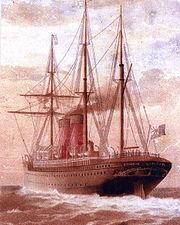
Ante Emilio Bolanča set sail into the world from Genoa on the steamship The Spartan Prince. He arrived in New York harbor on the 23rd of July, 1898.  He was received by his friend, Stjepan Baković, who lived at 177 Atlanta Avenue in New York.  As of the present writing, it is unknown as to what schooling Ante had, or where that schooling took place; what is known is that he was considerably more literate than the vast majority of Croatian émigrés of that time.  So, whether he had a formal education or he was self-schooled is still unknown.
From the information thus far gathered about Ante after his arrival in America, and after a period of time spent in New York City, we see he stayed in Butte, Montana in 1910 and was known as Anton Basetich.  The American Census documents from 1910 confirm that Anton was married at the time to 19-year-old Elsie, nee Coffin, from South Dakota.  From the same Census report, we learn that Anton was a journalist by profession. (The 1910 Census document erroneously records Anton as having arrived in the U.S. in 1903. Perhaps he came to Minnesota in that year.)

A year later, Anton and Elsie were living in Salt Lake City, Utah.  He was the editor of the Croatian Newspaper Radnička Obrana, (The Workers’ Defense). The Salt Lake City Directory of 1911 records that Anton was the Editor and Manager of the aforementioned newspaper, and that Emil Basetich was the President of the Slavonian Publishing Company. It is obvious that in both instances we are dealing with one and the same person.  Sadly, Anton’s wife Elsie died on the 16th of December, 1912.  According to the memory passed on in the family, Elsie died in childbirth of their firstborn, a girl.  It is not known with any certainty what became of the little girl.  It is thought that she was taken in by Elsie’s parents.
Following the death of his wife Elsie, most likely during 1913, Basetić moved from Salt Lake City to Duluth, Minnesota.  The Duluth City Directory of 1913-1914 indicates that the Slavonian Publishing Company‘s manager was Anton Basetich, while Milan Knezevich was the editor of Radnička Obrana. The newpaper was published in that city every Thursday.  That same directory of 1915-1916 indicates that Basetich continued to be the publisher of the newspaper, but was located at a new address.  As gleaned from the newspaper itself, the title of the publishing company was no longer known as the Slavonian Publishing Company, but as the Croatian Publishing Company. Clearly, Anton Basetić assumed ownership and editorial management of the Radnička Obrana. The newpaper had branch offices in Salt Lake City, Chicago, Milwaukee, and Gary. Indiana.
Though many Croatian newspapers saw the light of day in America, few of them survived for any length of time.  One of the rare numbers of Radnička Obrana to be found is the number dated March 11, 1916.  That edition indicates that it was the twelfth year of publication for that newspaper.  Clearly, this newspaper managed to survive longer than most Croatian publications in America at that time.
It would seem that around 1916, the Radnička Obrana ceased being published and that Anton moved from Minnesota to Chicago.  That same year, Basetić purchased the newspaper known as Hrvatski Rodoljub, (Croatian Patriot).  The paper was founded in 1915 and was published by B.F. Tolić in Pittsburgh, Pennsylvania.  Basetić transferred publication of the paper to Chicago.  This would indicate that he already lived in the city.
Between Yugoslavia and Croatia
This period of time was froth with war and was an especially worrisome time for Croatians in America as well as those in the homeland.  Aside from the wartime adversity, a deep political division and separation began to take shape among Croatians: there were those who were prepared to abrogate their national heritage and rights and eagerly accept unity with the Serbian Kingdom, and there were those who stood in defense of the right to Croatian Statehood.  Those in the first group were more vociferous, and political conditions then present stood in their favor.  The second group had to contend not only with the pro-Yugoslav element, but also with the burden of trying to prove to America and their fellow citizens (especially so after America’s entrance into the war in 1917) that they were not champions of Austria and the Central Powers, but simply desired freedom for their Croatian homeland.  So as to bring a shred of light into the political fog that overshadowed the time, a well-known and respected priest, Rev. Ivan Stipanović, established and published a Croatian journal, Rodoljub (Patriot), in Chicago in January of 1915.  Shortly thereafter (August of 1915), the journal’s name was changed to Hrvatski Katolički Glasnik, (The Croatian Catholic Messenger).  It assumed a newspaper format and became the voice of (almost all) Croatian Catholic priests in America.  Before the end of that same year, the paper established editorial links with Narodna Obrana that was published in Duluth, Minnesota, as well as with Hrvatski Rodoljub in Chicago.  With such combined forces, a group of Croatian patriots now began to publish Glasnik Istine (The Herald of Truth).  The editorial board resided at 2979 S. Wentworth Avenue, Chicago, Illinois.  Anton Basetić was chosen as its editor.  It appears that in 1916, Basetić’s Radnička Obrana changed it name to Narodna Obrana and subsequently melded into Glasnik Istine. Thus, he became its new editor.
While wartime blood flowed across the European front, a ferocious ideological war raged among the Croatians in America.  One group aligned with the Jugoslavenski Odbor, (The Yugoslav Committee) and welcomed, extolled, and aided the members of that committee on their arrival in the U.S., sending monetary aid and war volunteers.  Others were supporters of Croatian independence and warned about Greater-Serbian ideology and its future evil effects on the Croatian people.  A third group followed socialist ideas and also caused national and religious discord among Croatian émigrés across the world.  Under such conditions, Anton Basetić assumed editorship of the publication which by its orientation was Croatian and Catholic, and served as the representative and voice against the Yugoslav forces in Chicago and America.
Even prior to his assumption of the role as editor of the Glasnik Istine, Basetić wrote and spoke against the union with Serbia.  A significant event in the Croatian Community of Chicago serves as a primary example of his role among Croatian-American émigrés: on the 10th and 11th of March, 1915, in the LaSalle Hotel located in downtown Chicago, a Yugoslav Congress was held.  More than 550 delegates and guests to the congress were in attendance.  At the congress they spoke of the “homogeneity of the Yugoslav people” (naturally, the well-known Serbian in America delegate to the Congress, Dr. Paul Radosavljević, a professor at the University of New York, considered all Yugoslavs to be Serbs) and of the soon-to-be created Kingdom of the Serbs, Croatians, and Slovenes.  At the same time, a group of Croatians, mostly located around Wentworth Avenue in Chicago, held a massive counter-demonstration.  Some 3,000 Croatians gathered for that massive anti-Yugoslav counter-demonstration to hear one of its main speakers, namely, Anton Basetić.  Clearly, then, upon his move to Chicago and his undertaking of the role of editor of the Glasnik Istine, Basetić became a person of importance among Croatians not only in this metropolis but across all of America.
Before touching on his tragic death, it is appropriate that we say a bit more about his family.  Following the death of his first wife, Elsie (at the end of 1912), Anton married Sandra (Allessandra, Sanda) F. Herska while residing in Chisholm, Minnesota.  Sandra was from Severin na Kupi, located in the Gorski Kotar region of Croatia.  Two children were born from their union: Vera, a daughter, was born in 1916, in Minnesota, while Ivan (John) was born in 1919 in Chicago.

anton1

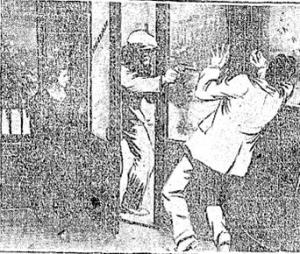
(The photograph of Anton Basetić and the drawing of the assassination are taken from the Chicago Daily Tribune, from November 6, 1921.)


The Assassination of Anton Basetić
On November 5, 1921, around 8:15 a.m., Anton Basetić left his home at 140 West 31st Street and arrived at the real estate office of Cannizzo, Jurko, and Company that was located on 2927 Wentworth Avenue, not far from his home.  Although the Glasnik Istine was printed by the Croatian Printery located a short distance away, Basetić, from all that can be garnered, chose, out of fear, to receive his mail at the aforementioned real estate office.  He picked up his mail on a daily basis.  That fateful morning, Marie Pullano, a 19-year-old clerk, was already at work in the office.  Upon the entrance of Anton Basetić, she alerted him that two unknown men were loitering aimlessly across the street from the office.  He thought she was frightened by them, and his response was: “Never mind, I’m here.  Don’t be afraid.”  Soon after, these two scoundrels entered the real estate office.  Marie and Anton went toward the door.  Marie opened one of the double-doors and asked what they wanted.  They remained silent.  One of the men stepped into the office, drew his pistol, and fired six rounds at Basetić as he stood alongside the young lady.  Two of the bullets struck their target—one in his shoulder and another in his neck.  A few short minutes later, Anton expired.  Marie, the clerk, fainted, while the two thugs dissapeared without a trace.  The entire tragic drama unfolded in a few short minutes.
All the newspapers in Chicago reported the incident and death of Anton Basetić.  They stressed that his death was of a political nature.  One of the newspapers cited the thinking of the police officials, namely, that his murder had the mark of international political intrigue.  In the meantime, the news reports fostered the erroneous suggestion that Anton Basetić was a fervent pro-Austrian partisan rather than stressing that he was an ardent patriot for the Croatian cause.  Even then, the well-known “logic” was in place: all who were not Yugophiles clearly had to be Austrophiles—later, after World War II, to be labeled as “fascists.”  Naturally, the police and newspaper reports of the incident failed to engage the question of who was behind the loathsome crime.  No serious police investigation of the murder ensued: the police did not concern themselves with who it was that wanted him dead.  They simply decided that the murder was “an accounting among the émigrés,” hence, the loss of a young Croatian life was of no consequence and not investigated, despite the fact that it occurred in the metropolis of Chicago and in broad daylight.
To this very day, Anton’s descendants hold to the passed-down conviction that his murder was the work of the notorious “Black Hand;” it is known only too well what sort of a bloody role that terrorist organization played in Serbia and beyond.  Although the organization was “officially” suppressed in 1917, it adherents continued their criminal work and Anton Basetić, at the very least, was a victim of their ideology.
Basetić was only 44 years of age when he was murdered.  He left behind a young wife, Sandra, and two infant children, as well as his child from his first marriage.  Out of fear, Sandra, along with her children, moved to Minnesota and spent the next six months there.  She returned to Chicago and struggled to raise her children.  Among other jobs, she worked as a cook in a student cafeteria at the University of Chicago.  According to the stories passed on by members of her family, she simply would not speak of the murder of her husband or of any political matters: she had her fill of such talk.  Her goal in life was to raise her children and set them on their way to success in life.  By all accounts, she was successful in that goal as were many other Croatian widows of her time and later.
In Conclusion
The martyrdom of Ante Emilio Bolanča, namely, Anton Basetić, was supressed and silenced at the time of his murder.  Silence about him and his assassination has endured for some 90 subsequent years.  This silence would have continued had not his two granddaughters, Sarah and Ann, the daughters of his son, Ivan, wished to know the truth about Anton, their grandfather.  Sarah succeeded in interesting me in this tragic incident as well.  She shared a good deal of facts about her grandfather that I relate in this article.  I am sincerely grateful to Sarah for having acquainted not only me, but Croatians in general, about her grandfather.  All the evidence indicates that he was the very first political martyr among the Croatian émigrés following the portentous and fateful year of 1918.
The assassinations of Anton Basetić and of other Croatian patriots across the world, remain largely unknown to us.  They await further investigation, so that we might give them honorable mention in the history of our Croatian Diaspora, as well as in the history of our homeland.

(English translation of the article „Anton E. Basetić – prva žrtva jugoterora u hrvatskoj emigraciji,“ published in Hrvatsko slovo (Zagreb), Year XVI, No. 817, December 17, 2010, p.16-17.)

ANTON E. BASETIĆ Prva žrtva jugoterora u hrvatskoj emigraciji

ANTON E. BASETIĆ

Prva žrtva jugoterora u hrvatskoj emigraciji

Hrvatsko slovo

17. prosinca 2010

Piše: Ante Čuvalo
Likvidacije Hrvata počele su već osnutkom Kraljevine Jugoslavije.  Prvom žrtvom drži se Anton Basetić, ubijen u Chicagu 1921.
Progon, svakovrsni progon, bio je jedna od povijesnih poveznica koja premošćuje vrijeme od krvavog rođenja do još krvavije smrti Jugo države.  No, velikosrpski teror u hrvatskim zemljama počeo je i prije ujedinjenja (počeo je u Vukovaru 9. rujna 1918.), a još osjećamo zadah smrti koja je harala i poslije njezine službene smrti.  Primarni srpski teror je također bio uzrokom terora na teror, ne samo među Hrvatima, nego i kod drugih koji su trebali nestati radi velikosrpskog projekta.  Ta megalomanska mora, koja je progutala toliko krvi i života, nažalost je i danas živa i svakodnevno je očitija i hrabrija!
O Hrvatima koji su ubijeni u emigraciji poslije Drugog svjetskog rata (najmanje 69) konačno se saznaje i u domovini.  Premda službeni Zagreb za ove (i druge) žrtve puno ne haje, ipak istina pomalo izlazi na svjetlo zahvaljujući i sudstvu drugih država, u prvom redu Njemačke.  Ali o teroru nad Hrvatima u emigraciji prije 1945. zna se vrlo malo, gotovo ništa.  Riječ je o još neistraženom dijelu hrvatske povijesti koji čeka da ga se domovina sjeti.
Prva žrtva jugoterora u Americi, a vjerujemo i u hrvatskoj emigraciji općenito, nakon ujedinjenja hrvatskih zemalja sa Srbijom i Crnom Gorom bio je Anton E. Basetić, urednik hrvatskih novina „Glasnik Istine“ u Chicagu.  Zbog svojih hrvatskih domoljubnih, odnosno protujugoslavenskih političkih stavova bio je mučki likvidiran „u sred bijela dana“ u Chicagu 5. studnog 1921.  Bilo je to ne samo ubojstvo novinara, nego i pokušaj zastrašivanja svih koji nisu bili voljni uhvatit se u novo jugo-kolo i zaplesati uz srpsku frulu.
Život i rad
antonAnton Basetić rođen je u Primoštenu 17. rujna 1877. (u crkvenim knjigama stoji 20. lipnja na jednom mjestu, a 20. rujna 1877. na drugom) od oca Ivana i majke Ane, rođene Makelja.  Obitelj je imala desetero djece.  Njegovo izvorno ime i prezime bilo je Ante Emilio Bolanča, koje je po dolasku u Ameriku promijenio u Anton E. Basetić/Basetich.  Nije jasno iz kojih razloga je promjenio prezime (donekle i ime) i zašto baš u Basetić, ali nalazimo da se i njegov brat Leon (rođen 11. travnja 1883., došao u Ameriku 24. listopada 1907.) po dolasku u Ameriku također služio prezimenom Basetić ili Bolanča-Basetić.
Ante Emilio Bolanča u svijet je odplovio iz Genove brodom „Spartan Princ“ i u New York stigao 23. srpnja 1898.  Išao je k prijatelju Stjepanu Bakoviću, 177 Atlanta Ave. u New Yorku.  Zasad nam nije poznato gdje, kada i koje škole je Ante pohađao, ali je zaisgurno bio pismeniji i učeniji od velike većine hrvatskih emigranata tog vremena.  Koliko je to bila formalna naobrazba ili se sam „u hodu“ doškolovavao ostaje nepoznanica.
Po onom što se dosad može pronaći, nakon dolaska i, vjerojatno, neko vrijeme boravka u New Yorku, Antu E. Bolanču 1910. surećemo kao Antona Baseticha u gradu Butte, Montana.  Američki dokumenti o popisu pučanstva iz te godine potvrđuju da je Anton tada bio oženjen devetnaestogodišnjom Elsie, rođenom Coffin u South Dakoti.  Iz istih dokumenata se vidi da je Anton po profesiji novinar.  (U ovom dokumentu se krivo tvrdi da je u SAD došao 1903.  Možda je te godine došao u Minnesotu.)
Godinu dana kasnije Anton i Elsie žive u Salt Lake Cityju, Utah.  Tu je bio urednik hrvatskih novina „Radnička Obrana“.  Naime, Salt Lake City Directory za 1911. navodi da je Anton urednik i manager spomenutih novina, ali i da je Emil Basetich predsjednik „Slavonian Publishing Co.“  Očito je da se radi o istom čovjeku.  Nažalost, 16. prosinca 1912. Elsie je umrla.  Po obiteljskoj predaji, umrla je rađajući prvo dijete, curicu.  Nije sigurno što je bilo od djeteta. Vjeruje se da su ga preuzeli majčini roditelji.

Među Hrvatima nastala je politička podjela,

između onih koji su htjeli jedinstvo sa Srbima

i onih koji su branili hrvtsku državnost

Nakon ženine smrti, vjerojatno tokom godine 1913., Basetić je preselio iz Salt Lake Cityja u Duluth, Minnesota.  Naime, Duluth City Directory za 1913.-1914. navodi da su „Slavonian Publishing Co.“, Anton Basetich manager, Milan Knezevich izdavač i urednik „Radničke Obrane“ u tom gradu.  Novina je izlazila svakog četvrtka. Directory za 1915.-1916. godinu piše da je Basetich sada izdavač istoimenih novina i adresa uredništva je drugačija nego godinu dana prije.  Iz novina se vidi da je izdavač ne više Slavonian, nego „Croatian Publishing Co.“.  Očito je da je Anton preuzeo vlasništvo i uređivanje „Radničke Obrane.“  Novina je imala povjerenštva u Salt Lake City-u, Chicagu, Milwaukee i u Gary, Indiana.
Puno je hrvatski novina u Americi pokrenuto, ali malo ih se održalo na životu dulje vremena.  Jedan od rijetko sačuvanih brojeva „Radničke Obrane“ je broj od 11. ožujka 1916. i tu čitamo da je to bilo dvanaesto godište tog tjednika, što znači da se ovo glasilo uspjelo održati dulje nego mnoge druge tadašnje hrvatske publikacije u Americi.
Moralo je to biti negdje tokom 1916. kad je „Radnička Obrana„ prestala izlaziti i Anton je preselio iz Minnesote u Chicago. Te godine Basetić je kupio novine „Hrvatski rodoljub“ (utemeljio 1915. i izdavao B. F. Tolić) u Pittsburgh-u i prenio uredništvo u Chicago, što znači da je on već tamo živio.
Između Jugoslavije i Hrvatske
Bila su to ratna vremena, posebice bremenita za Hrvate ne samo u domovini, nego i u Americi.  Osim ratnih nedaća, među Hrvatima je nastala duboka politička podjela, između onih koji su bili spremni odreći se hrvatskog državnog prava, i prigrliti jedinstvo sa Srbima i onih koji su stali u obranu hrvatske državnosti.  Prvi su bili grlatiji i svjetske prilike su im išle na ruku, a drugi su, osim borbe protiv projugoslavena, imali teret ukazivati Americi i svojim sugrađanima (posebice nakon američkog ulaska u rat 1917.) da oni nisu pobornici Austrije i Centralnih sila, nego samo ljubitelji hrvatske slobode.  Da bi u tu političku maglu unio zračak svijetla, poznati svećenik Rev. Ivan Stipanović počinje (siječanj 1915.) u Chicagu izdavati časopis „Rodoljub“.  Uskoro (kolovoz 1915.) časopis mijenja ime u „Hrvatski Katolički Glasnik“, poprima novinski oblik i postaje glasilo (gotovo svih) hrvatskih svećenika u Americi.  Još prije konca godine ova novina se udružuje s „Narodnom Obranom“, koja je izlazila u Duluth, Minnesota, i „Hrvatskim Rodoljubom“, te zajedničkim snagama počinju izdavati „Glasnik Istine.“  Uredništvo se nalazilo na 2979 S. Wentworth Ave., Chicago, a za urednika je izabran Anton Basetić.  Izgleda da je tokom 1916. Basetićeva „Radnička Obrana“ promjenila ime u „Narodnu Obranu“ i zatim se utopila u „Glasnik Istine“, kojem je on postao urednik.
Dok se krv prolijevala po europskim bojišnicama, među Hrvatima u Americi vodio se vrlo žestok ideološki rat.  Jedni su slijedili „Jugoslavenski odbor“, dočekivali, veličali i pomagali ljude iz Odbora te slali materijalnu pomoć i dragovoljce u rat.  Drugi su bili pobornici čuvanja i jačanja hrvatske državnosti te upozoravali na velikosrpsku ideologiju i njezine posljedice za hrvatski narod.  Treći su pak bili sljedbenici socijalizma i ubacivali dodatnu nacionalnu i vjersku smutnju među hrvatske emigrante.  U tim prilikama Anton Basetić postaje urednik glasila koje je bilo po orijentaciji hrvatsko i katoličko, te jedan od glasnogovornika protujugoslavenskih snaga u Chicagu i Americi.
Još i prije preuzimanja uredništva „Glasnika Istine“, Basetić je pisao i govorio protiv ujedinjenja sa Srbijom.  Jedan važan događaj dobro ilustrira njegovu ulogu u zajednici.  U Chicagu je 10. i 11. ožujka 1915. u hotelu LaSalle održan Jugoslavenski kongres na kojemu je sudjelovalo  preko 550 delegata i uzvanika.  Dok se tamo govorilo o jedinstvenom jugoslavenskom narodu (naravno, tad poznati Srbin u Americi dr. Paul Radosavljević, profesor na University of New York i delegat, sve ih je smatrao Srbima) i budućoj zajedničkoj državi, u hrvatskoj naseobini oko Wentworth ulice održan je masovni protuskup.  Na tom antijugoslavenskom okupljanju, koje je okupilo oko 3000 Hrvata, jedan od glavnih govornika bio je i Anton Basetić.  On je dakle poslije dolaska u Chicago i preuzimanja uredništva zasigurno postao osoba od velikog utjecaja među Hrvatima tog velikog grada ali i u cijeloj Americi.
Prije opisa njegove tragične smrti, red je još nešto reći o njegovoj obitelji.  Naime, poslije smrti njegove prve žene Elsie (krajem 1912.), Anton se 18. srpnja 1914. vjenčao sa Sandrom (Allessandra, Sanda) F. Herska u mjestu Chishlom, Minnesota.  Sandra je bila rodom iz Severina na Kupi u Gorskom kotaru.  U braku se rodilo dvoje djece.  Vera je rođena 1916. u Minnesoti, a Ivan 1919. u Chicagu.
Atentat u Chicagu
anton1Dana 5. studenog 1921. oko 8:15 Antun Basetić je iz svog doma na 31. ulici došao u ured trgovine nekretnina „Cannizzo, Jurko & Co.“, koji je bio na Wentworth ulici, nedaleko od njegove kuće.  Premda je „Glasnik Istine“ tiskan nedaleko u „Hrvatskoj tiskari“, Basetić je, po svemu sudeći iz opreza, poštu primao u uredu spomenute tvrtke i tamo danomice po nju dolazio.  Toga kobnog jutra u uredu je već bila mlada činovnica Marie Pullano i po Antonovu ulasku u ured upozorila ga da se dvojica nepoznatih muškaraca motaju na drugoj strani ulice ispred ureda, na što joj je odgovorio: „Ne boj se, ja sam tu“, misleći da ih se ona boji.  Ubrzo su ta dva (ne)čovjeka došla na vrata ureda, a Marie i Anton su pošli prema vratima.  Marie je otvorila jedno od dva staklena krila i upitala ih što žele.  Ništa nisu rekli, a jedan je zakoracio unutra, potegao pištolj i ispucao šest naboja prema Basetiću koji je stajao kraj djevojke.  Pogodila su ga dva hica,  jedan u rame, a drugi u vrat i Anton je za nekoliko minuta izdahnuo.  Mlada činovnica pala je u nesvijest, a ubojice su bez traga pobjegle. Tragična drama odigrala se u nekoliko minuta.
Sve chicaške novine objavile su izvješća o smrti Antona Basetića, naglašujući da je to bilo ubojstvo političke naravi.  Jedne novine citiraju mišljenje ljudi iz policije i kaže da ovo ubojstvo ima međunarodno zaleđe i da je to kulminacija međunardnih političkih trzavica.  Ali u tim izvješćima se provlači netočnost da je Anton bio zagrijani pro-Austrijanac, a ne da je bio hrvatski domoljub.  Slijedila se i tad već dobro nam poznata „logika“: svi koji nisu bili jugofili bili su austrofili (a kasnije fašisti).  Naravno, policija i novinska izvješća i ne ulaze u pitanje tko bi mogao stajati iza tog gnusnog zločina.  Nije bilo nikakve ozbiljnije istrage.  Za policiju su to bila „emigrantska posla“ i nikome nije bilo stalo istražiti zašto je izgubio život jedan Hrvat usred Chicaga i tko ga je ubio.
Među Antonovim potomcima i danas se čuva predaja da je atentat izvršila „Crna ruka“.  Oni i ne znaju što je bila „Crna ruka“, ali zna se dobro kakvu je krvavu ulogu ta teroristička organizacija odigrala u Srbiji i dalje.  Premda je ona bila službeno ugušena 1917., njezini sljedbenci su nastavili zločinački rad i, najvjerojatnije, Anton Basetić je bio žrtva u najmanju ruku njezine ideologije.
Basetiću je bilo samo 44 godine kad je ubijen.  Iza njega je ostala mlada žena Sandra s dvoje nejake djece i još dijete iz

Sve chicaške novine objavile su izvješća

o smrti Antona Basetića, naglašujući

da je to bilo ubojstvo političke naravi

prvog mu braka.  Sandra je od straha pokupila djecu, otišla u Minnesotu i tamo provela šest mjeseci.  Ponovo se vratila u Chicago, radila i mučila se da bi odgojila svoju djecu.  Među ostalim, radila je i kao kuharica u studentskom domu na University of Chicago.  Po pričanju članova njezine obitelji, nikad nije htjela govoriti o muževu ubojstvu ni o politici.  Bilo joj je svega dosta.  Njezin životni cilj bio je svoju djecu „na noge podići“ i u tome je bila vrlo uspješna, kao i mnoge druge hrvatske udovice.
Prešućena žrtva
Mučeništvo Ante Emilia Bolanče, odnosno Antona Basetića, bilo je prešućeno u vrijeme njegove pogibije, a o njemu se šutjelo i sljedećih 90 godina.  Bilo bi i potpuno zaboravljeno da ne bi njegovih dviju unuka (Sarah i Ann), kćeriju sina Ivana, koje su htjele doznati istinu o svom djedu.  Sarah je i mene zainteresirala za ovaj tragičan slučaj i sa mnom podijelila dosta podataka koje sam ovdje iznio.  Zahvaljujem joj što je upoznala ne samo mene, nego i hrvatsku javnost s djelovanjem i žrtvom svojeg djeda koji je, po dosadašnjim spoznajama, prvi politički mučenik u hrvatskoj emigraciji poslije zlokobne 1918.
Nedavno smo u „Hrvatkom vjesniku“ iz Melbourna (14. listopada 2010.) mogli pročitati svima nama iznenađujuće otkriće kako je 1. veljače 1942. „poludjeli“ četnik eksplozivom ubio 14 i osakatio još 15 Hrvata u Kalgoorlie-Boulder-u u Zapadnoj Australiji.  Ubojstva Antona Basetića 1921. i Hrvata u Australiji 1942., kao i druga po svijetu za koja još ne znamo treba istražiti i dati im dužno mjesto u povijesti hrvatske emigracije i domovine.

CRTICE IZ POVIJESTI HRVATA U AMERICI

Od Šibenika do New Yorka – „bez šolda“

umbri Bilo je to početkom 20. stoljeća kad se iz Hrvatske i drugih zemlja srednje i južne Europe masovno išlo tražiti sreću u Americi.  Išlo se iz potrebe – iz želje za kruhom i slobodom, vjerovalo se onima koji su prodavali ne samo putne karte nego i „maglu“, išlo se jer „svi idu“, a išlo i samo da se ide….
Tjelesno dobro razvijen, okretan i bistar momčić Božo Gicano iz Šibenika je gledao kako ljudi iz njegova mjesta svakodnevno odlaze u tu bajoslovnu Ameriku.  Njegov stariji prijatelj Srećko (vjerojatno rođak) već je bio u New Yorku, gradu koji je služio kao vrata tisućama novodošljaka na novi kontinent i u novi život.  Naravno, i Božo je sanjao kako će mu život biti sretan i lijep u tom velikom i bogatom svijetu, te čvrsto odluči poći preko oceana.  Njegova upornost i dobra sreća su ga na neobičan način dovele do željenog cilja.  Božino putovanje postade čak i atrakcija za novinare.  O njemu New York Times objavi članak na temelju kojeg su ove crtice i napisane.
Božin prvi pokušaj odlaska u svijet završio je neuspješno.  Naime, radi njegove upornosti, otac mu je jednog dana dao 100 forinti i svoj blagoslov, i dečko krene u Ameriku, ali se Božo ubrzo vratio doma.  Navodno ga je netko pokrao prije nego je stigao do mjesta polaska u daleki svijet.  Ostade praznih džepova, pa kamo će nego ćaći i materi.  Tko zna, možda je mali negdje novac i potrošio čim je kliznio ispod očeve kontrole.  Bilo kako bilo, novaca više nije bilo, a Boži se išlo u svijet.  Zato se on odluči prošvercovati do Amerike.  Mora da je mali bio „na vraga umetnut“!  Nekako se dočepa Trsta i tu se potajno ukrca na istoimeni brod do Aleksandrije u Egiptu.  Ali šta će on u Egipatu, on je pošao u Ameriku!  U Aleksandriji se prošvecuje na brod Fabyan i stigne u Liverpool u svibnju 1902.  Znao je Božo odakle brodovi redovito plove u New York.  Tu se nekako provuče bez karte na brod Saxonia, koji je polazio u New York.  Ali, na nesreću, otkriju ga i izbace s broda.  Dvadeset tegobnih dana je Božo proveo u Liverpoolu črkajući sretan trenutak.  Možemo samo zamisliti kako mu je bilo samu i bez „kinte“ u džepu u tuđem svijetu, ali velika želja za Amerikom mu je zasigurno pomogla izdržati sve nezgode.
Božin drugi pokušaj ukrcavanja bio je sretniji: nekako se prošvercao na Umbriu, tada jedan od najvećih i najpoznatijih putničkih brodova koji su redovito plovili od Liverpoola do NewYorka i natrag.  Ukrcao se u pola noći 13. lipnja 1902., dan prije nego je Umbria zaplovila preko Atlantika.  Božo se sakrio u kotao pomoćnog motora („donkey engine“) koji se upotrebljavao za destiliranje vode, ali samo u rijetkim slučajevima.  Božo je imao sreću da do takve potrebe nije došlo, jer da jest, to bi ga stajalo života.  Ipak je netko od putnika znao da je on na brodu i gdje se sakrivao, te mu je donosio komadiće kruha i kavu da bi preživio.  Je li to bio neki naš Jure, Mate, Ante… kome se Božo povjerio, tko zna.  Šestog dana plovidbe, na pučini Atlantika, jedan od brodskih inžinjera slučajno otkrije Božu u mračnoj i vrućoj kotlovnici.  Po izlasku na palubu, zamazanu i poderanu, netko od putnika mu je čak darovao odijelo, da momak pristojno izgleda.  Kad ga je uprava broda počela ispitivati nitko ga nije razumio niti su znali kojim jezikom govori.  Što će od njega nego ga povesti dalje, ta ne će ga baciti u more.  I tako naš Božo besplatno stigne do cilja, u New York, gdje ga predadoše službenicima imigracijskog centra na Ellis Islandu, kroz koji su tad prolazile na stotine tisuća imigranta godišnje.
Božo se sad našao u rukama onih koji odlučuju hoće li zakoraciti u zemlju o kojoj je sanjao ili će ga vratiti odakle je i došao.  U prvim trenucima su pomislili da je Mađar.  Ali, na Božinu sreću, tu se ubrzo nađe imigracijski inspektor George E. Schubert, koji otpočne s njim razgovarati i, na radost Božinu, Schubert veli kolegama, nije ovaj dečko Mađar, nego je došao iz Šibenika u Dalmaciji, iz grada u kojem sam i ja rođen.  Kakva slučajnost i sreća!  Od tog trenutka sve se odvijalo brzo i dobro.  Božine su se želje ispunile bolje nego je i sanjao.
Your browser may not support display of this image.Kad je šef ureda na Ellis Islandu, gospodin Williams, čuo priču o Božinu putovanju i da je pošao prijatelju Felixu/Srećku/ Gicanu u New Yorku rekao je da ovakav dečko, nakon tolikih napora da bi stigao u Ameriku, zaslužuje da ga se odmah pusti otići njegovu prijatelju Srećku i da može slobodno ostati u Americi.  Ali Božo nije imao Srećkovu adresu.  Jedino je znao da živi u New Yorku.  Ali Gospodin Schubert je znao za naseobine hrvatskih imigranata u gradu, a jedna od njih je bila i naseobina Dalmatinaca u Harlemu.  U roku od sat vremena Schubert je pronašao gdje Srećko stanuje, te povede Božu vlakom od Treće avenije do 111. ulice, zatim su pošli pješice do zgrade broj 2099 na Drugoj aveniji i na trećem katu nađu na okupu skupinu imigranata.  Kad su se došljaci pojavili na vratima, onaj najkrupniji među iznenađenim „domaćinima“ skoči, te sav uzbuđen počne vikati: „Božo, Božo“ i objeručke zagrli novodošlog „Amerikanca“.  Možemo samo zamisliti Božinu radost da je nakon toliko muke i „snalaženja“ mogao zagrliti svog prijatelja Srećka u dalekom New Yorku, kamo se uputio iz rodnog im Šibenika bez novčića u džepu.  Je li Božu sreća pratila u Americi kao što ga pratila do Amerike, ostaje zagonetka.
Ante Čuvalo – Chicago
city city2
Ellis Island & New York početkom 20. stoljeća

Jottings about Croatians in America

Josip F. Mikulec

Tireless World Hiker

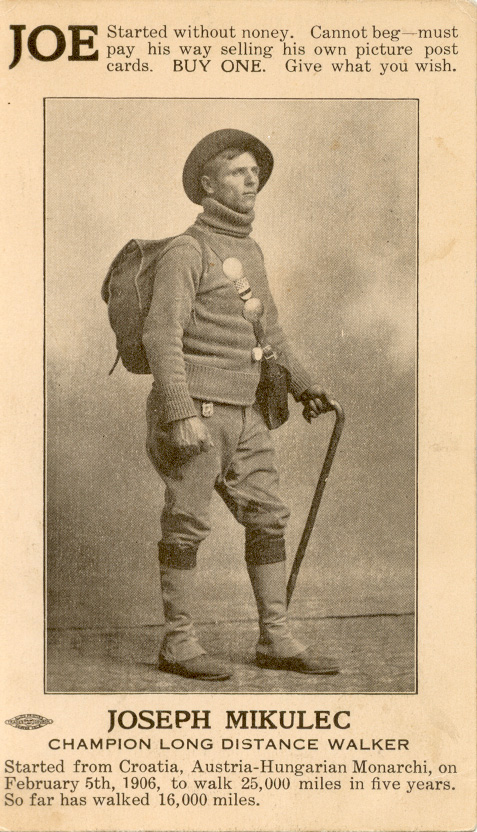
Some one-hundred years ago, the American press (and, I’m sure, elsewhere as well), reported on the then young, and I must say, very brave Croatian adventurer, Joža Mikulec.  He set out to circumnavigate the globe on foot in the span of five years.  With the start of this journey, Joža, one might say, became a perpetual wanderer.  Mostly hiking, he traveled the world some 28 years and achieved a degree of fame for having collected more than 30,000 autographs of world-famous people.  From time-to-time, some of the more notable American newspapers kept track of his wanderings across this globe of ours.

I haven’t noticed that this interesting, if not especially notable Croatian was mentioned among his fellow Croatians—at least not through the past decades or so.  I haven’t investigated as to how much was written about him in the Croatian press of the time.  I’ll leave that to those in Croatia who might be interested in his story.  Let this brief glance at Mikulec serve as my contribution to a fuller biography of this American Croatian who, by all accounts, was a restless soul who was always ready to break-in a new pair of shoes.

Joža Mikulec first caught my eye as I was searching trough some microfilm images of the Chicago Hrvatska Zastava  (The Croatian Banner), dated the 24th of January, 1908. The Banner carried a translation of an article that appeared in the Star Journal from Pueblo, Colorado, dated the 23rd of November, 1908.  Joseph Mikulec came through Pueblo at the time, and the Journal carried the story of his journey from Zagreb to Pueblo.

Among other facts, the article stated that Mikulec, a “young Croatian,” had arrived in Pueblo.  He had entered into an agreement with Matica Hrvatska (Croatian Cultural and Publishing Society) in Zagreb to hike 25,000 miles in the course of five years, and, upon completion of his trek that he would set to paper his journey for them. Matica, in return, would award him 50,000 crowns (c.$10,000 at the time) and also publish his account. The Star Journal stated that Josip was to have sent his report to Matica each and every week updating his journey.

Mikulec departed Zagreb on the 5th of February, 1906 and by the time he arrived in Pueblo, he had walked 15,800 miles. He had already exceeded his plan by 800 miles. Mikulec set out on his journey without any sort of material support. He simply sold picture postcards along the way so that he could have enough cash to feed himself. One could add, he found many kind and generous people along the way who were willing to come to his aid.

The Mikulec’s path took him across Italy, France, Spain and Portugal. He set out from Portugal by way of boat to Cape Town in Africa. From Cape Town he set sail for Argentina. He intended to cross from Mendoza into Chile, but, because of intense cold and snow in the Andes, he set out for Buenos Aires instead. Mikulec encountered particular difficulties when crossing the Argentinean Pampas. Besides the unfavorable terrain for hiking, and the lack of food and water, he was beset by robbers as well. That was toward the end of 1907. While in Buenos Aires, Mikulec came into contact with the richest Croatian in Argentina, namely, the ship-owner, Nikola Mihanović. Mihanović was most welcoming to him.

From Buenos Aires, Mikulec set out for Montevideo and then on to the North through Brazil (Santos, Rio de Janeiro, Vitoria, and Bahia). Once again, he was robbed while in Brazil, however, it was the mosquitoes that gave him the biggest pain. He set out from Brazil as a deckhand on a steamer bound for the U.S. He arrived in Philadelphia and from there, he set out for Baltimore and Washington. Leaving Washington, he set out through Virginia, West Virginia, Kentucky, part of Ohio, onto Indiana, Illinois, Missouri, Kansas, and into Colorado. Wherever he traveled, he sought out the autograph of important people and state and civic officials. He would ask that they affix the official seal of their jurisdiction to the signed autograph. He had a special book made just for that purpose, and he guarded it against loss faithfully.

Colorado’s Star Journal article printed his comments of praise for America and the Americans. They mentioned that he arrived in Springs, Colorado on the 22nd of November, 1908, and that he would temporarily reside with Nikola Badovinac. After leaving the company of Badovinac, Mikulec continued his journey toward the western shores and on into Portland. From Portland he planned to set out for Australia and from there to Japan, across Asia, and on through Siberia by way of train to St. Petersburg, Russia.

I have not succeeded in finding a description of Mikulec’s journey to Portland and beyond. However, I did find an article in the Chicago Daily Tribune, dated the 29th of July, 1910, wherein they report that the world traveler, Mikulec, arrived in Chicago on the 27th of July, and that the local Croatians were preparing a welcoming party for him on the 30th of July, in the National Hall on 18th Street. Mikulec would then set out for Springfield, capital city of Illinois, so as to obtain the autograph of the Governor just as he had done in all the states that he had traversed. The article also mentioned that he had an authentic autograph of President Taft. The article went on to say that Mikulec had worn out 42 pairs of shoes and that his journey was on schedule as he had planned and agreed to with Matica Hrvatska. In fact, he had said, he was 19 days ahead of his planned schedule.

From this “encounter” with Mikulec in Chicago, I was unable to thus far learn anything more about his journey until his reappearance in Chicago. The Tribune once again on the 21st of February, 1917—a full seven years later—writes that Mikulec once again arrived on foot in Chicago, and that his agreement with Matica Hrvatska was abrogated because he failed to fulfill his promise to journalize his travels as promised. They said that instead, he wrote what might be seen as a romanticized novel. This time they asserted that he had worn out 36 pairs of shoes. This would mean that Mikulec, despite his disagreement with Matica, continued his journey nonetheless and that he started anew to record how many shoes he had worn out. Meanwhile, the more important announcement in the article was the fact that Mikulec, adorned the length of his body with various medals of honor that he had received, had made a visit to the City Clerk’s Office of Marriage Registrations so that he could marry his fiancée, Mary Medrić. Mary was 36 years old at the time, and Mikulec was three years her senior. The author of the article notes that Mikulec, at the time of his registration, “is now plain Chicago ‘Joe’ instead of Croatian ‘Joža’,” and that the young couple would now reside at 1332 W. 18th Street, in Chicago. At the time, that part of Chicago had a very large Croatian community. One would think that Joe Mikulec, now married, would have settled down to a “normal” life among his fellow Croatians in Chicago. However, the newsman deceived himself: Mikulec remained the “Croatian Joža” and continued his adventurous journey across the world.

The New York Times, dated the 2nd of September, 1923, carried an article about Joseph Mikulec, the “collector of autographs.” The article goes on to relate that Mikulec had already traversed the globe twice, and had gathered autographs of important personages wherever he traveled. He found himself in New York city at the time of the article along with his leather-bound Autograph Book. The book, at the time, weighed a full 57 pounds. John F. Hylan, the mayor of New York, had signed Mikulec’s book as well as those who were well-known persons among the industrialists, artists, politicians, and others. The signatures of American Presidents, T. Roosevelt, W. H. Taft, W. Wilson, W. G. Hardy, C. Coolidge, along with other notables such as Lloyd George, Lord Curzon, the Prince of Wales, the President of China, Admiral Togo, J. Pierpont Morgan, and various senators, governors, ambassadors, etc. The article goes on to give a brief account of Mikulec’s first journey across the world, and adds that Joža’s full time residence was now (September, 1923) in Philadelphia. It goes on to say that he became a naturalized citizen in December of 1910, and that from 1910 through 1923 he journeyed through Australia, New Zealand, China, Japan, India, Egypt, the Holy Land, and South Africa. Mikulec told the press that he was quite exhausted and that he wished to settle down into a “normal” life on some farm in the plains of America that has fertile soil. Along with this wish, he hoped to see his book of autographs in some appropriate museum. Meanwhile, wanderlust, and, perhaps, a new pair of shoes, won out again, and Mikulec set out from New York for the West.

Within two months time, (20th of November, 1923) the New York Times once again carried a somewhat longer article about Mikulec. The article goes on to say that Mikulec arrived once again in New York along with his 58 pound, 2,896 page book of autographs. Upon entering the city, Joža immediately set out for the Rosenbach rare book store so as to attempt to sell his book of autographs. His main reason for doing so was that he was exhausted of lugging that heavy book around. It is interesting to note that the New York Times newsman accompanied Mikulec to Rosenbach’s firm. The newsman reports that Mikulec bemoaned the fact that he had not succeeded in gathering so much as a single autograph of any monarch. He sought $10,000 for his collection. Dr. Rosenbach felt the collection was worth at least that amount, but that he did not traffic in such books. He, however, did suggest that Mikulec seek out Henry E. Huntington in California who, perhaps, might be interested in buying his collection. Hand on forehead, Mikulec bemoaned the fact that he had collected Huntington’s autograph but that it had not occurred to him to offer Huntington his collection.

We meet Mikulec once again on the pages of the New York Times, on the 30th of October, 1927. This time, the paper simply published a picture of Mikulec showing his book of autographs to admirers on the streets of Berlin. Clearly, Joža did not find a buyer for his collection of autographs as he had hoped to do in New York some four years earlier. Instead, Mikulec continued his wandering across the world.

The last article I was able to find about Mikulec was also in the New York Times, dated the 29th of April, 1928. The headline read: “Man 28 Years on Tour Collects Autographs.” The sub-head read: “Wheels 55-Pound Volume Containing 30,000 Signatures in a Special Carriage.” The article says that Mikulec was 50 years old at the time, that he was from Croatia, that he set out across the world some 28 years ago and gathered autographs of renowned people along the entire way including the autographs of several European rulers, and nine American Presidents as well as those of well-known artists, writers, actors, scientists, politicians, religious leaders, etc. He lugged his collection in a specially designed cart, but had to haul the book on his back as he visited various offices of those whose autograph he sought. Mikulec said that he had traversed hundreds of thousands of miles on foot gathering these autographs and that he would continue his journey.

Thanks to the internet (boards.ancestry.co.uk) we found the following facts: Josip Franjo Mikulec was born on the 15th of January, 1878, in the village of Krušljevo selo, Croatia, near Zagreb. His father was Josip Mikulec, and his mother was Kata Novosel from the same village. The internet also informs us that Mikulec arrived in America in 1905, that he married Anna Stiopu on the 20th of June, 1908 in Westfield Chautauqua County, NY, and that on his application for citizenship (September, 1910) he indicated that he was not married.

The New York Times article dated the 2nd of September, 1923 states that he was born in Stubice, Croatia. Krušljevo selo is near Stubičke toplice.  What is more, the article of 1928 states that Mikulec had been on his journey for the past 28 years. If that is accurate, then we must assume that he could have arrived in America even before 1905 and then returned to Croatia to enter into his agreement with Matica Hrvatska. He set out on that agreed-to journey on the 5th of February, 1906. It is reasonable to assume that Mikulec was somewhat acquainted with the world prior to his setting out on his hike across the world. As far as his marriage is concerned, if he did in fact enter into a union with the Rumanian poetess, Anna Stiopu, who also set out on foot across the world in May of 1905, it would seem that the marriage of these two world-travelers did not last long; meanwhile, we are told that Josip married in Chicago in 1917.

As I said at the start, this is no more than a small excerpt of the life of a Croatian who wandered the world endlessly. Many questions arise such as those that ask: where and how did he die; did he have any children; what all lands did he hike through; do any reports that he was to have sent to Matica Hrvatska exist, that is, if they ever existed at all; and especially pertinent, whatever happened to his book of collected autographs? Should all the details of Joža’s travels ever become know, and the whereabouts of his book of collected autographs, the name of Josip Mikulec would and should find its way into the Guinness Book of World Records.

It is my hope that this article will arouse the interest and attention of its readers about this tireless Croatian adventurer and hiker, and that this article will inspire someone to seek out, record, and publish a fuller biography of Josip Franjo Mikulec, as well as to discover where and when he ended his life and what became of his treasured book of autographs gathered over so many years.

Ante Čuvalo—Chicago

Translated by Duško Čondić from Croatian into English

****

* Picture 1 – in possession of Ante Čuvalo
* Picture 2 – taken from the web: boards.ancestry.co.uk
* I am grateful to the staff of the Robert Hoag Rawlings Public Library in Pueblo for providing me with a copy of the Mikulec article from Star Journal, November 23, 1908.

Crtice iz povijesti Hrvata u Americi

JOSIP F. MIKULEC

NEUMORNI PJEŠAK KUGLOM ZEMALJSKOM

Unazad oko stotinu godina američke (vjerujem i drugdje) novine pisale su o tad mladom, moramo reći i veoma hrabrom, hrvatskom pustolovu Joži Mikulcu, koji se uputio pješice za pet godina obići kuglu zemaljsku. Tim putovanjem, moglo bi se reći, Joža postaje vječiti putnik. Putovao je širom kugle zemaljske, najviše pješice, barem 28 godina i proslavio se prikupljanjem preko 30.000 autografa raznih svjetskih uglednika. Neka važnija američka glasila pratila su, s vremena na vrijeme, njegov hod kroz ovaj naš bijeli svijet.

Nisam zapazio da se ovog, ako ne baš znamenitog, ali svakako zanimljivog Hrvata spominjalo među nama u Americi, svakako ne zadnjih desetljeća. Koliko se o njemu pisalo u Hrvatskoj u njegovo vrijeme i kasnije, nisam imao prigodu istraživati. To ostavljam znatiželjnima u domovini. Ovo moje upoznavanje s Mikulcem nek bude doprinos budućoj potpunijoj biografiji toga američkog Hrvata nemirna duha i uvijek spremna derati đonove novih cipela.

Joža Mikulec mi je prvi put „zapeo za oko“ kad sam pretraživao mikrofilmove čikaške Hrvatske Zastave i u broju od 24. prosinca 1908. pročitao prijevod članka iz dnevnika Star Journal od 23. studenog 1908 iz Pueblo, Colorado. Naime, koncem studenog 1908. Josip Mikulec je boravio u tom gradu i novine su donijele podulje izvješće o njegovu putovanju pješice od Zagreba do Puebla.

Među ostalim se veli, da je tih dana u grad Pueblo stigao Mikulec „mlad Hrvat“, koji je napravio ugovor s Maticom hrvatskom u Zagrebu (njezinim nakladnim zavodom) da će za pet godina proći 25.000 milja pješice i nakon putovanja napisati putopis, a Matica će mu isplatiti 50.000 kruna i izdati knjigu. Zato je Josip, veli novina, tokom putovanja svaki tjedan slao izvješće Matici o prevaljenom putu.

Mikulec je pošao iz Zagreba 5. veljače 1906. i do dolaska u Pueblo prevalio 15.800 milja, te da je nadmašio svoj plan i raspored putovanja za 800 milja. Putovao je bez ikakvih materijalnih sredstava, jedino je prodavao razglednice i od toga kupovao hranu. A moglo bi se zasigurno dodati, da je bilo uvijk dobrih i darežljivih ljudi koji su mu priskakali u pomoć.

Put iz Hrvatske našeg je Jožu vodio preko Italije, Francuske i Španjolske do Portugala. Otud je brodom otplovio u Cape Town, a odatle je otputovao u Argentinu. Htio je preći iz Mendoze u Čile, ali zbog hladnoće i snijega u Andama, pošao je prema Buenos Airesu. Posebice je imao problema preko provincije Pampa; osim neprikladna terena za hodanje, trpio je nestašicu hrane i vode, a usput su ga orobili i razbojnici. Bilo je to 1907. godine. U Buenos Airesu Mikulec se susreo s najbogatijim Hrvatom u Argentini, brodovlasnikom Nikolom Mihanovićem, koji ga je vrlo gostoljubivo primio.

Iz Buenos Airesa je otišao u Montevideo, zatim prema sjeveru kroz Brazil (Santos, Rio de Janeiro, Vitoria, Bahia). I u Brazilu je bio orobljen, ali su mu tamo najviše jada zadavali komarci. U Brazilu se, kao radnik, ukrcao na parobrod i stigao u Philadelphiu, a odatle je pošao u Baltimor i Washington – kroz Virginiju, Zapadnu Virginiju, Kentucky i dio Ohia, Indianu, Illinois, Missouri, Kansas do Colorada. Kamo god je prolazio, tražio je razne uglednije osobe da mu dadu autograf i, u slučaju državnih i drugih službenika, da udare pečat grada, općine ili države u njegovu knjigu napravljenu za tu svrhu, a koju je pažljivo čuvao.

Članak iz Puebla donosi i Josipove pohvale Americi i Amerikancima, te veli da je Mikulec 22. studenog stigao u mjesto Springs, Colorado, i da će odsjesti kod Nikole Badovinca, te zatim nastaviti put prema zapadnoj obali, a iz Portlanda je trebao poći u Australiju, pa preko Japana (Azije), te sibriskim vlakom preko Rusije do St. Petersburga.

Opis Josipova putovanja do Portlanda i dalje još nisam uspio pronaći, ali sam pronašao članak u Chicago Daily Tribune (29. srpnja 1910.) u kojem piše da je svjetski putnik Mikulec stigao u Chicago 27. srpnja, da Hrvati za njega priređuju doček za nedjelju 30. srpnja u Nacionalnom domu na 18. ulici, te da zatim odlazi u Springfield, glavni grad države Illinois, da bi od guvernera mogao dobiti autograf, kao što je dobio od drugih guvernera kroz čije države je prolazio. Također se navodi da je imao autentičan autograf predsjednika Amerike Tafta. Članak završava da je Mikulec dotad poderao 42 para cipela i da mu putovanje ide po planu kako je ugovorio s Maticom, i čak da je je 19 dana ispred planiranog vremena.

Iza ovog mog „susreta“ s Mikulcem u Chicagu, nisam mogao ništa pobliže saznati o nastavku njegova putovanja do njegove ponovne pojave u Chicagu. Gore spomenuta čikaška novina od 21. veljače 1917. (znači blizu sedam godina kasnije) piše da je Mikulec ponovo dopješačio u Chicago, da mu je propao ugovor s Maticom hrvatskom jer nije ispunio obećanja, da je počeo pisati putopis, ali se to izrodilo u romantični roman. Ovaj put se navodi da je poderao 36 pari cipela, što bi značilo da je Mikulec, premda nije ispunio Matičine uvjete, nastavio pješačiti i dalje, te valjda iznova počeo brojati koliko je poderao cipela. Ali najvažnija vijest u članku je ta da je Mikulec dan prije, „nakićen duzinom“ raznih odličja na grudima, sa svojom zaručnicom Mary Medrić posjetio gradski ured za vađenje vjenčanih dozvola. Ona je tada imala 36, a on 39 godina. Pisac članka veli da je Mikulec tad postao „obični čikaški ‘Joe’, umjesto hrvatskog ‘Jože’“ i da će mladi par živjeti na adresi 1332 W. 18. ulica, Chicago. Usput, u tom dijelu grada bila je jedna od tadašnjih velikih hrvatskih naseobina. Dakle, bilo bi za očekivati da se sad Joe Mikulec oženio, smirio i nastavio „normalan“ život među Hrvatima u ovom gradu. Ali, novinar se prevario, on je i dalje ostao „hrvatski Joža“ i nastavio putovati svijetom.

Naime, New York Times od 2. rujna 1923. donosi članak o Josephu Mikulcu, „sakupljaču autografa“. Članak ističe da je Mikulec dva puta obišao svijet pješice, sakupljajući autografe uglednijih osoba kamogod je prolazio. Tih dana je bio u New Yorku i njegovu ogromnu, kožom uvezanu knjigu s autografima (koja je tad težila 57 funti) potpisao je gradonačelnik John F. Hylan, kao i važnije osobe iz poslovnih krugova, kazališta, politike i drugi. U knjizi su bili potpisi američkih predsjednika T. Roosevelta, W.H. Tafta, W. Wilsona, W.G. Hardya i C. Coolidgea, kao i mnogih drugih uglednika: Lloyd George, Lord Curzona, Princa od Walesa, predsjednika Kine, admirla Togoa, J. Pierpont Morgana, raznih senatora, guvernera, ambasadora itd. Članak donosi sažetak priče o njegovu prvom putovanju i dodaje da je Jožin stalan boravak u to vrijeme (rujan 1923.) bio u Philadelphiji i da je u prosincu 1910 postao američki državljan, te da je otada, to jest od 1910. do 1923. obišao slijedeće zemlje: Australiju, Novi Zeland, Kinu, Japan, Indiju, Egipat, Svetu Zemlju i Južnu Afriku. Mikulec je za novine izjavio da je već umoran, da se želi smiriti i otpočeti „normalan“ život na kakvoj manjoj farmi u američkim plodnim ravnicama, a da bi knjigu sa autografima želio vidjeti u kakvu muzeju. Ali, ipak je želja za putovanjem pobijedila pa je Joža tada iz New Yorka krenuo prema zapadu.

Samo dva i pol mjeseca kasnije (20. studenog 1923.) New York Times opet donosi članak o Joži, ovaj put malo podulje štivo. Veli se da je Joža ponovo stigao u New York noseći svoju kjigu od 2.896 stranica i tešku 58 funti. Joža je došao u grad i odmah posjetio tvrtku Rosenbach, trgovinu rijetkih knjiga, da bih unovčio dragocjene autografe. Glavni mu je razlog za prodaju bio umor od nosanja te velike knjižurine. Zanimljivo je da ga je u trgovinu pratio novinar New York Timesa, koji opisuje Jožu i njegovo podrijetlo. Novinar dalje piše da je Joža vječiti putnik, nabraja iskupljene autografe znameniti ljudi, kako se Joža žali da nije uspio dobit autograf ni jednog kralja, itd. Mikulec je tražio 10.000 dolara za knjigu a vlasnik Dr. Rosenbach je prosudio da je to realna cijena, ali da se on ne bavi takvim knjigama, nego mu je preporučio posjetiti Henry E. Huntingtona u Kaliforniji, koji bi možda otkupio knjigu ove vrste. Mikulec se uhvatio za glavu i kazao da ima Huntingtonov autograf, ali da mu nije palo na pamet ponuditi mu knjigu kad je bio kod njega.

Jožu Mikulca ponovo susrećemo u New York Timesu 30. listopada 1927., ali ovaj put novina donosi samo njegovu fotografiju na kojoj znatiželjnim prolaznicima na ulicama Berlina pokazuje svoju ogromnu knjigu autografa. To znači da Joža nije prodao knjigu i da se nije smirio, kako je priželjkivao dok je bio u New Yorku četiri godine ranije, nego je nasatavio putovati svijetom.

Zadnji članak o njemu kojeg sam mogao pronaći u New York Timesu je od 29. travnja 1928., a naslovljen je „Čovjek 28 godina na turneji skupljanja autografa“. Podnaslov glasi: „Vozi u posebnim kolicima 55 funti težak svezak koji sadrži 30.000 potpisa.“ Članak navodi da je Joža tada imao 50 godina, da je iz Hrvatske, da je prije 28 godina pošao po svijetu skupljajući autografe poznatih osoba i da knjiga sadrži potpise nekoliko europskih vladara, devet američkih predsjednika i mnogobrojnih glasovitih umjetnika, pisaca, glumaca, znanastvenika, poltičara, vjerksih uglednika itd. Knjigu je vozio na posebno sagrađenim kolicima, ali ju je ipak morao na leđima nositi u urede osobama od kojih je tražio potpis. Josip izjavljuje da je prošao stotine tisuća milja i da nastavlja svoje putovanje svijetom prikupljajući autografe.

Zahvaljujući internetu (boards.ancestry.co.uk) nalazimo slijedeće podatke: Josip Franjo Mikulec rođen je 15. siječnja 1878. u selu Krušljevu od oca Josipa Mikulca i majke Kate r. Novosel iz istog sela. Također se, u istom izvoru, navodi da je Mikulec došao u Ameriku 1905. i da je oženio Annu Stiopu 20. lipnja 1908. u Westfield, Chautauqua County, NY, a da na molbi za američko državljanstvo (rujan 1910.) piše da nije oženjen.

U članku u New York Timesu od 2. rujna 1923. se kaže da je rođen u Stubici, a Krušljevu selo je nedaleko od Stubičkih toplica. Nadalje, članak iz 1928. navodi da Josip putuje već 28 godina, ako je to točno onda je on mogao biti u Americi i prije 1905., a zatim se vratiti u Hrvatsku i dogovarati s Maticom putovanje oko svijeta, koje je otpočeo 5. veljače 1906. Vjerovati je da je Joža ipak bio barem malo upoznao svijet prije nego se poduzeo poći pješice oko kugle zemaljske. Što se tiče ženidbe, ako je sklopio brak sa Annom Stiopu, rumunjskom pjesnikinjom koja je iz Rumunjske krenula pješice u svijet u svibnju 1905., izgleda da brak dvoje svjetskih lutalica nije trajao dugo i Josip se ponovo ženi 1917. u Chicagu.

Kako rekoh na početku, ovo je samo mali doprinos biografiji jednog Hrvata, vječitog pješaka lutalice po svijetu. Nameću se mnoga pitanja na koja bi trebalo odgovoriti, kao na primjer: gdje i kada je umro, da li je imao potomstvo, koje je sve zemlje propješačio, da li postoje izvješća koja je slao (ako je slao) Matici, a posebice gdje i kako je završila ta ogromna Jožina knjiga s autografima? Ako se pronađu detalji o Jožinim putovanjima i autografima, vjerujem da bi njegovo ime moglo i trebalo biti u knjizi Guinnes World Records.

Nadam se da sam člančićem barem malo probudio pozornost čitatelja na ovoga hrvatskog neumornog svjetskog putnika pješaka, te da će ovaj dopis nekoga ponukati istražiti, napisati i objaviti potpuniji životopis Josipa Franje Mikulca te pronaći gdje je i kako su završili on i njegovo blago kojeg je sakupljao toliko godina.

Ante Čuvalo – Chicago

***

* Slika 1.- u vlasništvu A. Čuvalo
* Slika 2. – uzeta sa web-a: boards.ancestry.co.uk
* Zahvaljujem osoblju u Robert Hoag Rawlings Public Library in Pueblo za kopiju clanka o Josipu Mikulec iz Star Journal, 23. studenog, 1908.

Our Declaration – A 1916 declaration by Croatian and Slovene Priests in America

Our Declaration

(A 1916 declaration by Croatian and Slovene Priests in America)

As Croatians and sons of the nation of Croatia, and of our fraternal Slovene lands, from the very start, we hereby announce and confirm our political stance as regards our homeland during these bellicose times—times which hold seen and unforeseen consequences.

We stand on the national, state, historical, and written rights of the Nation of Croatia and her people, which are contained, among others, in the Coronation Oaths taken by Croatian rulers as far back as 1490 and beyond, in fact, up to this very day; these rights are also contained in the Electoral Charter from the year 1527, as well as in the Pragmatic Sanction dated 1712. In short, we stand by the program as represented by the Party of Right from the year 1894 and as developed and promulgated long since by the apostle of Croatianism, Dr. Ante Starčević, and as adopted by our Slovene brothers at the gathering in Trsat.

We believe in the strength, national awareness, and patriotism of the Croatian and Slovene Peoples whom much more powerful enemies were unable to crush, as witnessed by 14 centuries of our history. In that already realized past, we look to our freedom and independence.

We believe that the Croatians and Slovenes, who are bound by faith, history, culture, and a contemporary national consciousness, factors that are powerful features in the nation of all peoples, comprise one whole group of peoples in southern Europe, and, as such, have all the necessary prerequisites for independence.

We know that from its inception in 924, the Croatian Nation, stretching from Mt. Triglav to the Drina and from the Danube to the Adriatic has never ceased to be, not even in its darkest days in the past, nor in more recent times from 1790 to the present. She has remained as a Nation and as a People, and will continue to remain so. Her loyal sons will not traffic with her rights.

We know that official Austria and Hungary, Turkey and Italy, aided by Great Britain, have, through the centuries, encroached and truncated the sacred rights and freedom of the Croatian People. The past history of the Croatians and Slovenes has condemned publicly and continues to condemn those very same peoples for all the wrongs and violations of their rights. Through the centuries we have fought and stood firm for our rights, rights which we will continue to value and honor, and which we ourselves must and will ultimately accomplish. Those who doubt the abilities of people to free themselves, thereby deny existence to them. Peoples who gain their freedom at the hands of others soon become their subordinates.

In the name of humanity and the right of a People to exist, we strongly condemn Hungary’s politics of force, and Austria’s approval of such politics. We seek the right to freely develop and will continue to seek the right for Croatians to retain their own lands and sea, as well as all their other rights. In the name of all the Croatian and Slovene blood spilt on the battlefields of Europe, we will seek that all wrongs against us be corrected, for that spilt blood cries out for revenge from God who is the avenger of all wrongs.

Herein we assert that the so-called Serbian element which was born and lives in the nation of Croatia during the past fifty years, or, better said, since they emerged on the political scene in Croatia, has always and faithfully stood on the side and at the service of the enemies of Croatia—especially the Hungarians, Austrians, and Italians. As to the question of the Slavs in general, and the South-Slavs in particular, our thoughts are guided by those expressed in the writings of our Croatian statesmen—patriots in life and work—Eugen Kvaternik and Ante Starčević, as well as by the mournful experience related to this question which befell our great Bishop Strossmajer from the very founding of the Jugoslav Academy and up to the very year 1885. When Bishop Strossmajer wanted to visit Serbia, the response of the Serbian government was that it could not guarantee his life or safety if he were to visit his flock which lived in Serbia. The fanatcism of the Serbs, a particular characteristic of theirs, was previously seen as being strong, as based on their oft repeated syntagm: “Serbians all and everywhere.” That fanaticism is now even stronger. According to their notion and teaching, all the Balkan Peoples should be subsumed by Serbia. We do not wish to become Serbs, or Yugoslavs, nor Serbo-Croatians, but we will remain Croatians, brothers to all remaining Slavs; however, each in his own house, in his own land, and within the scope of his own rights. From the time our forefathers settled in our present homeland, we have evolved and we have created our own history in this manner.

With Italy’s entrance into the present war, she commended the insane Austrian politics against the Croatians and Slovenes as related to their Littoral and Dalmatia. By being favorable to the Italian minority, Austria prepared the way for the Italian aggression. The French, English, and Russian Trilateral Memo of Understanding promised Italy ownership of the Adriatic and possession of our shore and the lands between Trieste and beyond. We most strongly condemn this traitorous act carried out by the great powers. England did not offer the Island of Malta to Italy as a reward for entering the war—an island she rules but which is inhabited only by Italians; nor did she offer them greater rights in the Mediterranean wherein she and the French rule, and even less, dominion in Egypt. France did not grant Italy the territories of Savoy or part of Tunisia where more than one and one-half million Italians live. Russia, which has interests in the Kingdoms of Serbia and Montenegro, acceded to the promises made to Italy such that no one asked Serbia or Montenegro at the time the promise was made to Italy; rather, they simply informed it (Serbia) of what they sold to Italy. These who thunder and rule in Europe did not offer that which, by virtue of the principles governing nationhood, they should have offered; rather, they gifted the very eyes and door of Croatian state and people to treacherous and enemy Italy, so that she might close the door and eyes of the Croatian Nation forever. They offered the bones and flesh of the Croatian and Slovene Peoples at the marketplace so as to buy Italy’s entrance into the war, a war where Croatian and Slovene heroes are dying while defending their home and hearth from the treachery committed against their Peoples by France, England, and Russia. In the announcements to their peoples, these powers stated that they are going to war for sake of freeing small nations. Their history belies such an announcement since they never freed so much as one People. To the contrary, they, in fact, always opposed such freedom; nor should they castigate Germany or Austria in that regard. They promised foreigners a full two-thirds of Croatian lands such that one-third of its 110,000 square kilometers will cease to remain part of Croatia once the fundamentals of the Trilateral Agreement and Italy take place…“They divided my garments and cast lots for them.”

A free and united Croatia will order its international and political relationships, and will enter into agreements and laws according to the principle which states: “regnum regno non praescribit leges”—“One nation does not prescribe laws to another.”

Previous [pro-Yugoslav] declarations, starting with that from the gathering in Chicago on the 10th of March, 1915, fail to mention any sort of guarantees sought by an independent People as a condition of their independence; quite to the contrary, they obliterate the basis for individual and national existence for the Croatians. They divest Croatia of its past, its rights, its national name, and its national significance.

Thus far, there is no authoritative declaration on anyone’s part that Croatia will remain independent in “Yugoslavia”; to the contrary, representatives of the parties that have the authority to issue such a declaration made pronouncements at their gatherings and in their speeches in favor of a monarchical Serbia. We do not want the nation of the Croatian People to be swallowed by a unitary “Yugoslavia,” or better said, a Greater Serbia, a Croatia that is at least three centuries older than the nation of Serbia. We remain loyal to God, to our People and Homeland, and to him to whom our people conveyed their sovereign right to rule, and which persists to this day, and is sustained through the Crown of Croatian rulers.

In conclusion, and in the uncertain position in play on these shores wherein our immigrants live, let the tried and tested words of the defenders of our People’s rights, namely, Dr. Matko Laginje from Istria, representative Stjepan Zagorac from the province of Croatia, Rev. Ivo Prodan from Dalmatia, Bishop Šarić from Bosnia, and Dr. I Kreka, from Kranjska in Slovenia, serve as our guiding beacon.

Let the war end as it will, we do not abrogate our stand; rather, we will seek an Independent Croatian Nation along with all those rights possessed by a sovereign people.

Rev. Dr. E. Kajić

Rev. Pet. Čančarević (after signing the document, he withdrew his name)

Rev. Bosiljko Bekavac

Rev. Ivan Raab

Rev. Ambroz Širca

Rev. D. Krmpotić

Rev. A. Živić

Rev. Leon Josip Medić

Rev. Anton Sojar

Rev. Francis Podgoršek

Rev. Irenej Petričak

Rev. Mihael Tušek

Rev. Fr. Racinger

Rev. M. Hranilović

Rev. Valentin Mihelić