Memorandum of the Croatian National Council of North America (1933)

MEMORANDUM

The Croat clings stubbornly to

freedom which has been transmitted to him

by his ancestors for so many centuries.

CROATIAN NATIONAL COUNCIL

Youngstown, Ohio, United States of America

“These are the ends for which the associated peoples of the world are fighting ….:

…. 2. The settlement of every question, whether of territory, of sovereignty, of economic arrangement, or of political relationship, upon the basis of the free acceptance of that settlement by the people immediately concerned, and not upon the basis of the material interest or advantage of any other nation or people which may desire a different settlement for the sake of its own exterior influence or mastery.”

PRESIDENT WILSON,

Address at Mount Vernon,

July 4, 1918.

“It is an old and indestructible demand of the Croatian People, that it should live in its own, sovereign, and independent state.”

D. HRVOJ,

Croatian Representative,

November 23, 1918.

Memorandum

Whenever a nation, or a state, becomes so “divided against itself” that the dissatisfaction, felt by one or more elements composing it, with their position in that state, and the intensity of their desire to break away from it, greatly out-weigh, on their part, all considerations favorable to its preservation and the retention of the status quo, even if this status be slightly modified, such a state—the lesson of history is unmistakable—cannot endure.  Such a state, moreover, is a standing danger to the peace of the neighboring nations, who are drawn into the conflict either by the very discord in, and the instability of, the country of incidence, or by the vortex formed by its ultimate sinking and vanishing from the surface.
The kingdom of Yugoslavia—formerly the kingdom of the Serbs, Croats and Slovenes—is a state, in which the discord between the component parts and the dissatisfaction of some of those parts with the ruling section have reached such heights and such intensity of feeling, that, if nothing is done to ease the strain, an open outbreak of hostilities is extremely probable, nay, inevitable.
What effect that happening would have on the peace in Southern Europe should not be a mystery to anyone familiar with the general situation in that part of the world.
At the present time, the only power, which keeps the discordant elements in Yugoslavia together, is the brutal force possessed and con– trolled by the ruling section, while the centrifugal forces consist of the desires and tendencies of most of the other sections to free themselves from the persecution and exploitation by the rulers.
The first and foremost of these sections—one that contains more than one-third of the total population of Yugoslavia—are the Croats, whose desire for freedom and independence is by no means unreasonable or whimsical, but is well founded on facts, and on the unfortunate experience they went through during the fifteen years of being a part of Yugoslavia.
The most important of these facts and experiences—the principal reasons for the Croatian demands and position—are as follows:

Croatian National Rights and Traditions.

I. The Croatian People represents a distinct, full-grown and highly civilized nation, with a fully developed national consciousness, based on twelve centuries of separate statehood and of continuous historic development, political, cultural and economic.

Fully organized State since Eighth Century

The main body of the Croatian people—seven of its strongest and largest tribes—came to present-day Croatia in the second quarter of the seventh century at the invitation of Emperor Heraclius, as the emperor’s allies in his fight against the Avars. In a bitterly fought war they succeeded in routing the Avars completely, and in conquering all the territories between the Danube and the Adriatic Sea, which they kept then for themselves, as their permanent habitation. Assimilating and absorbing all of the smaller Slavic tribes which had preceded them into this land, they were in a very short time able to organize their national state, which became as early as the middle of the eighth century an important factor in South-Eastern Europe. In the year 925, Croatia became a kingdom, which remained for two centuries the most powerful—with the exception of the Eastern Empire—and the best organized state in the Balkans and Central Europe.

In Personal union with Hungary

In 1102, the majority of the Croatian nobles elected as the king of Croatia the Hungarian ruler Koloman.  Thereby Croatia entered into a personal union with the kingdom of Hungary, preserving in that union not only the continuity of its separate statehood, but also the full sovereignty of the Croatian nation. This point is well established and is best illustrated by the fact that in 1527 the Croatian Diet elected as the king of Croatia Ferdinand I of Austria, quite independently and long in advance of the Hungarians.

Member State of Hapsburg Empire

By this election of Ferdinand all of Croatia—except Bosnia and Hercegovina then under Turkish rule—came into that combination of states, from which there developed in time the Austro-Hungarian Monarchy, the Hapsburg Empire.
Although even then, while a part of this empire, Croats were successful in preserving the internal autonomy of their country and the political individuality of their nation, the powers of Vienna and Budapest were yet able to encroach upon their rights and violate their interests in a sufficient degree to make the Croatian people justifiably dissatisfied with their status and with the treatment accorded them by the common rulers. This dissatisfaction became especially strong after 1849, when a regime of cruel absolutism was established, which—by greatly diminishing the scope of Croatian national autonomy, and by continuing the division of Croatian people in two separate political bodies—served well the selfish interests of the associated nations, but was very detrimental to the political, cultural and economic interests of all Croats.

Complete Independence regained 1918

In accordance with the truths expressed in the first paragraph of this Memorandum, the final result of the above mentioned state of affairs was, that—at the first opportunity they had—Croats broke away from their exploiters, and made their country again completely independent. The opportunity was given them by the developments in the world-war, and the independence was proclaimed by the Croatian Sabor (Diet), as the legal bearer and representative of the Croatian national sovereignty, on October 29, 1918—two weeks before the armistice on the Western front.

Treachery and Fraud of 1918.

II. The union of Croatia with the kingdom of Serbia was concluded, on the Croatian side, by politicians who had absolutely no authorization for such an act. The method of the union and even its earliest results was entirely adverse to the wishes and expectations of the Croats. For these reasons the act of the union was never ratified by the Croatian people, but was, on the contrary, overwhelmingly rejected by them, not only at the elections for the Constituent Assembly in 1920, but also at every other opportunity which they had before and since that time.

The idea of united front of the South-Slavs

During the long fight against the supremacy of Austria and Hungary a conclusion was reached by a number of Croatian leaders that, when the complete independence of Croatia is finally regained, a special arrangement will have to be made in order to protect it from new assaults by the old enemies.  An ideal protection, many thought, would be found in the establishment of a united front of all the South-Slavic nations, Slovenes, Croats, Serbs and Bulgars, which could find its expression in a common united state, organized either as a federation or confederacy of free and autonomous peoples.

During the war

In accordance with this thought, whose popularity rose in proportion to the growing hegemonistic tendencies of the Austro-Hungarians, those Croatian leaders, who had been able to leave the country before the outbreak of open hostilities in 1914, together with some Slovenes and Serbs from the lands of the Monarchy, constituted themselves into a “Yugoslav Committee”, the purpose of which was to work for the liberation of all the South-Slavs from the Austro-Hungarian rule and their ultimate union with Serbia and Montenegro into a common state, which would act as the protector of the liberty and territorial integrity of each nation joining it.
Inside the country, in Croatia, this program was also gaining momentum. Its most open and most radical champion was then the Starchevich’s Party of Rights, which, on June 5, 1918 adopted a resolution, whose most important clause was the following:

Expected retention of Croatian statehood

“We demand liberty and the union of all our people into a national state of the Slovenes, Croats and Serbs, which would preserve all the separate (national) individualities of our trinomial people, and guarantee the continuity of all the historic politico-juridical structures on its territory. On the basis of our own state-rights, we particularly demand the preservation of the continuity of the distinct Croatian statehood.”

Free State of the Slovenes, Croats and Serbs

This passage expresses not only what the members of the Starchevich’s Party of Rights thought, but also what the great majority of Croats wished, hoped for, and confidently expected from the union. In that expectation, the same declaration of the Croatian Diet, which proclaimed the complete independence of Croatia, expressed also the willingness of the Croats to join “a united, national, sovereign State of the Slovenes, Croats and Serbs, which would include all the territories in which this trinomial people now lives, irrespective of any provincial or international boundaries.” At the same sitting the Croatian Diet also recognized the National Council of the Slovenes, Croats and Serbs—organized some time before—as the de facto government of the State of the Slovenes, Croats and Serbs—a fully sovereign and independent state, which was established on the basis of that declaration, and which included all the South-Slavic lands of the (former) Austro-Hungarian Monarchy.
The duties and powers temporarily entrusted to the National Council SHS included those which up to that time were exercised either by the common government at Budapest, or by the central government at Vienna, or by the emperor; they also included the authority to enact necessary emergency legislation. The Council, however, was given no authority to conclude, on its own responsibility, a definite union with either Serbia, or any other -nation. The idea was to first complete the organization of the new State SHS, and then to enter, on a footing of full equality, into discussions with the constitutional representatives of Serbia, with the view of finding and establishing a mutually satisfactory basis, on which the union would ultimately be enacted.

The Geneva Protocol

The task of entering these discussions the Council entrusted to its own president, Doctor A. Koroshetz; to the president of the Yugoslav Committee of London, Doctor A. Trumbitch, and to a few other delegates. The meeting with the representation of Serbia—consisting of the prime-minister, Mr. N. Pasich, and of the chiefs of all the larger political parties—took place at Geneva, November 6-9, 1918. The result of the ensuing conference was the so-called “Protocol of Geneva”, which, although not quite satisfactory from the Croatian standpoint, was yet much more so than the act of Dec. 1, which superseded it. The Protocol, namely, not only accepted the principle of the complete equality of the State SHS with the kingdom of Serbia, but also left to the first named state its full sovereignty and self-government—with the National Council of Zagreb as the highest authority—until a new constitution had been adopted by the proposed Constitutional Assembly.

Intrigues and Nov. 24

Such an arrangement, however, was exactly what the real (though invisible) government of Serbia—a clique of militarists, financiers and politicians, with the prince-regent Alexander as one of the group—did not want. While the telegrams sent from Geneva were mysteriously “lost on the way”, this clique succeeded—by propaganda and cajolery, as well as by intrigues and various underhand deals—to so influence the membership of the National Council SHS at Zagreb, that it finally fell victim to the designs of the plotters, and decided (Nov. 24, 1918) for an immediate union with Serbia, conferring at the same time the highest executive authority on its prince-regent, Alexander Karageorgevitch.
Although the declaration, which proclaimed the above decision, contained also a few of what they considered as “saving clauses”, about which more will be said later, the members of the Council caused an irreparable mischief by their hastiness: Notwithstanding the fact that they had clearly overstepped their authority—which, of course, made their act constitutionally illegal—yet they had succeeded in giving over into the hands of the above mentioned ruling clique of Serbia all the real power in the whole country, administrative as well as military, opening thereby the way for all the misuse of that power, and for all the tyrannical persecutions, in which even some of them, themselves, later were victims.  This power, moreover, allowed Belgrade to manipulate further developments and arrangements connected with the organization of the united state in such a way, that Croats, instead of finding in the union a protection for their national independence and for the integrity of their territory, only found in it a monster, which has robbed them of both.

Beginning of terrorism

Immediately, namely, after the proclamation of December 1, 1918, Croatia was overrun by detachments of the Serbian army and gendarmerie, and a rule of terror and intimidation was introduced. The favorite method of this terror was and is the beating and flogging of the Croatian peasants and the incarceration of their leaders. The immediate motive for these atrocities was the fact that Croatian people—in contrast with the majority of their politicians, members of the National Council SHS—had a better sense of realities and of their national rights, and declined to accept the arrangement of Dec. 1 as final or legally binding.  In April 1919 they sent a petition with 157,669 signatures, to the Peace Conference at Paris, which petition pointed out the fact that, by their act of Dec. 1, the National Council SHS had clearly exceeded its authority, and that, therefore, this act was null and void.

Croats decline to accept the arrangement of Dec. 1

In November 1920, at the elections for the Constituent Assembly, Croats reiterated this stand.  More than three-fourths of all the Croatian votes were cast for parties — primarily the Croatian Peasant Party — whose programs included the non-recognition of the legality of the said act.  This position, as all the later parliamentary elections showed, was never changed by the Croatian people.

Broken Pledges.

III. Unauthorized on the Croatian side as it was, and such as it was, the Pact of the Union-if such a name could be given to a number of documents and declarations, the most important of which were the National Council’s resolution of Nov. 24, 1918, and the prince-regent’s address accepting the same—was afterwards broken, and violated in its most import- ant provisions, by the Serbian government and the executive head of the Serbian state.
In the National Council’s resolution of Nov. 24 the most important of the saving clauses”—on the basis of which many of the Croatian members, who would not have done so otherwise, voted for its adoption—was the following:

Constitution adopted contrary to preliminary provisions

“The final organization of the new state can be determined only in a general Constituent Assembly of the whole united nation of the Slovenes, Croats and Serbs, by a two-thirds majority of votes ….  For the Constituent Assembly is specifically reserved to determine: The Constitution, including the form of government—monarchy or republic,—the internal organization of the state, and the fundamental rights of citizens”.
In the address by which the prince-regent of Serbia, in behalf of that nation, accepted the Council’s declaration, and proclaimed the union of Serbia with the State of the Slovenes, Croats and Serbs, we find this passage:
“In regard to the wishes and opinions with which you have acquainted me, and all of which I and my government unreservedly accept, the government will at once undertake to bring to realization everything you stated regarding the transitory period till the meeting and the dissolution of the Constituent Assembly, and also everything you stated regarding the election and the organization of that Assembly”.
However, when the Constituent Assembly finally convened, more than two years later—the intervening time was utilized by the ruling clique to engineer the elections to its own advantage—the new constitution was not adopted by a two-thirds, but by a simple majority, only 223 out of 419 members having voted for its adoption. Even this simple majority, moreover, could be secured only after several smaller groups had been openly bought by the government; the expropriated Bosnian begs, controlling the Bosnian Moslems’ Party, receiving, for instance, 100 million Dinars. Out of 91 Croatian representatives only 11 voted for the new constitution, while 51 members of the Croatian Peasant Party, faithful to the principle of non-recognition of the original act of the union, never took their seats in the Assembly.
Eleven out of ninety-one, a little more than 12%! Yet, in November and December 1918 no cry was heard oftener than the assertion, that there would be no “majorization” in the Constituent Assembly of either of the uniting peoples, i. e., that no constitution would be adopted, unless it received the support of the majority of each, the Slovenian, the Serbian, and the Croatian representation.

Inequality in rights and privileges

Another provision contained in the “Pact of the Union” and announced with all the loudness possible was the principle of the full equality in civic rights and privileges of all citizens, regardless of their being Slovenes, Croats, or Serbs.
In reality, as soon as the union was carried through in the above described manner, it became evident, that being a Croat was a terrible handicap to all those who had any business with governmental agencies and particularly for those who were qualified for, and wished to enter, any branch of the government service. The Serbian ruling clique and the Serbian politicians had plenty of their own henchmen to place in the government service, and the question of qualifications was not considered one of importance.  There were many instances of former clerks with only a couple of years of public school education displacing law-school graduates with 15 or 20 years of experience, in the important office of district commissioner.
Army, finances, railroads, public instruction, diplomatic corps and foreign service—all these departments of government were filled with Serbs, protégés of the Serbian politicians, and in none of these departments was there ever much of a chance for a Croat, unless, of course, he was willing to become useful, not to the people, but to the camarilla.
In the Austrian-Hungarian army there were always from ten to twenty commanding generals who were Croats.  In Yugoslavia, which was supposed to be “their own” country to the Croats, there were at one time more than 80 generals, and not one of them was a Croat, although there still lived several of the former Austro-Hungarian high officers of Croatian nationality, who had rendered, during the critical period of October and November 1918, a great service to the cause of liberty of all the South-Slavic peoples.
This simple example may serve as a fair illustration of the “equality in privileges and civic rights” as between the Croatian and Serbian citizens of Yugoslavia.

Dictatorship—violation of the original “pact”

Still another cardinal provision in that “Pact” concluded between representatives of Serbia and the members of the National Council SHS was the unconditional stipulation that the united country would be run in accordance with the principles of democracy and parliamentarism.
In the above mentioned address of acceptance of the National Council’s declaration of Nov. 24, the prince-regent made the following pledge:
“Faithful to the example and to the counsels of my exalted parent, I shall be the king to only the free citizens of the State of Serbs, Croats and Slovenes, and shall always remain faithful to the great constitutional, parliamentary and broadly-democratic principles, based on the right of general popular franchise”.
This pledge was reiterated by the prince-regent in his first proclamation addressed to the people, and dated January 6, 1919, in the following words.
“As the king of a free and democratic people, I shall steadfastly, in everything I do, remain true to the principle of constitutional and parliamentary government . . .”
On the tenth anniversary-day of this last quoted proclamation, i. e., on January 6, 1929, king Alexander made another one by which he suspended the constitution, dissolved the parliament, and set up an absolutist dictatorship.

A Medieval Conspiracy.

IV. In setting up the dictatorship, the real rulers of Serbia have not only removed from their authority in Croatia the last remaining vestige of legality, but, since the preliminary steps leading to dictatorship included the murdering of foremost Croatian leaders, they have also made any reconciliation between Croatia and Serbia—for as long at least as they are the masters in the latter nation—quite impossible, except, of course, on the basis of complete restoration to the former of all the national and state rights.

Croatian opposition

The fraudulent manner in which the union with Serbia was executed, and the terrible misrule which followed that union, were naturally resented by the Croatian people, who in a short time developed a strong opposition to the whole system of government which was imposed on them against their will, and under which they were subjected to a reign of brutal terrorism. Since the very first elections held in the new state—those for the Constituent Assembly, in the fall of 1920—the Croatian voters expressed their dissatisfaction with the conditions by electing to the Belgrade parliament ever increasing numbers of deputies, who were opposed to the whole system on which the country was organized.
The Croatian opposition was becoming ever stronger. The ruling clique of Belgrade felt itself really endangered, and particularly so, when, through the efforts of Croatian deputies, one of their own number—R. Pasich, the son of the former veteran premier—had been publicly convicted for corruption, shady dealings, and misappropriation of -public property. Then, for the first time, rumors of an impending suspension of the parliamentary principle began to circulate in Belgrade coffeehouses and newspaper offices.

Croatian leaders doomed

The resistance of the Croats, however, was still increasing. Using the Belgrade parliament as the medium, through which they could be most easily heard, Croatian leaders were raising a cry of protest, which was becoming ever louder. The ruling camarilla was in a tight corner, but it was still far from being ready to give way to the will of the people. Instead, it decided: “Parliamentary must go, but, before this can be done effectively, Croatian leaders must first be put away . . where they could hold no speeches, and write no articles for the papers . . .”
June I 8 and 19, 1928 were busy days for some people in Belgrade. One of the busiest places was the king’s palace, where a great many conferences took place during those two days. One of the most frequent visitors to the palace was a Serbian representative, whose name was—Punisha Rachich. On the night of June 19, Punisha was there again and spent several hours in a talk with the Marshal of the King’s Court, Drag. Jankovitch.

Murder in the parliament

On June 20, this representative, a member of the parliamentary majority, asked to be recognized by the speaker. Afterwards he seemed to change his mind. But at the direct urging by the speaker—also, of course, a member of the parliamentary majority—he went to the rostrum and, immediately upon arriving there, he produced a revolver, which he leisurely proceeded to empty into a group of Croatian leaders. Result of the shooting: Two Croatian deputies dead, three wounded, one of the wounded being the chief of the Croatian Peasant Party, Stephen Radich, who died from the consequences of the shooting a few weeks later.
The first object of the conspiracy was attained. The way to the second was now open.
Dictatorship was proclaimed some six months after the shooting.

The Plight of Croatia.

V. Since one party to the Pact of the Union of December 1, 191 8, the National Council SHS, had no authority to conclude it; and since the other party to it, the king and the government of Serbia, had afterwards broken and violated its most important provisions: therefore, that pact is legally null and void, and the rule of Serbia over Croatia cannot be considered as resting on any other foundation, but on that of brut- al force. The main effects and consequences of that rule of force for Croatia were, and still are: the annihilation of the Croatian national individuality and of distinct Croatian statehood; the subordination of Croatian national and racial interests to those of Serbia; maladministration; economic exploitation of Croatia by the Serbian rulers; deliberate restraint of the cultural progress in Croatia; and a reign of terror and oppression.

Instead of better security — annihilation

ABOLITION OF THE STATE OF CROATIA. For twelve hundred years the Croatian people lived in their own national state. This state was at first completely independent, but since 1102 its independence of action was somewhat limited by the personal union with Hungary and, afterwards, by its becoming a member-state of the Hapsburg Empire. During all this time, however, Croatia preserved its individuality and distinctness as a nation, as well as the autonomy of its internal affairs. Resenting the hegemonistic policies of Hungary and the centralizing efforts of Vienna, and the encroachments upon their national rights and privileges, Croats made use of the opportunity given them by the developments in the world war BY MAKING THEIR COUNTRY AGAIN COMPLETELY INDEPENDENT. This newly won independence was, unfortunately, short-lived. Through treachery and fraud Croatia came into the grasping claws of imperialistic Belgrade, WHOSE FIRST MAJOR ACT, WHEN IN POWER, WAS THE ABOLITION OF THE SEPARATE CROATIAN STATEHOOD AND ANNIHILATION OF THE CROATIAN NATIONAL INDIVIDUALITY. Croatia was wiped off the map of Europe, its inhabitants transformed into a subject-people, its territories made into a domain for exploitation by the ruling class of Serbia.
Denationalization of the Croatian people was one constant policy of the Belgrade rulers. Since the establishment of the dictatorship this policy is particularly pronounced.  The use of the very names of “Croat” and “Croatia” was forbidden by a decree of the dictator, and also the Croatian flag, and every other emblem of Croatian national distinctness. The present generation of Croats is being forcibly prevented from using and honoring all that, which countless generations before it had zealously preserved, and had left to it, as its rightful heritage.

Betrayal of Croatian interests

SUBORDINATION OF CROATIAN NATIONAL INTERESTS IN THE FOREIGN POLICY OF YUGOSLAVIA. One of the main arguments propounded by the advocates of the union with Serbia among the Croatian politicians was, that such union would serve as a preservator for the integrity of the Croatian national territory.  This argument was proved as faulty, and the expectation on which it was based as unfounded, when a great part of Croatia was lost to it, only through either the criminal negligence or deliberate planning on the part of the Serbian diplomacy.

The terrible cost of “liberation”

ECONOMIC EXPLOITATION OF CROATIA. The economic policy of the Yugoslav (Serbian) government was from the very beginning violently anti-Croatian. Early in 1919 the government decided to devaluate the Crown (Krone), which was, naturally, the only money used in Croatia. The first act was to stamp all the Crown-notes with a special stamp, and to confiscate 20% of all the money offered for such stamping. Only a short time later, the stamped Crown was forcibly exchanged with the Serbian Dinar in the ratio of 4 Crowns for 1 Dinar—in spite of the fact that on international exchanges, although these were previously artificially manipulated through the selling of Crowns and buying of Dinars by the Belgrade government, the ratio was still much more favorable to the Crown. BY THESE TWO OPERATIONS THE CROATIAN NATION WAS ROBBED OF MORE THAN TWO-THIRDS OF ITS SAVINGS.
In addition to that, TAXES PAID BY CROATS WERE, AND STILL ARE, FROM THREE TO SIX TIMES AS GREAT AS THE TAXES PAID BY THE INHABITANTS OF SERBIA WITH THE SAME INCOME AND PROPERTY. This inequality has been defended by the Serbian politicians with the cynical statement, that the Croatian people were thereby paying only what they “owed” Serbia for their “liberation” from the Austro-Hungarian yoke!
The rate of taxation was not only exorbitant but truly ruinous. While the prices of agricultural products, which bring more than 80% of Croatia’s income, fell between 1921 and 1928 nearly 300%, the rate of taxation rose in the same period some 1500%.
The power of the government was also used to divert the flow of commerce in such a way as to benefit Serbia and weaken Croatia. There were many instances of government’s refusing a license to operate to a manufacturing or commercial concern unless and until it was willing to move its place of business from Croatia to Serbia.
DUE TO SUCH ECONOMIC POLICIES OF THE SERBIAN GOVERNMENT, CROATIA, ONCE A REMARKABLY PROSPEROUS COUNTRY, IS TODAY ON THE VERGE OF ECONOMIC RUIN.

Forcing down the standards of culture

GOVERNMENT’S SABOTAGE OF CROATIAN CULTURAL PROGRESS. In the field of cultural and educational endeavors Belgrade pursued the same policy in regard to Croatia as in the field of economic development. Many Croatian cultural institutions and organizations were forcibly dissolved and their funds confiscated by the government. The standards of teaching in the public schools were deliberately lowered, a great many of the high schools altogether abolished, and the standards of the University of Zagreb impaired by the refusal or restriction of necessary budgetary credits. Several of the most prominent professors at the University were dismissed, some because of their political convictions, some again simply in order to injure the cultural prestige of the Croatian nation in general, and of its main university in particular.
These were some of the means by which Belgrade hoped to equalize the cultural standing of Serbia with that of Croatia, WHOSE CIVILIZATION IS SEVERAL CENTURIES IN ADVANCE OF THE SERBIAN.

Corruption and incompetence of officials

MALADMINISTRATION. In accordance with their idea that Yugoslavia was only an enlarged Serbia, the Serbs retained the same administrative apparatus, which had been designed to administer a nation of a little more than 4,000,000 people, to administer a country with a population of more than 12,000,000. This apparatus was, moreover, filled with personnel—appointed for political reasons, as previously mentioned—so incompetent and so corrupt, that in a short time a terrific chaos became supreme in all the branches of public life.
Croatia, whose administrative machinery before the union was excellent, felt the change to the new system of inefficiency, incompetence, and plunder-by-bribery most strongly, for it was to Croatia that the worst element of the Balkanic Serbian officialdom was sent, THIS TYPE BEING THE MOST SKILFUL IN THE ART OF PERSECUTING AND TERRORIZING A PEACEFUL AND CIVILIZED PEOPLE.

Barbarian methods and oriental cruelty

OPPRESSION AND TERRORISM. From the time, when the first Serbian troops came into Croatia, and up to the present day, Croats were subjected to a reign of terror and oppression, which has few equals in the whole history of Europe. It began with the flogging of the Croatian peasants in the winter of 1918-1919 and reached its height in the killing of the Croatian national leaders in June 1928. During the era of dictatorship, consequent upon that killing, it was developed into a complete system of governing by terror and persecutions.

Culmination Under dictatorship

The installation of the dictatorship was followed by the suspension of the rights of assembly and free speech. Then the press was muzzled, and the whole country was put under a rigid censorship so that no cry for help may escape across the frontiers. When these preliminaries had been attended to, thieves and other common criminals were released from the jails and penitentiaries—to make room for the “political offenders”. In a short time all these jails and penitentiaries were filled to overflowing with the patriotic Croats, whose only “crime” was, that they wanted to remain true to their nation and their race. These prisoners were then generally subjected to the most inhuman cruelties imaginable, the purpose of which was to extract from them incriminating “confessions” by which others could be arrested and convicted.

Flogging, bastinado, murder

The favorite forms of torture were flogging and bastinado, but frequently methods were used which probably had not been employed since the times of the barbaric invasions. Only two of the many KNOWN instances: A merchant, Javor by name, was hanged by one arm, while burning candles were applied to his naked body. To M. Starchevich, a young college graduate, heavy weights were hanged on the most vital part of the male human body, and removed only, when the terrible pain caused him to loose consciousness. Later they were put on again, and the operation was repeated several times. It happened at times that one of the victims could not endure such or similar treatment, and he died either during the torture, or shortly afterwards. The unfortunate’s body was then generally thrown from an upper-story window down on the pavement below, to make it appear as though he had committed suicide.  In this particular manner, and in less than two years, eight Croatian patriots lost their lives in the Zagreb penitentiary alone.
Again, dozens of prisoners were killed by the police while being taken from one jail to another. The pretext was always that the victims had “tried to flee”, or that they were “resisting the officers of the law”.

Persecutions and killings of intellectuals

Croatian intellectuals seemed to be especially obnoxious to the dictatorial government of Belgrade. One of them, the University Professor Milan Sufflay, whose inborn astuteness had prevented Serbian agents from bringing him to jail by the favorite method of the frame-up, WAS FINALLY MURDERED BY PROFESSIONAL ASSASSINS HIRED FOR THAT PURPOSE THE AGENTS OF THE GOVERNMENT, MEMBERS OF THE ZAGREB POLICE FORCE.
The same method was used in the, fortunately unsuccessful, attempt to assassinate the Croatian leader Dr. Mile Budak. Doctor Budak escaped death only because of his strong constitution, but, as a consequence of the terrible beating he received in that assault, he had to spend many months in bed, recuperating from the wounds and from the shock to his nerves.
The latest victim is Jos. Predavec, the representative of the Croatian Peasant Party, who was murdered.
Such are the means upon which the King of Serbia and his camarilla rely in their efforts to restrain Croatia—enslaved by them only through fraud and treachery—from regaining its freedom and independence.
Can they be successful? Or will they succeed in only starting another general conflagration in Europe—as they did once before?

Conclusion

In view of all the reasons enumerated and all the f acts mentioned above, the Croatian National Council of North America, in the name of more than 250,000 American Croats, who have either countersigned or otherwise endorsed this Council’s resolution of February 22, 1932, hereby declares:
1. The rule of the king and the government of Serbia over Croatia has no basis in either law or equity. It is maintained exclusively by force, and in direct opposition to the repeatedly and clearly expressed will of the Croatian people. The further toleration of that rule is, for that reason, dangerous to the peace in Europe, and contrary to the best interests of civilized humanity.
2. The only true representative and the only de iure government in Croatia is at the present time the Croatian National Representation consisting of representatives chosen by the Croatian people in the parliamentary elections of 1927.
3. The Croatian National Council of North America heartily endorses—with the amending reservation, contained in clause 4 of this declaration—the resolution of the Croatian National Representation of November 1932, as interpreted and amplified by its now imprisoned president, Doctor Vlatko Matchek. This resolution calls for a return of Croatia to the status of October 29, 1918, and demands an immediate withdrawal of the Serbian army and of the king’s minions from the territory of Croatia, in order, that the Croatian nation may freely determine the form of government, under which it wishes to live, and all the relationships with the neighboring nations, into which it may wish to enter.
4. In reference to the future relationships of Croatia with the neighboring nations, including Serbia, the Croatian National Council of North America, in accordance with the opinions and demands expressed in the four appendices to this document and in the Joint-Memorandum of all the Croatian groups in emigration, feels duty-bound and fully authorized to state:
Americans of Croatian descent, and Croats residing in the United States and Canada, as well as all the other groups of the Croatian race now living outside the boundaries of Croatia (in South America, Belgium, France, Germany, etc.) have repeatedly and nearly unanimously expressed a decided preference, over all the other suggested solutions of the Croatian question, FOR THE REESTABLISHMENT OF CROATIA AS A COMPLETELY FREE, COMPLETELY SOVEREIGN, AND COMPLETELY INDEPENDENT NATION, inside of whose boundaries would be gathered and reunited all the historically Croatian territories on which Croatian people live in compactness.
5. Having been assured, and fully convinced, that Croats in Croatia agree completely with the above stated declaration of political aims of the Croatian nation, but are prevented from publicly proclaiming their convictions by the brutal force of their oppressors: Therefore we, the members of the Croatian National Council of North America, in the name of 250,000 people of Croatian origin now living on this continent, appeal hereby to the League of Nations, to the governments of the United States and Canada and all other civilized nations, to the Press, and to the individual statesmen and political leaders of the world., to use their power and their influence in such a way, as to speedily bring an end to the suffering and to the enslavement of the Croatian nation.
We particularly appeal to them to prevail upon the king and the government of Serbia to peacefully withdraw the Serbian troops and administrative apparatus from the Croatian territory, in order, that the Croatian nation may in complete freedom exercise its right of self-determination, and decide about its future. We also ask, that to the right of national self-determination of Croatia no strings be attached beforehand, and that the free decision of the Croatian people be in advance recognized as final and binding for all the parties concerned.
In conclusion, we again call attention to the fact, that, unless the just demands of the Croatian nation receive, in the future, more consideration from the League of Nations and other responsible factors, and, unless Serbia is prevailed upon to recognize Croatia’s right of national self-determination, and to peacefully withdraw from its territory, Croatian people have no other recourse open, but to resort to that kind of self-help, which may include open rebellion. If that happens, further conflicts will be unavoidable, and the peace of the world will again be disturbed.
The responsibility for such consequences will not rest with the Croats, whose just demands include only the recognition of their elementary rights to liberty and free development.

Youngstown, Ohio, September 20th, 1933.

Kuzma Kuharić

Ivan Stipanović

Ivan Krešić

Milan Billich

Appendices

Appendix No. 1

Declaration of the All-Croatian Congress

(On October 16 and 17, 1931, representatives from nearly all of the fraternal, educational, and political organizations of Americans of Croatian descent and of Croats residing in the United States and Canada, met in Detroit, in order to protest against the oppression of their brethren in the country of their common origin, and to design plans, whereby they could participate more actively in the fight for a free and sovereign Croatia.  This, the All-American Congress, unanimously adopted the following declaration:)
Americans of Croatian descent and Croats residing in the United States and Canada, as represented at this Congress, enthusiastically declare themselves in complete sympathy with their brethren in the country from which they originate, and with their demand for the re-establishment of the free and independent Croatia.
The All-Croatian Congress protests bitterly and vehemently against the oppression and the persecutions of the Croatian people in the homeland, and against the rule of terror and exploitation, the responsibility for which lies with king Alexander Karageorgevich and his henchmen.
This Congress appeals to the League of Nations, to the governments of all free nations, especially the government of the United States, and to all liberty loving and humane people throughout the world to do everything in their power to bring to an end the suffering of the Croatian nation by a general recognition of that nation’s right of self- determination.

Appendix No. 2

MESSAGE

OF THE CROATIAN PRIESTS

TO THE CROATIAN PEOPLE

IN THE UNITED STATES OF AMERICA

“We, the undersigned, Catholic priests of Croatian birth or ancestry, hereby proclaim to our beloved Croatian brethren this, our message and our vow:
In union with you, and with all true sons and daughters of Croatia, we shall always defend the vital interests of Croatia in national and religious affairs; and, with all the strength of our souls, we shall stand staunchly by our Croatian brethren, ever ready to make any necessary sacrifice, so that our brothers and sisters, who live across in the beloved land of our ancestors, with our humble help may regain for the Croatian people that position in the family of nations, which is rightly theirs as ordained by God and justice.”
Dated December 1st, 1931.
Rev. Mirko Kajić, D.D., pastor, Johnstown, Pa.
Rev. Oskar Šuster, pastor, Detroit, Mich.
Rev. Francis Podgoršek, pastor, E. Chicago, Ind.
Rev. Leo Jos. Medić, OFM., pastor, Steelton, Pa.
Rev. I. Petričak, OFM., Steelton, Pa.
Rev. Ivan Stipanović, pastor, Youngstown, Ohio
Rev. John Juricek, pastor, Omaha, Nebr.
Rev. Albert Žagar, pastor, Millvale, Pa.
Rev. Ilija Severović, pastor, Chicago, Ill.
Rev. Ambroz Mišetić, OFM., pastor, Milwaukee, Wis.
Rev. Špiro Andrijanić, OFM., pastor, So. Chicago, Ill.
Rev. Zvonko Mandurić, OFM., pastor, West Allis, Wis.
Rev. Blaž Jerković, OFM., pastor, Chicago, Ill.
Rev. Bono Andačić, OFM., San Francisco, Calif.
Rev. Franjo Bahorić, pastor, Los Angeles, Calif.
Rev. V. Vukonić, pastor, Lorain, Ohio
Rev. B. Badura, pastor, Lackawanna, N.Y.
Rev. Chas. A. Štimac, pastor, Kansas City, Kansas
Rev. Dobroslav Sorić, pastor, Pittsburgh, Pa.
Rev. A. Hugolin Feisz, OFM., Chicago, Ill.
Rev. Josip Mišić, Youngstown, Ohio
Rev. Anselm Slišković, pastor, Farrell, Pa.
Rev. Vladislav Luburić, OFM., Chicago, Ill.
Rev. Josip Matun, Cleveland, Ohio

Appendix No. 3

Resolution

ADOPTED AT THE 3rd CONVENTION OF THE H. B. Z.

(CROATIAN FRATERNAL UNION,)

HELD ON THE 27th OF JUNE 1932, IN GARY, IND.

The third Convention of the H. B. Z., representing and speaking in behalf of the 90,000 organized Croats in the United States and Canada, and interpreting the thoughts and feelings of its members concerning the conditions to which the Croatian nation in the old country is subjected, adopts, unanimously, the following declaration:
1) The H. B. Z. condemns most emphatically all the tyrannies and persecutions, that have been, and still are, perpetrated by the Belgrade regime over Croatia and the Croatian nation. It condemns the annulment of the millennial Croatian State, the total disregard of Croatian interests in the spheres of international politics, in economics, and its cultural development. It condemns the unabated use of terror as a means, by which the insane imperialism of Belgrade militarists tries to keep the Croatian nation forcibly and perpetually enslaved.  It condemns, explicitly, the imprisonment, flogging, torturing and murdering of Croatian leaders, eliminating, thereby, the best sons of the Croatian nation.
2) Having unbounded faith in the immortal American declaration of independence and of the inalienable right of every nation to its freedom and to an independent and self-sustaining national life, which right has been attested to the Croatian nation by the well known declaration of the President of the United States during the world war, this Convention solemnly demands the return to the Croatian nation its liberties, its confiscated rights and its stolen wealth. It, furthermore, demands the acknowledgement of its sovereign right to decide for itself, and to establish its own State: a free and independent Croatia with full freedom, full equality and perfect social justice for all its citizens.
3) The Convention greets all those Croatian patriots who work and strive in the spirit of the above declaration, calling to them: Persist, and do not relax, until the defrauded and sorely tried Croatian nation has established its right to a free life in a free State of Croatia.
4) The Convention honors the countless victims who sacrificed their lives in the struggle against the imperialistic tyranny and for the freedom of their nation and the rights of Man.

Appendix No. 4

AFFIDAVIT OF OFFICERS OF

THE CROATIAN NATIONAL COUNCIL OF NORTH AMERICA

RELATIVE TO CIRCULATING PETITIONS APPEALING FOR THE NATIONAL INDEPENDENCE OF CROATIA

THE STATE OF OHIO

COUNTY OF MAHONING

ss:

KUZMA KUHARICH and REV. JOHN A. STIPANOVIC, both of Youngstown, Ohio, being first duly sworn according to law, upon their oaths severally depose and say:
That they are the duly elected, qualified and acting president and secretary, respectively, of THE CROATIAN NATIONAL COUNCIL OF NORTH AMERICA; that as such, they were instructed and authorized to circulate, amongst the Americans of Croatian ancestry or Croatians residing in the United States of America and others, petitions which were styled “AN APPEAL FOR NATIONAL INDEPENDENCE OF CROATIA”, and which contained the following language:
WHEREAS, the Croatians, who constitute one of the smaller civilized nations of Europe, have been wrongfully and unjustly denied their national independence and their right of self-determination after the World War; and
WHEREAS, militaristic Serbia now rules Croatia through force and deceit and chicanery; and
WHEREAS, the tyrannical, despotic and oppressive government of the Serbs is persistently subjugating and trodding over the Croatians, with a view of wiping them out of their motherland; and
WHEREAS, the Croatians in Croatia (including Slavonia, Dalmatia, Bosnia, Hercegovina and Vojvodina), by reason of the Serbian military occupation of the Croatian provinces, are being wrongfully denied the privilege to freely express their honest convictions as to their right of self-determination as a nation.
NOW THEREFORE, be it resolved, that we, the undersigned, either Americans of Croatian descent, or Croatians residing in the United States of America, or friends and advocates of justice and liberty for all nations, hereby appeal to you for the liberation of Croatia from the tyrannical and despotic rule and domination of the Serbs, and we further appeal to you for the national independence of subjugated and down-trodden Croatia.
Pursuant to said authority and said instructions, such petitions were circulated and the genuine and bona fide signatures of 41,087 such persons were procured; and that in addition thereto, the genuine and bona fide signatures of 66 civic, church and fraternal organizations, by and through their respective officers, were procured.
AND FURTHER, deponents saith not.
Kuzma Kuharić (signature)
Ivan Stipanović (signature)

SWORN to before me, and subscribed in my presence this 20th day of September, 1933.

Julia M. Matus, m.p.

Notary Public.

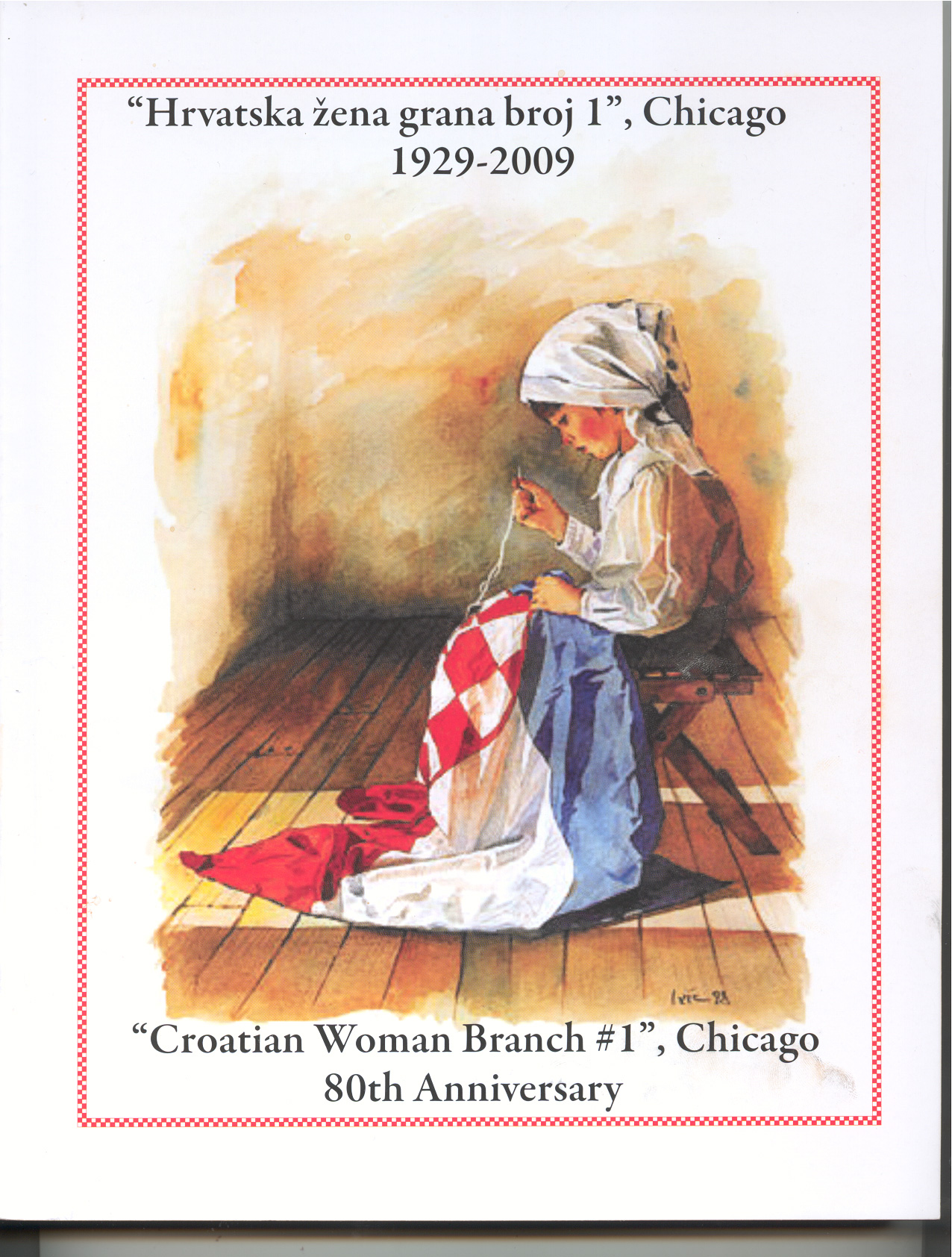
Povijest društva “Hrvatska žena grana broj 1” – A History of “Croatian Woman Branch # 1”

Povijest društva “Hrvatska žena grana broj 1”, Chicago

1929. – 2009.

Društvo „Hrvatska žena“ osnovano je davne 1921. godine u Zagrebu s dobrotvornim ciljem „pomaganja hrvatskoj sirotinji, katoličkom življu, te dobrim Hrvaticama bez imetka“. Njen osnutak je vezan za cijeli jedan pokret koji seže u srednji vijek, a posebice u XIX. stoljeće kada su osnivane mnoge zaklade, bratovštine i udruženja s ciljem pomaganja nevoljnima. Ni Hrvati, niti njihova društva, u tome ne bijahu iznimka. Nakon Prvog svjetskog rata i stvaranjem Kraljevine, a kao rekacija na velikosrpske ideje i ugroženost opstojnosti hrvatskog naroda, osnivanju se različita društva. Tako su žene uključene u Radićevu stranku osnovale društvo pod nazivom „Hrvatsko srce“, a osnivaju se i mnoga tzv. Gospojinska društva s istim ciljem. Upravo ta društva bila su preteče osnivanju društva “ Hrvatska žena“.

Društvo “Hrvatska žena“ je osnovala Marija Kumičić, a za prvu voditeljicu Društva izabrana je gospođa Zora pl. Trnski, a njene potpredsjenice bijahu Ivka barunica Ožegović i gospođa Marija Kumičić. Sama imena ovih dičnih žena govore o ozbiljnosti pothvata, te o njegovu kulturnom utemeljenju. U prilog njihovoj ozbiljnosti i odgovornosti spram onih koji pate, a koji su istog roda, govori i činjenica kako su uskoro nakon osnivanja Društva organizirani ogranci diljem Hrvatske: u Petrinji (srpanj, 1921.) u Osijeku (srpanj, 1921.), u Požegi (1921.), u Karlovcu (rujan 1921.), u Jastrebarskom (1922.), te Sisku, Daruvaru, Brodu na Savi, Gospiću, Ogulinu, Vukovaru i drugim gradovima širom Hrvatske.

Bijaše to od samog početka snažno organizirano Društvo s jasnim ciljevima na kulturnom i humanom polju. Njihova dobrota seže daleko, za njih se čuje od mnogih , a njihova ljubav nalazi korijena i daleko od domovine, gdje god žive Hrvati. Njihov rad najbolje je izražen već na samom početku u Pravilu Društva kojeg su izradile gospođe Slava Furst i Julka Patriarch, a koje je odobreno 21. svibnja 1921. U njemu se ističe:

“Zadatak je društva da goji među hrvatskim ženama smisao za društvenost, koja će rađati inicijativom i akcijom na nacionalnom i feminističkom polju, na polju čovječnosti, prosvjećivanja, morala, narodnog zdravlja, društvenosti i privrede.” Da bi žene što bolje ostvarile ove zadane ciljeve odmah su osnovani odsjeci, prosvjetni, feministički, privredni i socijalni. Pjesnički te ciljeve skladno spjeva Josipa pl. Glembay u Osijeku 1922:

“Za dom svoj živi, pati i radi

Sloga Hrvata nam je spas

Doći će i vama sretni dani

Zapjevajmo u sav glas

Ljubit slobodu, a mrzit zlo

Hrvatske žene geslo je to’.”

Njihova žar i ljubav prema svom narodu vodila ih je k aktivnostima na svim poljima te dovela Društvo u sukob s vlastima. Već dvadesetih godina u srpskoj monarhiji Društvo je bilo zabranjivano zbog “nacionalističkog i separatističkog djelovanja”. Zbog pozivanja istaknutih hrvatskih javnih djelatnika na skup obilježavanja imendana dr. Starčevića i Radića na koji se odazvalo oko 1000 ljudi, država je 12. lipnja 1922. zabranila društvo “Hrvatska žena”. Gotovo isti tjedan slična sudbina se dogodila i društvu u Karlovcu. Ove zabrane su bile kratkotrajne. Iako je Društvo u svim gradovima zbog svog izrazitog domoljublja bilo kažnjavano i zabranjivano, ono je dvadesetih i tridesetih godina ipak odlučno nastavljalo svoj rad. Njegov konačni slom i završetak rada dogadja se u vrijeme NDH-a, kada je zakonskom odredbom države NDH-a 5. svibnja 1943. godine “Društvo Hrvatska žena” nakon pune 22 godine “dobrotvornog, kulturno-prosvjetnog i rodoljubnog rada” prestalo djelovati. Oduzete su sve prostorije u matičnoj kući koja se nalazila u Patačićkinovoj ulici broj 1a.

Društvo “Hrvatska žena” u Americi

Već nekoliko godina nakon osnivanja Društva u Zagrebu, 27. siječnja 1929. godine, utemeljeno je Društvo “Hrvatska žena, Grana br. 1 – Chicago”. Početak je bio uistinu zanimljiv, a kada govorimo o povijesnom pregledu nastanka socijalnih, humanitarnih, pa i političkih ustanova, onda svakako moramo priznati da je to uvijek djelo pojedinaca koji su imali jasnije vizije, ciljeve i poglede od drugih. Takvu jednu viziju imaše gospođa Agata Djurak kada se sa svojom kćeri Vilmom Strunjak obratila vlč. Inocentu Bojaniću, o. dominikancu iz Hrvatske župe Presvetog Trojstva u Chicagu. Izrazile su mu želju za osnivanjem društva koje bi se bavilo kulturnim i humanitarnim radom. Vlč. Bojanić im izlazi u susret dajući im svesrdnu podršku. Uskoro dolazi do prvog inicijativnog susreta s kojeg je vrijedno zabilježiti slijedeća imena: Klara Škvorc, Barbara Balija, Rozalija Kovačević-Kirin, Rozalija Sedar-Vuksanović, Frances Frkonja, Mary Karačić, Borislava Absac, Ruža Cesar, Magdalena Guldenpfening. Društvu su dale ime “Hrvatska žena, grana br. 1 – Chicago”. Za prvu predsjednicu su izabrale gospođu Klaru Škvorc. Već na samom početku Inicijativni Odbor je odredio svrhu i ciljeve društva: “djelovati na kulturnom i humanitarnom polju i ujedno upoznati Amerikance i strance s Hrvatskom i njenom kulturom.” I od početka, članice ovog vrijednog Društva počele su ostvarivati upravo taj određeni cilj. Organizirale su brojne izložbe i zabave te nastupale u svim aktivnostima koje su Hrvati Chicaga pripremali. Njihova aktivnost uskoro prelazi granice grada Chicaga te dolazi do osnivanja još 26 grana diljem Amerike. Već na početku, Društvo je legalizirano dobivši državnu dozvolu i svoju povelju (charter).

Tridesetih godina i posebice četrdesetih godina u vrijeme rata, Društvo pomaže Crveni križ i vojnike – kako američke tako i hrvatske. Pomažu lokalne bolnice, šalju vojnicima pakete i uplaćuju novac u zajedničke fondove osnovane u tijeku II. svjetskog rata. Domovinu Hrvatsku takodjer pomažu u vrijeme ratnih nedaća, te šalju pakete pomoći u daleku i dragu domovinu. Po završetku rata i tijekom masovnog stradanja u domovini i patnje hrvatskog naroda u izbjeglištvu, Hrvatska žena slala je pomoć hrvatskim izbjeglicama i sirotinji u logore diljem Europe i Južne Amerike.

Stišavanjem poratnih nedaća, Društvo se vraća kulturnom radu, te pomaže hrvatske studente, posebice na Duquesne University, kako bi što bolje naučili pjevati hrvatske pjesme i svirati tamburicu i na takav jedinstven način promicati hrvatsku kulturnu baštinu. Upravo takvim radom one su uspjele dvije objektivno različite kulture; američku i hrvatsku stalno sjedinjavati i približavati jednu drugoj. Mlađe generacije Hrvata upravo su po tim aktivnostima naučile biti jedno, iako su trajno obilježeni dvjema kulturama. Kao ilustracija toga može nam poslužiti pjesma koju napisa još 1922. prva predsjednica Društva Klara Škvorc:

“Ja sam rodjen Amerikanac,

Ali ipak nisam Indijanac.

Moja me je majka naučila,

da mi je mila još jedna domovina.

Prva mila domovina moja,

Jeste zemlja Georga Washingtona,

A to mi je i ponos i dika,

Jer se zove Slavna Amerika.

A druga je domovina mila

Gdje se Otac i Majka rodila,

A to vam je ona gruda sveta

Hrvatska nam na tisuće ljeta.

I zato se ja ponosim s tim

Jer sam, Hrvatske majke sin.

Živila naša Amerika!

Živila naša Hrvatska!”

Pedesetih, šezdesetih pa i sedamdesetih godina, kada su domovinu (iako nedostupnu u komunizmu) snašle elementarne nepogode, poplave i potresi, Društvo ponovno šalje novčanu pomoć kao i pomoć u hrani i lijekovima. Tih godina su i mnogi hrvatski misionari pošli diljem svijeta navještajući kršćansku ljubav. Njihov život prečesto bijaše bijeda i neimaština. Hrvatska žena se brine i za njih, te im šalje pomoc kao i hrvatskim župama, školama, te obiteljima hrvatskih robijaša diljem svijeta.

Aktivnosti Društva u novije vrijeme

Društvo “Hrvatska žena, grana broj 1” ponaosob je vrlo aktivno u hrvatskoj zajednici grada Chicaga u posljednjih 20 godina. Njezina socijalna, humanitarna, kulturna, prosvjetna i nacionalna aktivnost zaista je veličanstvena. Spomenuti ćemo ovdje samo jedan mali dio velikih aktivnosti. Vec 1988. Društvo pruža pomoć hrvatskim književnicima u domovini kao i hrvatskim rodoljubima i aktivistima na raznim poljima djelovanja, diljem svijeta. Njihova pomoć karitativnim udrugama nastavak je tradicije i karizme koju Društvo njeguje od početka. Već tada, dok je komunizam još bio snažan u Domovini, oni potpomažu hrvatske producente u nastajanju filmskih zapisa o tragediji nacije u zadnjih 50 godina. Isto tako pomažu se i hrvatski zatvorenici u americkim zatvorima.

1989. godine Društvo slavi svoju 60. obljetnicu postojanja. Tom prigodom iz Domovine dolazi poznata liječnica dr. Ružica Ćavar, borac za ljudska prava Hrvata, posebice na medicinskom polju. Njezina nazočnost na ovoj obljetnici i govor o neizbježnim demokratskim promjenama u Domovini motiviralo je mnoge Hrvatice grada Chicaga da pristupe Društvu. Njezina nazočnost je zaslužna da se broj članica penje na divnih dvije stotine.

Dolaskom godine 1989., a to znači i godina uoči stvaranja hrvatske države, “Hrvatska žena” se aktivno uključuje u pomoć i nastojanje da se snovi povijesti što lakše ostvare. Tako već na početku materijalno pomažu Franju Tuđmana, budućeg hrvatskog predsjednika te ostale aktivne javne djelatnike u domovini i svijetu čija imena su obično bila pisana crnim slovima, a druženje s njima bilo više nego opasno.

Početkom devedesetih

Prijelomne 1990. godine novije hrvatske povijesti, Društvo izgrađuje jače veze s domovinom te svojim prilozima podupire i Crkvu i državu na putu k slobodi, neovisnosti i budućnosti. Iako domovina zove i treba pomoć “Hrvatska žena” nastavlja pomagati pojedince i obitelji u njihovim često hitnim slučajevima. Tako se pomažu oboljela i slijepa djeca itd. U ljeto 1990. godine u Hrvatsku putuju predsjednica Zlata Ivezic, tajnica Milica Trutin i rizničarka Nevenka Jurković. I nakon pune 43. godine u središnjem hrvatskom gradu, Zagrebu, osnivaju inicijativni Odbor Hrvatske žene u Domovini. Ovo su prva nastojanja i koraci povratka na izvore.

U jesen iste godine “Hrvatska žena” po prvi put održava Modnu Reviju koja postaje tradicionalna jesenska manifestacija Društva. Ovom revijom Društvo prikuplja znatna materijalna sredstva koja onda odmah upućuje u domovinu. Mjesec listopad 1990. posebice je važan u povijesti Društva “Hrvatska žena grana broj 1”, Chicago. Naime tada, 25. listopada 1990. predsjednica Društva, gospođa Zlata Ivezić odlazi na osnivačku skupštinu Hrvatske žene u Zagrebu i nosi im znakoviti povijesni dar neizbrisive povezanosti:

– izvorni barjak “Hrvatske žene”

– grb “Hrvatske žene”

– 2,000 dolara pomoći za početak rada.

Iste godine pomažu se i stradali rudari u rudniku Tuzla, te središnji katolički Karitas u Zagrebu. Godina 1990. je važna ne samo za ostvarenje povijesnog sna o državnosti Hrvata, nego i za budućnost samog Društva “Hrvatska žena”. Naime te godine sastaje se Uprava društva i svi članovi društva kako bi izglasali ciljeve i zadaće rada ovog Društva. Njihova vizija ukratko obuhvaća slijedeće:

* skupljanje humanitarne pomoći i rad na pripremanju kontejnera za Hrvatsku

* slanje pisama raznim ustanovama

* prodaja kolača i hrvatskih umjetnina s ciljem prikupljanja sredstava

* organiziranje javne molitve krunice i međugorskih molitvenih skupina

* prikupljanje financijskih sredstava

* organizacija dobrotvornih banketa

* prodaja maslinovih grančica s crveno-bijelo-plavom trakom na Cvjetnicu u hrvatskim župama grada Chicaga

* organiziranje godišnje modne reviju (Fashion Show)

Već u proljeće 1991. godine kada domovina zapada u političko-ustavne, državotvorne i regionalne krize, Društvo prepoznaje potrebe naroda i šalje prvi kontejner pomoći u domovinu. To je ujedno početak sveobuhvatne pomoći koje će Društvo slati u više od 100 kontejnera i vrijednosti više od 10 milijuna američkih dolara. Žene, članice Društva razvijaju svoje aktivnosti i traže nove načine kako bi, iako daleko, bile blizu onima koji pate. Kao plod takva razmišljanja one na Cvjetnicu 1990. godine po prvi put prodaju znakove mira-maslinove graničice u svim hrvatskim župama grada Chicaga. Od tada do danas to ostaje vrlo draga i plodonosna tradicija. Iste godine kada se mnogi prilozi Hrvata Amerike slijevaju u Hrvatski Nacionalni Fond i Hrvatska žena ne izostaje, nego već na početku daruje tom fondu u Chicagu 15,000 američkih dolara. U isto vrijeme šalju pomoć od 5,000 dolara za lijekove u Hrvatsku te 10, 000 dolara za stradale u već započetom ratu.

Kao što sam spomenuo na početku, njihova aktivnost nije samo humanitarna. Žene su aktivno sudjelovale i dizale svoj glas u borbi protiv rata, nasilja i jednostranosti američkih i europskih državnih kabineta. Tako Društvo održava molitvu bdijenja sa svijećama ispred gradske vijećnice u Chicagu, organizira demonstracije, šalje na tisuće pisama američkim kongresmenima u Washigton, D.C., skuplja peticije za priznavanje Hrvatske Države itd.

Valja spomenuti aktivno sudjelovanje i svih hrvatskih župa grada Chicaga u svim hvale vrijednim pothvatima Hrvatske žene. Župe su pomagale na različite načine sve akcije, ustupajući uvijek svoje prostorije, utjecaj i tradiciju.

Godine 1992. predsjednicom društva postaje gospođa Nevenka Jurković. Aktivnosti se nastavljaju i množe. Pomaže se izdanju knjige prof. P. Cohena o stradanju Židova u Srbiji, kupovini medicinskih aparata, pojedinačne pomoći hrvatskim ratnim invalidima i stradalnicima rata. Zbog sve većih takvih potreba Društvo organizira banket u ožujku 1992. ciji prihod je išao za pomoć hrvatskim invalidima, a već u travnju za pomoć hrvatskoj ratnoj siročadi. Prepoznajući opasnosti Istoka u Slavoniji i prepolovljavanja Istočne Hrvatske Društvo šalje pomoć gradu Osijeku od 4,500 dolara. U toj godini, gotovo svaki mjesec Društvo organizira humanitarne bankete za pomoć domovini, kao i za pomoć pri plaćanju kontejnera koji sve češće odlaze put Hrvatske. Želeći i na političkoj sceni učiniti što više Društvo pomaže pri dolasku uglednog američkog Senatora D’Amata u Hrvatski kulturni centar-Chicago. Sve učestalije članice Društva prodajom kolača poslije svetih misa u hrvatskim župama, pokušavaju puniti fond koji pomaže i obnavlja domovinu.

Već početkom godine 1993. kada je najavljeno da se počima s obnovom tek kupljenog prvog hrvatskog veleposlanstva na američkom tlu, Društvo šalje svoj doprinos. U ožujku nakon stizanja užasnih vijesti iz karlovačkog kraja, “Hrvatska žena” šalje pomoć karlovačkoj bolnici (10,000 dolara), a u mjesecu lipnju održava banket za žrtve silovanja i tom prigodom iz domovine pozivaju gospođu Jadranku Cigelj, jednu od preživjelih iz pakla srpskih logora. U istom mjesecu predsjednica Društva, gospođa Jurković i dopredsjednica Marica Tomačić odlaze u Zagreb na Prvi Hrvatski Sabor Hrvatske žene. Tim činom povijest se ponavlja i tako dokazuje da su svi napori kroz 70 godina Društva “Hrvatska žena grana br. 1”, Chicago uistinu bili proročki s ciljem povratka na korijene i ognjišta što se ovim činom i ostvarilo. U isto vrijeme ispred hrvatske župe Presvetog Trojstva u Chicagu održava se molitveno bdijenje za uspjeh navednog Sabora u Zagrebu.

Svjesni kako je važna informacija i kako često u novije vrijeme mediji, a ne ratnici stvaraju povijest, članice šalju prilog Hrvatskom Informativnom Centru u Zagrebu. U mjesecu studenom Društvo organizira doček znamenitog Hrvatskog narodnog kazališta iz Zagreba.

Društvo poziva u Chicago Katu Šoljić, hrvatsku majku koja je u Vukovaru izgubila 4 sina. Izuzetni napori su učinjeni i na pomoći koja se slala tek novoosonovanim podružnicama “Hrvatske žene” u domovini.

Godina 1994. počima uistinu svečano. Tako 5. veljače, Društvo proslavlja plemenitih 65 godina svoga postojanja. Svečanost počinje radnim sastankom u Hrvatskom etnićkom institutu u Chicagu (Drexel Blvd.), nastavlja se svečanom svetom misom u župi sv. Jeronima, te završava banketom u dvorani župe sv. Jeronima. Tom prigodom Društvo poziva sve predstavnike hrvatskih župa i ustanova grada Chicaga te mnoge ugledne goste:

Dragica Pandek – predsjednica Hrvatske žene iz Zagreba.

Mario Nobilo – veleposlanik Republike Hrvatske pri UN-New York.

Gordana Turić – zastupnica Hrvatskog Sabora iz Zagreba

Anthony Petrušić – predsjednik Hrvatske katoličke zajednice za Ameriku i Kanadu

Anthony Berić – predsjednik AMCRO – New York

Snježana Franetović – “Hrvatska žena grana br. 32”, Detroit

Paula Majdak – “Hrvatska žena grana br. 3”, Milwaukee

Jasminka Ćorluka “Hrvatska žena”, Montreal

Brothers Rigis i sestra Dora, Salvatorian Mission House, iz New Holstin – Wisconsin

Tom posebnom prigodom izdana je i vrlo dobro uređena spomen knjiga 65. obljetnica društva “Hrvatska žena grana br. 1”, Chicago. Valja ne zaboraviti da je Društvo također do sada tiskalo spomen knjige o 45., 50., 55., i 60. obljetnice postojanja.

Nakon toga nižu se aktivnosti koje obuhvaćaju sudjelovanja na hrvatskim svjetskim saborovanjima u Clevelandu i Zagrebu, sudjelovanje na hrvatsko-američkom Kongresu u Chicagu, suorganiziranje banketa “Akcija za život”, proslave dana državnosti, itd. U ljeto 1994. Društvo organizira izložbu hrvatske kulturne baštine u State Building u sredistu Chicaga.

Godine 1995. gost Društva iz Domovine je Damir Plavšić, predsjednik studenata HVIDRA-e, te tom prigodom Društvo pomaže ratne invalide s darom od 25,000 dolara. U ljeto te godine, ponovno pomažu Akciju za život, a u mjesecu listopadu modnu reviju čine drugačijom i neuobičajenom predstavljujući narodne nošnje iz hrvatskih pokrajina. Isti mjesec, svjesni kulturocida počinjena na hrvatskom jugu, Društvo organizira dobrotvorni ručak za pomoć franjevačkom samostanu u Konavlima (5,000 dolara). Također Društvo predstavlja i promovira film “Vukovar se vraća kući.” Pomaže se i rade na promociji hrvatskih interesa, te u tu svrhu Društvo daje potporu ($8,000) hrvatsko-američkoj udruzi.

Svjesni da je rat završio “Hrvatske žene” se spremno odazivlju potrebama na svim područjima života. Valja svakako, ponajviše ovdje naglasiti, kako je u vrijeme ratnih stradanja od 1992. do 1996. Društvo poslalo preko 100 kontejnera pomoći vrijednih preko 10 milijuna američkih dolara. Veliku ljubav u otpremanju kontejnera i organizaciji pomoći darovale su gospođe Milica Trutin i Nina Perović. U tome su obilato pomagali i mnogi drugi među kojima valja spomenuti Hrvatsku katoličku zajednicu, Salvatorian Mission House iz Wisconsina i dr. Sve Hrvatske župe grada Chicaga su vrlo aktivno sudjelovale u ovom projektu. Stoga, radi povijesti i ljubavi, vrijedno je zapamtiti da je Društvo pomagalo cijelu Domovinu. Imena mjesta to najbolje potvrđuju: Zagreb, Rijeka, Mostar, Zadar, Šibenik, Vrlika, Ljubuški, Kloštar Ivanić, Sinj, Osijek, Djakovo, Imotski, Karlovac, Vinkovci, Poljica kod Omiša, Šestanovac-Katuni, Posušje, Split, Široki Brijeg, Makarska, Dubrovnik, Slavonski Brod, Vrgorac, Tomislavgrad, Gabela Polje-Metković i Čapljina, te pojedinci i skupine iz svih krajeva Hrvatske i Bosne i Hercegovine. Osim toga Društvo je pomagalo i mnoge američke socijalne ustanove kao npr. Mercy Home, Children Memorial Hospital, American Red Cross, Misericordia Home i dr.

Slijedeće godine 1996. Društvo organizira u Hrvatskom centru svečani banket u povodu 67. obljetnice svoga postojanja, te cjelokupan doprinos šalju hrvatskim političkim zatvorenicima u Americi. Kroz cijelu ovu godinu članice svojim neumornim radom pomažu razne ustanove u domovini, koje uključuju crkve, karitase, ogranke “Hrvatske žene”, centre za djecu i mladež i mnoge druge. U mjesecu svibnju aktivnost je izražena i u organiziranju izložbe dječjih radova na temu “Djeca Rata – Children of War” koja je održana na DePaul University u Chicagu. U mjesecu listopadu održana je tradicionalna modna revija. Prihod s ovog skupa poslan je Domu Dubrava koji se brine za osposobljavanje djece i mladeži s tjelesnim oštećenjima (25, 000 dolara) te Hrvatskom Kulturnom centru – Vukovar u izgradnji (4,000 dolara).

Iste aktivnosti se nastavljaju i 1997. gdje posebice treba istaknuti 68. godišnji banket Društva s osobitim gostima čija nazočnost je uvelike doprinijela dostojanstvenom obilježavanju časne prošlosti “Hrvatske žene”. Među mnogima, spomenuti ćemo samo one iz domovine: sarajevski nadbiskup Vinko kardinal Puljić, gospođa Ljilja Vokić, ministrica Prosvjete i Športa države Hrvatske, pomoćnica ministrice Vlasta Sabljak i drugi. Iste godine u mjesecu lipnju, Društvo pomaže u organizaciji izložbe djela poznatog i priznatog umjetnika hrvatske naive, Ivana Lackovića Croate koja je održana u Hrvatskom etničkom institutu u Chicagu. Iste godine ponovno pomaže Hrvatsko američku udrugu ($1,000) želeći tako pridonijeti boljitku općeg hrvatskog ugleda u Americi.

Godine 1998. među brojnim i pohvalnim pothvatima valja istaknuti svijest i pomoć Sveučilištu u Mostaru (30,000 dolara), te suorganiziranje izložbe o kardinalu Stepincu u Hrvatskom etničkom institutu u Chicagu u povodu 100. obljetnice rođenja. Znajući kako je od osobite potrebe vrijedno brinuti se o Istini o povijesti našega naroda, hvale vrijedno je spomenuti da je Društvo u mjesecu siječnju ’98. pomoglo svojim prilogom u slanju knjige dr. Ante Čuvala “Historical Dictionary of Bosnia and Herzegovina” u knjižnice većih američkih sveučilista. Istog mjeseca Društvo se pridružuje mnogim hrvatskim organizacijama diljem Amerike u akciji “Prijatelji Vukovara” te za obnovu centra za hendikepiranu djecu u Vukovaru daruje 3,000 dolara. Društvo je 6. listopada 1998. u Hrvatskom kulturnom centru organiziralo i pomoglo potpisivanje knjige “Healing the Heart of Croatia – Liječenje srca Hrvatske” autora poznatog kirurga dr. Novika i svećenika Josepha Kerrigana. Dr. Novik je ugledni profesor kirurgije i pedijatrije na sveučilištu Tennessee u Memphisu i direktor međunarodne zaklade za liječenje srčanih mana u djece. Zajedno sa svećenikom Kerriganom iz Memphisa, dr. Novik je spasio mnogu djecu u Hrvatskoj s urođenim srčanim manama od sigurne smrti. Na 18. dan istog mjeseca održana je uspješna tradicionalna Modna revija čiji prihod od 7,000 dolara odlazi u gore spomenutu svrhu.

Početkom godine 1999.(6. veljače) održana je u Hrvatskom centru u Chicagu svečana proslava 70. obljetnice postojanja ovog Društva. Među brojnim uzvanicima, iz domovine dođoše predsjednica Hrvatske žene iz Zagreba, Dragica Pandek, njena zamjenica Zlata Horvatić i saborska zastupnica Gordana Turić. Događaj je svakako posebnim učinio dolazak dr. Williama Novicka, poznatog dječjeg kirurga sa sveučilišta Tennessee iz Memphisa. Cjelokupan profit s ove obljetnice poslan je u zagrebačku bolnicu Rebro za pomoć djeci sa srčanim manama te kupnju specijaliziranih monitora. Krajem ožujka iste godine članice prodaju maslinove grančice ispred hrvatskih crkava zarađujući novac za nadolazeće projekte. U jesen iste godine, Društvo organizira još jednu uspješnu modnu reviju u hotelu William Tell. Zarada od te manifestacije poslana je za kupnju inkubatora u dječjoj bolnici u Splitu. Osim humanitarnog rada, Društvo podupire kulturne djelatnosti te dovodi dvije glumice Helenu Buljan i Dubravku Miletić koje izvode komediju u dvorani sv. Jeronima u Chicagu.

Godine 1999. Društvo pomaže obitelj Combaj s jedanaestero djece iz zagrebačkih Sesveta. Društvo je kumovalo na krštenju 11. djeteta.

Novi zanos u novom stoljeću

Početkom novog milenijuma, 2000. Društvo dovodi u Chicago poznatog pjevača Dražena Žanka. Njegov koncert je održan 29. siječnja 2000. u dvorani sv. Jeronima, a prihod ponovno poslan za djecu u splitskoj bolnici. Tradicionalna modna revija ove godine bila je drugačija. Naime poznata modna kreatorka Gordana Radić došla je iz Hrvatske te zaista pokazala američkoj publici svoje kreacije i najnoviju modu na hrvatski način. Revija koja je održana 22. listopada u hotelu Holiday Inn bila je vrlo uspješna i zanimljiva. Pomoć dobivena od ovog događaja je poslana bolnici Mostar (za kupnju gastroskopa).

Godina 2001. počela je ponovno kulturnom promidžbom. Naime Društvo je pomoglo promociju knjige Julianne Bušić “Ljubavnici i luđaci” koja govori o životnom putu Juliane i Zvonka Bušića i njihovoj borbi za slobodnu Hrvatsku. U mjesecu travnju iste godine (4. travnja), Društvo Hrvatska žena ponovno nastavlja prekinutu tradiciju humanitarnih ručaka na Cvjetnicu. Prihod s ovog ručka otišao je siromašnim hrvatskim obiteljima u Kninu preko karitasa Sv. Ante. U jesen iste godine (21. listopada) nastavljena je tradicija modnih revija. Te godine bila je revija posebice financijski uspješna. Održana je po prvi put u Hrvatskom centru u Chicagu, a sav prihod je otišao za pomoć stradalima u terorističkom napadu na New York. Donacija je poslana preko katoličkog karitasa. U godini 2002. održana su dva velika događaja. Ručak na Cvjetnicu (24. ožujka) za pomoć Vukovaru bijaše izniman događaj. Gošća ove svečanosti bila je ugledna spisateljica iz Zagreba Maja Freundlich. Na jesen iste godine, 20. listopada održana je modna revija u Royalty West hotelu.

U godini 2003. ručak na Cvjetnicu i vrlo uspješna modna revija održani su u Hrvatskom Centru također za pomoć domovini. Na modnoj reviji je sudjelovalo preko 450 gostiju i bijaše to najuspješniji skup takve vrste.

Godina 2004. također je vrlo aktivna. Ručak na Cvjetnicu ponovno je okupio Hrvate Chicaga u velikom broju gdje su iskazali svoju nesebičnost. Krajem ljeta (12. rujna), Društvo je organiziralo svečani banket za pomoć hrvatskom užniku Anti Ljubasu koji je mjesec dana prije toga izišao iz američkih zatvora nakon više od 23. godine robije. Banket izuzetno dobro posjećen održan je u dvorani sv. Jeronima. Jesenska modna revija održana u Hrvatskom Centru 24. listopada bila je ujedno i pomoć Srednjoj Bosni. Naime, sav prihod s ovog događaja otišao je za izgradnju dječjeg doma u Kiseljaku koji s velikom ljubavlju vode sestre franjevke. Na ovom događaju se prvi put predstavio novi hrvatski veleposlanik u Washingtonu gospodin Neven Jurica.

Nemoguće je sve nabrojiti,ali ukratko bitno je spomenuti slijedeće. Samo u razdoblju od pet godina, Društvo Hrvatska žena je darovalo pomoć u iznosu od 235.000 dolara. Veliki je to novac! Posebice veliki kada znamo da je izravno poslan siromašnima, najpotrebnijima. Na tu činjenicu doista treba biti ponosan! Sve članice ovog Društva doista mogu biti ponosne na svoj vrlo kvalitetno i nesebično obavljen posao.

Osim ovog financijskog podatka kako je lijepo znati da u tom istom periodu Društvo je pomagalo tako mnogo projekata i siromaha. Vrijedno je spomenuti samo neke: Pomoć hrvatskim zatvorenicima, hrvatskim radio klubovima, hrvatsko-američkom udruženju, hrvatskim crkvama u Chicagu, izgradnji spomen obilježja u domovini, udruzi za hrvatske studije u Americi, dječjoj bolnici u Chicagu, mnogim siromašnim obiteljima u domovini, od Zagreba, Splita, do Jajca, Vukovara, itd. dječjim domovima, raznim karitativnim udrugama, kulturnim manifestacijama, nabavci medicinskih uređaja za bolnice u domovini (Zagreb, Split, Mostar…), hrvatskim studentima, tiskanju knjiga o Hrvatskoj, simpoziju o Vukovaru u Washigton, D.C., nabavci zemljišta za kuće siromašnih Hrvata u Kninu, obiteljima stradalih u New Yorku i mnogi drugi projekti koje je pojedinačno nemoguće i spomenuti.

U istoj godini na 27. dan mjeseca studenog 2004. održana je svečana proslava 75. obljetnice postojanja Društva. Svečani banket je održan u dvorani Sv. Jeronima., a glavni gost iz domovine bio je vukovarski gvardijan fra Zlatko Špehar. Sav prihod ovog skupa poslan je za pomoć vukovarskoj djeci. Također na skupu je bila nova konzulica hrvatske države gospođica Zorica Matković. Kustos Hrvatskih franjevaca fra Marko Puljić predvodio je molitvu, a bili su nazočni svi predstavnici hrvatskih župa. Za Božić iste godine poslana je pomoć obiteljima u potrebi: obitelj Domazet za izgradnju kuće (Muć), obitelji Ivana Čuvalo za pomoć liječenja bolesnog djeteta (Ljubuški), mnogobrojnoj obitelji Drage Radića ( Slavonski Brod). Ukupni darovi u godini 2004. Koji su poslani potrebnima bili su u iznosu od 62,780.00 dolara.

Godina 2005. nastavljena je istim zanosom i ljubavlju. Već početkom godine (6. ožujka 2005.), u dvorani Sv. Jeronima održan je dobrotvorni ručak za bivšeg hrvatskog užnika Ranka Primorca, a nekoliko tjedana kasnije tradicionalnim ručkom na Cvjetnicu (20. ožujka) pomoć je poslana bolnici u Mostaru za nabavku medicinskog automobila kao i za dječju bolnicu u Rijeci. Na 15. dan mjeseca svibnja, zajedno sa svim hrvatskim župama grada Chicaga, Društvo je organiziralo skup sjećanja u povodu 60. obljetnice Bleiburga i tragedije Križnog puta. Jesenska modna revija održana je u William Tell hotelu , a modni kreatori su stigli iz Hrvatske, boutique “Rafaela” dizajnerice Jadranke Šegota. Za zabavu se pobrinuo legendarni Kićo Slabinac i Trio Rio. Prihodi s ovog skupa išli su za pomoć žrtvama vremenske nepogode, haragana Katrina, te za nabavku medicinskog aparata za bolnicu na Hvaru. Ukupni darovi u godini 2005. koje je Društvo skupilo i poslalo iznosili su 52,000.00 dolara.

Prva polovica 2006. godine obilježila je pomoći za potrebnu djecu. Naime na Cvjetnicu (6. travnja 2006.) svečanim ručkom u Hrvatskom centru u Chicagu pomognuta su djeca u “Dječjem domu Egipat” u Sarajevu i dječjem vrtiću u Kiseljaku. U jesen iste godine organizirano je skupljanje pomoći za obitelj Migić koja se vratila u Hrvatsku. Modnom revijom održanom 22. listopada u Hrvatskom kulturnom centru, Chicago, uz hrvatske momke i djevojke iz naše zajednice kao manekeni, skupljena je pomoć za dvije bolnice: u Splitu i Osijeku. Ukupni darovi poslani u toj 2006. godini iznosili su 34,830.00 dolara.

Godina 2007. počela je obilježavanjem i sjećanjem ponovno na bleiburške događaje. Naime na Cvjetnicu 1. travnja 2007. godine u Hrvatskom kulturnom centru organizirano je skupljanje donacija za izgradnju sakralnog prostora na Bleiburgu. Odaziv ljudi naše hrvatske zajednice bio ja zaista fantastičan. Zajedno sa hrvatskim župama našeg grada bio je ovo događaj ponosa. U jesen te godine održana je tardicionalna modna revija u Ashton Place hotel. Po prvi put Društvo je predstavilo modu poznate trgovine “Lord &Tylor”. Prihod ove revije otišao je za pomoć Domu zdravlja u Slunju. Također je poslana donacija za kapelicu u Vukovaru, te je pomognuta obitelji Tomić s 11 djece iz Slavonskog Broda. Ukupni darovi te godine 2007. dosegli su fantastičnih 68,330.00 dolara.

U prošloj godini 2008. nastavljen je rad istim žarom.  16. ožujka 2008. u Hrvatskom kulturnom centru u Chicagu, svečanim ručkom na Cvjetnicu pružena je pomoć obiteljima u nevolji i potrebi, te je poslana pomoć Udruzi Specijalne policije iz Domovinskog rata “Tigar” u Gospiću. U jesen prošle godine, 19. listopada održana je Modna revija pod nazivom “Tradicijsko u suvremenom” u Holiday Inn North Shore u Skokie. Ovo je bila drugačija modna revija od svih dosadašnjih, a predstavili su je gosti iz Zagreba s voditeljem gosp. Josipom Forjanom iz “Posudionice i radionice narodnih nošnji” iz Zagreba. Njihov dolazak je sponsorirao grad Zagreb, uz pomoć pročelnika za kulturu Pavla Kalinića. Sve ovo svakako ne bi bilo moguće bez nezaobilazne potpore u ovom i svim događajima, hrvatske konzulice gospodične Zorice Matković. Prihodi su poslani staračkom domu “Sveti Josip Radnik” u Ljubuškom kojeg vode časne sestre, s prvotnom namjerom uvođenja grijanja koje do tada nije postojalo. Također je poslana pomoć dječjem vrtiću “Pčelice” u Livnu, te baki Elizabeti Lepinski koja vodi brigu o svojoj unuci Matei koja je ostala bez oba roditelja. Ukupni darovi u 2008. iznosili su 48,000.00 dolara.   Na samom kraju godine, u najhladniju nedjelju mjeseca prosinca u povijesti Chicaga, u organizaciji “Društva Hrvatska žena grana broj 1”, održan je svečani skup u čast izlaska na slobodu hrvatskog užnika Zvonka Bušića. Tako je s ovom godinom i ovim skupom završeno jedno poglavlje povijesti u kojem je ovo časno Društvo nesebično pomagalo hrvatske užnike.

Tako je Društvo samo u zadnje četiri godine skupilo i poslalo pomoć u iznosu od 266,000 dolara za potrebe potrebnih. Iako članice ovog Društva o ovome nikada ne govore, ali je vrijedno spomenuti upravo ovu količinu darova kojima je Društvo učinilo život lakšim mnogima koji pate.

Za razliku od mnogih koji se hvale dostignućima, ovo ponizno Društvo tiho radi i svojim radom čini veličanstvene stvari. Kao što je više nego očito, ovo izuzetno vrijedno Društvo hrvatskih žena grada Chicaga pisalo je povijest djelima dobra i srcem ljubavi. Njihova potpora svemu onome što u sebi nosi pečat hrvatskog, vrijednost ljudskog, cijenu povijesnog i veličinu kulturnog, vrijedna su časti i poštovanja. Dani truda i godine rada, njih evo 80, znak su da i u vrijeme hrvatskih tragedija i requiema, narodnih uspona i padova, hrvatska žena i majka, ma gdje god bila, uvijek je sačuvala srce ljubavi i oči pune nade. Za nadati se je da će mlade djevojke i supruge ugledati već sada ovu zvjezdanu stazu koja je i mukom i suzom i radosti i vjerom stvarana kroz gotovo cijelo dvadeseto stoljeće i tako tu dobrotu nastaviti i prenijeti u godine i desetljeća koje će biti onoliko lijepa, koliko mu oni podare ljubavi, vremena, smisla, vizije i vezova koji ponovno slažu raskidane niti vrijednosti u povijesnom mozaiku čije geslo jest: dobro je činiti dobro!

Fra Jozo Grbeš

U Chicagu, mjeseca siječnja, godine Gospodnje 2009.

1

A History of “Croatian Woman Branch # 1”, Chicago

1929-2009

Its Origin in the Homeland

Croatian Woman” was founded in 1921, in Zagreb, with a simple mission: Help Croatians who are in need and less fortunate. Its roots are directly tied to a movement that began in the Middle Ages but strengthened in the 19th Century, a movement toward goodwill and Christian charity. Croatia, much like the rest of the Western World, had a multitude of brotherhoods, fraternities, and Roman Catholic organizations focused on philanthropy and altruism spread throughout the country. After the First World War and the creation of Yugoslavia, many of the existing and newly founded organizations began to take on Croatian-nation-oriented agendas in a direct response to the installment of the pro Serbian government and its attempt to erase the national identity of the Croatian people. Similarly, women involved in Stjepan Radic’s political party founded “Croatian Heart” with the same goals in mind: Helping Croatians who were less fortunate while also preserving Croatian Catholic culture. In fact, “Croatian Heart” was the predecessor to the organization “Croatian Woman,” which was founded by Maria Kumicic. The first president to be chosen was Zora pl. Trnski, and her vice presidents were Ivka barunica Ozegovic and Maria Kumicic. Being the wives of famous writers and political figures in Croatia, these women’s distinguished last names already displayed the legitimacy of the organization and its ability to influence the community. Another display of the organization’s legitimacy was its instant proliferation throughout the country: Petrinje (July 1921), Osijek (July 1921), Pozega (July 1921), Karlovac (September 1921), followed in 1922 by Jastrebarsko, Sisak, Daruvar, Gospic, Vukovar, and many other cities.

From the start “Croatian Woman,” as an organization, was strongly built with a foundation based on clearly set goals in the cultural and humanitarian fields. Their goodwill was deeply imbedded, far-reaching, and felt by many throughout the world wherever Croatians live and people are in need. Their work is best exemplified and stated in the beginning of the organization’s bylaws, which were written by Slava Furst and Julka Patriarch, and which were chartered on May 21, 1921. The bylaws state: “The goal of the organization is to cultivate a social standard among Croatian women, which is conducive to the promotion of social, public, economic, moral and humanitarian health in both national and feminist fields.” In order to achieve this, the women divided the goals into separate categories and designated four separate branches: cultural, feminist, humanitarian, and social. Josipa Glembay wrote this song to illustrate their goals in Osijek in 1922.

Live work and suffer for your country

For Croatian unity is our only hope

The day is near when we will rejoice

Sing proudly in one voice:

Condemn evil, cherish freedom —

This is the motto of Croatian women.”

Their unconditional love for their people led them into many fields which brought them into conflict with the authorities. In the early 1920s, during the Serbian monarchy, the organization was banned because of “nationalistic and separatist activities.” Because of their participation in the celebration of the famous Croatian activists Dr. Ante Starcevic and Stjepan Radic, where over one thousand people gathered, the state prohibited the existence of “Croatian Woman” on June 12, 1922. In nearly the same week “Croatian Woman” in the city of Karlovac suffered the same fate. The prohibitions, however, were short lived. Even though the organization was punished and prohibited because of their love for their people and their country, they continued their work with a strong determination. Despite all of their hard work, the N.D.H. shut down all existing offices of “Croatian Woman” on May 5, 1943. Twenty two years of humanitarian, cultural, and patriotic work, which began on Patacickinova Street, would cease to exist.

Croatian Woman” in America

Only a few years after the foundation of “Croatian Woman” in Zagreb, its first branch would open in Chicago. It was the original idea of Agata Durak and her daughter Vilma Strunjak to start a woman’s organization in Chicago’s Croatian community. She brought this idea to the attention of Dominican Father Innocent Bojanic at Holy Trinity Croatian Parish in Chicago. With his support, “Croatian Woman, Branch No. 1 – Chicago” was founded on January 27, 1929. Soon the first meeting was called to order, with the following women present: Klara Skvorc (first president), Barbara Balija, Rosalija Kovacevic Kirin, Rosalija Sedar Vuksanovic, Frances Frkonja, Mary Karacic, Borislava Absac, Ruza Cesar and Magdalena Guldenpfening. From the beginning, the women decided that their main goals would be to help people on both the cultural and humanitarian levels while also displaying Croatian culture to the American people. Immediately, the group was active in creating exhibits throughout the greater Chicagoland area. The state of Illinois recognized the importance of the organization and granted them a legal charter within the year. Almost instantly twenty six other branches registered throughout the country.

During the Thirties and Forties, when war engulfed the entire world, “Croatian Woman” did all they could to help. In America and abroad, they worked with the Red Cross and local hospitals, sending packages to soldiers and medical aid to the wounded. They donated time and money to help their homeland, Croatia, and everyone who was suffering and in pain. After the war, when Croatian refugees were scattered all over Europe and South America, “Croatian Woman” did their best to accommodate their needs.

After the misfortunes of the war subsided, the organization returned to one of their original goals – promoting Croatian culture in America. In the Midwest, the organization showed great support for Duquesne University, one of the first universities to offer the Croatian language, Croatian folklore and Croatian music as part of their curriculum. Through this, “Croatian Woman” was able to help educate a new generation of Croatians born in America, who needed to combine the knowledge of two cultures. It was their goal to teach their children to be proud both of the United States of America and their Croatian heritage.

Even in the Fifties, Sixties and Seventies, when the homeland was isolated by the Iron Curtain of Communism, “Croatian Woman” found ways to send food, medicine and financial aid to the countless victims of flooding and earthquakes. Meanwhile, Croatian Catholic missionaries worked hard, combating misery and poverty, to spread the Christian Faith and love. “Croatian Woman” does all it can to support these missionaries and churches.

Activism Over the Last Fifteen Years

Over the last fifteen years “Croatian Woman, Branch No. 1” has been highly active in Chicago’s Croatian community. This not-for-profit organization’s social, humanitarian, cultural and educational services to this community are magnificent to say the least. It would be impossible to list everything that they have done for Croatia and its Chicago community, so we will attempt to share only a small portion with you.

In 1988, “Croatian Woman” helped Croatian writers and activists in Croatia and all over the world. Their aid toward humanitarian groups and their leaders is only a continuation of their traditional work since their foundation in 1921. Even when Communism’s grasp of the country was the strongest, the organization helped countless independent film producers and artists spread the truth about the Croatian tragedy in Yugoslavia. During this time they also helped Croatian prisoners in America and elsewhere with letters, petitions, and legal counsel.

In 1989, the organization celebrated its 60th anniversary and was honored to receive Dr. Ruzica Cavar from Croatia as the keynote speaker at their annual banquet. Dr. Cavar was a human rights activist with a background in medicine. Her speech directly challenged the women of Chicago to get more involved in the democratic process here and abroad. As a result, the organization expanded from one hundred to over two hundred members in the Chicagoland area. The year 1989 also marked the beginning of Croatia’s decision to secede from Yugoslavia. “Croatian Woman” was actively involved in materializing the age-old dream of a free Croatia. From the beginning, the organization raised funds to help Franjo Tudjman, the future president of Croatia, and other political activists despite knowledge that these figures were blacklisted by the Yugoslav government, which made any association life threatening.

In 1990, the organization strengthened its ties to the Croatian government and its Catholic Church on the road to freedom, independence, and a brighter future. While doing so, “Croatian Woman” never forgot about its obligations to the poor and sick. An example of this was when the organization gathered funds to help a group of blind children who needed expensive surgeries to see again. That summer the president of “Croatian Woman” in Chicago, Zlata Ivezic; secretary Milica Trutin; and treasurer Nevenka Jurkovic traveled to Zagreb to help set up the revival of “Croatian Woman” in its homeland. After forty-three years of absence due to its prohibition in 1943, the organization made its triumphant return to Zagreb with the establishment of its startup committee.

In the fall of that same year “Croatian Woman, Branch No. 1 – Chicago” hosted its first annual fashion show. The proceeds were immediately sent to Croatia. In October the president, Zlata Ivezic, traveled to Croatia to attend the first ever Assembly of Croatian Women in Zagreb. The trip was made special when Zlata Ivezic donated $2,000.00 in the name of “Croatian Woman, Branch No. 1 – Chicago” and returned the original flag and coat of arms, two historical artifacts which had been guarded in Chicago for over sixty years.

In the same year, the organization sent financial help to coal miners in Tuzla, and the Catholic charity Karitas in Zagreb. This is also the year when the board, together with all of its members, gathered to revise and create a new set of goals to take “Croatian Woman, Branch No. 1 – Chicago” into the future. This is a simplified version of their vision:

Gathering of humanitarian aid and preparing containers (40×10 feet) to be sent to Croatia.

Creating pamphlets, petitions, literature etc. for promotion of Croatian causes.

Organizing prayer services and vigils in the name of world peace.

Collecting donations.

Creating fund-raisers.

Organizing an annual fashion show.

Organizing bake sales.

Selling olive branches as a sign of peace.

In the spring of 1991, when Croatia was in the midst of the political, economic and regional crisis, the organization sent their first shipment of humanitarian aid, which would one day amount to over one hundred containers equaling more than $10 million in value.

During the same year, when everyone donated to the Croatian National Fund, “Croatian Woman” led the way by donating $15,000.00. They also sent $5,000.00 for medicinal needs and $10,000.00 to wounded soldiers in the escalating war.

As stated before, their activities were not only humanitarian. “Croatian Woman” also participated in, and organized many rallies and demonstrations in attempts to help win the battle for Croatia’s recognition. It is also important to acknowledge the local parishes and churches for their help and public approval and support during this time.

In 1992, Nevenka Jurkovic became president of “Croatian Woman, Branch No. 1 – Chicago.” Obligations and activities would also multiply due to the ever growing need for assistance in wartime Croatia. The organization helped Prof. P. Cohen published his book about the tragedies that had befallen the Jews in Serbia. They also purchased medical equipment and donated money to wounded soldiers and other victims of the war. Because of the growing need for financial aid, “Croatian Woman” found itself organizing at least one fund raiser/banquet per month. In March of 1992, proceeds went to Croatian war invalids. In April, proceeds went to Croatian orphanages throughout the country. Later, recognizing the hardships caused by the Serbian military in eastern Slavonia, the organization sent $4,500.00 to the besieged city of Osijek. At the end of the year, “Croatian Woman” co organized an event hosting as an honored guest the esteemed U.S. Senator Al D’Amato, at the Croatian Cultural Center in Chicago.

In 1993, information was released that the first Croatian embassy would open on American soil and the organization did their part to help fund it. In March, after receiving the horrendous news of massive destruction in the area of Karlovac, “Croatian Woman” donated $10,000 to its hospital. In June, a banquet for rape victims of war was organized with Jadranka Cigelj, herself a victim of the Serbian-run concentration camps. She was the main guest speaker. In the same month, president Nevenka Jurkovic and vice president Marica Tomacic traveled to Zagreb to attend the first “Croatian Congress of Croatian Woman” in Zagreb, while members at home conducted a simultaneous prayer vigil. This would prove to be the definitive moment in the revival of “Croatian Woman” as an international organization with its roots finally replanted in Croatian soil.

In a time when history seems to be written and choreographed by the media, members of “Croatian Woman”, knowing the importance of information, sent letters, factual documents, and financial donations to the Croatian Information Center in Zagreb.

In November they organized the arrival of the Croatian National Theatre, famous for their theatrical performances all over Europe. The organization also invited and brought to Chicago Kata Soljic, a mother who lost four sons to the war, as a guest speaker.

1994 would prove to be a very special year. Beginning with its anniversary on February 5, “Croatian Woman, Br. No. 1 Chicago” celebrated an astounding 65 years of existence. This special day began at the Croatian Ethnic Institute at 4851 S. Drexel Blvd., followed by Holy Mass at St. Jerome’s Church in Bridgeport. The celebration ended at St. Jerome’s banquet hall, where everyone was honored by the presence of these highly esteemed guests:

Dragica Pandek, President, “Croatian Woman, Zagreb”

Mario Nobilo, Croatian Ambassador, United Nations, N.Y.

Gordana Turic, Croatian Parliament representative, Zagreb

Anthony Petrusic, President, Croatian Catholic Union for the U.S. and Canada

Anthony Beric, President, Amcro, New York

Snjezana Franetovic “Croatian Woman, Branch #32 – Detroit”

Pola Maydak “Croatian Woman Branch #3 – Milwaukee”

Jasminka Corluka “Croatian Woman – Montreal”

Brother Regis and Sister Dora of the Salvatorian Mission House, New Holstein, Wisconsin

At this same event, “Croatian Woman, Br. #1 – Chicago” published and released its 65th Anniversary edition, which contained local advertisements and a brief but concise history of the organization. Also worthy of mention, are the publications for the Chicago branch’s 45th, 50th, 55th, and 60th years of existence.

At this time “Croatian Woman” joined the Croatian World Congress in meetings held in both Cleveland and Zagreb, and also the Croatian American Congress in Chicago. Together with the Croatian Catholic Union and the Croatian parishes of Chicago, they helped organize the “Action for Life” annual banquet and which sponsored orphaned children from Croatia and Bosnia and Herzegovina. They also organized the Croatian Art Exhibit in the Chicago State Building which became a yearly event.

In 1995, special guest Damir Plavsic, president of HVIDRA (students wounded in war), was present at the banquet held at the Croatian Cultural Center which raised $25,000.00 for the wounded Croatian students. In October, “Croatian Woman” had its yearly Fashion Show which was special this year due to the fact that models displayed Croatian ethnic costumes. The organization also raised $5,000.00 for the Franciscan monastery in Konavle, near Dubrovnik. They also donated $8,000.00 to the “Croatian American Association,” whose main function is to lobby for Croatian causes in Washington.

Many people need to be thanked for the success of “Croatian Woman”: From the countless volunteers like Milica Trutin and Nina Perovic who individually helped pack the containers, to the organizations like the Croatian Catholic Union and the Salvatorian Mission House in Wisconsin, and all of the Croatian Parishes in Chicago who actively participated in this project. In all one hundred containers filled with over $10 million worth of aid was sent to various cities in Croatia. These cities all confirmed arrival and expressed their appreciation: Zagreb, Rijeka, Mostar, Zadar, Sibenik, Vrlika, Ljubuski, Klostar Ivanic, Sinj, Osijek, Djakovo, Imotski, Karlovac, Vinkovci, Poljica kod Omisa, Sestanovci Katuni, Posusje, Split, Siroki Brijeg, Makarska, Dubrovnik, Slavonski Brod, Vrgorac, Tomislav Grad, Gabela Polje Metkovic, and Capljina, including different groups in Croatia, Bosnia and Hercegovina.

Croatian Woman” also gave a helping hand to social groups here in Chicago area, such as Mercy Home, Children’s Memorial Hospital, and Misercordia etc.

In 1996, “Croatian Woman” held their 67th anniversary banquet at the Croatian Cultural Center in Chicago, raising money for political prisoners and their families in the U.S. In May, they organized an emotionally touching exhibit at DePaul University which displayed the art work of children who had witnessed and survived the atrocities of the war against Croatia. That same year in October, their fashion show raised $25,000.00 for the Dubrava Center in Zagreb for handicapped children and young adults. They also raised $4,000.00 for the Croatian Cultural Center in Vukovar to help rebuild the devastated city.

In 1997, the annual banquet brought to Chicago special guests Cardinal Vinko Puljic, the archbishop of Sarajevo; Mrs. Ljilja Vokic, the Minister of Education and Sports in Croatia; and her assistant, Mrs. Vlasta Sabljak. In June, “Croatian Woman” helped to organize an art exhibit featuring the works of the famous naive artist Ivan Lackovic which were displayed in the halls of the Croatian Ethnic Institute in Chicago. They also gave another $1,000.00 to the Croatian American Association.

1998 proved to be another noteworthy year. Of the many actions taken, the most notable was the donation of $30,000.00 to the University of Mostar. They also co organized an exhibit honoring Cardinal Alojzija Stepinac on the 100th anniversary of his birth. They also helped sponsor a book by Dr. Ante Cuvalo titled The Historical Dictionary of Bosnia and Hecegovina, which was sent to the libraries of all major universities and many government officials. In January, “Croatian Woman” joined several other organizations in their support for “Friends of Vukovar” and donated $3,000.00 to help rebuild their center for handicapped children. In June, they organized the book signing of “Healing the Heart of Croatia.” Present at the Croatian Cultural Center were the authors – Fr. Joseph Kerrigan and world-renown pediatric heart surgeon Dr. William M. Novick. Dr. Novick is a professor at the University of Tennessee and also the medical director of the “International Children’s Heart Foundation.” Together with Fr. Kerrigan, a Catholic Priest at the Cathedral of the Immaculate Conception in Tennessee, the two traveled to Zagreb and saved the lives of countless children from certain death.

On February 6, 1999 the 70th anniversary celebration of this organization was held at the Croatian Cultural center. Among the many guests present at this event was the president of Croatian Woman in Zagreb, Mrs. Dragica Pandek, vice president Zlata Horvatic, and Croatian parliament representative Gordana Turic. The presence of Dr. William Novick, the well-known children’s heart surgeon from the University of Tennessee in Memphis was especially significant for this event. The profit from this anniversary celebration was sent to Rebro hospital in Zagreb to help children with heart defects and to purchase heart monitors. On Palm Sunday of the same year, the members sold olive branches in front of our Croatian churches to help raise funds for upcoming events. In the fall of the same year another successful fashion show was held at William Tell hotel. Funds raised from this event were used to purchase incubators for the children’s hospital in Split. Aside from humanitarian work, the organization supported cultural events, such as bringing two actors from Croatia, Helen Buljan and Dubravka Miletic, who put on a comedy at St. Jerome’s parish hall.

In 1999, Croatian Woman also helped the Combaj family by being Godparent to the family’s 11th child.

The new millennium began with a concert whose performer was Drazen Zanko, a well-known Croatian singer. His concert was held on January 29th at St. Jerome’s parish hall and funds raised from the concert were sent once again to the children’s hospital in Split. The traditional fashion show was different in 2000 because the fashions presented were by Gordana Radic, a well-known Croatian designer who came from Croatia to introduce her wonderful clothing line. The event was held on October 22nd at the Holiday Inn hotel and was quite successful. The proceeds from this event were sent to Mostar (to purchase gastroscopes).

2001 began with another cultural event. The organization assisted in promoting the book by Julianne Busic, “Lovers and Madmen,” which tells the life story of Julianne and Zvonko Busic and their fight for a free Croatia. On April 4th of the same year, the traditional Palm Sunday luncheon was held. Proceeds were sent to Croatian families in Knin through St. Anthony’s charity. On October 21st of the same year, the annual fashion show was held and it was especially successful. It was held at the Croatian Cultual Center for the first time and all proceeds were sent to help the families of the victims of the September 11 tragedy in New York. The donation was sent through the Catholic charities.

In 2002 two very big events took place, the first was the Palm Sunday luncheon on March 24th. Proceeds from this event were sent to assist the city of Vukovar. The honored guest for this event was Maja Freundlich from Zagreb, who is a well-known writer. The other big event to take place was the annual fashion show on October 20th, which was held at Royalty West Hotel.

In 2003, the Palm Sunday luncheon and very successful fashion show were held at the Croatian Cultural Center. Proceeds from these events were sent to Croatia. Over 450 guests attended the fashion show, that being the biggest and most successful show.

The year 2004 was busy with several activities. The Palm Sunday luncheon gathered Chicago Croatians who once again showed their generosity to those in need. And on September 12th, the organization held a banquet to assist Ante Ljubas, who was released from prison after 23 years. The banquet was held at St. Jerome’s parish hall and many guests were present. The fall fashion show was held at the Croatian Cultural Center on October 24th and the proceeds were sent to Kiseljak to assist in building a day-care center, run by Franciscan sisters. Neven Jurica, the ambassador from Croatia, came from Washington D.C. to attend this event.

In the five years before it turned 75, “Croatian Women” demonstrated great vitality, as a summary of some of its accomplishments shows: assisting Croatian prisoners, radio clubs, the Croatian American Association, the Croatian parishes in Chicago, organizations for Croatian studies in America, a children’s hospital in Chicago, many families in need in Zagreb, Split, Jajce, Vukovar, etc., day-care centers, charities, cultural performances, building of memorials in Croatia, purchasing of medical equipment for hospitals in Zagreb, Split and Mostar, helping poor Croatian students, printing a book about Croatia, supporting a symposium about Vukovar in Washington D.C., purchasing property for Croatian refugees in Knin, helping families of the 9/11 tragedy in New York, and many other projects which are too many to list.

November 27, 2004, a grand celebration of the 75th anniversary of the organization’s existence was held in St. Jerome’s parish hall, featuring the main guest, Fr. Zlatko Spehar, the Franciscan Superior from Vukovar. All of the proceeds from this event went to help the children of Vukovar. The newly appointed Consul to Chicago of the Republic of Croatia, Ms. Zorica Matkovic, was also a guest. Fr. Marko Puljic, Custos of the Croatian Franciscans, led the prayers. Representatives from all of the Croatian parishes were in attendance. For Christmas of that year, help was sent to families in need: the Domazet family, to build a house (Muc); the Ivan Cuvalo family, for medical help for their child (Ljubuski); the many members of the Drago Radica family (Slavonski Brod). Donations collected in 2004 and sent to the needy were in the amount of $62,780.00.

The year 2005 saw the continuation of the same love and enthusiasm. Early in the year, on March 5, a benefit luncheon was held at St. Jerome Parish for former Croatian prisoner Ranko Primorac. A few weeks later the traditional philanthropic luncheon on Palm Sunday, March 20, took place for the benefit of a Mostar hospital’s purchase of an ambulance, as well as for the children’s hospital in Rijeka. On May 15, together with all of Chicago’s Croatian parishes, the society organized a memorial gathering in observance of the 60th anniversary of Bleiburg and the tragedy of the “Krizni Put” (the way of the cross traveled by Croatians tortured by the Partizans). The fall fashion show was held at the William Tell Hotel, with fashion creators from Croatia, featuring Jadranka Segota, a designer from boutique “Rafaela.” The entertainment was provided by the legendary Kico Slabinac and Trio Rio. Revenue from this event went to help victims of Hurricane Katrina, and to the hospital in Hvar for the purchase of medical equipment. The total amount raised by the society in 2005 and given to charitable causes was $52,000.00.

The first half of 2006 was dedicated to helping needy children. Namely, on Palm Sunday, April 6, the annual benefit luncheon held at the Croatian Cultural Center in Chicago, helped two children’s centers: “Egipat Children’s Home” in Sarajevo, and the pre-school in Kiseljak. In fall of this year a collection was taken to help the Migic family, who returned to Croatia. The annual fashion show was held on October 22, at the Croatian Cultural Center in Chicago, featuring young people from our community as models. The proceeds from this event were sent to a hospital in Split and one in Osijek. Money raised during the year totaled $34,830.00.

The year 2007 began by marking and recalling once again the events at Bleiburg. At the annual Palm Sunday luncheon on April 1, the society organized a collection of donations to establish a sacred space at Bleiburg. The response of the Croatian people of our community was truly fantastic. This was a proud occasion for the Croatian community of our city. The yearly fall fashion show was held at Ashton Place Hotel. For the first time, the society presented fashions from the famous Lord & Taylor store. Proceeds from this event went to help the health center in Slunj. A donation was also sent to the chapel in Vukovar, and to the Tomic family of 11 children in Slavonski Brod. Total funds raised during this year reached the fantastic sum of $68,330.00.

Last year, 2008, the work of the society continued with the same zeal. The traditional Palm Sunday luncheon, held at the Croatian Cultural Center in Chicago, provided help to families in trouble and need by sending the money raised by the event to a special police association in Gospic. In the fall, the annual fashion show took place on October 19, at the Holiday Inn North Shore in Skokie under the title of “Traditional in Contemporary.” This one was different from all preceding fashion shows. It was presented by guests from Zagreb lead by Mr. Josip Forjan of the Zagreb shop for renting and making national costumes. The guests were sponsored by the city of Zagreb with the help of the Director of Culture, Pavle Kalinic. All of this, however, would not have been possible without the indispensable help of the Croatian Consul, Zorica Matkovic. Funds raised by this event were sent to St. Joseph the Worker home for the elderly in Ljubuski, an institution run by nuns. The primary purpose of this charitable donation was to install a heating system, something the home has never had. Funds also went to the preschool “Pcelice” in Livno, and to Elizabet Lepinski, a grandmother caring for her orphaned grandchild. Funds raised this year totaled $48,000.00. At the end of this year, on the coldest December Sunday in the history of Chicago, the “Croatian Woman, Branch #1” organization sponsored a special gathering in honor of the release of Croatian prisoner Zvonko Busic. This occasion marked the end of the year and the end of another chapter in the history of this noble organization that so unselfishly came to the aid of a Croatian prisoner.

In the last 4 years alone, this society raised funds and sent help in the amount of $266,000.00 to the needy. Although the members of this group never speak about this accomplishment, it is nonetheless worth mentioning the amount of donations that enabled the organization to make easier the lives of many who suffer.

It is apparent that this exceptionally worthy organization of Croatian women in Chicago bravely wrote their own history through volunteer actions and heart-felt love. Their support for all things related to love, humanity, culture, and the Croatian identity must be recognized and honored. These past times of hardship and years of labor are testament to the fact that through times of Croatian tragedy and persecution, Croatian women and mothers, wherever they might be, will always keep their hearts full of love and their eyes full of hope. Hopefully young women and wives, here in America and in Croatia, will recognize the importance of what their mothers and grandmothers established through blood, sweat and tears over many decades of work, and realize that the 21st Century will only be as beautiful and rewarding through the same volunteer labor and heart-felt love, which is exemplified in the Croatian Woman’s motto, “It is good to do good.”

Fr. Jozo Grbes


The Future of America's Croatian Youth

The Need for Modernization of the National and Grassroots Infrastructure of the Croatian-American Community

     Luka Misetic

     The future of the Croatian-American community lies, obviously, in its youth. The concept of the term “Croatian-American Youth,” however, encompasses a broad range of people who come from diverse backgrounds. They come from all class levels, they range in different ages, they come from various educational backgrounds, and they come from different upbringings depending upon the strength of the Croatian community from which they come. Despite this diversity, however, the “Croatian-American Youth” are remarkably consistent in their answers and views of the Croatian American community, and their vision of our community in the 21st Century.

     In an informal, unscientific internet survey of Croatian-American youth, ten questions were posed. These questions were as follows:

     1. How do you see the present general situation among Croatians in the USA?

     2. How do you see the future of the Croatian American Community in the USA?

     3. How do you see the role of your generation in the present/future Croatian community in the USA?

     4. How much is your generation really interested in preserving the Croatian identity in this country?

     5. How did the independence of Croatia affect your generation?

     6. What forces have had the greatest impact upon your Croatianism?

     7. How do you perceive the leading figures among the Croatians in the USA at the present time?

     8. If you visited Croatia in recent times, how do you perceive the general situation in Croatia?

     9. Would you consider going to Croatia to live and work permanently?

     10. What do you think, as an American Croatian, are the greatest strengths and weaknesses of the Croatians in general?

     The results of this survey reveal that, in general, younger Croatian Americans have a strong attachment to their native land and wish to maintain as close a link as possible to their Croatian heritage. However, they also believe that our community is generally divided and lacks a sense of direction or purpose, especially with the achievement of Croatian independence and the end of the war. Almost all respondents felt that the community was filled with talented, educated and ambitious individuals who were dedicated to the strengthening of the Croatian American community, as well as to the development of an independent, democratic, free market Republic of Croatia. These resources, however, are being wasted because of the lack of organization within our community.

     This paper will provide an overview of the results of the unscientific Internet poll. We received 36 completed responses, ranging from each coast of the United States and points scattered in between. The following answers were provided to our questioning:

     What is the general state of the Croatian American Community?

     Respondents generally feel that the community is less proactive than it was in the early 1990’s. They describe the situation as “fragmented and unorganized,” “lacking unity,” and lacking leadership. Overall, there is a sense that the community is slowly deteriorating, and to make matters worse, this mood is combined with an overall sense of resignation that nothing much will change in the future. There is a consensus that our community lacks leadership and organization. Respondents describe a once vibrant community that is now experiencing a broad sense of apathy and malaise. On the positive side, some respondents believe that the community is vibrant, and that the future is bright because of the increasing numbers of educated professionals in our ranks.

     How does the youth see the future of the Croatian Community?

     The overall majority of respondents felt that the Croatian community would become (or would continue to remain) fragmented, unorganized, and assimilated. Others said that it was too difficult to tell, and a minority felt that the community would “remain strong and tight-knit.” The view of most was that there was a distinct lack of leadership and impetus to bring about long term unity and build a solid foundation for the Croatian-American community. A minority of respondents felt that the future of the Croatian-American community involved a return to Croatia, either on a permanent basis or through some other direct involvement with the home country.

     How do you see the role of your generation in the present/future Croatian community in the USA?

     Responses ranged from the positive: “we are the cross-roads generation that will transform our community as a result of our education and job opportunities;” to the negative: “the Croatian- American youth will assimilate into American culture, and it will be up to new immigrants to continue the Croatian culture in the United States.” Most responses were in between those two extremes. There is a certain level of anxiety among the respondents because most do not know what the future holds for the Croatian-American community. A level of frustration underlies their views of the future. This frustration appears to be born of a combination of factors, but mostly because there is a sense that there is interest and passion for Croatia and all things Croatian among the youth, but there is also a certain resignation to the notion that Croatian-Americans are too disorganized, too divergent, and lacking in leadership to capitalize on the interest and passion that certainly exists in their respective communities.

     How much is your generation really interested in preserving the Croatian identity in this country?

     A significant majority of respondents answered that there is a strong interest in preserving Croatian identity in this country. Our respondents, however, were unable to determine exactly which elements within the Croatian community were most interested in preserving culture, nor were they able to determine why this interest was prevalent. Nevertheless, almost all of the respondents felt that there is an interest within the younger Croatian generations for maintaining their cultural identity. It is interesting to note, however, the observations of some respondents who felt that this interest is developed on an individual by individual or family by family basis, and not as a result of the efforts of the Croatian community as a whole.

     How did the independence of Croatia affect your generation?

     This question evoked the most passionate answers among our respondents. All of the respondents felt that the achievement of Croatian independence was a turning point in their lives. A significant number, for example, recalled childhood days when classmates and others had no idea what Croatia or a Croatian was. Thus, these respondents felt that when Croatian independence was achieved, it was not only a national turning point, but a personal vindication which granted them co-equal standing with other ethnic groups and individuals. The essence of the responses was that Croatian independence increased their personal pride and self-esteem.

     Other positive views were that the drive for Croatia’s independence was a tremendous unifying force that served as a catalyst for social c
ohesion within our community. All of the respondents report with pride at the efforts of their own local Croatian community during 1991-95, when their communities provided material, financial and political support to Croatia in its struggle for independence.

     The negative, however, of this period of social cohesion is that the spirit of cohesion and progress deflated like a balloon after the struggle for independence was completed. The aftermath of the achievement of independence is that the community is left without a unifying goal. The energy of the early 90’s has dissipated.

     An interesting trend was the conclusion by some respondents that Croatian independence would have long term benefits for the maintenance of Croatian culture because more and more people would be traveling to or working in Croatia. The ties with the mother country will be stronger than in the pre-independence period, and as a result the Croatian-American community will be stronger and our culture more likely to be preserved.

      What forces have had the greatest impact upon your Croatianism?

     Our respondents offered both positive and negative influences on their “Croatianism.” Most, if not all, mentioned their parents as the primary source of their Croatian identity. The Church was a close second in terms of Croatian influence. Other positive influences on Croatian identity included: Croatian independence, the war for independence, more travel to Croatia, cultural/folklore groups.

     There were not many “negative influences” on our respondents’ Croatianism. Some negatives, however, included: disharmony with the Croatian community, too much politics associated with being Croatian, and disappointment with the Croatians in Croatia.

     How do you perceive the leading figures among the Croatians in the USA at the present time?

     Unfortunately, most of our respondents could not name a single leader within the Croatian- American community. Those that were mentioned included Melchior Masina, President of the Croatian Catholic Union; Anthony Peraica, former President of the Croatian American Association; Bernard Luketich, President of the Croatian Fraternal Union; and Dr. Ante Cuvalo, professor at Joliet Community College. Many respondents simply stated that the leadership of the Croatian-American community was comprised exclusively of older men, mostly first generation, and that there were no leaders within the younger generation.

     The inability to provide answers to this question reveals the fundamental frustration of the Croatian youth: the desire to capitalize on the passion for Croatia, but the lack of any recognizable leadership or institutions through which to organize.

     If you visited Croatia in recent times, how do you perceive the general situation in Croatia?

     Our respondents provided their answers in 1999, before the recent election and change in government in Croatia. Nevertheless, their answers provide insight into the perception of the Croatian-American youth regarding the situation in Croatia.

     All of our respondents feel that Croatia is a country of significant beauty and natural resources and that it has all the elements necessary to be a successful and prosperous nation. This includes the people, whom our respondents view as warm and friendly and the backbone of Croatia.

     Our respondents, however, view the overall situation in Croatia as bleak. Politically in 1999, our respondents felt that too much power had been concentrated in too few people and that this was not healthy for Croatia. The economic situation was viewed as depressing and bleak, and many commented that their relatives are struggling under these difficult economic conditions.

     Would you consider going to Croatia to live and work permanently?

     On the positive side, almost all of our respondents indicated that they would consider returning to Croatia to live and work permanently. The reason for this is summed up by one person: “When I am in Croatia, I just get the sense that this is where I belong.” Most indicated that they love Croatia, its natural beauty and the way of life.

     On the negative side, however, most respondents indicated that they would in fact not return to Croatia, even though they would consider it. The reason boils down to one reason only: the economy and the lack of opportunity. Our respondents reasoned that they did not believe that opportunities existed for them. They believed that even if they could obtain employment, they were not sure that they would receive paychecks. The standard of living is much lower than here in the United States, and our respondents were unwilling to lower their standard of living significantly.

     Most of the respondents perceived the situation in Croatia in 1999 as politically and economically bleak, and therefore did not believe that they would return permanently to Croatia in the near future.

     What do you think, as an American Croatian, are the greatest strengths and weaknesses of the Croatians in general?

     The greatest strengths of the Croatian community, according to our respondents, were: hard- working people, united, proud, strong family bonds, determined, intelligent, honest.

     The greatest weaknesses of Croatians in general were: disunited, unmotivated (due to the end of the war), stubborn, impatient, lack of professional role models and leaders, too political. Others complained that Croatians in Croatia had become too lazy as a result of the communist system.

     It is interesting to note that our respondents were divided almost evenly as to whether the trait of “unity” was a strength or a weakness of Croatians in general.

     Conclusion

     The informal internet survey reveals that the Croatian American youth generally is very interested in maintaining its cultural identity and in helping Croatia prosper. Nevertheless, there is an overall frustration with the lack of leadership and organization within the Croatian-American community. The younger generation is crying out for the establishment of a new “social infrastructure,” that will unite the younger generation and the community as a whole.

     Much of the social infrastructure established over the last 50 years was designed to cater to the needs of either the post-World War II generation or of the immigrant generations of the 50’s, 60’s and 70’s. Thus, churches, cultural centers and fraternal organizations were built for, and are currently dominated by, the over-40 age group. Needless to say, this has left many in the under- 40 crowd feeling left out, or alternatively feeling that the existing social infrastructure does not address the needs of a generation which is not blue collar, like their parents, but more likely employed in a profession. This younger generation feels that their talents are underutilized in the current social infrastructure. Furthermore, the current social infrastructure has built into it political and social divisiveness that is a remnant of earlier decades, and which often has nothing to do with the younger generation. The fact that these feuds continue serves to drive away a younger generation which wishes to help, but does not wish to immerse itself in the squabbles of the past.

     What is needed is a new, dynamic leadership that will capitalize on the energy, edu
cation and skill of the younger generation and provide new clubs or organizations (or new leadership in existing clubs or organizations) to modernize our community and take advantage of the tremendous resources that exist in the Croatian Youth, as well as the tremendous love for Croatia that our Croatian Youth possesses.

Triangular Relations: Croatian Diaspora, The U.S.A., And The Homeland

Presented at the Association for Croatian Studies symposium “Croatian Diaspora in the U.S.A. on the Eve of the Third Millennium” held at St. Xavier University, Chicago, April 17, 1999.
Ante Cuvalo – Chicago, Illinois
Introduction
For the ancient Greeks, diaspora [The word diaspora is a compound of two Greek words, speirein (to scatter) and the preposition dia (over, apart)] meant migration and colonization. In time, however, Jews who scattered throughout the world became known as the Diaspora. Today, diaspora denotes a variety of communities whose members or their ancestors have been dispersed from their original homeland for various reasons. Scholars do, however, distinguish several types of diasporas. One such categorization divides diasporas into the victim, labor, trade, imperial, and cultural diaspora types.[Cohen, Robin. Global diaspora – An introduction. Seattle: University of Washington Press, 1997, p. x.] According to this division, Africans in the Americas, Armenians, and Jews typify the victim, the British the imperial, Indians the labor, Chinese and Lebanese the trading, and the Caribbean the cultural diaspora. This and similar generalizations, however, do not reflect the full complexity of why groups of people leave their native land. The Croatian diaspora is a good example of multi-causal reasons for leaving the homeland.
Today’s Croatian diaspora communities in Austria (Gradisce/Burgenland), western Hungary, Moravia, Slovakia, Romania, and Italy are descendants of the Croats who left their country as the victims of Turkish invasions 500 years ago. The ancestors of the Croat diaspora community in Kosovo (today on the verge of extinction), however, were mining and commercial entrepreneurs who settled in the region before the Turkish onslaught.
The Croatian immigrants to the so-called New World, especially during the last one hundred years, have been leaving their homeland in large numbers for two main reasons: economic and political. Sometimes, however, it is impossible to delineate the two because the lack of economic opportunities was often linked to political oppression. In general, Croats who came to the U.S.A. and Canada at the end of the last and the beginning of this century were primarily a labor diaspora. The immediate post-World War II emigrants, on the other hand, fall into the category of victim diaspora. Most of them were directly or indirectly forced out from Yugoslavia as political undesirables. Those who left the country on their own, or were encouraged to leave, in the mid-1960s and after, were mostly job seekers in Western Europe. After staying in Western Europe for a while, many of them settled overseas, including in the United States. During this period, an increasing number of professionals, seeking better economic opportunities in the West, also left the homeland.
An interesting phenomenon, however, did occur among the Croats who left the country after 1918, especially among those who left in the 1960s and after. Namely, although they might have left the homeland for economic reasons, in a relatively short time many of them became political emigrants, seeing themselves as victims of the Yugoslav state and its regime. Lack of freedom prevented them from becoming fully conscious of their individual or national predicaments. They realized, only after leaving the country, that their misfortunes were a reflection of the predicaments of the Croats as a nation within the multi-national state of Yugoslavia. This resulted in their politicization and many began to see themselves as a “victim diaspora.”
Recent world events and the revival of Croatian independence and statehood have pushed the Croatian diaspora in the U.S.A. and other parts of the world into a new phase of history. The Croat diaspora today is in a process of reconfiguration, redirecting its energies, looking for new forms to express its identity and culture, and new ways of securing its own future. Not only the Croats in the homeland, but also the Croats outside the country are going through a time of major change. Hopefully for the better.
The First Side Of The Triangle: Croatian Diaspora And The U.S.A.
The question of identity
Is there a “homo Americanus?” There was a popular belief (held by some even today) that there was a “genuine” all-American culture into which all Americans should melt. In reality, this usually meant to conform to the Anglo-Saxon cultural values. Ethnicity was valued by some, but only as a social sub-system temporarily supplementing the culture of the majority. Thanks to the rise of Black Pride and Power, ethnicity in America became popular in the 1970s. Politicians recognized its potential and President Gerald Ford established an office of ethnic affairs in 1974. During the 1980s and 1990s, however, ethnicity has been pushed aside and even suspected of being a sign of intolerance and bigotry. “Multiculturalism” and “diversity” became the politically correct slogans of the day. These terms imply open-mindedness, inclusiveness, tolerance, and celebration of differences. In practice, however, the American form of multiculturalism, instead of being all-inclusive, turned out to be intolerant of ethnicity. Its primary focus was on gender, race, and sexual preference, while ethnic diversity was out of its scope. All Americans of European origin, for example, are seen as belonging to a single dominant and exploitative culture and history. Similarly, multiculturalists pay little attention to the ethnic differences of peoples whose origins are Latin American or Asian. The fact is that in the age of “multiculturalism” and in the name of “diversity,” ethnicity is ignored or even thought of as undesirable.
On the other hand, most European ethnic groups, including Croatians, surrender relatively quickly to the dominant American cultural values. Although I am just beginning to do research on the history of the Croatians in the Chicago area, it seems that within two or three generations the dominant American core culture is totally assumed by American Croats and what is left of the Croatian subculture are possibly grandma’s favorite dishes, a few ethnic melodies, in some cases attendance at Christmas Midnight Mass in a Croatian Catholic church, or coming to an annual Croatian festival for a taste of roasted lamb. But a meaningful ethnic consciousness is practically non-existent.
Furthermore, it seems that ethnic groups melt much faster in America than, for example, in Canada, Australia, or Latin America. This can be seen from the fact that it is quite normal for an ethnic child in Canada to be bilingual (or even trilingual), while to teach a child a second language in the U.S. is a major struggle. Learning a second language is thought by many to be a useless form of torture. Besides the lack of governmental support for ethnic language schools, the cultural predisposition in this country is such that to be an American and to speak English is more than enough!
In contrast to an aggressive pressure on immigrants and their children to Americanize during the early decades of this century, today’s Americanization process is more subtle. For example, in order to become a “true” professional and to climb upwards into the elite strata of American culture, ethnic children are expected to cut off their ties with the “historical burdens” of their parents. They are pressured to believe that the ethnic part of their lives is irrelevant, which in turn encourages them to forget the culture of their ancestors. Such young ethnics, even if they are raised in an ethnically aware home, are often tempted to “put off” their ethnicity until they are accepted by the professional elite. But, by the time they enter the elite culture, they already have distanced themselves too far from their ethnic base or become afraid that their professional success might be hurt if they identify with an ethnic group (especially, a small ethnic group). There are, for example, a number of important media, business, and political personalities of Croatian heritage in this country, but very few of them acknowledge their ethnicity.
American academia, for example, sees itself as the bastion of multiculturalism, tolerance, and diversity, yet it is very annoyed by ethnicity and what is referred to as “ethnic scholarship.” To be an accepted scholar, the commanding heights of American cultural and scholarly establishment require one to look at the world from their well-entrenched world view and accept all the prerequisites that come with it. For example, anyone who had an “unorthodox” view on the former Yugoslavia simply could not be “anointed.” In the Croatian case, one had a chance to be accepted into higher circles only if he or she were willing (or pretended) to speak “Serbo-Croatian” or to teach “Yugoslav” literature, to praise self-management and the socialist market economy, or be willing to embrace the official belief that Tito had resolved the nationality problem and had created a model system where the best of socialism and capitalism converged. To argue that all of the above was built on faulty foundations virtually meant professional death.
Thus, whether we admit it or not, all who want to move upwards into the American cultural elite and to be closer to the centers of power are pressured to cut off their ethnic ties or at least to make their ethnicity meaningless.
One should keep in mind, however, that it is always interesting, fulfilling, and sometimes rewarding to challenge the establishment and the existing status quo. To be an ethnic American, a Croatian-American, might not “fit” the conventional expectations of today’s core culture. But to have deep ethnic roots, to cherish one’s positive family traditions and values, to love the land of one’s own ancestors, and to add ethnic (Croatian) “spice” to the American culture can only enrich people’s lives and America, too.
Diaspora and the Host Country
Diasporas are usually a factor and sometimes a tool in the relationship between the so-called host country and the homeland. Very often, diasporas contribute to the establishment, strengthening, and maintenance of good relations between the new and the old homelands. The role of a diaspora can also be disruptive to such relations. However, the nature of a diaspora’s role is defined not only by the diaspora itself but many times by the host country and the homeland.
The Croatian diaspora has played both a disruptive and a constructive role in the relations between the U.S. and those who ruled the Croatian homeland. During the Yugoslav period, for example, the anti-Yugoslav Croat diaspora was seen as a harmful factor while the pro-Yugoslav segment of the diaspora was considered a positive catalyst. However, U.S. policymakers used both groups as tools of their policies toward the former Yugoslavia.
In the post-World War II period, the U.S. used the Croatian diaspora to put pressure on socialist Yugoslavia any time it wanted. Any visible recognition of pro-independence Croats by some U.S. state or federal official had an unpleasant echo in Belgrade. Furthermore, Croatians were active members of the so-called “Captive Nations” organization, which was at least a symbolic instrument of the U.S. foreign policy within the framework of the Cold War. On the other hand, when Washington wanted to make a friendly gesture and strengthen the ties with Belgrade, the elements of the pro-Yugoslav diaspora were used as instruments in promoting good relations and an attempt was made to neutralize the pro-independence groups.
The Yugoslav government used the diaspora for its own purposes, most of all by promoting visits to the “stari kraj” (the old country), by invitations to the Yugoslav independence day, by organizing festivals, etc. It used the diaspora to project an image of being a “normal” country wanting to have “normal” relations with the U.S. and with the rest of the world. The Yugoslav regime, through its agents, sometimes disguised as Croatian nationalists, undertook activities that blackened the reputation of pro-independence movement in the eyes of the world.
Furthermore, the host country and the homeland sometimes encouraged and even actively promoted divisions and fragmentation within the diaspora if they felt that its potential unity might be dangerous to the friendly relations between the two countries. The Croatian diaspora in the U.S., for example, was disunified for a long time not only because it was divided over the question of the Yugoslav state, but also because it was manipulated by both the American and Yugoslav government agencies.
At the beginning of the decade of the nineties, the role of the Croatian diaspora in this country became radically different from that of the past. As socialist Yugoslavia began to break up and the war of Serbian aggression began, American Croatians became a visible witness in Washington to the fact that the Croatian people at home and abroad wanted a free, independent, and democratic state of Croatia. During those few crucial years, the diaspora knew instinctively what to ask of the U.S. government and the American people: to stop the Serb aggression, recognize Croatian independence, and help Croatia in its post-war and post-communist era reconstruction. It is probably impossible to measure how much the diaspora did influence the official Washington and the American public opinion, but one could say for certain that its activities did have a very positive effect on the fate of the homeland and its relations with America.
Today, however, the Croatian diaspora’s influence on the official Washington or on the public opinion in America does not correspond to its size and potential, or to its love for the homeland. It seems that, at the present time, the Croatian community in the U.S.A. neither has a clear or well-defined idea of what its role in Washington should be nor does it have the necessary structures for translating its energies and potential into an effective presence in the U.S. capital.
In order to remedy the present situation, the Croatian diaspora should ask itself: Should the diaspora be simply an extension, a transmission belt, of the policies and wishes of the (present or future) government in Zagreb? Is it desirable for the diaspora to speak in Washington in unison or is it better to have a variety of constructive approaches to promote U.S.- Croatian relations? Can the Croatian diaspora in this country serve as a type of non-governmental organization and act as an independent factor in relation to both Washington and Zagreb, promoting the long-term interests of both countries? Can a diaspora in general, and the Croatian diaspora in particular, be an effective movement on the international level? And finally, how and who will define the role of the Croatian diaspora and/or frame its organizational structures into an effective presence in the U.S.A.? Is this possible and even desirable?
Furthermore, when individuals or groups from the Croatian diaspora come to Washington to speak on behalf of the homeland, do they know what to ask for? Do they themselves recognize and understand the problems in Croatia and Bosnia and Herzegovina or the issues dividing Zagreb, Washington, and the Croats in Bosnia and Herzegovina? Do they come to Washington with realistic and well-planned proposals or with a list of generalities and improbabilities? One of the most sensitive and most important issues among the Croatians today is the future of the Croats in Bosnia and Herzegovina; but does the Croatian diaspora have any realistic proposal to offer to the American power brokers or do they simply react to the problems of the moment?
Finally, the question should be asked: How effective is the Croatian diaspora in Washington today? The answer depends on its goals. If the goal is to get together once or twice a year to show official Washington that American Croatians love newly independent Croatia and, as a bonus, experience an emotional charge for doing a patriotic act, the answer is positive. But if the diaspora’s goal is to influence U.S. policies toward Croatia and Bosnia and Herzegovina, it is apparent, the effectiveness of the Croatian diaspora is marginal at best.
Since the war of independence began, the Croatian diaspora has been focused on its relationship with official Washington, but the diaspora should not lose sight of the importance of its relations to the American community at large. Croatians have a proud tradition in America of being a hardworking, self-reliant, and family oriented community. However, Croatians are one of the “invisible” ethnic communities in the U.S.A.. There are no “Croatian towns” in our big cities, “Croatian pizza,” “Croatian bread”, or a “Croatian Riverdance” production. Croatians make the news only when something negative happens. But, much of the blame is due to American Croatians themselves. They must get more involved in various civic and community activities. Only those who are active become visible.
Today, with Croatia on the world map, the diaspora does not have to be preoccupied with national independence or with being a constant witness that Croatia does indeed exist. It can now direct part of its energies to becoming an organized, active, and more visible community in America. By getting involved as an ethnic group with other ethnics and the community at large, the Croatian diaspora can not only make itself a factor in American politics and culture, but also strengthen the life of the diaspora itself and reinvigorate ethnic pride in those who are on the way to losing their Croatian identity.
Second Side Of The Triangle: Croatian Diaspora And The Homeland
Pre-independence Era
In regard to relationships with the homeland, the Croatian diaspora in the U.S.A. was divided into two major camps throughout this century, especially since 1918. While one faction accepted the political status quo or actively supported the Yugoslav state, the others either had sympathies for, or actively promoted the idea of Croatian independence. The first group had amicable or at least working relations with Yugoslavia; the second advocated Yugoslavia’s dissolution. In turn, the Yugoslav regime not only abhorred the Croatian political emigrants but used all means, including assassinations, to curb their influence.
The political diaspora, although not well-organized or strong, served as witness to the truth in their belief “Jos Hrvatska ni propala dok mi zivimo!” (Croatia is not yet lost so long as we live!) and that was very disturbing to both the royalist and communist regimes in Belgrade. The pro-independence faction of the diaspora, however, did have an unofficial and invisible but vital relationship with the homeland. It was united with the homeland through the ideals of freedom and independence. It was this deep, and one might say, metaphysical unity that gave the Croatian diaspora legitimacy to speak on behalf of the Croatian people in the homeland.
Relations Since 1990
Since the declaration of Croatian independence, the diaspora’s relation with the homeland has been for the most part dynamic and strong, simultaneously it has also been going through some painful shifts and uncertainties.
At first, because of the war and newly realized freedom, relations were enthusiastic, idealistic, even euphoric. For the first time in many decades the homeland and diaspora were free to embrace one another.
In the last few years, however, working relations have been cooling off. Some of the reasons for this change are an “overheated” relationship during the war of independence and a realization that the decades of separation have resulted in different habits, outlooks, and cultures. While the diaspora’s loyalty to Croatia and its independence has not been shaken, there are increasing doubts about the political, economic, social, and cultural norms and practices in the “old country.” Common perceptions are that socialist work ethics, unprofessionalism, corruption, nepotism, cronyism and similar vices permeate the Croatian state system and that there is not much the diaspora can or is allowed to do about it. As a result, there are no significant efforts on the part of the diaspora to put pressure on the ruling elite in the homeland to steer the national ship in a different direction. Instead, there is growing silence and indifference, along with a gradually loosening of homeland-diaspora ties.
There are several official and semi-official channels between Croatia and the Croats in the world today. Besides the Catholic Church, which has been traditionally an important bridge between the homeland and the Croat immigrants, one should mention the following official diaspora-homeland links.
Presently, there are twelve members in the present Sabor (Parliament) in Zagreb who represent the diaspora. Two of them are from the United States. Unfortunately, those twelve neither reflect the general wishes or the will of the diaspora nor are they visible witnesses to the higher ideals of democracy and civil society within the present political system in Croatia. Although a certain percentage of Croatians in diaspora believe that there should be a direct link between the diaspora and the Sabor in Zagreb, they do not accept the present arrangements. They do not want such links to become a bone of contention or an instrument of party politics in Croatia. A constitutional formula must be found which will ensure that the genuine wishes and ideas of the diaspora are heard in the homeland, that those who represent the diaspora are accountable to the diaspora and not to a political party (or parties) in Croatia. Furthermore, those representing the diaspora, besides being a firm institutional bridge between the homeland and the diaspora, must promote the highest standards of freedom and democracy, stay above party politics, and promote long range interests of both the Croats in the diaspora and the homeland.
The second official bridge between Croatia and her diaspora, the Ministry of Return and Immigration, was recently abolished. Its main activities were concentrated on helping the returnees to cope with bureaucratic and other problems after coming back to Croatia. Such work was needed and praise-worthy, but the Ministry’s role was limited in regard to the life of the diaspora as a whole.
Hrvatska Matica Iseljenika/HMI (Croatian Emigrant Central Organization) has an established institutional tradition in linking Croatia and its diaspora. It was formed in 1951 as the Matica Iseljenika Hrvatske/MIH (Central Organization of the Emigrants from Croatia). Although it was under communist party patronage till 1990, through the decades of its existence it has created and kept formal contacts with many Croatian organizations and institutions throughout the world. Its most visible presence among the Croats in the diaspora today is through its two publications: a monthly Matica and an annual Iseljenicki Kalendar (Emigrant Almanac) Without minimizing its importance as an institution, it should be pointed out that from its inception the HMI has been oriented toward being a one-way street. For example, in the magazine Matica, which is very nicely edited, we regularly read about the past and present life and activities of the diaspora, that is to say, we read about ourselves. True, at times various views and opinions from the diaspora are published, as well as critical views from within Croatia about the homeland-diaspora relations. But a major shortfall of the HMI is that it promotes the presence of the homeland among the Croatians outside the country, but it remains an insignificant voice for the diaspora in the homeland.
During the Yugoslav socialist regime, the main role of the MIH was to promote and/or safeguard the ideals of socialism and Yugoslavism among the Croats in diaspora. MIH was not there to be an instrument through which the diaspora might influence the homeland or spread “dangerous” ideas in the country. Today, however, the situation is radically different; and, because it is different, the HMI and its publications would be better utilized to create the necessary strong and multi-directional bridge across which the various parts of the same people could freely communicate and enrich each other.
One of the most visible diaspora organizations in Croatia today, which claims to represent all Croatians scattered around the world, is the Croatian World Congress. With the blessing and the help of the present government in Zagreb and its media, it has been projecting itself as the linchpin between the homeland and the Croats outside the homeland.
The main weaknesses of the Congress, however, are that it is perceived (and with good reasons) as an extension of the ruling HDZ party, that its effectiveness is minimal (at least in the U.S.A.), and finally, that it is a form without much substance, because its legitimacy is derived from links to the ruling power structures in Croatia and not from the diaspora itself.
In order to become a genuine voice of the diaspora, the Congress must undergo a radical transformation, but it seems that this will not be the case in the near future. One might doubt if the present (and perhaps the future governments) in Croatia truly desire to see a unified and well-organized diaspora because if it did happen, the diaspora might be the wild card in Croatia’s domestic politics. Thus, the probability is that those in power and their allies are interested more in manipulating than in unifying the diaspora into a formidable force.
Croatia’s diplomatic missions in this country are the most immediate official links between the diaspora and the homeland. These missions are relatively new and both the diaspora and Croatia’s representatives are not used to such direct contacts. Too much ad hoc interference on the part of either side will be more disruptive than helpful. A problem exists also in the diplomatic staff: a significant number are former communist Yugoslav diplomats or at least those who viewed the diaspora as an enemy. For these reasons, major efforts are needed to create strong, rational, and well-planned foundations for good and lasting contacts that will be beneficial for Croatia, the diaspora, and the U.S.A.
In the relationship of the diaspora and Croatia, one should not neglect the role of those who have returned to the homeland. They are the living and most often positive links between the two worlds. But unfortunately some of the returnees are not helping homeland-diaspora relations. They often parade as the idealists, patriots, and “experts” who have returned to help Croatia. In reality, however, they are helping themselves and their large egos. Instead of being examples of higher political standards, they have often become, together with their likes in the country, political entrepreneurs without a sound ideology, without ideas, and without idealism. Such individuals often serve as negative examples for Croats at home and abroad. Through them, the diaspora sees the negative side of the situation in Croatia, and to the people in Croatia they represent all that is negative in the diaspora.
Finally, one of the most confusing issues among the Croats in the diasporas is their relationship with Bosnia and Herzegovina. Generally speaking, Bosnia and Herzegovina is not taken seriously as the homeland of the Croats, even by those born there, although the Croats have been inhabitants of that land since the early Middle Ages and are recognized as one of the three constituent peoples in the country. Instead of trying to make direct links with the Croatian political, cultural, educational, and other institutions in Bosnia and Herzegovina, both the self-proclaimed “leaders” of the diaspora and official Zagreb have been ignoring or even obstructing such ties. Preservation of national “unity” is the usual phrase one hears as a cover for ignoring this crucial issue, not only for the Croats in Bosnia and Herzegovina but also for the future of Croatia.
The Third Side Of The Triangle: Croatian Diaspora In The U.S.A.
Intra-community Relations
From the 16th century, Croatians have been present in this land. However, only since the end of the last century and the beginning of this one when more massive Croatian immigration began to take place, can we properly speak of a Croatian diaspora in the U.S. Although many immigrant Croats planned to return to their homeland after earning and saving a few dollars, their voyage to the New World was a one-way trip. Those pioneers, who were accepted as good laborers but expected to shed their “cultural baggage,” succeeded in establishing viable and functional Croatian ethnic communities in many American industrial and mining centers, despite enormous hardships. They built churches and clubs, published many newspapers and books, formed singing societies, folklore groups, and self-help organizations.
The intra-Croatian community life in this country, however, was not only creative and dynamic but also divisive. Suffice to mention just a few most visible divisions that persisted within the Croatian communities for many decades. Regional identities were quite strong. People came from various parts of Croatia, Bosnia and Herzegovina, and Burgenland Austria. Legally they were Austro-Hungarians, Italians, or later Yugoslavs while their primary identity still remained on a village or regional level. An interesting process did take place among the Croatians in America: many of them passed through the process of national homogenization not in Croatia but in the diaspora.
Ideological and political divisions and passions were strong, sometimes even violent, in the Croatian communities in this country, especially among the members of the first generation. Some accepted the ideals of socialism, Slavism, Yugoslavism, anti-clericalism, and atheism. Others cherished the national or religious identity, and for some the two were equally strong. Such divisions persisted even in the same organizations. The Croatian Fraternal Union, for example, was made up of various factions and it has passed through different stages of ideological shifts in its over a hundred years history.
In the last few years, the Croatian diaspora in the U.S. A. has been united more than ever before. Old regionalism and sharp ideological differences are diminishing. Support for the Croatian Spring in the late 1960s and frustrations with its brutal suppression at the end of 1971 served as a unifying factor among the Croats in the diaspora. And then came the war of Yugo-Communist-Serbian aggression and the emergence of Croatia as an independent country. These events of the early 1990s have solidified American Croatians in their ethnic identity and their support for the homeland. Furthermore, there are no significant ideological differences among the Croats in America today. The overwhelming majority of them believe that Croatia’s future can be secured only on the principles of the present norms of Western democracy and market economy. The underlining fact is, all factions, organizations, and generations within the active part of the diaspora are united in their love for the homeland and its freedom. But that unity and love may easily fade away if the present situation is not properly assessed, necessary adjustments made, and new visions and goals stimulated.
The Present Ambiguities
At the present time, however, the Croatian diaspora in this country is going through a major phase of uncertainty. The love for the homeland and Croatian pride is being undermined by growing indifference. What is happening is more than a cooling off period after an intensive activity during the war of independence. It seems there is a growing frustration with the unfulfilled ideals and goals that existed only a few years ago. It might be that the homeland is also frustrated with the diaspora. For the diaspora, the homeland was a beautiful dreamland, which many were not allowed even to visit. On the other hand, for many in the homeland, the Croats in the diaspora were either evil incarnated or selfless patriots and pure idealists. Now that the two sides are beginning to know each other, its seems neither one is happy with what they see. Hopefully this should not result in indifference or even resentment but in rational dialogue through which new and common goals might be found for the benefit of both the homeland and the diaspora.
While the older and more established institutions, like churches and fraternal unions are not shaken much by recent changes, a number of former organizations, mainly political ones, have disappeared or are fading away. (Hrvatsko Narodno Vijece, for example). There are no independent community oriented Croatian publications in this country any more. (“Danica” and “Hrvatski Glasnik”, for example died with the coming of Croatia’s independence). A number of new organizations (cultural, political, charitable…) have been started since 1990. Most of them began on an ad hoc basis. Some have already died out while a number of others are alive on paper only. Chapters of only one Croatian political party, namely the ruling HDZ, are still visible in a few Croatian communities in this country, but experience has shown that the existence of homeland political parties in the diaspora can not play a positive role but only a divisive one in the communities.
Two segments of Croatian diaspora in this country that are possibly the most confused at the present time are former politically active groups and individuals and the younger generation of Croats who have fallen in love with Croatia during her latest struggle for independence. Definitely, Croatia’s independence has exhilarated the first group because its life-long dreams were fulfilled. But there is now a sense of confusion regarding the role of the former political activists and their sense of purpose. There is a lack of desire and/or ability on their part to formulate and embrace new dreams and visions.
Many among the Croatian younger generation in America, on the other hand, are forward-looking, full of energy, enthusiasm, and love for their own ethnicity and for Croatia. They see themselves at the beginning of a new and great era for Croatians. Their main frustration stems from the lack of organizational structure and clearly formulated goals. These are college students and younger professionals, many of whom have gone through Croatian language schools and/or folk dancing and tamburitza groups, but now when they feel that they can actively participate in the community, their enthusiasm is stifled because simply there are no institutional structures through which they can express themselves and feel useful. This often results in disappointments, indifference, and quick abandonment of the Croatian identity.
Both the older, once politically active generation, and the younger American-Croatian enthusiasts have great potential. The first has economic potential and deeply rooted patriotism. The second have energy, education, and love for Croatian culture and the homeland. What is needed is finding a suitable framework for using these major potentials both for individual growth and for the greater good of the community. If the Croatian diaspora in the U.S.A. is to secure its future in the next millennium, either the old organizational structures have to be adapted to the present and future needs, or new ones established, or both.
If one takes a horizontal look at the Croatian diaspora in the U.S. today, it can be easily concluded that much of its energies are devoted to folk-oriented activities, like folk dancing, tamburitza music, and Croatian language for children. Then come sports, like soccer, bowling, and golf, along with annual festivals, fundraisers, and charitable activities. The parishes serve as the lasting and most popular gathering places and the activities are for the most part those of the older and established communities and organizations. But one should not forget that the newest Croat immigrants in the U.S.A. have been dispersed in small groups all over the country. They do not have organizations or parishes, and if something is not done, they will simply melt away.
If looked at vertically, however, we realize that the Croatian diaspora in this country never succeeded in reaching its goals of having lasting activities on a higher cultural and educational level. True, there is the Croatian Academy of America and the Association for Croatian Studies. But these are relatively small groups of self-motivated individuals who are trying to make a difference among American scholarly circles. But there is neither a Croatian college, nor a single Croatian chair at an American university, nor an independent institute for Croatian studies. What is even more disturbing is the fact that there is not even an appreciation for the need of such institutions. But only well-established scholarly institutions and hard-working professionals can bring about the desired results.
Furthermore, the Croatian presence in U.S. institutions of higher learning, especially in the field of humanities and social sciences, is minuscule. True, during the Yugoslav period, Croatian scholars were usually suspects of nationalism not only in Yugoslavia but in this country, too. The fact is that very few second-generation Croatians have interest or patience to pursue higher degrees in the above-mentioned fields. Croatian sons and daughters tend to follow the professions that are more financially rewarding rather than those in academia. Our young people are excellent high school and college students, but most of them do not find it rewarding to go to graduate schools, or if they do, they pursue “practical” and more materially rewarding professions.
Moreover, among the Croatians in the U.S. A. there are no established channels of cooperation among the bigger business entrepreneurs, professionals, and the community at large. A short-lived cooperation existed during the last war, but that is fading away. The class stratification among the Croats in this country is also more or less determined according to the above groups. The bigger entrepreneurs or those in well-paid professions are usually marginal to the community life. They are “occasional” Croatians. It seems that very few children from the upper-class are visible or active in Croatian communities or institutions. One of the major reasons for Croatian ineffectiveness and disfunctionalism as a community can be in this unbridged vertical stratification. But ways must be found to connect the various social, economic, and intellectual forces, if the Croatian community is to move forward into the next century, not only in preserving Croatian music, dances, and food recipes, but also in being present on a higher level of culture and education in this country.
Finally, an East European Jewish tale describes how a husband tells his wife that he has invested a million zloty and he is worried what will happen to his investment if the Messiah came. Everything would be lost. The wife answers: ” With God’s help, the Messiah will not come yet.”
The “Messiah has come,” an independent Croatia is here. The Croatians in the USA have invested much in the new homeland and, at the same time, many have worked for and dreamed about the freedom of Croatia. The question is can they save their life investments (not only material) in this country and still become a part of the “promised land”? Or is Croatia for most of the diaspora merely an imaginary homeland while America is the true “promised land”? We believe that question should not be asked in these terms. It seems that many American-Croats look at both countries as their true homelands. Many, if not most of them, believe that they do not have to abandon either one but embrace both.
The real practical questions for us today are: How can we become a part of the homeland although we are citizens of and live in this country? How can we find new ways to preserve and strengthen our ethnicity? How can we build wide and firm two-way bridges with the homeland and help Croatia and the Croatians in Bosnia and Herzegovina to live in security, freedom, prosperity, and a lasting peace? And how can we make a painless transition, if we decide to return to the homeland of our birth and our ancestors?
By raising the above issues and questions at this symposium, we hope to stimulate a constructive discussion among the Croatians in the USA and the homeland in pursuit of a better future for all the Croats in the next millennium.

The Croatian Diaspora in the U.S.A. on the Eve of the Third Millennium

“The Croatian Diaspora in the U.S.A. on the Eve of the Third Millennium”

A symposium held at St. Xavier University, Chicago, April 17, 1999


Welcoming Remarks by Ante Čuvalo – President of the ACS
 
On behalf of the Association for Croatian Studies (ACS), I would like to welcome all of you, especially our guests from outside the Chicago area, to the first symposium of the ACS. Your interest, sacrifices, and participation are greatly appreciated.
 
I would also like to express our deep thanks to St. Xavier University and its entire community for allowing us to gather at this distinguished learning institution.  Special thanks to the Department of History and Political science and the Department of Sociology and Anthropology for sponsoring this event.  Dr. John Gutowski was our contact-person with the University, I thank him for enthusiastically supporting the symposium and for being a good friend.  Everyone I encountered at this institution has made me feel at home, and I am grateful for their friendliness and help.
 
Friends and colleagues,
We are not only at the end of the 20th Century and of the 2nd Millennium, but we are living through a very exciting and challenging period of history.  Within only the last ten years, the Soviet empire has imploded and the communist system with it.  A new realignment of the world order has taken place.  The bipolar world has vanished and a number of new independent states have emerged from under the rubble of communism.  But, the falling of the Berlin Wall has also unleashed new violence, wars, and suffering for many, including the people of Slovenia, Croatia, Bosnia and Herzegovina, and now Kosovo.  Furthermore, the old system has fallen apart but the earlier ruling elite is still alive and doing well.  This elite is trying to reinvent itself, but in many cases it is the same old mentality and habits in a new wrapping.
 
Today, there are many questions to be asked about the world as a whole.  Just to mention a few: how can we balance the growing globalization with the multiplication of independent nation states? Will the architects of the global free market and global civil society bring about a global meltdown and chaos or prosperity and peace for all?  How will the increasing power of the nongovernmental organizations and social movements at the international level affect the present role of the nation state?  Are we marching toward a clash of civilizations or toward a more harmonious and humane “global village”, or, at least, “global city”?  What will be the future and the role of racial, ethnic, and religious diasporas around the globe? Does globalization imply homogenization, or a colorful world of free individuals, groups, and peoples, or a world of intolerance?  But our task today is not global. We are here to take a closer look at an ethnic group, namely Croatians, in this country and see it from within and analyze its relations to the homeland.  Although our focus is on Croatian diaspora in the US, our discussions can not be isolated from recent events in Southeastern Europe.
 
Furthermore, we are here today to meet people, share our views, and to hear those of others.  We are here not to start a political movement, to raise funds, or to change the world.  It is time to look at ourselves, at our own problems and virtues. The Association for Croatian Studies is a scholarly organization and its task is to raise issues, to ask questions, to analyze, and make suggestions to those willing to hear them.  By doing that, we hope to make a positive contribution to the Croatian community at large.
 
Welcome and may all of you have a fruitful and enjoyable day.